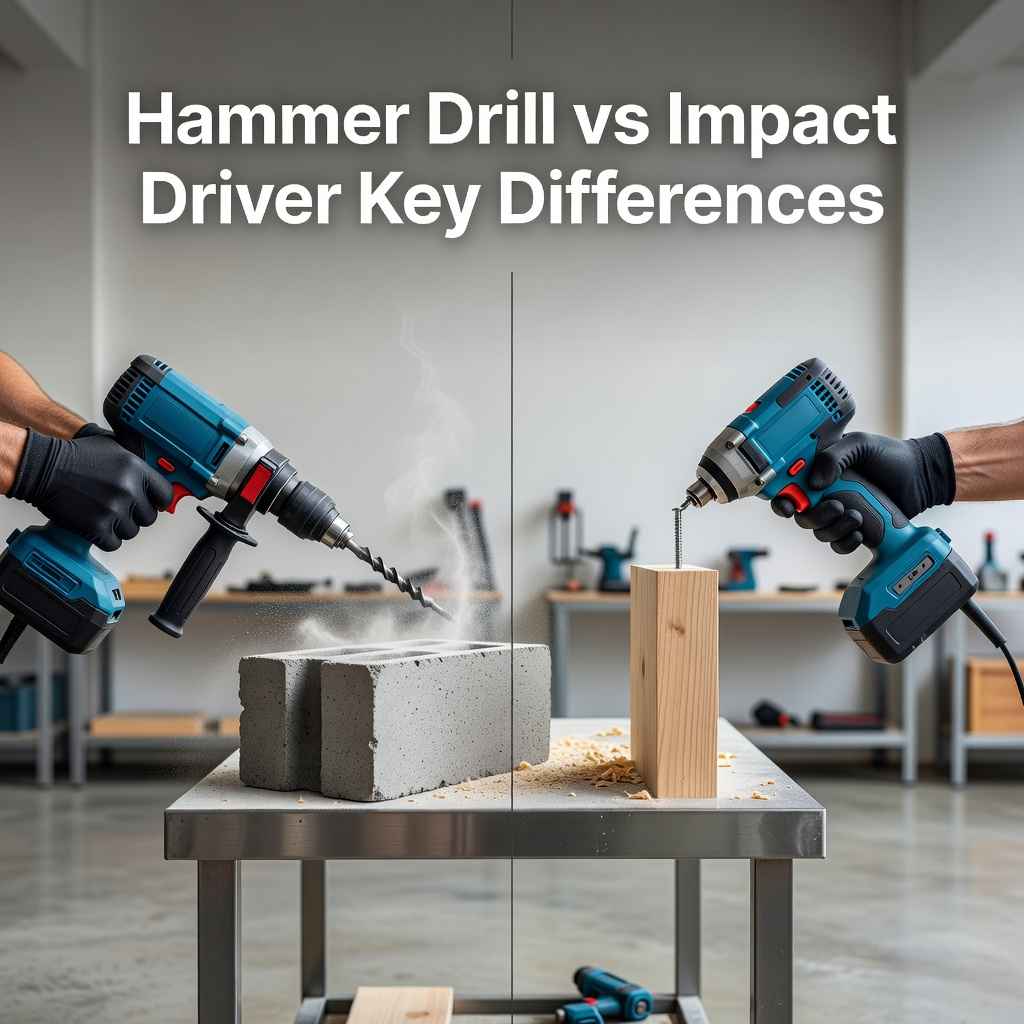
Hammer Drill vs Impact Driver: Key Differences
Choosing the right power tool can feel tricky, especially when you’re new to DIY projects. Many people wonder about the Hammer Drill vs Impact Driver: Key Differences because they look similar but do very different jobs. This can lead to confusion and picking the wrong tool for your task.
Don’t worry, this guide will make it super clear. We’ll break down what each tool is best for, step by step.
Understanding Hammer Drills
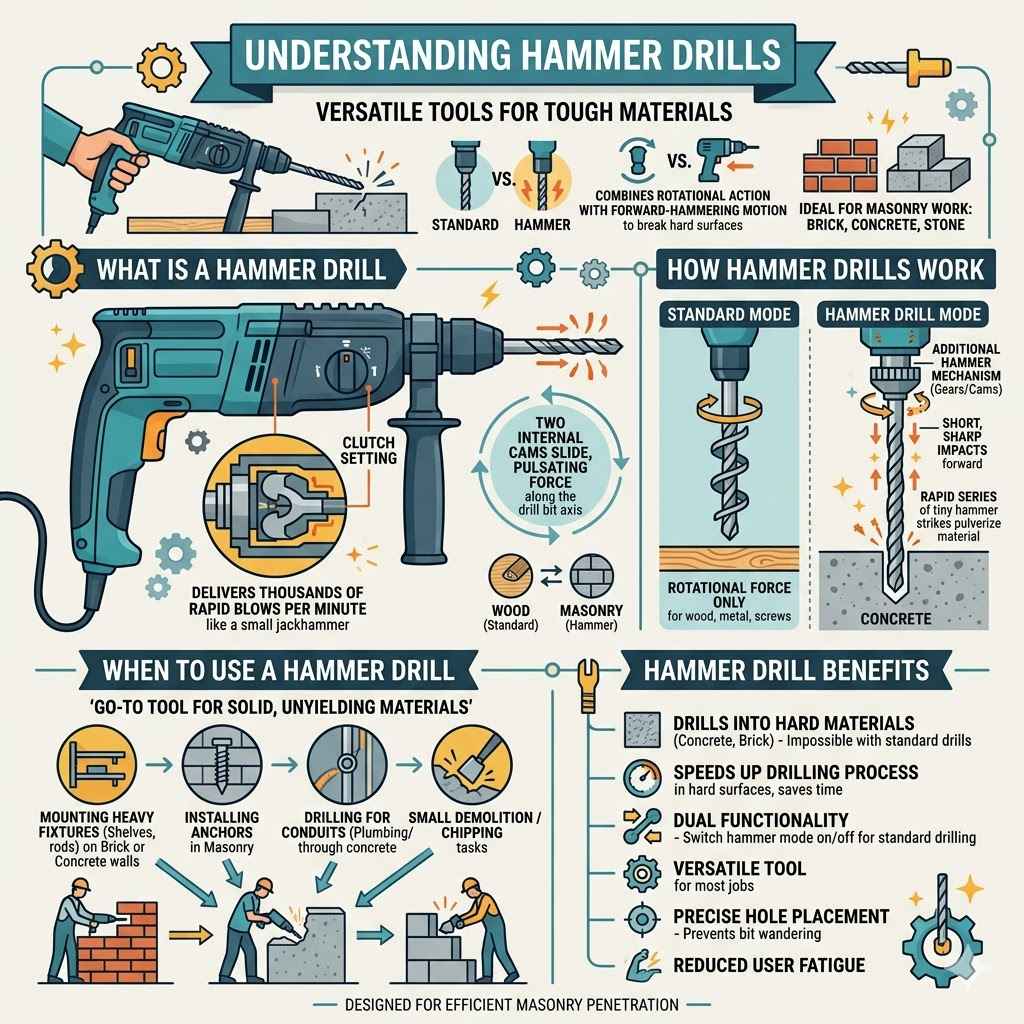
Hammer drills are versatile tools designed for drilling holes in a variety of materials, with a special ability to tackle tougher surfaces like brick, concrete, and stone. They combine the rotational action of a standard drill with a forward-hammering motion that helps to break up hard materials as the bit spins. This makes them ideal for masonry work and other tasks where you need extra power to penetrate dense surfaces.
The hammering action is crucial for these applications, differentiating them from regular drills and impact drivers.
What is a Hammer Drill
A hammer drill is a power drill that has a special clutch setting. This setting allows the drill to deliver thousands of rapid blows per minute, sort of like a tiny jackhammer, while it’s also spinning. This combined action makes drilling into tough materials much easier than using a regular drill.
When you need to put screws into wood, it works just like a normal drill. But when you switch to the hammer mode, it really shines for drilling into concrete or brick.
The hammering action is created by two internal cams that slide against each other. These cams impart a pulsating force along the axis of the drill bit. This force, along with the drill’s rotation, pulverizes the material in front of the drill bit, allowing it to penetrate more effectively.
It’s important to use the correct drill bits designed for hammer drilling when using this feature.
How Hammer Drills Work
The core mechanism behind a hammer drill’s unique capability lies in its dual modes of operation. In its standard drilling mode, it functions just like any other power drill, delivering consistent rotational force to the drill bit. This is suitable for drilling into softer materials like wood or metal, or for driving screws.
When you engage the hammer drill mode, an additional mechanism comes into play. This involves two internal gears or cams that engage and disengage rapidly. As they move past each other, they create a series of short, sharp impacts that are directed forward, along the length of the drill bit.
Think of it as a rapid series of tiny hammer strikes happening thousands of times a minute.
This percussive action, combined with the drill’s rotation, effectively pulverizes or chips away at hard materials like concrete, brick, or stone. The force of the impacts helps to break down the material’s structure, making it easier for the rotating drill bit to remove it and create a hole. The intensity of the hammering can often be adjusted, allowing for control based on the material being drilled.
When to Use a Hammer Drill
A hammer drill is your go-to tool when you need to drill holes in solid, unyielding materials. This primarily includes masonry surfaces such as concrete, brick, cinder block, and stone. For example, if you are mounting shelves on a brick wall or installing a new railing into a concrete patio, a hammer drill will make the job significantly easier and faster.
It’s also useful for tasks that involve drilling into very hard woods where a regular drill might struggle or overheat. However, its main advantage is in its ability to penetrate masonry effectively. For tasks involving wood or metal, you would typically switch the hammer function off and use it as a standard drill.
This versatility makes it a valuable addition for homeowners and contractors alike who encounter a variety of drilling jobs.
Here are some common scenarios where a hammer drill is essential:
- Mounting heavy-duty fixtures like curtain rods, towel racks, or security systems onto walls made of brick or concrete.
- Drilling pilot holes for anchors in masonry for structural applications.
- Creating holes for plumbing or electrical conduits through concrete walls or floors.
- Demolition tasks where small amounts of material need to be chipped away.
Hammer Drill Benefits
The primary benefit of a hammer drill is its capability to drill into hard materials like concrete and brick. This means you can tackle projects that would be impossible or extremely difficult with a standard drill. The hammer action significantly speeds up the drilling process in these materials, saving you time and effort.
Another advantage is its dual functionality. When the hammer mode is turned off, it performs as a regular drill. This makes it a versatile tool that can handle most drilling and driving tasks around the house.
This versatility means you might be able to get by with just one drill for many jobs.
The impact it delivers helps to prevent the drill bit from wandering on hard surfaces, allowing for more precise hole placement. This precision is important for many installation tasks. Its power also means less user fatigue on tough jobs.
Understanding Impact Drivers
Impact drivers are specialized tools designed for driving screws and fasteners, especially into tough materials or when a large number of fasteners need to be driven. Unlike hammer drills that hammer forward, impact drivers deliver rotational impacts, also known as “percussive blows,” in a powerful turning motion. This makes them excellent for fastening applications where you need high torque and speed without stripping screws or camming out.
They use a hammering mechanism that applies torque in bursts, allowing them to drive screws with significantly more power than a standard drill. This is achieved through a specialized clutch system that engages and disengages rapidly, delivering short, powerful rotational twists. This action is incredibly effective for tasks like building decks, installing cabinets, or assembling furniture.
What is an Impact Driver
An impact driver is a power tool designed specifically for driving screws and bolts. It looks similar to a drill but has a different internal mechanism. Instead of just spinning, it delivers rapid rotational impacts, or “kicks,” when it meets resistance.
This makes it incredibly powerful for fastening jobs.
The key difference from a hammer drill is the direction and type of impact. A hammer drill hammers straight forward, and an impact driver hammers in a twisting motion. This rotational hammering action allows it to apply much more torque than a standard drill.
This extra torque is what makes it so good at driving long screws or fasteners into dense materials.
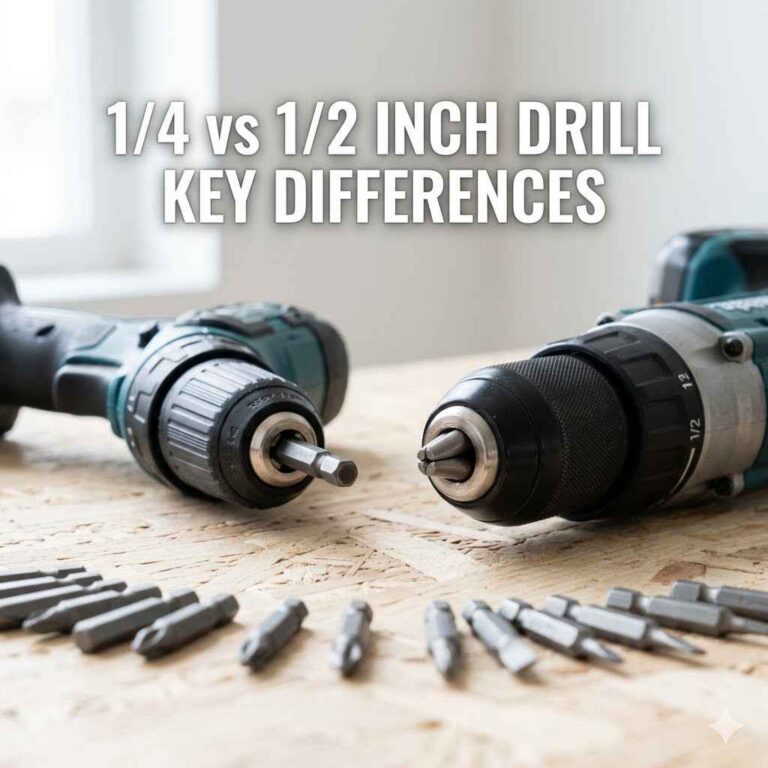
Impact drivers typically have a 1/4-inch hex chuck, which accepts screwdriver bits directly. This chuck design is faster for bit changes and provides a more secure connection for the high torque the tool delivers. They often have variable speed triggers, allowing for fine control over the driving process.
How Impact Drivers Work
The operation of an impact driver relies on a unique internal mechanism that produces rapid, powerful rotational impacts. When you pull the trigger, a motor spins an internal hammer. This hammer is attached to a drive shaft.
When the tool encounters resistance, such as a screw head meeting hard material, the spinning hammer is designed to slide past an anvil. As it slides, it gets pushed back by a spring and then slams forward with great force, striking the anvil. This striking action translates into a powerful, short burst of rotational torque applied to the output shaft and thus to the fastener.
This process repeats thousands of times per minute, delivering bursts of torque that can significantly exceed the torque of a standard drill. This allows the impact driver to easily drive long screws, lag bolts, and other stubborn fasteners without stripping the screw head or requiring excessive physical effort from the user. The force is delivered as a rapid series of “kicks” rather than a continuous application of torque.
When to Use an Impact Driver
An impact driver is the ideal tool for any job that involves driving a lot of screws or driving large, long screws into tough materials. Think about building a deck, assembling furniture, installing drywall, or putting up fencing. These tasks often require significant torque and speed to drive fasteners quickly and efficiently.
If you’re driving screws into hardwoods, framing lumber, or even through metal studs, an impact driver will perform much better than a standard drill. It also helps prevent stripped screw heads because the rapid impacts bite into the screw slot better than a constant torque. For professional contractors and serious DIYers, an impact driver is often considered an essential tool for fastening tasks.
Here are some typical applications for an impact driver:
- Driving long lag screws into wood for framing or deck construction.
- Assembling large pieces of furniture that require many screws.
- Installing metal framing or connectors in construction projects.
- Quickly driving hundreds of screws for large projects like sheds or playhouses.
Impact Driver Benefits
The main advantage of an impact driver is its immense power and torque for fastening. It can drive screws with ease that would stall or strip out a regular drill. This power helps you complete fastening jobs much faster.
Another significant benefit is reduced user fatigue. Because the tool does most of the work with its powerful impacts, you don’t need to apply as much downward pressure. This is a huge advantage on long projects.
It also helps prevent stripped screw heads and cam-outs, which can waste time and damage fasteners.
The compact size and lighter weight compared to many hammer drills also make them easier to maneuver in tight spaces. The quick-change hex chuck also speeds up bit swaps, making your workflow more efficient.
Hammer Drill vs Impact Driver Key Differences Compared
When comparing a hammer drill and an impact driver, the fundamental difference lies in their primary function and the type of action they employ. A hammer drill is designed for drilling holes, particularly in hard materials, using a forward-hammering motion. An impact driver, on the other hand, is built for driving screws and fasteners with immense torque using a rotational impact.
Think of it this way: a hammer drill drills with a hammering action, while an impact driver fastens with a hammering action. The mechanism that generates the impact is also distinct. Hammer drills use cams that slide against each other to create forward impacts.
Impact drivers use a rotating hammer that strikes an anvil in a twisting motion. This means the forces they apply are fundamentally different, leading to different applications.
The chuck size and type also set them apart. Hammer drills typically have a three-jaw chuck that can hold various drill bit sizes and types, including masonry bits. Impact drivers usually have a 1/4-inch hex chuck designed for quick bit changes and to withstand the high torque of rotational impacts, primarily accepting screwdriver bits and hex shank accessories.
Mechanism and Power Delivery
The internal mechanisms that drive these tools are what truly define their differences. A hammer drill’s mechanism is designed to deliver a forward, percussive blow. This is achieved by two cams within the gearbox that slide against each other.
When engaged, they create a rapid, pulsing action that drives the drill bit straight forward. This is ideal for breaking up material.
An impact driver’s mechanism, however, is designed to deliver rotational torque in bursts. A spinning hammer is thrown outwards by centrifugal force when the tool encounters resistance. This hammer strikes an anvil, which is attached to the output shaft.
Each strike imparts a powerful twisting force. This is perfect for overcoming the resistance of screws and bolts.
This difference in power delivery means they excel at different tasks. The continuous forward hammering of a hammer drill is for penetration. The rapid rotational hammering of an impact driver is for sustained turning power against resistance.
| Feature | Hammer Drill | Impact Driver |
|---|---|---|
| Primary Use | Drilling holes (especially in masonry) | Driving screws and fasteners |
| Impact Action | Forward (percussive) | Rotational (torsional) |
| Mechanism | Sliding cams | Hammer striking an anvil |
| Chuck Type | 3-jaw chuck (keyless or keyed) | 1/4-inch hex chuck |
| Torque | Moderate to high (for drilling) | Very high (for fastening) |
| Best For | Masonry, concrete, brick, stone | Wood, metal, drywall, decks, furniture assembly |
Applications and Best Uses
The applications for which each tool is best suited are quite distinct. A hammer drill shines when you need to create holes in hard, dense materials. This includes drilling into concrete walls for anchors, making holes in brick for shelving, or even drilling through stone.
Its forward hammering action is crucial for efficiently breaking up these materials.
An impact driver is the champion of fastening. If you’re driving a lot of screws, long screws, or screws into tough wood, this is your tool. Building decks, assembling furniture, installing cabinets, or working with lag bolts are all prime applications for an impact driver.
Its high torque and rotational impacts ensure fasteners go in quickly and securely without stripping.
While a hammer drill can drive screws, it’s not as efficient or powerful for sustained fastening as an impact driver. Conversely, an impact driver cannot drill holes effectively because it lacks the forward hammering action needed for masonry.
Consider these scenarios:
-
Mounting a heavy mirror on a concrete wall
This requires drilling through concrete. A hammer drill is the correct tool for this job because its percussive action will break through the concrete to create the necessary holes for anchors. -
Assembling a large wooden shed
This involves driving hundreds of screws, possibly into dense lumber. An impact driver is ideal because its high torque and speed will drive these screws quickly and efficiently, reducing user fatigue and the risk of stripping screw heads. -
Installing a new kitchen
This could involve drilling pilot holes in wood and driving cabinet screws. For pilot holes in wood, either tool can work, but for driving many cabinet screws quickly and securely, an impact driver is more efficient.
Choosing the Right Tool
The decision between a hammer drill and an impact driver depends entirely on the task at hand. If your primary need is to drill holes, especially into masonry, concrete, or brick, a hammer drill is the clear choice. Its hammering action is specifically designed for this purpose, making the job faster and easier.
If your focus is on driving screws, bolts, and other fasteners, particularly in large quantities or into hard materials like dense wood, then an impact driver is superior. Its high torque and rapid rotational impacts provide the power needed to drive fasteners efficiently and without stripping.
Many DIYers and professionals find that having both tools in their arsenal offers the most versatility. They complement each other perfectly, covering a wide range of drilling and fastening applications. Some cordless tool kits even offer a drill/driver and an impact driver as a set, recognizing their complementary roles.
Can You Use an Impact Driver as a Drill?
While an impact driver is a powerful tool for fastening, it is not designed to function as a general-purpose drill, especially for creating holes in hard materials. The primary reason is its mechanism. Impact drivers deliver rotational impacts, which are excellent for driving screws, but they lack the forward hammering action necessary for drilling into concrete, brick, or stone.
You can technically use an impact driver to drill small holes in softer materials like wood or thin metal, provided you use the correct bits designed for impact drivers (typically 1/4-inch hex shank bits). However, even in wood, the hammering action can sometimes cause the bit to skate or create a messier hole compared to a standard drill. For drilling larger holes or any holes in masonry, an impact driver is simply the wrong tool for the job.
Drilling with an Impact Driver
Using an impact driver for drilling can be done, but with significant limitations. The tool is designed to accept standard 1/4-inch hex shank drill bits. These bits are readily available and allow you to drill into materials like wood, plastic, and sometimes thin metal.
The process involves using a variable speed trigger to control the rotational speed. For drilling, you would want to apply steady pressure and let the tool’s rotation do the work. However, it’s crucial to understand that the impact driver’s mechanism is optimized for fastening.
The rapid rotational impacts, while powerful for driving screws, can sometimes be too aggressive for creating clean, precise holes, especially in softer materials where the impacts might cause splintering or tear-out.
A major drawback is the inability to drill into masonry. The impact driver does not have the forward hammering action needed to chip away at concrete or brick. Attempting to do so will likely result in a dull bit, a lot of noise, and no hole.
When It’s Not Advisable
It is generally not advisable to use an impact driver for drilling holes when:
- You need to drill into masonry, concrete, brick, or stone. Impact drivers simply do not have the necessary drilling action for these materials.
- You require precise, clean holes. The aggressive rotational impacts can lead to less precise results, especially in softer woods where splintering can occur.
- You are drilling large diameter holes in wood. While it can do it, a drill/driver with more torque control and a wider range of bit compatibility might offer a cleaner cut and more efficient performance.
- You are driving very small screws where the power of an impact driver might be overkill and increase the risk of stripping the screw head or over-driving it into the material.
For these situations, a standard drill/driver or a hammer drill (for masonry) is the appropriate tool. Using the right tool ensures efficiency, safety, and better results.
Can You Use a Hammer Drill as an Impact Driver?
Yes, a hammer drill can be used as an impact driver for driving screws. In fact, many hammer drills have a “screw driving” or “clutch” setting that allows you to adjust the torque to prevent over-driving or stripping screws. When the hammer function is turned off, it operates as a standard drill/driver.
However, while a hammer drill can drive screws, it does not possess the same specialized torque and rotational impact delivery as a dedicated impact driver. This means it might not be as efficient or as powerful for driving long screws into very hard materials or for rapidly driving a large number of fasteners. The torque delivery is more continuous rather than burst-like.
Driving Screws with a Hammer Drill
Hammer drills are equipped with a clutch mechanism that offers adjustable torque settings. This clutch is vital for screw driving. When you set the desired torque, the drill will stop rotating once that torque is reached, preventing you from over-tightening screws or stripping their heads.
To drive screws with a hammer drill, you simply select the drill/driver mode (turning off the hammer action) and then choose an appropriate torque setting on the clutch. For wood screws, start with a lower setting and increase it as needed. For larger fasteners or harder wood, you might need a higher setting.
The variable speed trigger also allows for control, letting you start screws slowly and then increase speed.
While it can do the job, the “impact” delivered by an impact driver is unique. A hammer drill’s primary action is rotation; the hammering is only when drilling into masonry. An impact driver’s “impact” is specifically designed to add rotational force.
Limitations of Hammer Drills for Fastening
Despite their ability to drive screws, hammer drills have limitations when compared to dedicated impact drivers. The main limitation is the absence of the specialized rotational impact mechanism. This means they don’t deliver the same sheer torque power as an impact driver.
For driving very long screws, lag bolts, or multiple screws into dense hardwoods, a hammer drill might struggle to keep up. It might bog down, require more user effort, or take longer to complete the task. The continuous torque delivery, while good for drilling, isn’t as effective for overcoming high resistance during fastening as the burst-like torque of an impact driver.
Additionally, while the clutch helps prevent over-driving, the control offered by an impact driver’s variable speed trigger combined with its rotational impacts can often lead to a cleaner, more secure fastening job. If you frequently engage in heavy-duty fastening tasks, a hammer drill might not be sufficient on its own.
Frequently Asked Questions
Question: What is the main difference between a hammer drill and an impact driver?
Answer: A hammer drill is for drilling holes in hard materials using forward impacts, while an impact driver is for driving screws with rotational impacts and high torque.
Question: Can I use an impact driver to drill holes in concrete?
Answer: No, an impact driver does not have the forward hammering action needed to drill into concrete or masonry. Use a hammer drill for that.
Question: Can I use a hammer drill to drive screws?
Answer: Yes, a hammer drill can drive screws when its hammer function is turned off, using its clutch settings for torque control.
Question: Which tool is better for building a deck?
Answer: An impact driver is generally better for building a deck because it excels at driving many screws quickly and efficiently into wood.
Question: Do I need both a hammer drill and an impact driver?
Answer: It depends on your projects. If you do a lot of masonry work, you need a hammer drill. If you do a lot of fastening, an impact driver is very useful.
Many people find having both ideal for versatility.
Summary
When choosing between a hammer drill and an impact driver, remember their core functions. Hammer drills excel at drilling into tough materials like concrete and brick. Impact drivers are king for driving screws and fasteners with high torque.
While a hammer drill can drive screws, and an impact driver can drill soft materials, neither tool is a perfect replacement for the other’s primary job. Select the tool that best fits your typical projects for the most efficient and effective results.