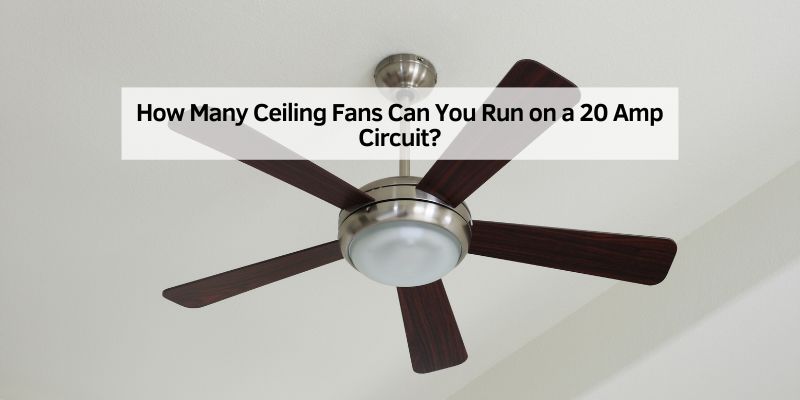
How Many Ceiling Fans Can You Run on a 20 Amp Circuit?
I learned electrical circuits the fun way—by messing up! Years ago, I tried installing three ceiling fans in my garage, thinking my 20 amp circuit could handle anything. Nope! The breaker tripped, and my fans went silent. That flop taught me how to calculate how many ceiling fans on a 20 amp circuit properly. This article will guide you through figuring out how many fans your circuit can handle. We’ll cover what a 20 amp circuit is, how to calculate fan loads, and simple tips to avoid my mistakes. Whether you’re a beginner or a pro, you’ll find easy steps, safety advice, and fun examples to make your project a breeze!
What’s a 20 Amp Circuit Anyway?
A 20 amp circuit is like a highway for electricity. It can carry up to 20 amps of current safely. Amps measure how much electricity flows, like water through a pipe. Most homes use 120-volt circuits, so a 20 amp circuit can handle about 2400 watts (20 amps × 120 volts = 2400 watts). Ceiling fans use watts, so knowing this helps you figure out how many ceiling fans on a 20 amp circuit you can safely run.
Ceiling fans vary in power. A standard fan uses 60-80 watts, but fancy ones with lights or high-speed motors might use more. If you overload—the circuit throws a tantrum and trips! Let’s break down how to avoid that.
Why Knowing Fan Limits Matters
Overloading a circuit is risky. It can cause tripped breakers, overheating wires, or even fires. I once saw a friend cram five big fans on one circuit—yikes! The breaker kept tripping, and the wires got warm. Knowing how many ceiling fans on a 20 amp circuit keeps your home safe and your fans spinning. Plus, it saves you money by avoiding rewiring or electrician fees.
How to Calculate Ceiling Fans on a 20 Amp Circuit
Calculating how many ceiling fans on a 20 amp circuit is a piece of cake. You just need to know the wattage of your fans and do some simple math. Here’s an easy step-by-step guide:
- Check Fan Wattage: Look at the fan’s label or manual. Most standard fans use 60-80 watts. Fans with lights might hit 100-150 watts.
- Add Up Total Watts: Multiply the wattage by the number of fans. For example, five 80-watt fans = 400 watts.
- Apply the 80% Rule: For safety, only use 80% of a 20 amp circuit’s capacity (2400 watts × 0.8 = 1920 watts).
- Compare: If your total watts (e.g., 400) is under 1920, you’re good! If not, reduce fans or use a new circuit.
Table 1: Fan Wattage and Circuit Capacity
Tools and Materials You’ll Need
You don’t need fancy gear to figure this out. Here’s what I use:
- Multimeter: Checks circuit load (about $20 at hardware stores).
- Calculator: For quick wattage math.
- Fan Manuals: To find wattage ratings.
- 12-Gauge Wire: Safe for 20 amp circuits.
I recommend a basic multimeter like the Klein Tools MM300. It’s easy for beginners and under $30. If you’re wiring fans, use 12-gauge wire—it handles 20 amps better than 14-gauge. Check out NEC guidelines for safe wiring tips.
Benefits of Planning Your Circuit
Planning how many ceiling fans on a 20 amp circuit has big perks:
- Safety First: Avoids fires or breaker trips.
- Saves Money: Prevents costly rewiring.
- Cool Comfort: Keeps fans running smoothly.
But there are drawbacks. If you mix fans with other devices (like lights), you’ll hit the 1920-watt limit faster. I learned this when I added a shop light to my fan circuit—oops, breaker trip! Stick to dedicated circuits for fans if you can.
My Top Tips for Ceiling Fan Circuits
As an electrician, I’ve wired dozens of fans. Here are my go-to tips:
- Check Wattage Twice: Labels can be sneaky. Confirm fan wattage before buying.
- Use Energy Star Fans: They use less power (some as low as 7 watts!).
- Avoid Mixing Devices: Fans and lights on the same circuit eat up watts fast.
- Test Your Circuit: Use a multimeter to check the load before flipping the switch.
Visual Idea: A simple diagram showing a 20 amp circuit with multiple fans wired to a breaker would help. Another idea is a chart comparing fan wattages (standard vs. Energy Star). These aren’t included but would make calculations clearer.
Common Mistakes to Avoid
Don’t make these rookie errors I did early on:
- Ignoring the 80% Rule: Overloading is a fire hazard. Stick to 1920 watts max.
- Using 14-Gauge Wire: It’s okay for 15 amp circuits, but 20 amp needs 12-gauge.
- Guessing Wattage: Always check the fan’s label or manual.
Table 2: Circuit Wire Comparison
Alternative Approaches
If a 20 amp circuit can’t handle your fans, try these:
- Dedicated Circuits: Run a separate 20 amp circuit for fans only. It’s safer but costs more (about $200-300 for an electrician).
- 15 Amp Circuits: These handle 4-5 fans but limit other devices.
- Energy-Efficient Fans: Swap to low-wattage fans to fit more on one circuit. Check Energy Star for options.
Visual Idea: A flowchart showing how to decide between a 15 amp or 20 amp circuit for fans would be handy but isn’t included here.
Frequently Asked Questions
How Many Ceiling Fans Can a 20 Amp Circuit Handle?
Up to 20 standard 80-watt ceiling fans can fit on a 20 amp circuit. This assumes no other devices and follows the 80% rule (1920 watts max). Check fan wattage and avoid overloading for safety.
Can I Mix Ceiling Fans and Lights on a 20 Amp Circuit?
You can, but it limits fan numbers. Lights add wattage (e.g., 60 watts per bulb). Calculate total watts (fans + lights) and stay under 1920 watts to avoid tripping the breaker.
Do Energy Star Fans Save Circuit Space?
Yes, they use less power. Some Energy Star fans use as little as 7 watts, so you could fit more on a 20 amp circuit compared to standard 80-watt fans.
What Happens if I Overload a 20 Amp Circuit?
The breaker trips, shutting off power. Overloading can overheat wires, risking fire. Always calculate total watts and stick to the 80% rule (1920 watts) for safety.
Do I Need 12-Gauge Wire for a 20 Amp Circuit?
Yes, it’s recommended. 12-gauge wire handles 20 amps safely, while 14-gauge is better for 15 amp circuits. Check NEC guidelines for details.
Can I Use a 15 Amp Circuit for Ceiling Fans?
Yes, for 4-5 fans. A 15 amp circuit handles about 1440 watts (80% of 1800 watts). It’s fine for small setups but less flexible than a 20 amp circuit.
How Do I Check My Circuit’s Load?
Use a multimeter to measure current. Add up fan wattages and divide by 120 volts to estimate amps. Keep total load under 16 amps (1920 watts) for a 20 amp circuit.
Wrapping It Up
Figuring out how many ceiling fans on a 20 amp circuit is easy once you know the math. A 20 amp circuit handles about 20 standard 80-watt fans if you follow the 80% rule (1920 watts max). Use 12-gauge wire, check fan wattage, and avoid mixing too many devices. My garage fan flop taught me to plan carefully, and now my fans spin smoothly! Try calculating your circuit load or share your fan setup ideas in the comments. For more electrical tips, visit UL Solutions. Ready to install some fans? You’ve got this—no sweat!