Hunter vs Harbor Breeze Ceiling Fans
Choose Hunter if you want stronger airflow, broader control options, and better odds of finding a compatible remote system; choose Harbor Breeze Ceiling Fans if a low-cost replacement or quick fan swap matters more than long-term parts support. The better pick comes down to room size, ceiling height, and whether you are repairing an existing fan or replacing it.
This guide is part of our Ceiling Fan Remote, Wiring, Wobble and Noise Problems: Hunter, Hampton Bay, Harbor Breeze and More series.
Hunter vs Harbor Breeze at a glance
| Factor | Hunter | Harbor Breeze Ceiling Fans | Winner |
|---|---|---|---|
| Airflow | Hunter Builder Deluxe: 3525 CFM | Harbor Breeze Merrimack: 2221 CFM | Hunter |
| Efficiency | Hunter Builder Deluxe: 96 CFM per watt | Harbor Breeze Merrimack: 61 CFM per watt | Hunter |
| Controls | Remote control, wall control, and HunterSMART Wi‑Fi products are available across the category | Remote control capable models exist, but support varies by model | Hunter |
| Room fit | Better for buyers who want more documented model variety | Better for budget replacements and simple room swaps | Harbor Breeze Ceiling Fans |
| Warranty focus | Limited lifetime warranty, with motor coverage called out on many models | Warranty terms vary by model | Hunter |
Airflow
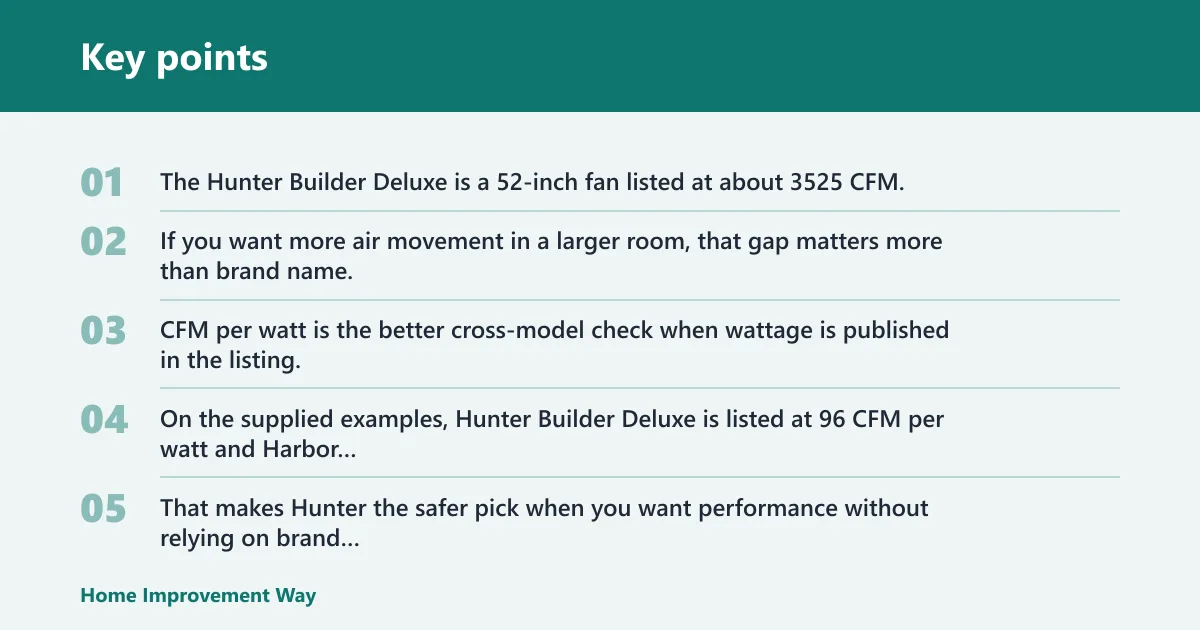
Hunter has the stronger example spec here. The Hunter Builder Deluxe is a 52-inch fan listed at about 3525 CFM, while the Harbor Breeze Merrimack is listed at about 2221 CFM. If you want more air movement in a larger room, that gap matters more than brand name.
Efficiency
CFM per watt is the better cross-model check when wattage is published in the listing. On the supplied examples, Hunter Builder Deluxe is listed at 96 CFM per watt and Harbor Breeze Merrimack at 61 CFM per watt, so Hunter moves more air for each watt listed. That makes Hunter the safer pick when you want performance without relying on brand reputation alone.
Controls
Hunter has the deeper control lineup in the supplied facts: remote control products, wall control products, and HunterSMART Wi‑Fi products all appear in the category. Harbor Breeze Ceiling Fans can be remote control capable too, but that depends on the model and the installed receiver. For a retrofit, the control path matters as much as the fan itself.
Room fit
Harbor Breeze Ceiling Fans gets the nod for quick replacements and lower-cost room swaps. Hunter is the better pick when you want more documented options across control types and a broader premium range. If the room needs a specialty fit, check the model listing before you buy rather than assuming one brand covers every ceiling height or mounting need.
Warranty focus
Hunter’s limited lifetime warranty is the cleaner ownership signal in the supplied facts, especially on the motor. Harbor Breeze warranty terms are more model-specific, so you need to check the listing or manual for the exact coverage on your fan. That difference matters if you want the brand with clearer motor support over time.
Ceiling fan choice matrix

This matrix ties the room and repair decision to the better brand choice. Use it to decide whether you should buy new, replace a worn part, or keep the existing fan and change only the receiver or control setup.
| Room type | Priority | Hunter advantage | Harbor Breeze Ceiling Fans advantage | Best choice |
|---|---|---|---|---|
| Low ceilings | Flush mount or close-to-ceiling fit | More model variety to check for low-profile options | Harbor Breeze Mazon 44-In is flush mount and indoor use | Harbor Breeze Ceiling Fans |
| Bedroom quietness | Low noise and stable mounting | Many control options, which can help with setup flexibility | Mazon 44-In has quiet motor technology | Harbor Breeze Ceiling Fans |
| Outdoor covered spaces | Indoor/outdoor rating and reverse airflow | Model-by-model options may be broader | Merrimack II 52-in is indoor/outdoor with reverse airflow | Harbor Breeze Ceiling Fans |
| Budget replacements | Lower upfront cost and straightforward swap | More premium options if you are willing to spend more | House-brand pricing fits budget replacement use | Harbor Breeze Ceiling Fans |
| Remote-control retrofits | Receiver fit and replacement path | More control families and wall-control choices | Remote-capable models can be a simpler low-cost swap | Hunter |
Say your bedroom has an 8-foot ceiling and the existing fan hums after a receiver failure. A flush-mount model can solve the height issue, but the receiver still has to match the remote path. In that case, a low-profile Harbor Breeze model may fit the room better, while Hunter is the safer bet if you want more documented control options for a repair path.
Suppose your covered patio already has a fan box and you want reverse airflow for year-round use. The model listing matters more than the brand label. A Harbor Breeze Merrimack II 52-in gives you indoor/outdoor use, reverse airflow, remote control enabled operation, LED light, and five blades, which makes it a clear replacement candidate for that setting.
Which brand has better airflow and efficiency?
Use CFM to compare air movement, not brand reputation. On the supplied examples, Hunter’s Builder Deluxe is listed at 3525 CFM, while the Harbor Breeze Merrimack is listed at 2221 CFM. If wattage is also published, compare CFM per watt next, because that shows how much air the fan moves for the power it uses.
Hunter Builder Deluxe as the reference point
The Hunter Builder Deluxe Indoor Ceiling Fan is a 52-inch model with a three-position mounting system, LED light, remote-capable operation, and a lifetime limited warranty on the motor. Its listed airflow of 3525 CFM and efficiency of 96 CFM per watt give you a concrete benchmark for comparing other fans. That makes it easier to judge whether a cheaper fan is actually moving enough air for the room.
Harbor Breeze examples
The Harbor Breeze Merrimack II 52-in is listed at about 2221 CFM and about 61 CFM per watt, so it appears to trail the Hunter example on both airflow and efficiency. The Harbor Breeze Mazon 44-In is a different kind of example: indoor use, flush mount, quiet motor technology, and a light kit. When you compare Harbor Breeze models, use the exact listing rather than assuming every fan in the brand runs the same way.
Which brand is quieter?
Quietness depends on balance, mounting, motor design, and the control setup, not on brand name alone. For a low-profile reference, the Harbor Breeze Mazon 44-In includes quiet motor technology and a flush-mount design, both of which can help in bedrooms or small rooms. If a fan still sounds noisy, the fix may be the mount or receiver path rather than the motor itself.
Why the mounting setup matters
A fan that is slightly loose, off-center, or paired with the wrong receiver can rattle or hum even if the motor itself is fine. That is why low-ceiling rooms often need both the right fan shape and the right control hardware. A quiet-sounding model is not enough if the installation stack is wrong.
When a receiver fix is the better answer
If the existing fan is otherwise in good shape, replacing the receiver may solve the noise and control issue without buying a new fan. That is especially true when the lights and blades are still serviceable. Check the FCC ID on the existing receiver first, then match the replacement path before you swap the entire unit.
Do Hunter and Harbor Breeze remotes work the same way?
No. Most ceiling fan remotes depend on the installed receiver, so a remote is only universal if the receiver supports it. If the receiver is missing, damaged, or mismatched, you may need a receiver kit upgrade path or a remote that matches the FCC ID of the original hardware.
Receiver-based compatibility
A universal remote is not truly universal in the way shoppers often mean it. The receiver decides what signals the fan accepts, and many remotes only work within a specific receiver family. That is why a remote that works on one Hunter or Harbor Breeze fan may not work on another model with different electronics.
FCC ID matching workflow
- Find the FCC ID on the receiver or fan documentation.
- Match the replacement remote or receiver kit to that ID.
- Confirm whether the fan is remote-ready or needs a receiver swap.
- Check whether the light kit and motor controls are on separate channels.
If the model listing says the fan is remote control capable but the remote is not included, that means you still need to verify the receiver path. Harbor Breeze can be remote control capable, but that detail does not remove the need to match the hardware. Hunter’s broader control lineup makes the support path clearer on many models, especially when you want wall control or Wi‑Fi options.
Choose Hunter if… / Choose Harbor Breeze Ceiling Fans if…
Choose Hunter if you want stronger spec transparency, more control options, and better odds of finding a compatible remote system. Choose Harbor Breeze Ceiling Fans if you want a budget replacement, an indoor/outdoor model, or a low-profile fan for a standard room. For a repair, keep the existing fan if a receiver or transmitter swap is enough.
Choose Hunter if…
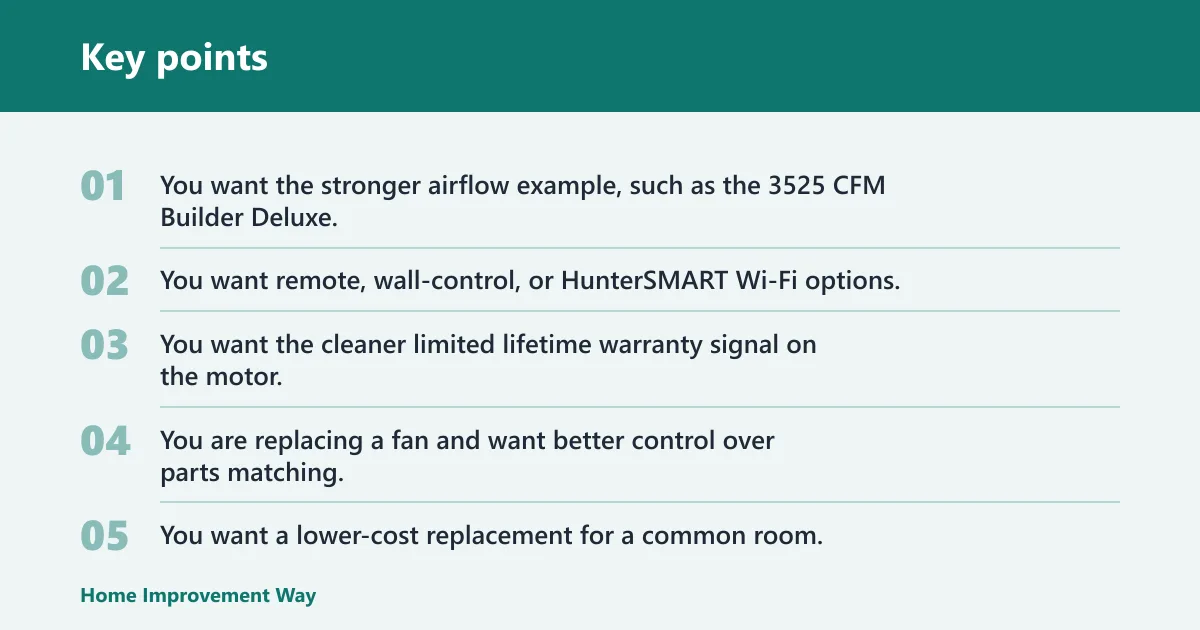
- You want the stronger airflow example, such as the 3525 CFM Builder Deluxe.
- You want remote, wall-control, or HunterSMART Wi‑Fi options.
- You want the cleaner limited lifetime warranty signal on the motor.
- You are replacing a fan and want better control over parts matching.
Choose harbor breeze ceiling fans if…
- You want a lower-cost replacement for a common room.
- You need a low-ceiling or flush-mount option like the Mazon 44-In.
- You want an indoor/outdoor model such as the Merrimack II 52-in.
- You only need a simple fan swap and do not want to pay for extra control features.

Frequently asked questions
Hunter fans vs harbor breeze
Hunter is the better fit when airflow, control options, and warranty clarity matter more. Harbor Breeze Ceiling Fans is the better fit when the goal is a lower-cost replacement or a model-specific room solution. The right choice depends on the exact fan, not the brand name alone.
Are hunter fans better than harbor breeze?
Hunter is better for buyers who want stronger airflow data, more control choices, and a limited lifetime warranty on many motors. Harbor Breeze Ceiling Fans can still be the better practical choice for budget swaps, flush-mount rooms, and outdoor covered spaces. The better brand is the one that fits the room and the repair path.
Who makes harbor breeze ceiling fans
Harbor Breeze is the official Lowe’s ceiling fan house brand, and the sourcing or manufacturing can vary by model and over time. It is not accurate to treat one manufacturer name as universal across every Harbor Breeze fan. Check the exact model listing or manual for the relevant maker details.
Which brand is quieter: Hunter or Harbor Breeze?
Quietness comes down to the specific model, the mount, and the receiver setup. The Harbor Breeze Mazon 44-In is a useful low-profile reference because it includes quiet motor technology and a flush-mount design. A loose mount or mismatched receiver can make either brand sound worse.
Are Hunter and Harbor Breeze fan remotes universal?
No. Remote compatibility depends on the installed receiver, and universal remotes are only universal when the receiver supports them. For replacement, match the FCC ID or use a receiver kit upgrade path. If the remote is not included, confirm compatibility before buying.
Which brand is better for low ceilings?
Harbor Breeze Ceiling Fans is usually the easier first stop for low ceilings because the lineup includes flush-mount examples such as the Mazon 44-In. Hunter also has low-profile options, but you need to verify the specific model listing. For a short ceiling, the mounting style matters more than the logo.
Sponsored / affiliate links. As an Amazon Associate I earn from qualifying purchases. I may earn additional commission from eligible campaigns.