Is Manufactured Wood The Same As Particle Board
Many people starting out with DIY projects or furniture shopping often wonder, Is Manufactured Wood the Same as Particle Board? It can be a bit confusing with all the different names out there. This guide will make it super simple. We will break down exactly what each term means and how they relate to each other, step by step.
Get ready to understand manufactured wood like a pro!
Understanding Manufactured Wood Versus Particle Board
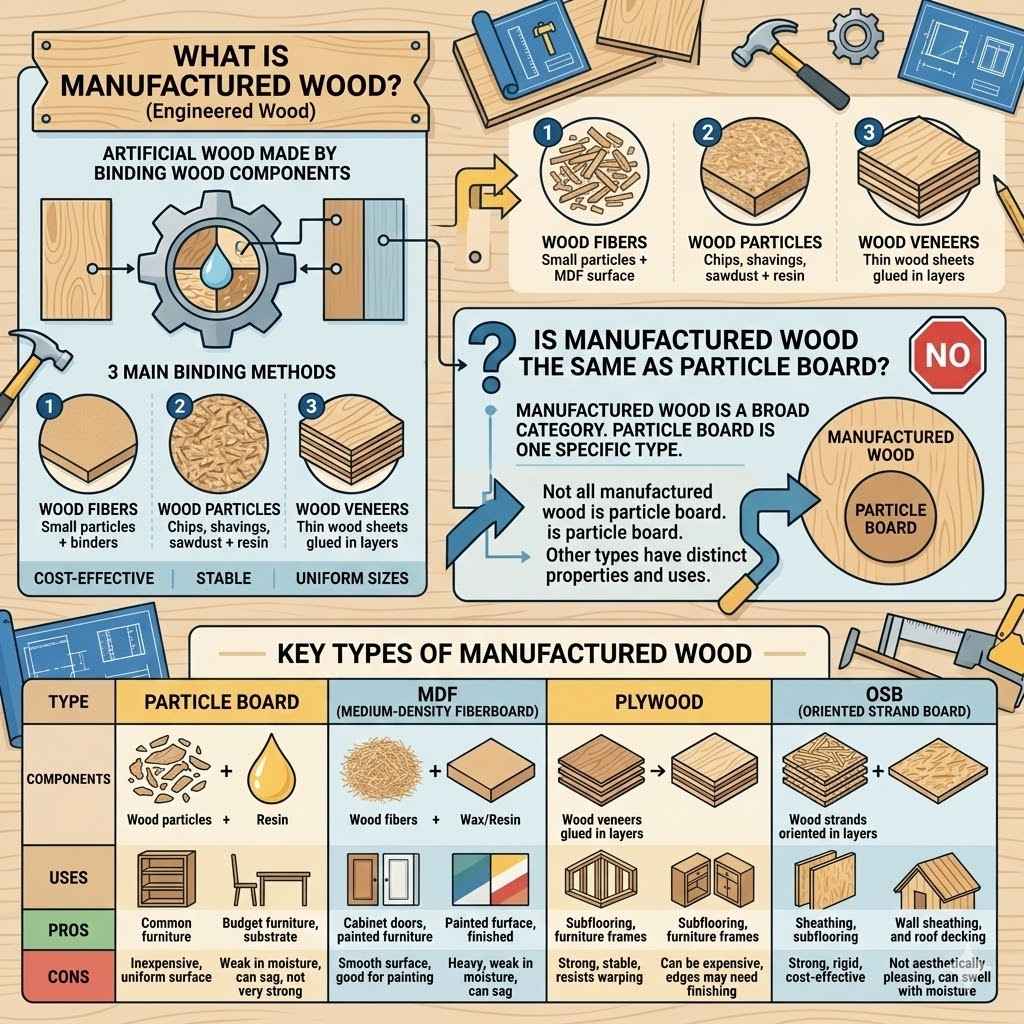
Manufactured wood is a broad category that covers many types of wood products created by binding wood fibers, particles, or veneers together with adhesives or resins. These products are designed to offer cost-effective and stable alternatives to solid lumber, often using wood waste or byproducts. They are used widely in furniture, cabinetry, and construction.
Knowing the different types helps you choose the right material for your needs.
Particle board is a specific type of manufactured wood. It is made by pressing together wood particles such as sawdust, wood chips, and wood shavings with a synthetic resin binder under heat and pressure. The particles are generally larger and less uniform than those used in other composite wood products.
This process creates a dense, rigid panel.
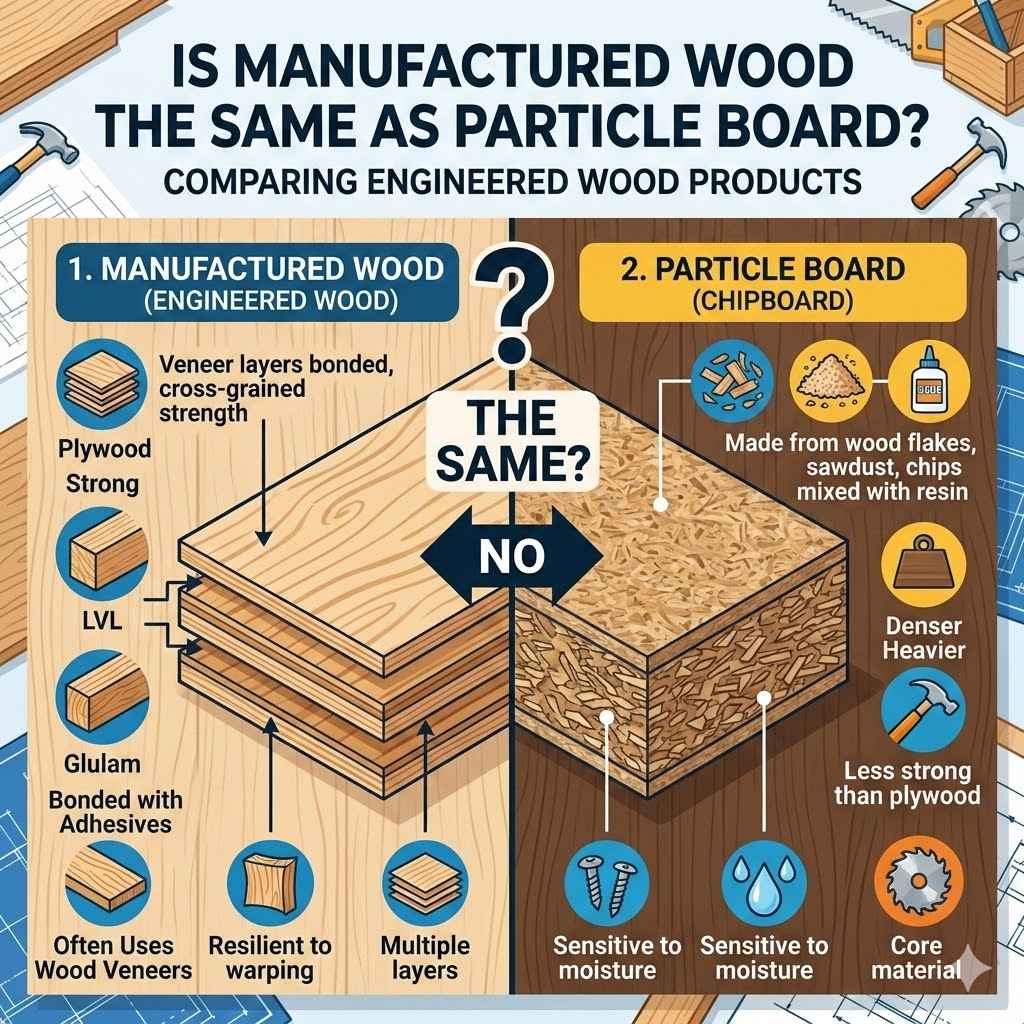
The key difference lies in the components and how they are put together. While particle board is a kind of manufactured wood, not all manufactured wood is particle board. Other types, like plywood or MDF, use different forms of wood and manufacturing methods, leading to distinct properties and uses.
Understanding these distinctions is important for making informed decisions.
What is Manufactured Wood?
Manufactured wood, also known as engineered wood or composite wood, is a term for any wood product made by artificially binding wood strands, particles, fibers, or veneers together. This binding process usually involves using adhesives, resins, or heat and pressure. The goal is to create wood panels that are consistent in quality, more stable, and often more affordable than natural solid wood.
These materials are crucial in modern furniture making and construction because they can be produced in large, uniform sizes and have predictable strength characteristics. They also help reduce waste by utilizing wood byproducts. This category includes a wide array of products, each with unique compositions and properties.
Exploring these types reveals how versatile engineered wood can be.
The development of manufactured wood has been driven by the need for sustainable forestry practices and the desire for materials that perform reliably in various conditions. Unlike solid wood, which can warp, shrink, or crack with changes in humidity and temperature, many engineered wood products offer enhanced dimensional stability. This makes them ideal for applications where consistency is key.
- Wood Fibers Small, often dust-like particles are used, typically with binders. This creates a smooth surface ideal for finishing. This method allows for fine details and a very uniform texture throughout the panel.
The end product is known for its consistency and ease of machining.
- Wood Particles Larger chips, shavings, or sawdust are compressed. This is the defining characteristic of particle board. The size and shape of these particles affect the board’s density and strength.
Generally, larger particles can lead to a lighter, less dense board, while finer particles can create a denser, stronger product.
- Wood Veneers Thin sheets of real wood are glued together. Plywood is a prime example, where layers of veneer are cross-laminated for strength. This construction provides excellent structural integrity and resistance to warping.
The visible grain pattern comes from these wood layers.
Key Types of Manufactured Wood
There are several popular types of manufactured wood, each with its own characteristics and best uses. Understanding these will help you differentiate them easily. They range from very dense boards to lighter, more flexible options.
Each type is engineered for specific performance needs.
Medium-Density Fiberboard (MDF)
Medium-Density Fiberboard, or MDF, is made from wood fibers that are broken down into their basic components and then reformed into panels using wax and resin binders. These fibers are heated and pressed into dense, flat panels. MDF is known for its smooth surface, which makes it excellent for painting, veneering, and laminating.
It is denser and stronger than particle board but less prone to splintering. This makes it a popular choice for furniture components, cabinetry doors, and decorative moldings. The consistent density means it can be cut and shaped without worrying about voids or inconsistencies within the material itself.
Its smooth finish allows for a high-quality painted appearance.
MDF panels are very stable and do not expand or contract as much as solid wood. However, they are susceptible to moisture damage and can be quite heavy. When working with MDF, it’s important to use appropriate dust masks, as the fine fibers can be harmful if inhaled.
The binders used can also contain formaldehyde, though low-emission options are widely available.
Plywood
Plywood is one of the oldest and most common types of engineered wood. It is constructed from thin layers of wood veneer, called plies, that are glued together with the grain of adjacent layers oriented at right angles to each other. This cross-graining technique gives plywood exceptional strength and stability.
It resists shrinking, swelling, and warping.
The alternating grain patterns in plywood mean that forces are distributed evenly across the panel, making it very strong in all directions. This makes it ideal for structural applications like subflooring, sheathing, and furniture framing. Different grades of plywood exist, varying in the quality of the veneers used and the types of adhesives.
Some plywood can have a decorative face veneer for visible applications.
The strength of plywood makes it a superior choice for many applications where load-bearing is a concern. It is also relatively lightweight compared to its strength. However, the edges of plywood can sometimes be rough and may need to be covered or finished for aesthetic purposes.
The quality of the glue and the number of plies can significantly impact its performance.
Oriented Strand Board (OSB)
Oriented Strand Board, or OSB, is made from strands of wood, typically from fast-growing trees like aspen and poplar, that are arranged in layers and bonded together with adhesives. The strands in each layer are oriented in a particular direction, usually parallel to each other, and the layers are oriented at right angles to each other, similar to plywood. This gives OSB good structural integrity.
OSB is a very common material for wall sheathing, roof decking, and subflooring in residential construction. It is known for its strength, rigidity, and resistance to moisture, although it can swell if exposed to excessive water for prolonged periods. It is generally more cost-effective than plywood, making it a popular choice for structural applications where appearance is not the primary concern.
The manufacturing process for OSB allows for efficient use of wood resources, often using smaller trees and wood waste. The visible surface of OSB typically shows the directionality of the wood strands, giving it a distinctive appearance. While it’s great for structural framing, it’s not typically used for visible furniture or decorative elements.
A comparison of common manufactured wood types shows their varied properties:
| Type | Primary Components | Common Uses | Pros | Cons |
|---|---|---|---|---|
| Particle Board | Wood particles (sawdust, chips) + Resin | Shelving, substrate for laminates, budget furniture | Inexpensive, uniform surface | Weak in moisture, can sag, not very strong |
| MDF | Wood fibers + Wax/Resin | Cabinet doors, painted furniture, moldings | Smooth surface, good for painting/cutting | Heavy, weak in moisture, can sag |
| Plywood | Wood veneers glued in layers | Subflooring, furniture frames, cabinetry | Strong, stable, resists warping | Can be expensive, edges may need finishing |
| OSB | Wood strands oriented in layers | Sheathing, subflooring, roof decking | Strong, rigid, cost-effective for structure | Not aesthetically pleasing, can swell with moisture |
What Exactly Is Particle Board?
Particle board is a specific type of manufactured wood, distinguished by its composition and manufacturing process. It is made from wood particles, which can include sawdust, wood chips, wood shavings, and other wood waste materials. These particles are combined with a synthetic resin binder, such as urea-formaldehyde or phenol-formaldehyde.
The mixture is then pressed under high heat and pressure to form rigid panels. The size and shape of the wood particles are generally larger and more irregular than the fibers used in MDF. This creates a board that is relatively inexpensive to produce and has a uniform, but somewhat coarse, texture.
Its density can vary depending on the manufacturing process.
Particle board is often used as a core material, covered with a laminate, veneer, or melamine finish to improve its appearance and durability. This makes it a popular choice for affordable furniture, shelving, and countertops. Its widespread use is due to its low cost and ease of manufacturing.
However, its structural limitations are important to consider.
The raw materials for particle board are often sourced from sawmills and woodworking factories, making it an efficient use of wood byproducts. This contributes to its lower cost compared to other wood composites. The binder used is crucial for the board’s integrity and can affect its environmental and health ratings.
Modern manufacturing often uses lower formaldehyde emission binders.
The Manufacturing Process of Particle Board
The creation of particle board involves several key steps to transform wood waste into a usable panel product. The process begins with collecting and preparing the wood particles. These particles are then mixed with adhesives and formed into a mat.
Finally, the mat is pressed and finished.
The quality and properties of the final particle board heavily depend on the type of wood used, the size and uniformity of the particles, the type and amount of binder, and the conditions during pressing. Each step is carefully controlled to achieve the desired density, strength, and stability for the intended application.
Particle Preparation
The first stage involves gathering wood waste from various sources, such as sawmills, furniture factories, and even forest thinning operations. These raw materials are then processed to reduce them into consistent particle sizes. This can involve chipping, hammermilling, or shredding.
The goal is to create particles that are uniform enough for even distribution and compression.
Screening processes are used to separate particles by size and shape. Fines (very small particles) and over-sized pieces are removed or reprocessed. The moisture content of the particles is also carefully controlled, as it affects the bonding process and the final density of the board.
Typically, the moisture content is reduced to around 2-5%.
The type of wood used can influence the board’s properties. Hardwoods tend to create denser particles, while softwoods can result in lighter boards. A mix of wood types is often used to balance cost and performance.
The resulting particles are then ready for the next stage of the manufacturing process.
Binding and Mat Forming
Once the wood particles are prepared, they are mixed with binders. The most common binders are urea-formaldehyde (UF) resins, which are cost-effective and provide good bonding. Phenol-formaldehyde (PF) resins are sometimes used for applications requiring greater moisture resistance.
Wax emulsions are also added to improve water repellency.
The particles and binder are thoroughly mixed to ensure even coating. This mixture is then spread onto a conveyor belt or forming line to create a mat of uniform thickness. The mat is designed to have a higher concentration of finer particles on the surfaces for a smoother finish and a core of larger particles for strength and lower density.
This layered structure is crucial for the board’s performance.
The density of the mat is carefully controlled to ensure consistent pressing. Automated systems ensure that the mat is evenly distributed, preventing thin spots or thick areas that could lead to weak points in the finished board. The mat’s formation is critical for the final product’s uniformity.
Pressing and Finishing
The formed mat is then fed into a press. This is typically a multi-daylight press that applies heat and pressure simultaneously. The heat activates the binders, causing them to cure and bond the wood particles together.
The pressure compacts the mat, reducing its thickness and increasing its density. This is the stage where the panel gains its structural integrity.
The pressing cycle is precisely controlled for temperature, pressure, and time. Once pressing is complete, the board is cooled and trimmed to size. It may then undergo further processing, such as sanding to achieve a smooth surface, cutting to specific dimensions, or application of decorative finishes like laminates or veneers.
Quality control checks are performed throughout the process.
The resulting panels are durable, stable, and ready for use in a wide range of applications. The efficiency of this pressing process allows for high-volume production, contributing to the affordability of particle board. Post-pressing, the board’s edges might be sealed or machined for specific joinery techniques.
Properties and Uses of Particle Board
Particle board offers a unique set of properties that make it suitable for specific applications, particularly where cost and ease of use are primary concerns. Its characteristics are a direct result of its manufacturing process. Understanding these properties is key to choosing it wisely.
One of its main advantages is its low cost. Because it is made from wood waste and relatively simple manufacturing processes, it is often significantly cheaper than solid wood or even other engineered wood products like MDF or plywood. This makes it an attractive option for budget-conscious consumers and manufacturers.
Particle board also provides a stable, uniform surface. Unlike solid wood, it does not contain knots or grain variations that can affect consistency. This uniformity makes it easy to work with for tasks like cutting, drilling, and machining.
It can also be easily covered with decorative materials, which is a major reason for its use in furniture.
Strengths of Particle Board
- Affordability Particle board is generally the most cost-effective manufactured wood product available. Its raw materials are inexpensive, and the manufacturing process is efficient, allowing for high production volumes. This makes it a popular choice for projects where budget is a major consideration, such as entry-level furniture, temporary structures, or DIY projects that don’t require extreme durability.
- Uniformity and Smoothness The surface of particle board is very uniform and smooth, especially after sanding. This consistency is ideal for applying finishes like paint, laminate, or veneer. There are no knots, grain patterns, or voids to disrupt the finish, ensuring a consistent look.
This makes it easy to achieve a professional-looking final product, even with simple application techniques.
- Dimensional Stability Particle board is relatively stable dimensionally, meaning it does not expand or contract significantly with changes in temperature and humidity like solid wood does. This stability helps maintain the shape of products made from it over time, preventing warping or twisting, which is crucial for furniture that needs to maintain its form and function.
Weaknesses of Particle Board
- Moisture Sensitivity Particle board is highly susceptible to moisture damage. If it gets wet, the wood particles swell, the binders can degrade, and the board can lose its structural integrity, becoming crumbly and weak. It should never be used in areas with high humidity or where it might come into direct contact with water, such as bathrooms or unfinished basements.
- Limited Load-Bearing Capacity Particle board is not as strong as plywood or solid wood, especially when subjected to heavy loads over time. It can sag or even break under significant weight, particularly if the span is large. This makes it unsuitable for primary structural components or furniture that will bear heavy items without adequate support.
- Durability and Repairability When damaged, particle board can be difficult to repair effectively. Chips and dents can be challenging to fill and match seamlessly. Because it is made of compressed particles, repairs may not be as strong as the original material.
Screws and fasteners can also strip easily if not inserted carefully, as the material offers less grip than denser woods.
Common Applications
Given its properties, particle board is most commonly used in furniture manufacturing, especially for less expensive items. It serves as the core material for cabinets, shelves, tabletops, and drawer bottoms. These components are typically covered with decorative laminates, veneers, or melamine coatings to enhance their appearance and provide some protection against moisture and wear.
It is also widely used as a substrate for countertops, particularly for laminate countertops. In this application, a layer of plastic laminate is bonded to the particle board surface, creating a durable and easy-to-clean work surface. However, the edges of the countertop must be well-sealed to prevent moisture from seeping in.
Another common use is for shelving in closets, bookcases, and other storage units. It is also sometimes used as a tackable surface in offices or workshops, often covered with fabric. While not suitable for structural framing, it can be used for some interior non-load-bearing partitions when covered with appropriate finishes.
Its use in ready-to-assemble (RTA) furniture is widespread due to its cost-effectiveness and ease of machining for fasteners.
Distinguishing Manufactured Wood From Particle Board
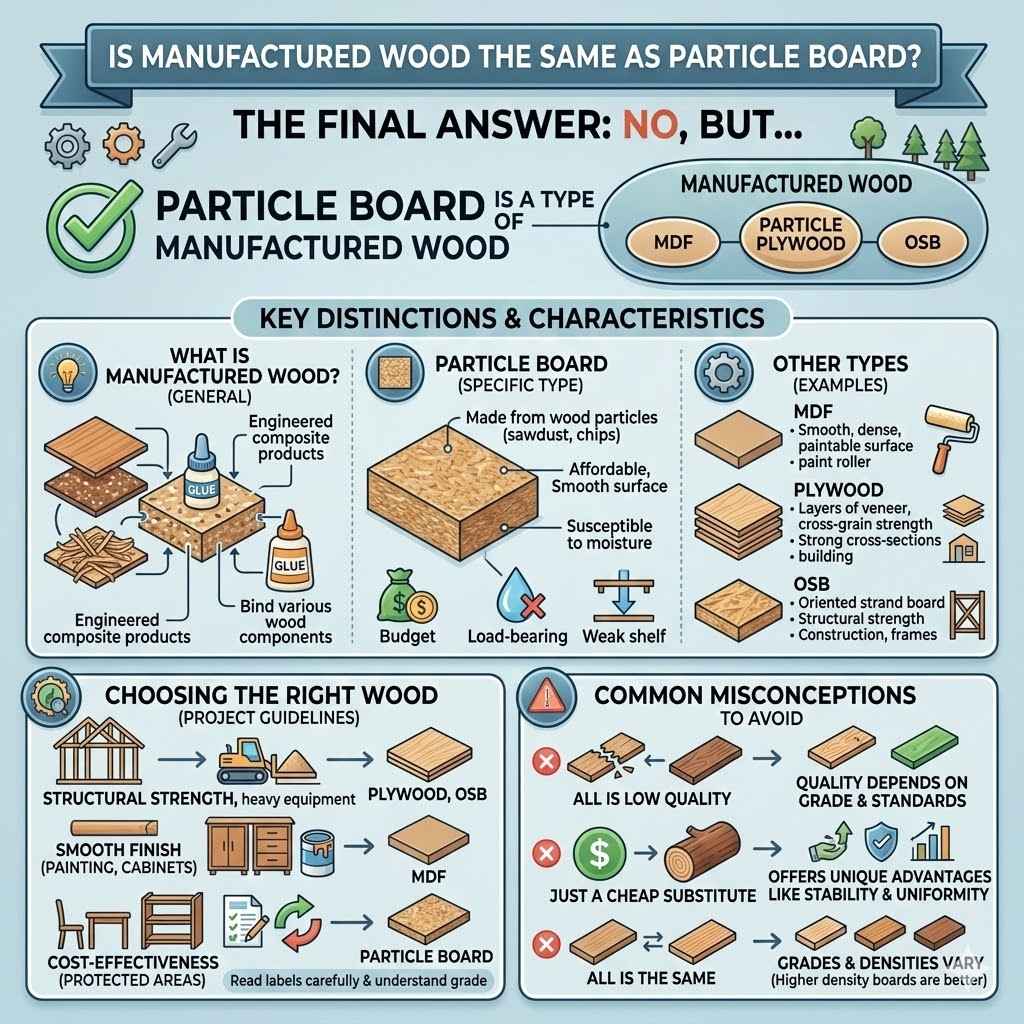
The main point of confusion is that particle board is indeed a type of manufactured wood, but not all manufactured wood is particle board. Think of “manufactured wood” as a large family, and “particle board” is one member of that family. Other family members include MDF, plywood, and OSB, each with their own distinct features.
The way these materials are made is the biggest differentiator. While particle board uses loose wood particles, other types use different forms of wood arranged in different ways. This leads to significant variations in strength, density, moisture resistance, and cost.
Knowing these differences helps you pick the right material for any project.
The visual appearance can also offer clues. Particle board often looks like compressed sawdust, sometimes with visible chip fragments. MDF is usually a uniform, fine, and dense material.
Plywood shows layers of wood veneer, and OSB has a distinctive pattern of wood strands. These visual cues can help you identify the type of manufactured wood you are looking at.
The Family Tree of Manufactured Wood
To clarify the relationship, let’s visualize the hierarchy. At the top is the broad category of manufactured wood. Below that, you find several specific types, each with its own manufacturing process and characteristics.
Particle board is one branch of this tree.
This helps to understand that when someone refers to “manufactured wood,” they might be talking about any of these composite materials. However, when they specifically mention “particle board,” they are referring to the product made from compressed wood particles with binders. This distinction is crucial for accurate communication and material selection.
The development of these different types of manufactured wood has allowed for a wide range of applications that might not be feasible or economical with solid lumber alone. Each type has been engineered to solve specific challenges, whether it’s strength, cost, finishing capabilities, or stability.
Comparing Particle Board with Other Composites
Let’s look at how particle board stacks up against its close relatives:
- Particle Board vs. MDF Particle board is made from larger wood chips and sawdust, while MDF uses very fine wood fibers. This makes MDF denser, smoother, and generally stronger and more rigid than particle board.
MDF is better for intricate routing and painting, whereas particle board is typically used as a substrate for laminates. MDF also tends to be more expensive than particle board.
- Particle Board vs. Plywood Plywood is made from thin sheets of wood veneer glued together with alternating grain patterns. This construction gives plywood superior strength, stability, and resistance to sagging compared to particle board.
Plywood is often used for structural applications and furniture frames where strength is critical. Particle board is much more affordable but far less strong.
- Particle Board vs. OSB OSB is made from wood strands oriented in layers. It offers good structural strength and rigidity, making it a common choice for construction sheathing and subflooring.
Particle board is generally less strong and rigid than OSB and is not typically used for structural purposes. OSB’s appearance is also very different, with its visible strands.
A scenario to illustrate the difference:
- Imagine you are building a bookshelf. For the main structural frame and shelves that will hold heavy books, plywood or solid wood would be the best choice for strength and to prevent sagging. OSB could also work for structural elements if appearance is not a concern.
- If you are looking for a more budget-friendly option for shelves that will not bear extreme weight, or if you plan to cover the shelves with a laminate or veneer for a finished look, particle board could be an option. However, you would need to be mindful of its weight limits and moisture sensitivity.
- For cabinet doors that need to be painted smoothly, MDF is an excellent choice due to its uniform surface and excellent finishing capabilities. It offers a better balance of strength and finishing quality than particle board for this specific application.
Why the Confusion Exists
The confusion often arises because both terms refer to wood products created through manufacturing processes, rather than being harvested as a single piece of lumber. They are both “manufactured” in a sense, and particle board is one specific way to manufacture wood panels.
Furthermore, the retail and manufacturing industries sometimes use terms loosely or interchangeably, adding to the bewilderment. For consumers, especially those new to DIY or furniture shopping, the distinctions can seem minor, but they have significant implications for the performance and longevity of the final product. Clear terminology helps avoid costly mistakes.
The marketing of furniture can also contribute. Some pieces might be described as “wood composite” or “engineered wood,” which could encompass particle board, MDF, or a combination. Without specific details on the material composition, it’s hard for a consumer to know exactly what they are getting.
This lack of specificity makes it hard to gauge durability.
Is Manufactured Wood the Same as Particle Board? The Final Answer
No, manufactured wood is not the same as particle board, but particle board is a type of manufactured wood. The term “manufactured wood” is a broad category that includes various composite wood products made by binding wood components together. Particle board is just one specific example within this larger category, characterized by its use of wood particles like sawdust and chips.
Other common types of manufactured wood include MDF, plywood, and OSB. Each of these has different compositions, manufacturing methods, and resulting properties. Understanding these differences is key to selecting the right material for your project, whether it’s furniture, construction, or any other application.
The key takeaway is that while particle board is a manufactured wood product, it has distinct characteristics and limitations compared to other engineered woods. Its affordability and smooth surface make it useful, but its susceptibility to moisture and lower load-bearing capacity mean it’s not suitable for all uses. Always consider the specific type of manufactured wood and its properties for your needs.
Choosing the Right Manufactured Wood
When deciding which type of manufactured wood to use, consider the project requirements carefully. For structural integrity and strength, plywood or OSB are often preferred. For applications requiring a smooth, paintable surface, MDF is a superior choice.
Particle board is best suited for projects where cost is a primary factor and the material will be protected from moisture and not subjected to heavy loads. Always look at the specific grade and specifications of the manufactured wood product you are considering.
Reading product descriptions and labels carefully will help you identify the exact type of manufactured wood being used. Don’t hesitate to ask for clarification if you are unsure about a material’s composition or suitability for your intended use. This due diligence ensures a successful and durable outcome for your project.
Common Misconceptions to Avoid
One common misconception is that all manufactured wood is of low quality. While particle board can be the least durable, other engineered woods like high-quality plywood or MDF can be very strong and long-lasting. The quality depends greatly on the specific product and its manufacturing standards.
Another misconception is that manufactured wood is simply a cheap substitute for solid wood. While it is often more affordable, it also offers unique advantages like stability and uniformity that solid wood cannot match. It’s not about substitution but about choosing the material that best fits the application.
Also, avoid assuming that all particle board is the same. There are different grades and densities of particle board, each with slightly different properties. Some higher-density particle boards can offer better strength and moisture resistance than standard grades.
Frequently Asked Questions
Question: What is the primary difference between manufactured wood and particle board?
Answer: Manufactured wood is a broad category of wood composites, while particle board is a specific type within that category made from compressed wood particles like sawdust and chips with binders.
Question: Is particle board strong enough for shelves?
Answer: Particle board can be used for shelves, but it may sag over time if the span is too long or the load is too heavy. Plywood or MDF are often better choices for heavy-duty shelving.
Question: Can particle board get wet?
Answer: No, particle board is very sensitive to moisture. It swells and loses its integrity when exposed to water, so it should be kept dry.
Question: What is the best type of manufactured wood for painting?
Answer: Medium-Density Fiberboard (MDF) is excellent for painting because it has a smooth, uniform surface without wood grain, allowing for a seamless finish.
Question: When should I choose particle board over other manufactured woods?
Answer: Choose particle board when budget is a major concern, the item will not bear heavy loads, and it will be protected from moisture. It’s ideal for laminate-covered furniture surfaces or basic shelving.
Conclusion
So, to be clear, manufactured wood is a large family, and particle board is one member. They are not the same thing, but particle board falls under the broader umbrella of manufactured wood. Each type has its own strengths and weaknesses, so picking the right one means looking at your project’s needs.
Particle board is budget-friendly and great for covered surfaces, but other types like MDF or plywood offer more strength or better finishing. Make an informed choice!