Milwaukee Brushless Hammer Drill vs Fuel
Trying to pick out the right Milwaukee hammer drill can feel tricky, especially if you’re new to tools. You see terms like “brushless” and “FUEL” and wonder what they really mean for your work. It’s easy to get confused when looking at all the options.
But don’t worry, we’ll break it all down in a simple way so you can make the best choice for your projects. We’ll guide you through what makes each drill stand out and what features matter most to you.
Milwaukee Brushless Hammer Drill vs Fuel Explained
This section helps you understand the core differences between Milwaukee’s brushless technology and their premium FUEL line when it comes to hammer drills. It’s all about getting the most power and best performance for your tasks. We will explore what makes these drills special and how they can help you get jobs done faster and easier.
Understanding these distinctions will help you pick the perfect tool.
What Does Brushless Mean for a Hammer Drill
Brushless motors are a big deal in power tools. Unlike older brushed motors that use carbon brushes to transfer power, brushless motors use magnets and electronic controls. This means there’s less friction, less heat, and more efficient use of battery power.
For a hammer drill, this translates to longer run times on a single charge and more consistent power delivery, even when you’re really pushing the tool.
A brushed motor has physical brushes that wear out over time and need replacing. They also create sparks and heat. A brushless motor has no brushes, so it lasts longer, runs cooler, and uses the battery’s energy more wisely.
This makes your tool more reliable and efficient.
Think of it like this: a brushed motor is like an old car engine with many moving parts that can wear out. A brushless motor is like a modern, high-tech engine that runs smoother, lasts longer, and uses less fuel. This efficiency is key for demanding jobs.
Benefits of Brushless Technology
Increased Power Output: Brushless motors can deliver more power for their size compared to brushed motors. This means your hammer drill can handle tougher materials and applications without bogging down. It’s like having a stronger engine in your drill for those heavy-duty tasks.
Extended Battery Life: Because brushless motors are more efficient, they use less battery power. You’ll get more holes drilled and more work done on a single battery charge. This is a huge advantage when you’re working on a job site far from a power source or tackling a large project.
Greater Durability and Longevity: With fewer parts to wear out, brushless motors are more robust and have a longer lifespan. You won’t need to worry about replacing carbon brushes, meaning your tool will serve you well for years to come. This makes the initial investment more worthwhile.
Improved Performance Consistency: Brushless motors maintain their power output better under heavy loads. The drill won’t feel like it’s losing strength as quickly when you’re drilling into hard concrete or dense wood. This consistent performance helps you work more efficiently and with less fatigue.

Understanding Milwaukee FUEL Technology
Milwaukee’s FUEL line represents their highest tier of cordless power tools. It’s not just about having a brushless motor; it’s a whole system engineered for maximum performance. FUEL tools combine a POWERSTATE™ brushless motor, REDLITHIUM™ battery technology, and REDLINK PLUS™ electronics.
This integrated approach delivers incredible power, speed, and durability.
When you see the FUEL label on a Milwaukee hammer drill, it means you’re getting their best. These drills are designed for the toughest jobs and for professionals who demand the utmost from their equipment. They offer superior speed, torque, and run-time compared to standard cordless tools.
The FUEL system works together like a finely tuned orchestra. The motor provides the raw power, the battery delivers that power efficiently, and the electronics manage everything to ensure optimal performance and protection. This synergy is what makes FUEL tools stand out.
The Three Pillars of Milwaukee FUEL
POWERSTATE™ Brushless Motor: This is Milwaukee’s advanced brushless motor. It’s designed for higher efficiency, longer life, and more power output than standard brushless motors. It provides the raw muscle for drilling through concrete or tough masonry.
REDLITHIUM™ Battery Technology: These batteries offer longer run time, more power, and better battery life than ever before. They are built to withstand tough job site conditions and deliver consistent power, even in extreme temperatures. This means fewer battery changes and less downtime.
REDLINK PLUS™ Electronics: This is the intelligent control system that ensures optimal performance. It monitors and manages the tool and battery, offering advanced overload protection, temperature control, and power optimization. It prevents damage to the tool and battery, extending their life.
Milwaukee Brushless Hammer Drill vs Fuel What’s the Difference in Performance
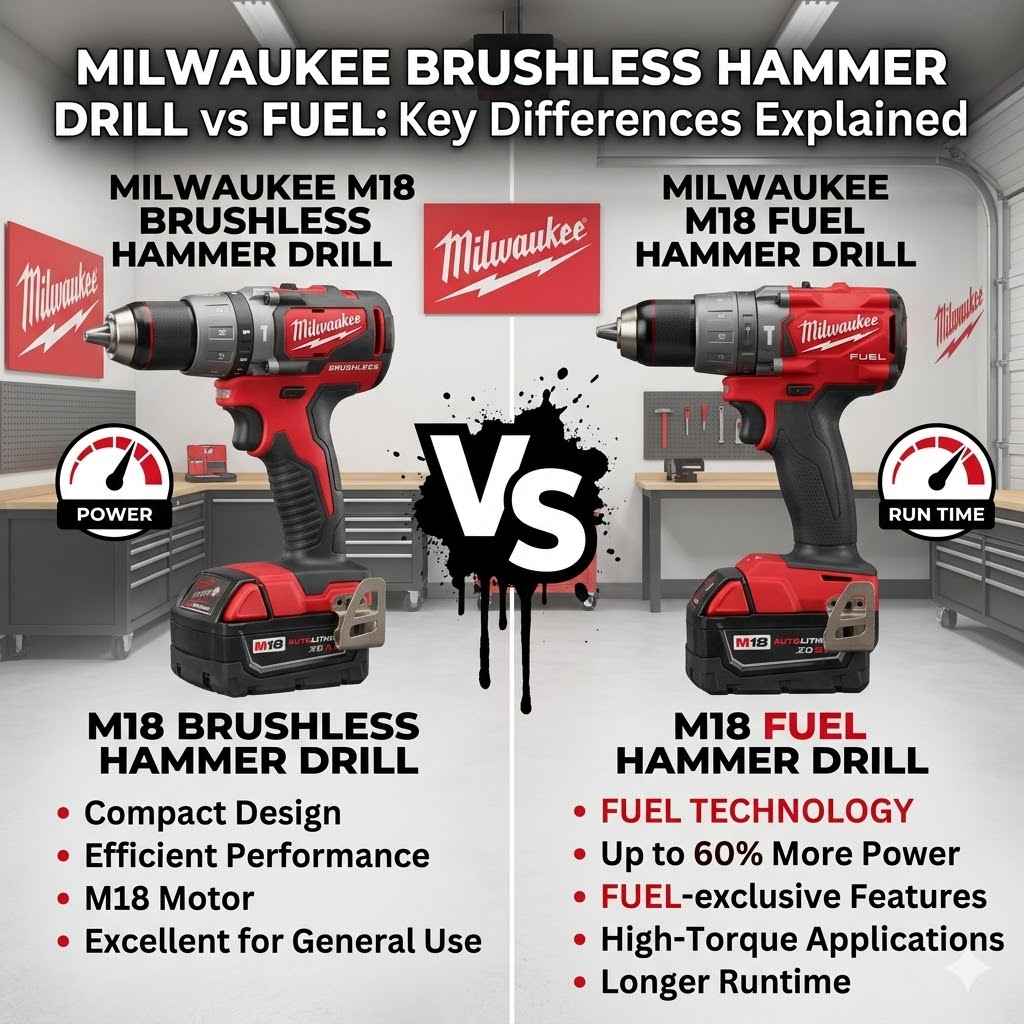
The main performance difference between a standard Milwaukee brushless hammer drill and a FUEL model boils down to raw power, speed, and endurance. While both use brushless motors, the FUEL line is optimized for peak performance. This means faster drilling speeds, higher torque for tough applications, and longer run times, especially under demanding conditions.
For example, when drilling into concrete, a FUEL hammer drill will likely power through the material much faster than a non-FUEL brushless model. It will also maintain that speed for more holes before needing a battery change. This is critical for professionals on tight schedules.
Here’s a look at how they might stack up in real-world scenarios:
| Feature | Standard Brushless Hammer Drill | Milwaukee FUEL Hammer Drill |
|---|---|---|
| Drilling Speed (Concrete) | Good | Excellent |
| Torque Output | High | Very High |
| Battery Runtime | Very Good | Exceptional |
| Durability Under Load | Good | Superior |
| Cost | Moderate | Higher |
Milwaukee Brushless Hammer Drill vs Fuel Key Features Compared
When comparing a standard Milwaukee brushless hammer drill to a FUEL model, you’ll notice several key features that set them apart. These often include motor power, battery capacity, added functionalities like impact control modes, and overall build quality. Understanding these nuances helps you match the tool to your specific needs.
While both offer excellent brushless power, the FUEL line is engineered for those who push their tools to the limit. This means more advanced features and a higher level of performance that can make a real difference on demanding job sites.
Motor Power and Torque
The heart of any hammer drill is its motor. In the Milwaukee Brushless Hammer Drill vs Fuel comparison, the FUEL models typically boast higher wattage motors and more advanced winding designs. This results in greater torque, which is the rotational force that allows the drill to power through tough materials like concrete, brick, or dense wood.
A higher torque output means the drill can apply more twisting force. This is essential for tasks like driving large fasteners into hard surfaces or drilling large-diameter holes. Without sufficient torque, the drill can stall or struggle, slowing down your work considerably.
FUEL drills are designed to overcome these challenges.
For instance, a standard brushless drill might offer up to 700 in-lbs of torque, while a comparable FUEL model could push 1000 in-lbs or more. This significant difference is immediately noticeable when drilling into difficult materials.
Battery Technology and Run Time
Battery technology plays a crucial role in cordless tool performance. Milwaukee’s REDLITHIUM™ batteries are a cornerstone of their FUEL system. These batteries offer higher energy density, meaning more power in a smaller package and longer run times.
They also feature advanced battery management systems to optimize power delivery and protect against overcharging and overheating.
A standard brushless hammer drill might come with a 4.0 Ah (Amp-hour) battery, providing a good amount of run time. However, FUEL models are often paired with higher capacity batteries, such as 5.0 Ah or even 6.0 Ah, allowing for significantly more work to be completed between charges. This is a major benefit for extended jobs.
Consider a scenario where you need to drill 50 holes into concrete. With a standard brushless drill and a 4.0 Ah battery, you might need to swap batteries midway through the job. With a FUEL drill and a 6.0 Ah battery, you might complete the entire job on a single charge, saving valuable time and effort.
Durability and Build Quality
Both standard brushless and FUEL hammer drills are built to last, but Milwaukee reserves its highest level of durability and premium build quality for the FUEL line. This includes more robust housing materials, enhanced sealing against dust and moisture, and higher-grade internal components. These tools are designed to withstand the rigors of daily professional use.
A FUEL drill is engineered with the understanding that it will be used in demanding environments. This might mean being dropped occasionally, exposed to dust and debris, or used for extended periods at high power. The enhanced build quality ensures it can handle these stresses and continue to perform reliably.
For example, the chuck on a FUEL hammer drill might be made of hardened steel for greater durability, and the tool’s internal gearing might be forged for maximum strength. These seemingly small details add up to a tool that can endure more abuse.
Impact and Speed Control Features
Advanced features like variable speed triggers and multi-mode selectors enhance the versatility of hammer drills. While many brushless drills offer variable speed, FUEL models often provide more precise control and a wider range of settings. Some FUEL hammer drills may also offer advanced modes, such as specific settings for hammer drilling, drilling only, and screwdriving, each optimized for its task.
These control features allow you to tailor the drill’s performance to the specific material you’re working with and the type of fastener you’re using. For instance, when driving screws, you want lower speed and precise torque control to avoid stripping the screw head or damaging the material. When hammer drilling concrete, you need high speed and powerful impacts.
Some higher-end FUEL models might even include electronic clutch settings, offering finer control over torque. This is particularly useful for delicate tasks where over-torquing could cause damage. This level of control is often a hallmark of premium tools.
Use Cases for Milwaukee Brushless Hammer Drill vs Fuel
Choosing between a standard Milwaukee brushless hammer drill and a FUEL model often comes down to the type of work you do. For occasional DIY tasks or light-duty home repairs, a good brushless drill might be more than sufficient. However, for frequent, heavy-duty use or professional applications, the added performance and durability of a FUEL drill are invaluable.
Understanding your typical workload will help you decide where your money is best spent. It’s about matching the tool’s capabilities to your demands to ensure efficiency and longevity.
DIY and Homeowner Applications
For the average homeowner, a standard Milwaukee brushless hammer drill is an excellent choice. It provides more than enough power and performance for common tasks like hanging shelves, assembling furniture, drilling into drywall or occasional wood studs, and even small concrete projects like anchoring a fence post. The brushless motor ensures good battery life and reliability for these less frequent, but still demanding, tasks.
These drills offer a significant upgrade over older brushed models, providing a smoother experience and better power. They are user-friendly and come with features that make everyday jobs easier. The investment is typically lower, making them an accessible option for most households.
Example tasks for a standard brushless hammer drill:
- Assembling flat-pack furniture that requires numerous screws to be driven in.
- Hanging heavy pictures or mirrors on a wall, which might involve drilling into studs or masonry anchors.
- Mounting a TV bracket onto a solid wall, whether it’s drywall with studs or a concrete wall.
- Light-duty concrete work, such as drilling a few holes for expansion anchors or for a small garden feature.
Professional and Heavy-Duty Use
For contractors, tradespeople, or anyone who uses a hammer drill daily for demanding jobs, the Milwaukee FUEL line is the clear choice. These tools are built to withstand continuous use, high stress, and the harsh conditions of a job site. The superior power, speed, and endurance of FUEL drills translate directly into increased productivity and less downtime.
When every minute counts, the extra speed and torque provided by a FUEL hammer drill can save hours over the course of a project. The enhanced durability also means fewer repairs and replacements, making it a more cost-effective investment in the long run for professionals.
Consider a plumber needing to drill dozens of holes through concrete walls daily for pipe installation. A FUEL hammer drill will complete these tasks significantly faster and with less strain on the tool and the user. Similarly, an electrician running wire through multiple brick walls would benefit immensely from the speed and power of a FUEL drill.
Choosing the Right Model for Your Needs
The Milwaukee Brushless Hammer Drill vs Fuel decision ultimately hinges on your specific requirements. If your projects are infrequent and relatively light, a standard brushless model offers great value. If you’re a professional or a serious DIYer tackling challenging jobs regularly, the performance and durability of a FUEL drill are hard to beat.
Think about how often you’ll use the tool, the types of materials you’ll be drilling into, and your budget. It’s often better to invest in a higher-performance tool that will last longer and perform better, even if it means a higher upfront cost, especially for professional use.
Here’s a simple decision guide:
- Choose a standard Brushless Hammer Drill if: You are a homeowner doing occasional DIY, need a tool for light assembly or hanging items, and your budget is a primary concern.
- Choose a Milwaukee FUEL Hammer Drill if: You are a professional tradesperson, use your drill daily, need maximum power and speed for tough materials like concrete and masonry, and require exceptional durability and long run times.
Milwaukee Brushless Hammer Drill vs Fuel Battery Compatibility
A significant advantage of Milwaukee’s cordless systems is battery compatibility. If you’re already invested in Milwaukee’s M18™ battery platform, you’ll find that many standard brushless and FUEL hammer drills use the same batteries. This can save you money and convenience, as you can share batteries across different tools in the M18™ line.
However, it’s important to note that while batteries might be compatible, the performance of the drill will still be dictated by its motor and electronics. A high-capacity battery will give a standard brushless drill longer run time, but it won’t magically turn it into a FUEL drill in terms of raw power output.
M18™ System Benefits
Milwaukee’s M18™ system is one of the most extensive cordless tool platforms available. It features hundreds of tools, from drills and saws to lighting and outdoor equipment, all powered by the same M18™ batteries. This means that if you own an M18™ battery, you can power a wide range of Milwaukee tools.
This ecosystem approach is a major selling point for Milwaukee. It allows users to gradually build their tool collection without needing to buy new batteries and chargers for every single tool. You can often buy bare tools (without batteries) at a lower cost if you already have compatible batteries.
For example, if you have a Milwaukee M18™ FUEL impact driver, you can use the same batteries for your M18™ FUEL hammer drill, an M18™ circular saw, and even an M18™ work light. This interchangeability is incredibly convenient and cost-effective.
Battery Size and Power
M18™ batteries come in various amp-hour (Ah) ratings, such as 2.0 Ah, 4.0 Ah, 5.0 Ah, and 6.0 Ah. The Ah rating indicates the battery’s capacity, or how much energy it can store. A higher Ah rating means longer run time on a single charge.
However, higher Ah batteries are also physically larger and heavier.
For a standard brushless hammer drill, a 4.0 Ah or 5.0 Ah battery is usually sufficient for most home tasks. For a FUEL hammer drill, especially when used for heavy-duty applications, a 5.0 Ah or 6.0 Ah battery is recommended to take full advantage of the tool’s power and endurance. The FUEL system is designed to utilize the full potential of these higher-capacity batteries.
It’s also worth noting that Milwaukee offers different battery chemistries and performance tiers within the M18™ line. Their High Output™ batteries, for instance, are designed to deliver even more power and run time than standard REDLITHIUM™ batteries, often paired with their most powerful FUEL tools.
Matching Batteries to Your Drill
When choosing a hammer drill, consider the batteries you already own or plan to purchase. If you have several M18™ batteries, you can easily swap them between your drills. For optimal performance with a standard brushless drill, a 4.0 Ah battery is a good balance of power and weight.
For a FUEL drill, especially for demanding tasks, you’ll get the best results with a 5.0 Ah or larger REDLITHIUM™ battery.
The tool’s manual will specify the recommended battery types and sizes for best performance. While most M18™ batteries will fit, using the appropriate capacity ensures you get the most out of your hammer drill, whether it’s a standard brushless or a FUEL model.
Milwaukee Brushless Hammer Drill vs Fuel Maintenance and Longevity
Both standard brushless and FUEL hammer drills are designed for durability, but proper maintenance ensures they last their full potential lifespan. Brushless motors themselves require very little maintenance, but the tool as a whole benefits from good care. The FUEL line, with its premium components, is built for longevity, but even the best tools need attention.
Regular cleaning, proper battery care, and avoiding abuse will help keep your Milwaukee hammer drill performing at its best, regardless of whether it’s a standard brushless or a FUEL model. This focus on longevity makes it a worthwhile investment.
Keeping Your Tool Clean
Dust and debris are the enemies of any power tool. After each use, especially when working in dusty environments like construction sites or workshops, it’s important to clean your hammer drill. Use a dry cloth to wipe down the exterior and a soft brush or compressed air to clear any dust from vents and motor housing.
A buildup of dust can lead to overheating, reduced efficiency, and potential damage to internal components. Keeping the tool clean is one of the simplest yet most effective ways to extend its life. Pay special attention to the chuck and any areas where debris can easily accumulate.
For example, after drilling into concrete or brick, you’ll want to clear out all the dust from the chuck and the front housing. This prevents the dust from getting into the gearing or motor over time, which can cause wear and tear.
Battery Care and Storage
Proper battery care is crucial for both performance and longevity. Milwaukee REDLITHIUM™ batteries are designed to be durable, but they still require attention. Avoid exposing batteries to extreme temperatures (both hot and cold) for extended periods.
Store them in a cool, dry place when not in use.
It’s also a good practice to avoid fully discharging batteries regularly. If possible, recharge them when they are low but not completely empty. This can help preserve the battery’s overall lifespan.
Most modern lithium-ion batteries have built-in protection to prevent over-discharge, but it’s still a good habit.
If you’re storing your batteries for a long time, aim for a partial charge (around 50-70%). This state is generally considered optimal for long-term storage of lithium-ion batteries, minimizing self-discharge and stress on the cells.
Avoiding Overload and Abuse
While both standard brushless and FUEL hammer drills are designed to handle demanding tasks, they have limits. Pushing any tool beyond its intended capacity can lead to premature wear or failure. For instance, trying to drill extremely large holes in very hard concrete with a smaller hammer drill could overload the motor or damage the gearing.
Learn to recognize when the tool is struggling and consider if a larger or more powerful drill might be needed. In the Milwaukee Brushless Hammer Drill vs Fuel debate, the FUEL line is built for more abuse, but it’s still not indestructible. For the standard brushless models, being mindful of these limits is even more important for ensuring longevity.
Using the correct drill bit for the material and application is also key. A dull or incorrect bit will force the drill to work harder, increasing the risk of overload and reducing efficiency. Always ensure your bits are sharp and appropriate for the job.

Frequently Asked Questions
Question: What is the main difference between Milwaukee brushless and FUEL hammer drills?
Answer: The main difference is that FUEL is Milwaukee’s premium line, featuring their most advanced POWERSTATE™ brushless motors, REDLITHIUM™ batteries, and REDLINK PLUS™ electronics for maximum power, speed, and durability. Standard brushless drills still offer good performance but are not engineered to the same peak levels as FUEL models.
Question: Do I need a FUEL hammer drill for home use?
Answer: For most home use, like hanging shelves or assembling furniture, a standard Milwaukee brushless hammer drill is usually sufficient. You only truly need a FUEL hammer drill if you frequently tackle very demanding tasks like drilling through hard concrete repeatedly or in professional trades.
Question: Can I use my M18™ batteries with any Milwaukee hammer drill?
Answer: Yes, as long as both the drill and the battery are part of the Milwaukee M18™ system, they will be compatible. You can use your M18™ batteries with both standard M18™ brushless and M18™ FUEL hammer drills, though the FUEL models will perform best with higher capacity batteries.
Question: How do I know if my Milwaukee hammer drill is FUEL?
Answer: Look for the “FUEL” branding prominently displayed on the tool itself, often on the body of the drill. The packaging will also clearly state if it is a FUEL model. FUEL tools represent Milwaukee’s highest performance tier.
Question: Will a FUEL hammer drill last longer than a standard brushless one?
Answer: Generally, yes. The FUEL line is built with higher-grade components and is engineered for greater durability under extreme use. While standard brushless tools are also built well, the FUEL designation indicates Milwaukee’s commitment to maximum longevity and performance for professional-level demands.
Summary
When deciding between a Milwaukee brushless hammer drill and a FUEL model, consider your typical tasks. Standard brushless offers great power for home DIY, while FUEL delivers peak performance for professionals needing ultimate speed and durability. Both use efficient motors, but FUEL is engineered for the toughest jobs and longest workdays.