What Is a Downrod: Essential Guide
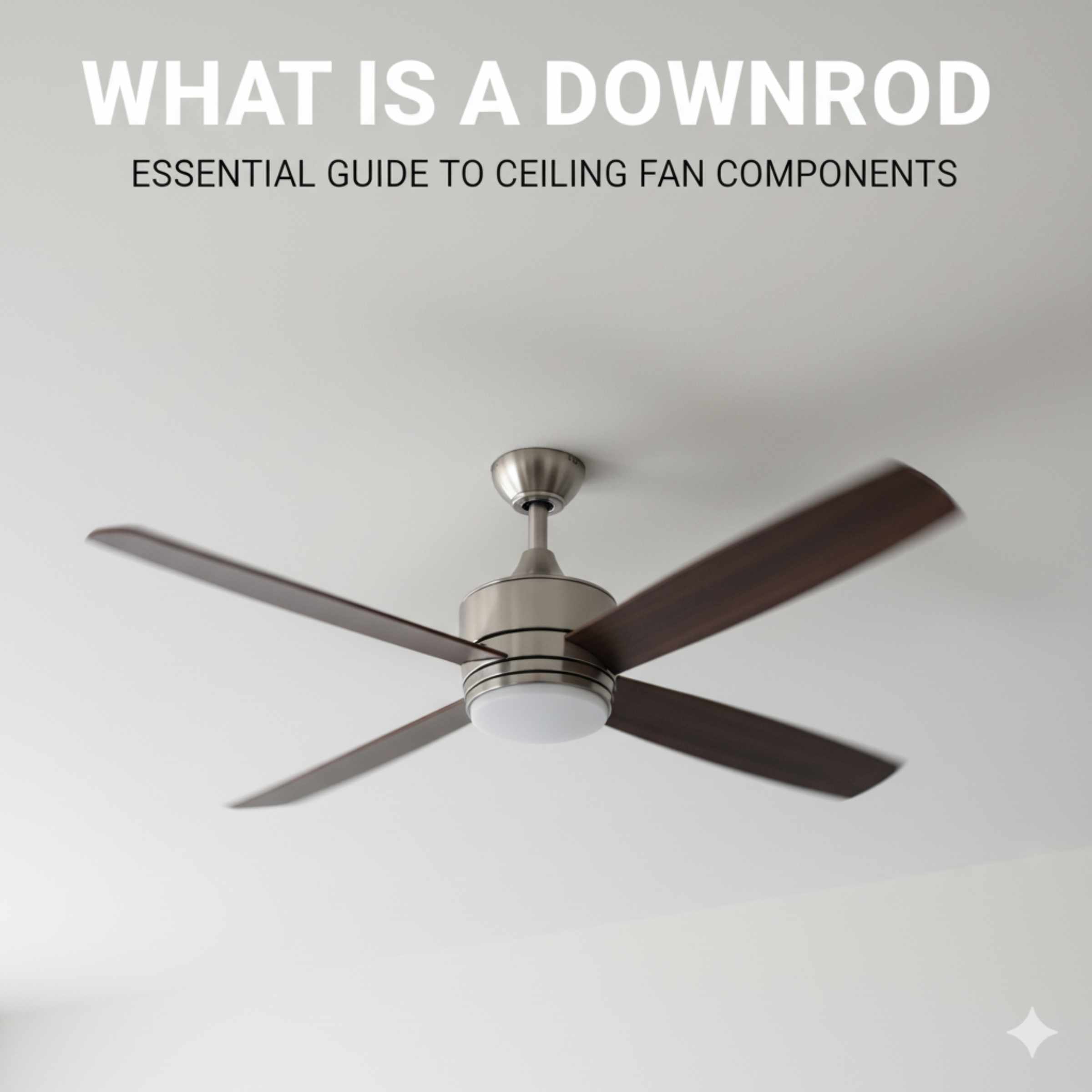
A downrod is a decorative or functional pipe that extends a ceiling fan from its mounting point. It’s crucial for proper fan performance, ensuring optimal airflow and clearance from obstructions like sloped ceilings or light fixtures, making it an essential component for many ceiling fan installations.
Ever looked up at a ceiling fan and wondered how it hangs so perfectly, moving air all around the room? Sometimes, that fan doesn’t sit right against the ceiling. It might be too close, or maybe your ceiling is a bit angled. That’s where a simple, yet mighty, piece called a downrod comes in. If you’ve ever felt a bit lost when it comes to ceiling fan parts, you’re in the right place. We’re going to break down exactly what a downrod is and why it’s so important for getting your ceiling fan working its best. Get ready to understand this often-overlooked part and feel confident about your next home improvement project!
What Exactly Is a Downrod?
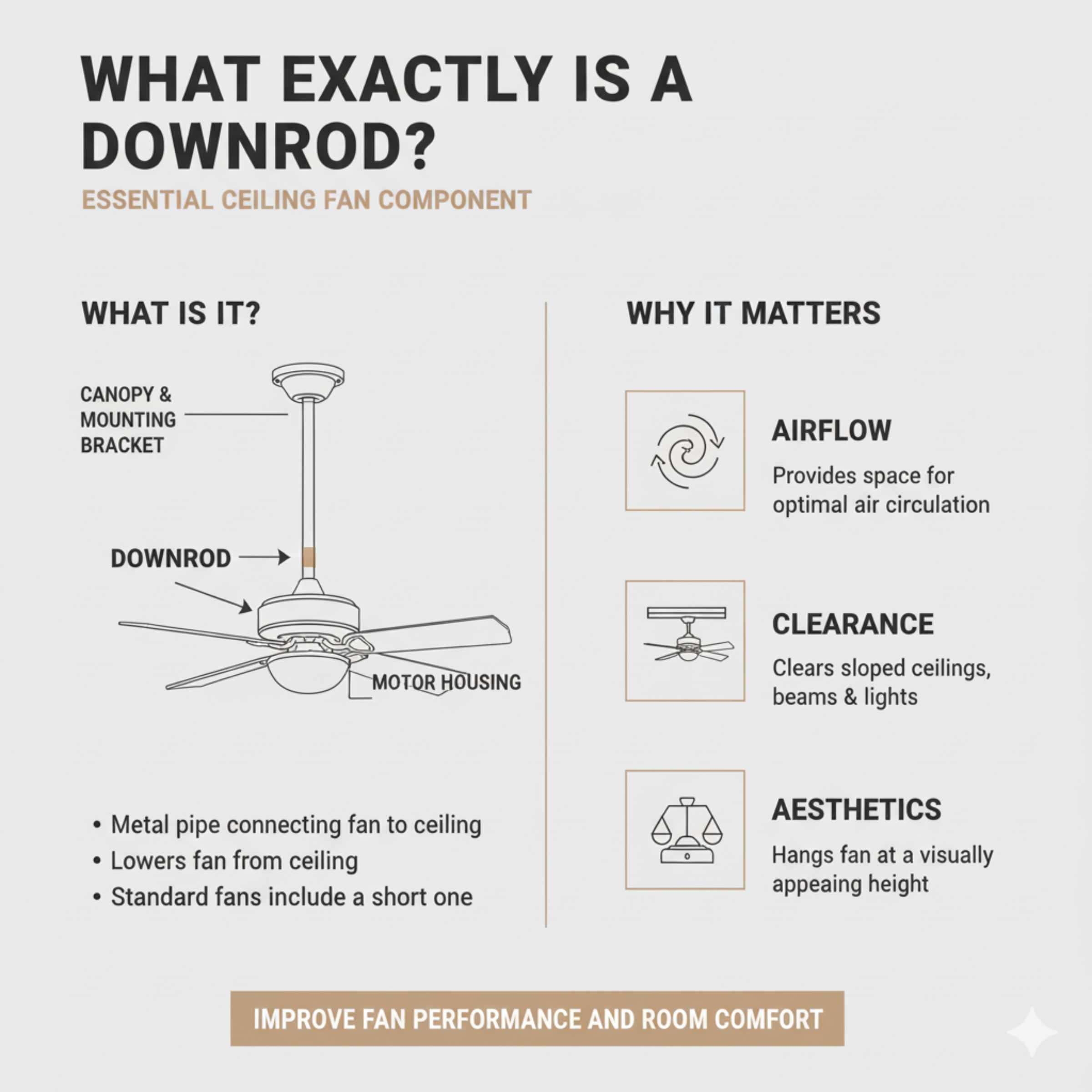
At its core, a downrod is simply a metal pipe that connects the ceiling fan’s motor housing to the canopy and mounting bracket. Think of it as an extension pole. When you buy a ceiling fan, it usually comes with a short downrod, often just a few inches long. However, this might not be enough for every situation. This is where longer downrods become necessary.
The downrod’s primary job is to lower the fan from the ceiling. This might seem counterintuitive, but it’s vital for a few key reasons:
- Airflow: A fan needs space to breathe and circulate air effectively. If it’s too close to the ceiling, the blades can’t create a strong downdraft (for cooling in the summer) or updraft (for circulating warm air in the winter).
- Clearance: Some ceilings are sloped, or there might be light fixtures or beams directly above where the fan needs to be mounted. A downrod provides the necessary clearance.
- Aesthetics: A fan that’s too close to the ceiling can look cramped and out of place. A downrod helps the fan hang at a more visually appealing height, balancing its size with the room.
Why Is the Right Downrod Length So Important?
Choosing the correct downrod length isn’t just about looks; it directly impacts your ceiling fan’s performance and safety. Using the wrong length can lead to several issues:
- Inefficient Air Circulation: If the fan is too high, the air it moves might not reach the living space effectively, making it feel like the fan isn’t doing its job. If it’s too low, it could create a “chopping” effect rather than a smooth airflow.
- Safety Hazards: A fan that’s too low could be a hazard in rooms with high foot traffic, especially if people are tall. Conversely, if it’s too high and not properly secured, it could be unstable.
- Blade Clearance: This is a big one. Fan blades need to be at least 7 feet (about 2.1 meters) from the floor for safety. If your ceiling is particularly high, a longer downrod is essential to achieve this.
- Motor Strain: While less common, a fan that’s constantly struggling to move air due to improper height might put extra strain on its motor over time.
The general rule of thumb is that the fan blades should be about 8 to 9 feet (around 2.4 to 2.7 meters) above the floor for optimal air circulation in a standard 8-foot ceiling. For higher ceilings, you’ll need longer downrods.
When Do You Need a Downrod?
You’ll most likely need to consider a downrod beyond the one that comes with your fan in these common scenarios:
- High Ceilings: If your room has ceilings taller than 8 feet, you’ll almost certainly need a longer downrod. The higher the ceiling, the longer the downrod required.
- Sloped or Vaulted Ceilings: Most standard ceiling fans are designed for flat ceilings. If you have a sloped ceiling, a downrod is often necessary to allow the fan to hang level and clear the highest point of the slope. Some fans are specifically designed for sloped ceilings and come with a sloped ceiling adapter, but a downrod is still usually part of the equation. You can find more information on mounting fans on sloped ceilings from resources like Energy.gov’s guide to ceiling fans.
- Low Ceilings (Rarely): In some very rare cases, even the shortest downrod might make the fan too low for a standard 8-foot ceiling, especially if you have a very low-profile fan. In such instances, you might use a “flush mount” or “hugger” fan that doesn’t use a downrod at all.
- Obstructions: If there’s a light fixture, beam, or other fixture directly above the fan’s intended mounting spot, a downrod can help position the fan correctly to avoid interference.
Types of Downrods and Their Features
Downrods are typically made from metal and come in various lengths and finishes to match your ceiling fan and decor. Here’s a breakdown of what you might encounter:
Materials
Most downrods are constructed from steel or aluminum. These materials are chosen for their strength, durability, and ability to be easily finished with paint or other coatings.
Finishes
The finish of the downrod is important for aesthetic consistency. Common finishes include:
- Brushed Nickel
- Oil-Rubbed Bronze
- Matte Black
- White
- Polished Chrome
- Wood Grain (less common, often a painted finish to mimic wood)
It’s best to choose a downrod finish that matches or complements your ceiling fan’s motor housing and blades.
Sizes and Lengths
Downrods come in a wide range of lengths, typically measured from the point where the downrod attaches to the fan motor to the point where it attaches to the ceiling bracket. Common lengths include:
- 3 inches
- 6 inches
- 12 inches
- 18 inches
- 24 inches
- 36 inches
- 48 inches
- 60 inches
- 72 inches
Some manufacturers offer even longer custom downrods for very high ceilings.
Compatibility
This is crucial! Not all downrods are universal. Most major ceiling fan brands (like Hunter, Casablanca, Minka Aire, etc.) use their own specific downrod threading and connection systems. Always check your ceiling fan’s manual or the manufacturer’s website to determine which downrod is compatible with your fan model. Attempting to use an incompatible downrod can be unsafe and may void your fan’s warranty.
How to Choose the Right Downrod Length
Selecting the correct downrod length is a straightforward process, but it requires a little measurement. Here’s how to do it:
1. Measure Your Ceiling Height
Use a tape measure to determine the height of your ceiling from the floor. This is your starting point.
2. Determine Desired Fan Height
For optimal airflow, the fan blades should be between 8 and 9 feet from the floor. For very high ceilings, ensure the blades are at least 7 feet from the floor to be safe, but aim for closer to 8-9 feet if possible for better circulation.
3. Calculate Required Downrod Length
Subtract the desired fan height from your ceiling height. The result is the approximate downrod length you’ll need.
Formula: Ceiling Height – Desired Fan Height = Required Downrod Length
Example: If your ceiling is 10 feet (120 inches) high and you want the blades to be 8 feet (96 inches) from the floor:
120 inches – 96 inches = 24 inches. You would need a 24-inch downrod.
4. Account for the Fan’s Canopy and Motor Housing
The measurements above are a good starting point, but remember that the fan itself has a certain height from its mounting point to the blades. Most ceiling fan manuals provide a “downrod drop” measurement, which is the total distance from the ceiling to the bottom of the fan blades with a specific downrod length. Use this information to fine-tune your choice.
5. Consider Sloped Ceilings
If you have a sloped ceiling, you might need a downrod in conjunction with a sloped ceiling adapter. The adapter helps the fan hang straight, and the downrod provides the necessary height. The angle of the slope and the highest point of the ceiling will influence the downrod length needed to ensure the blades don’t hit the ceiling.
6. Consult Your Fan’s Manual
Your ceiling fan’s installation manual is your best friend. It will typically have a chart or guide that recommends downrod lengths based on ceiling height. Always refer to this first!
A Quick Guide to Downrod Lengths by Ceiling Height
Here’s a general guideline to help you select the right downrod length. Remember to always verify with your fan’s manual and adjust based on your specific room and fan model.
| Ceiling Height | Recommended Downrod Length | Notes |
|---|---|---|
| 8 feet (Standard) | 3 to 6 inches (often included with fan) | Ensure blades are at least 7 feet from floor. |
| 9 feet | 12 inches | Provides better airflow for higher ceilings. |
| 10 feet | 18 to 24 inches | Essential for effective air circulation. |
| 11 feet | 24 to 36 inches | Lowering the fan significantly improves performance. |
| 12 feet | 36 to 48 inches | Crucial for bringing the fan to an effective height. |
| 13+ feet | 48 inches and longer (or custom) | Consider professional advice for very high ceilings. |
Note: These are general recommendations. Always prioritize safety (minimum 7 feet blade clearance from floor) and optimal airflow (ideally 8-9 feet from floor to blades).
How to Install a Downrod
Installing a downrod is usually part of the ceiling fan assembly process. If you’re replacing a downrod or installing a new fan, here are the general steps. Always refer to your specific fan’s manual, as procedures can vary slightly between brands.
Tools You Might Need:
- Screwdrivers (Phillips and flathead)
- Wire strippers/cutters
- Pliers
- Adjustable wrench
- Ladder
- Safety glasses
- Voltage tester
- Your ceiling fan manual and the correct downrod
Step-by-Step Installation:
- Turn Off Power: This is the most critical step for safety. Go to your circuit breaker box and switch off the power to the room where you’ll be working. Use a voltage tester to confirm the power is off at the ceiling box.
-
Assemble the Motor and Downrod:
- Lay the fan motor housing on a soft surface (like its packaging or a blanket) to prevent scratches.
- Feed the fan’s electrical wires through the chosen downrod.
- Slide the decorative canopy and any trim rings onto the downrod BEFORE attaching it to the motor.
- Attach the downrod to the fan motor housing. This usually involves inserting a clevis pin through pre-drilled holes and securing it with a cotter pin. Some models might use screws. Ensure these are tightened securely.
-
Hang the Fan:
- Carefully lift the fan assembly up to the ceiling mounting bracket.
- Most mounting brackets have a hook or groove designed to hold the fan assembly temporarily while you connect the wiring. Hang the fan on this.
-
Connect the Wiring:
- Follow your fan’s manual for specific wiring instructions. Generally, you’ll connect the house wires (black to black for hot, white to white for neutral, and green/bare to green/bare for ground) to the corresponding fan wires.
- Use wire nuts to secure the connections.
- Tuck all wires neatly into the electrical box.
-
Mount the Canopy:
- Slide the canopy up to the ceiling, covering the mounting bracket and wiring.
- Secure the canopy to the mounting bracket, usually with screws.
-
Attach Fan Blades and Light Kit (if applicable):
- Attach the fan blades to the blade brackets, and then attach the blade brackets to the motor.
- If your fan has a light kit, wire and attach it according to the manual.
-
Restore Power and Test:
- Go back to your circuit breaker and turn the power back on.
- Test the fan at all speed settings and ensure the light works. Check for any wobbling.
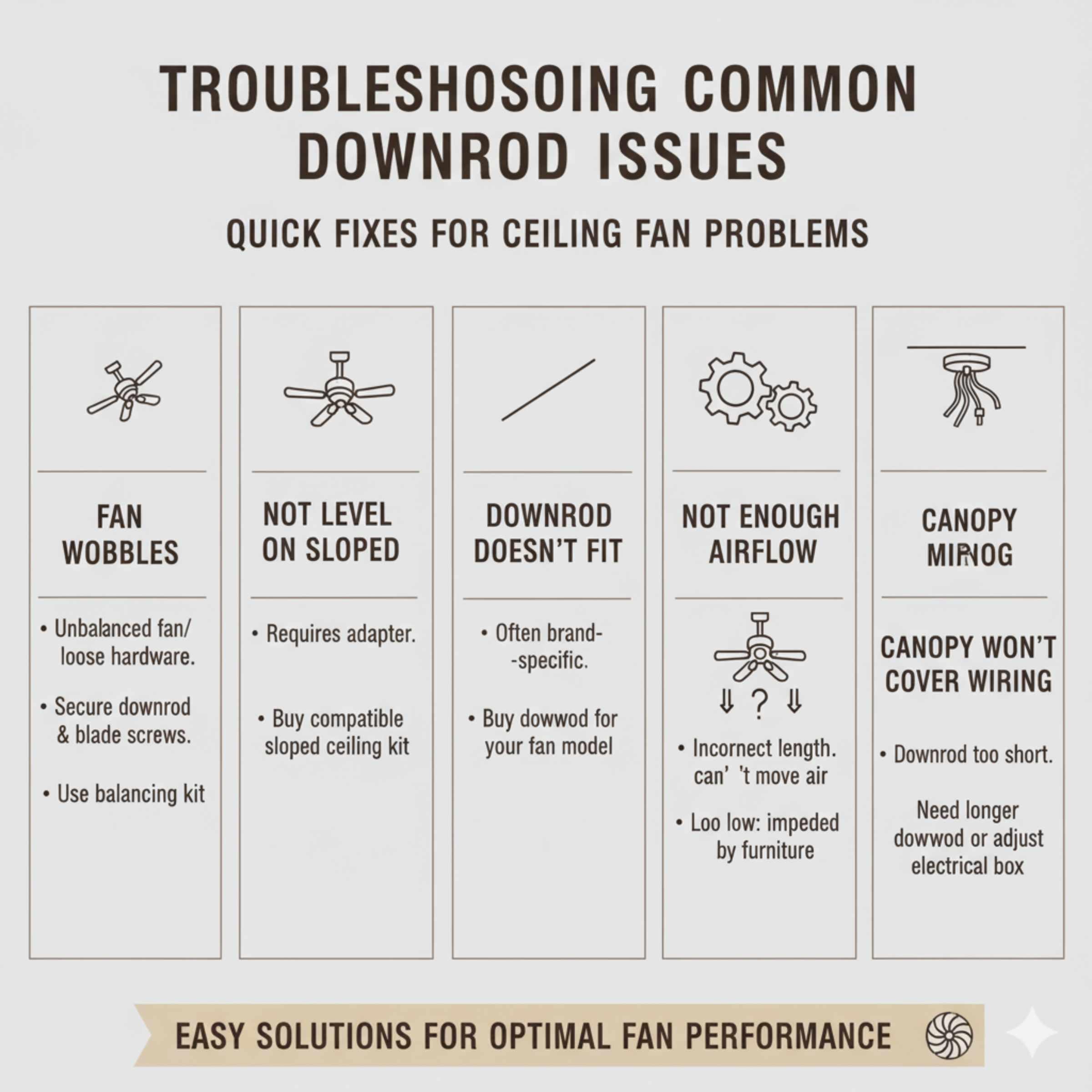
Troubleshooting Common Downrod Issues
Even with the best intentions, you might run into a snag. Here are a few common issues and how to fix them:
- Fan Wobbles: This is often due to an unbalanced fan or loose mounting hardware. Ensure the downrod is securely attached to both the motor and the mounting bracket. Check that all blade screws are tight. Many fans come with a balancing kit to help correct minor wobbles.
- Fan Won’t Hang Level on a Sloped Ceiling: If you’re using a downrod on a sloped ceiling without a proper adapter, the fan might not hang straight. You’ll need to purchase a compatible sloped ceiling adapter for your fan model. These adapters allow the downrod to hang vertically even when the ceiling is angled.
- Downrod Doesn’t Fit: As mentioned, downrods are often brand-specific. If you bought a generic downrod, it might not have the correct threading or connection type. Always buy downrods designed for your specific ceiling fan model.
- Not Enough Airflow: If the fan seems weak, double-check that you’ve chosen the correct downrod length. If the fan is too high, it won’t move air effectively. If it’s too low and the blades are close to furniture or people, it could also impede airflow.
- Canopy Won’t Cover Wiring: If your downrod is too short for the electrical box or mounting hardware, the canopy might not be able to cover everything neatly. In this case, you might need a slightly longer downrod or ensure the mounting box is installed correctly.
Frequently Asked Questions (FAQ)
Q1: What is the standard length of a ceiling fan downrod?
A1: The “standard” downrod that often comes with a fan is typically 3 to 6 inches long. This is usually suitable for an 8-foot ceiling. However, many fans are sold without a downrod, or with only a short one, requiring you to purchase a longer one separately based on your ceiling height.
Q2: Can I use a downrod from a different brand of ceiling fan?
A2: Generally, no. Downrods are often designed with specific threading and connection mechanisms that are proprietary to each ceiling fan brand and sometimes even specific models. Using an incompatible downrod can be unsafe and may void your warranty. Always check compatibility with your fan manufacturer.
Q3: How do I know if I need a downrod at all?
A3: You need a downrod if your ceiling is higher than 8 feet, if you have a sloped or vaulted ceiling, or if there are obstructions that prevent mounting the fan directly to the ceiling box. If the fan blades would be less than 7 feet from the floor with a flush mount, you need a downrod.
Q4: What’s the minimum distance the fan blades should be from the floor?
A4: For safety, ceiling fan blades should be at least 7 feet (approximately 2.1 meters) from the floor. However, for optimal air circulation, it’s best to have the blades about 8 to 9 feet from the floor.
Q5: Can I cut a downrod to a custom length?
A5: While it’s technically possible to cut a downrod, it’s generally not recommended for beginners. Cutting can damage the threads or internal wiring channels, and improper cutting can weaken the rod. It’s safer and easier to purchase a downrod in the exact length you need from the manufacturer.
Q6: Do I need a special downrod for a sloped ceiling?
A6: Often, yes. While a downrod is usually part of the solution for a sloped ceiling, you’ll typically also need a specific sloped ceiling adapter. This adapter attaches to the mounting bracket and allows the downrod to hang straight down, ensuring the fan operates safely and effectively.
Conclusion
So, there you have it! A downrod is more than just a simple pipe; it’s a critical component that ensures your ceiling fan operates efficiently, safely, and looks great in your home. By understanding what a downrod is, why its length matters, and how to choose and install the right one, you’ve taken a significant step towards mastering your home improvement projects. Remember to always prioritize safety, consult your fan’s manual, and measure carefully. With the right downrod, you can enjoy perfectly circulated air and a beautifully balanced ceiling fan for years to come. Happy installing!