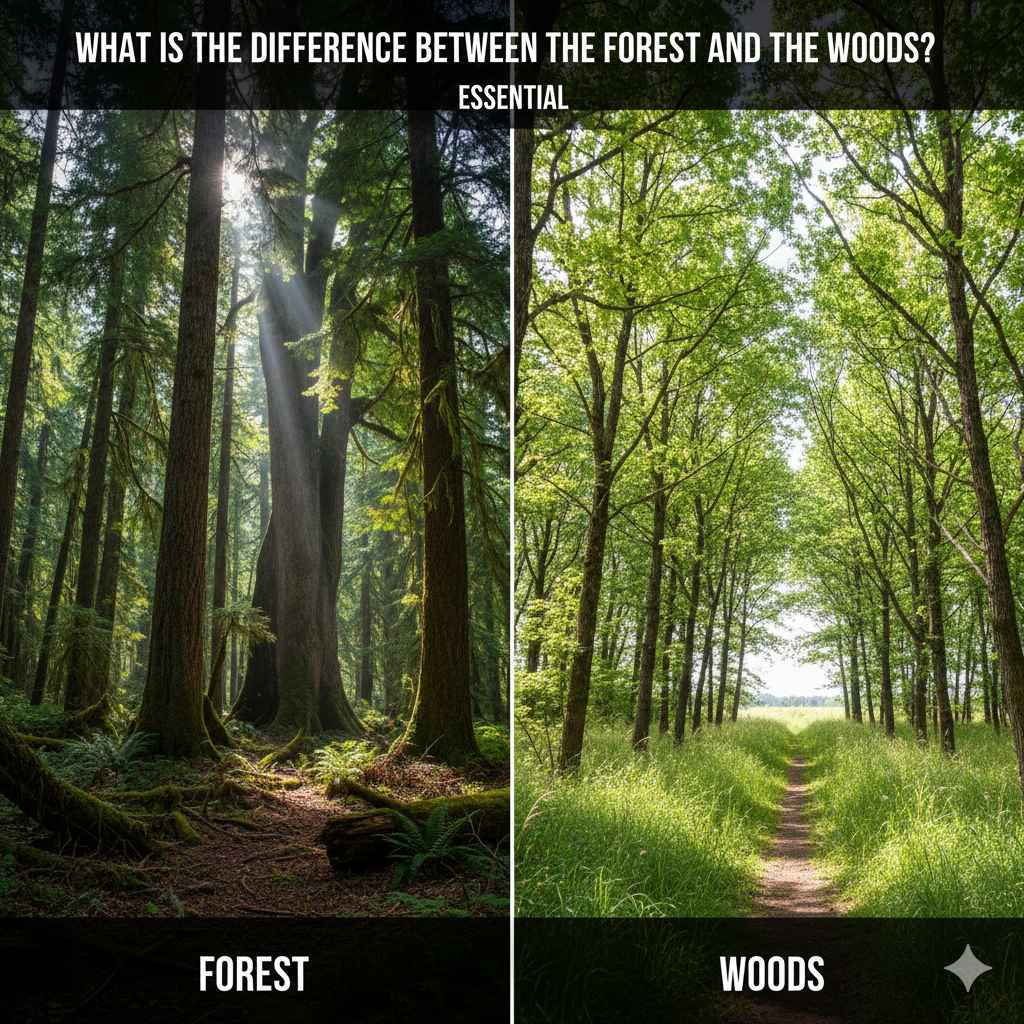
What Is The Difference Between A Forest And The Woods? Essential
The core difference between a forest and the woods lies mainly in size, density, and ecological complexity. Simply put, woods are generally smaller, less dense groupings of trees, while a forest is a much larger, established, and more complex ecosystem.
Have you ever stood at the edge of a patch of trees and wondered, “Is this a forest or just some woods?” It’s a common question! Many people use these words to mean the same thing, and honestly, it can be confusing. For those of us who enjoy hiking, building things from natural materials, or just appreciate nature around our homes, knowing the real distinction matters. Does it affect how we approach property lines, conservation, or even just planning a weekend walk?
Absolutely! Don’t worry; understanding this difference is easier than building a complex birdhouse. We are going to break down the technical terms and the common understanding in a way that makes perfect sense. By the end of this, you will easily spot the subtle—and sometimes not-so-subtle—differences.
Understanding the Common Terms: Woods vs. Forest
When we talk about trees growing together, we use several terms—woods, forest, timberland, grove. While these terms overlap, forestry experts and ecologists generally agree on what sets them apart. Think of it like comparing a small shed to a large workshop; both involve construction, but the scale and purpose are different. Let’s dive into the standard definitions that help us tell them apart.
The Simple Definition of “The Woods”
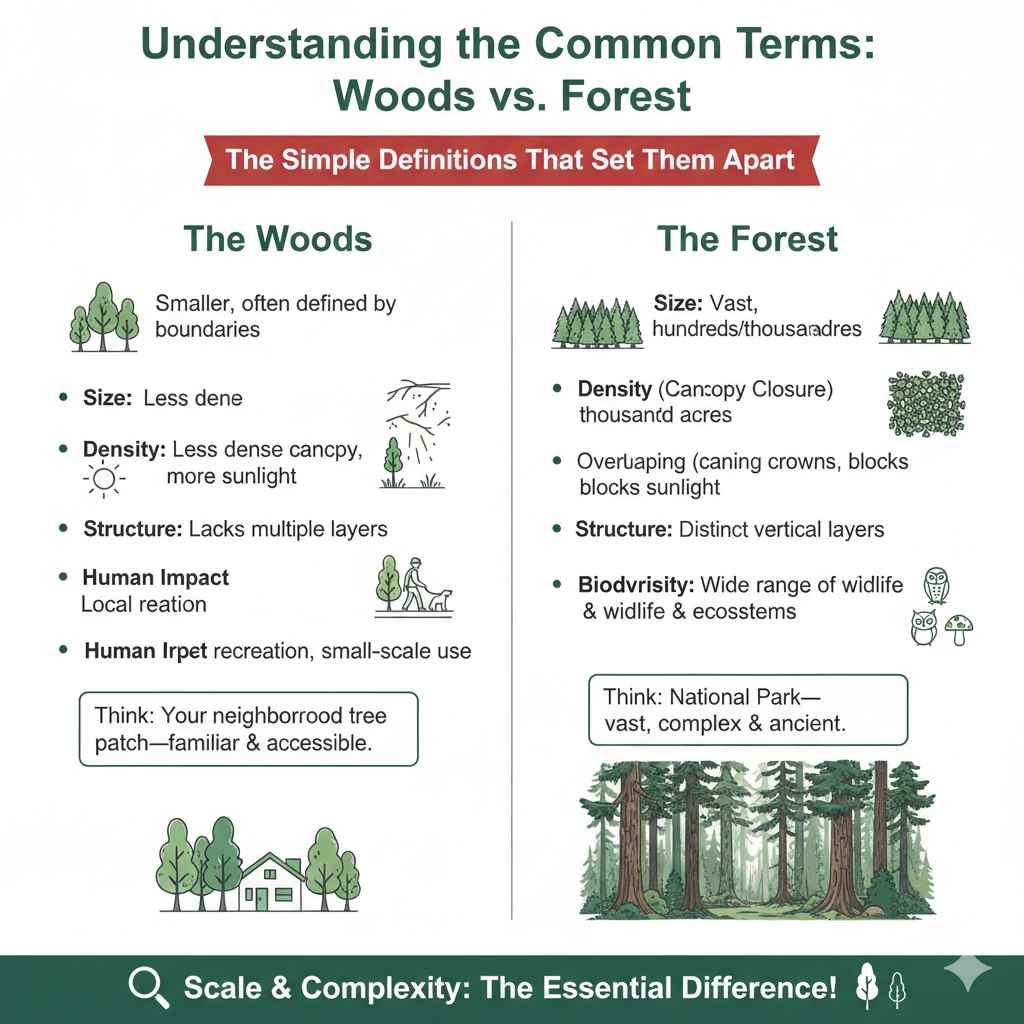
The term “woods” often describes a smaller, less dense area covered in trees. If you look out your back window and see a thicket of trees that covers a few acres, you’re probably looking at the woods.
Key Characteristics of Woods:
- Size: Generally smaller land area, often defined by property lines or natural boundaries.
- Density: Less dense canopy; more sunlight reaches the forest floor, allowing grasses and smaller plants to thrive easily.
- Structure: Usually lacks multiple layers (like a dense understory or mid-canopy). It’s often just mature trees and the ground beneath them.
- Human Impact: Woods are often managed for smaller-scale use, like local recreation or small-scale firewood collection.
Think of the woods as your neighborhood tree patch—familiar, accessible, and relatively easy to walk through. If you own a larger backyard that transitions into a stand of trees, that’s typically the woods.
The Official Definition of “A Forest”
A forest is a much larger, more established, and ecologically significant area. Ecologically speaking, a forest is defined by its complexity and maturity. It represents a significant, often continuous, ecosystem.
Key Characteristics of a Forest:
- Size: Vast area, often covering hundreds or thousands of acres. It’s a large, continuous stand of trees.
- Density (Canopy Closure): The tree crowns (canopies) usually overlap significantly, blocking most direct sunlight from reaching the ground. This is called high canopy closure.
- Structure: Forests possess distinct vertical layers—the emergent layer (tallest trees), the canopy, the understory (smaller trees and shrubs), and the forest floor.
- Biodiversity: Forests support a much wider range of wildlife and more complex ecological interactions due to their age and size.
When you read about national parks or large tracts of public land dedicated to conservation, you are usually reading about forests. These areas have developed over long periods, creating stable habitats.
The Critical Distinctions: Size, Canopy, and Ecology
While “size matters,” the structural differences are often what separates a forest from the woods in professional terms. As a DIY enthusiast, understanding these nuances can help you identify the type of ecosystem you might be working near or managing.
1. The Role of Size and Scale
In many common uses, size is the primary differentiator. While there is no universally agreed-upon acreage cutoff, general guidelines exist:
- Woods: Generally covers less than 5 to 10 acres, sometimes much smaller, and often occurs near human development.
- Forest: Usually starts at 50 acres and extends indefinitely. The U.S. Forest Service often deals with land masses measured in the thousands of acres.
The concept of scale impacts management. You can usually manage the health of a small patch of woods yourself with basic knowledge of pruning or selective clearing. A forest, however, requires large-scale planning, often involving professional resource managers, governmental agencies, or established conservation bodies. For instance, understanding large-scale timber harvesting regulations is very different for a five-acre patch of woods versus a thousand-acre section of state forest.
2. Canopy Closure: Sunlight Tells the Story
This is one of the most important ecological markers. Canopy closure refers to how much of the sky is covered by the leaves and branches of the trees when looking up from the ground.
Canopy Comparison Table
| Feature | Woods (Thicket/Grove) | Forest (Established) |
|---|---|---|
| Canopy Overlap | Minimal or patchy; sunlight breaks through easily. | Significant; canopies interlock, creating deep shade. |
| Light on Forest Floor | Moderate to high light levels. | Low light levels (shade tolerant species dominate). |
| Undergrowth Appearance | Grasses, ferns, and sun-loving shrubs are common. | Mosses, shade-tolerant saplings, and sparser ground cover. |
If you can easily see the sun dappling the ground, you’re likely in the woods. If the woods are so dense that you need a flashlight even during the day, you are entering forest territory. This light level dictates what other plants can grow, which in turn affects the habitat for animals.
3. Ecological Complexity and Age
Forests have had more time to develop complex relationships between different species. This complexity is often visible in the structure of the trees themselves.
A forest generally features trees of many different ages, creating the layered structure mentioned earlier. You’ll find tall, mature “overstory” trees, medium-sized “mid-story” trees, and young saplings waiting for a gap in the canopy to grow. This is called old-growth or mature structure.
Woods, especially those on younger properties or areas cleared decades ago, often have trees that are similar in age and height (a even-aged stand). They lack the complexity of a long-established forest ecosystem.
To learn more about how different ecosystems are classified based on age and size, you can look at resources provided by the USDA Forest Service regarding forest inventory and analysis, which gives specific criteria for land classification.
When Size Doesn’t Matter: Context is Key
Sometimes, context overrides the strict ecological definitions. For example, in everyday language, we often use the words interchangeably, which is perfectly fine for a casual chat.
The Cultural and Vernacular Usage
In many parts of North America, particularly the eastern United States, “the woods” is a colloquial term used for any undeveloped, tree-covered area, regardless of size. If someone says, “I’m heading out into the woods to collect some fallen limbs,” they probably mean the stand of trees near their home, even if a forester might technically call it a small woodland tract.
Conversely, “forest” often carries connotations of government land, preservation, or immense scale. If a local zoning board discusses land use, they might use “forest” to denote a large, environmentally protected tract, even if the canopy isn’t perfectly closed everywhere.
The Impact on Woodworking and DIY
For us as homeowners interested in using natural materials or managing our property, the distinction helps set expectations:
- Wood Identification: If you are planning to sustainably harvest firewood or timber for a project, managing a small “woodlot” is vastly different from obtaining permission or navigating regulations for a massive “forest.”
- Safety and Access: Navigating a small woodlot near your home is usually straightforward. Venturing deep into a true forest requires more preparation—better navigation skills, knowledge of local wildlife hazards (like bears or venomous snakes), and understanding emergency communication options.
- Tree Health: In smaller woods, trees might suffer more stress from high winds or disease because they lack the protection offered by the vast network of adjacent trees in a forest. Recognizing stress is key for safe felling or pruning projects.
When buying or selling property, or if you are dealing with local permits, understanding how these terms are officially defined by local authorities is crucial. This often dictates building setbacks, clearing regulations, and taxation.
Zoning Definitions
Local governments often adopt legal definitions based on established forestry standards, usually emphasizing size and intended use. For example, a municipality might define:
- Woodland Buffer: Any area of trees between 1 and 10 acres adjacent to residential property, subject to specific screening rules.
- Designated Forest: Any tract exceeding 50 acres managed under a long-term forest management plan, possibly receiving tax breaks for conservation.
It is always wise to check your local municipal code or consult with a land surveyor if you plan major clearing, as their definition of “woods” versus “forest” might directly impact your project timeline and budget.
Exploring Other Related Terms
To round out your knowledge, let’s briefly look at a few other terms you might hear thrown around when discussing trees.
What is a Grove?
A grove is usually a small cluster of trees, often uniform in species or deliberately planted, sometimes with open ground between them. Think of an orchard—an orchard is a type of cultivated grove. Groves are much smaller and less dense than woods.
What is Timberland?
Timberland is an economic term. It refers to any forested land that is currently managed or designated for the production of wood products (lumber, pulp, etc.). A forest can be timberland, or it can be strictly protected conservation land. A small woodlot could also be considered timberland if the owner plans to harvest trees commercially.
What is a Stand?
A “stand” is a forestry term referring to a relatively uniform area of trees, often defined by species, age, or condition. You might refer to a “stand of mature oak” within a larger forest. It is a specific section, not the whole ecosystem.
Practical Application: Which One Are You Standing In?
Let’s put this knowledge to the test. Imagine you are out walking:
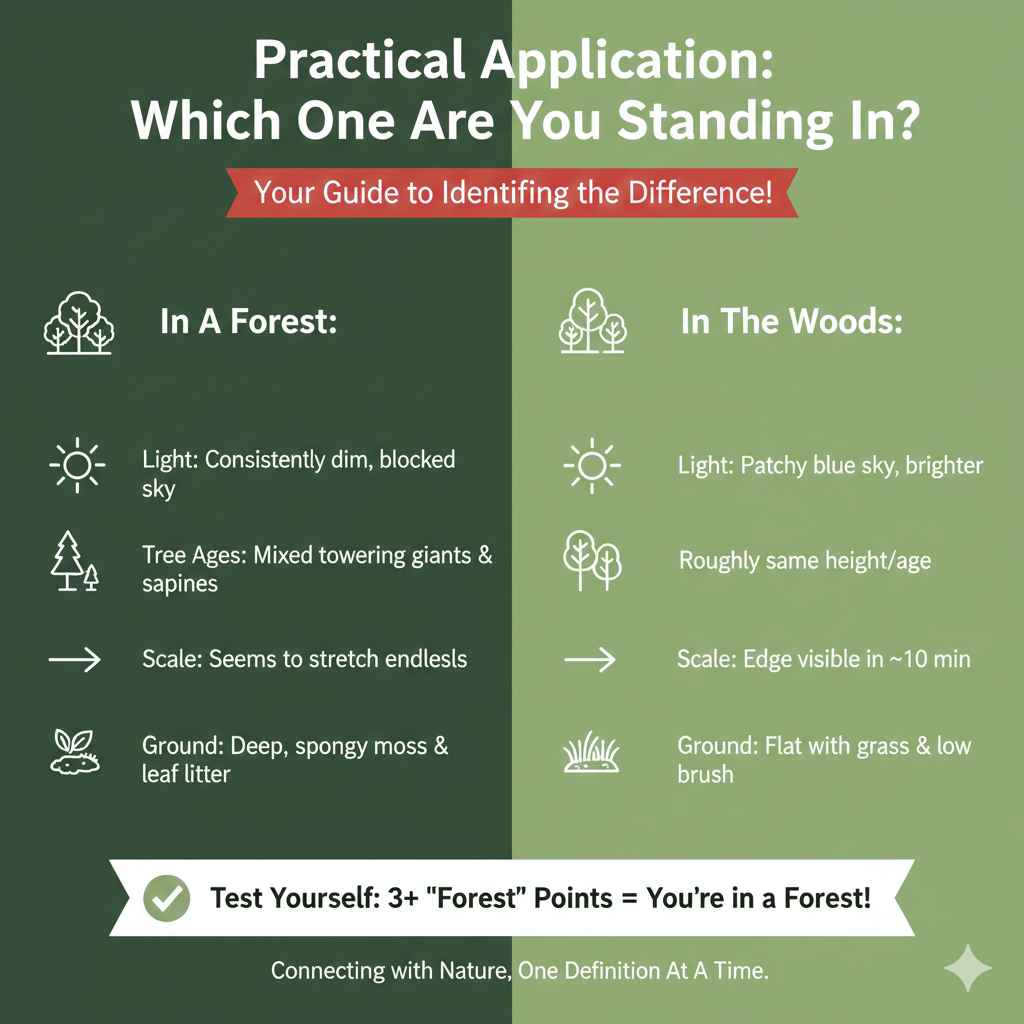
- Check the Light: Can you see clear blue sky patches, or is it consistently dim, even midday? (Dim points toward Forest).
- Look Around You: Are the trees all roughly the same height and age, or are there towering giants alongside tiny saplings? (Mixed ages point toward Forest).
- Gauge the Scale: Can you see an edge clearly within a 10-minute walk, or does the tree cover seem to stretch endlessly in every direction? (Short distance points toward Woods).
- Observe the Ground Cover: Is the ground spongy, covered in deep mosses and decaying leaf litter built up over centuries? Or is it relatively flat with some patches of sunlight supporting low brush? (Deep litter and moss suggest Forest).
If you can answer “yes” to three or more points suggesting large scale, high density, and complex layering, you are almost certainly in a forest. Otherwise, you are enjoying a lovely patch of woods.
Frequently Asked Questions (FAQ) for the DIY Homeowner
Q1: Does the definition of woods or forest change based on geography?
Yes, slightly. In areas where trees are rare, like arid regions, even a small grouping might be called a “woodland.” However, the ecological size/density distinction remains the standard for professional forestry across the US.
Q2: If I clear a few trees in my backyard woods for a shed, am I ruining the ecosystem?
For small-scale removal in your own woods, you are generally fine, provided you follow local ordinances regarding tree removal and runoff. Be mindful of removing too many large trees at once, as that drastically increases sunlight and can harm remaining plants. Small, selective clearing is healthy maintenance.
Q3: Are jungles and rainforests considered forests?
Yes. A rainforest is a specific type of forest characterized by very high annual rainfall. It is definitely a forest because it is large, dense, and possesses the complex, layered structure described above.
Q4: Is there a legal minimum size for something to be considered a “forest” for property tax purposes?
This varies widely by state and county. Many jurisdictions use 10 acres as a threshold for special “Forest Tax” classifications, but you must check your local assessor’s office for the exact number that applies to your area.
Q5: If I only see one type of tree (like only pine trees), can it still be a forest?
Yes. While high biodiversity is common in mature forests, a large, established stand composed mainly of a single species (like a massive pine plantation managed for timber) is still technically a forest due to its size, density, and scale.
Q6: Which environment is generally safer to explore without a map?
The woods. Because woods are smaller and less dense, it is usually easier to locate landmarks or find the edge where you started. Forests require better navigation skills due to the vast, often monotonous tree cover.
Conclusion: Confidence in Knowing Your Trees
Whether you call the trees near your property the “woods” or the “forest,” the important takeaway for us as homeowners and DIY enthusiasts is understanding the scale and complexity involved. Woods are smaller, lighter, and often part of your immediate landscape management. Forests are vast, layered, ecologically intricate, and often managed on a larger conservation scale.
Now that you know the essential differences—size, canopy closure, and structure—you can look at any patch of trees with more confidence. This knowledge isn’t just trivia; it helps you respect the environment, manage your own land wisely, and perhaps, choose the right terminology when talking to neighbors or contractors. Go ahead, step outside, and appreciate the density and diversity you see. You’ve got the essential knowledge down pat!