Faucet Repair Cost: What Homeowners Should Expect
Faucet repair cost usually falls between $100 and $400 for a common residential repair, while a full faucet replacement often costs more because it includes the new fixture, removal, installation, and possible plumbing changes. The exact price depends on the leak, faucet design, access under the sink, local labor rates, and whether hidden damage is found.
A dripping kitchen or bathroom faucet is rarely an emergency, but it should not be ignored for months. A small leak can stain a sink, waste water, damage the cabinet, or point to a valve problem that becomes harder to repair. This guide explains realistic cost ranges, what a plumber is likely to check, which repairs are reasonable for a homeowner, and when replacement is the better value.
What is the average faucet repair cost?
For a straightforward repair, the total commonly includes a service or diagnostic charge, labor time, and one or more replacement parts. A simple tightening, washer, O-ring, or supply-line correction may stay near the lower end of the range. A cartridge faucet, pull-down kitchen faucet, touchless faucet, or hard-to-reach installation can cost more because the part is more specific and the repair takes longer.
A useful way to read a quote is to separate the price into four questions: What is the plumber charging to arrive and diagnose the issue? How much labor is included? Which part is being replaced? Is there any additional work required to access the plumbing? Two quotes can look very different while covering different amounts of work.
- Basic adjustment or connection repair: often the least expensive option when the faucet body and shutoff valves are sound.
- Seal, O-ring, washer, or aerator repair: usually a small-parts job, although corrosion can make removal difficult.
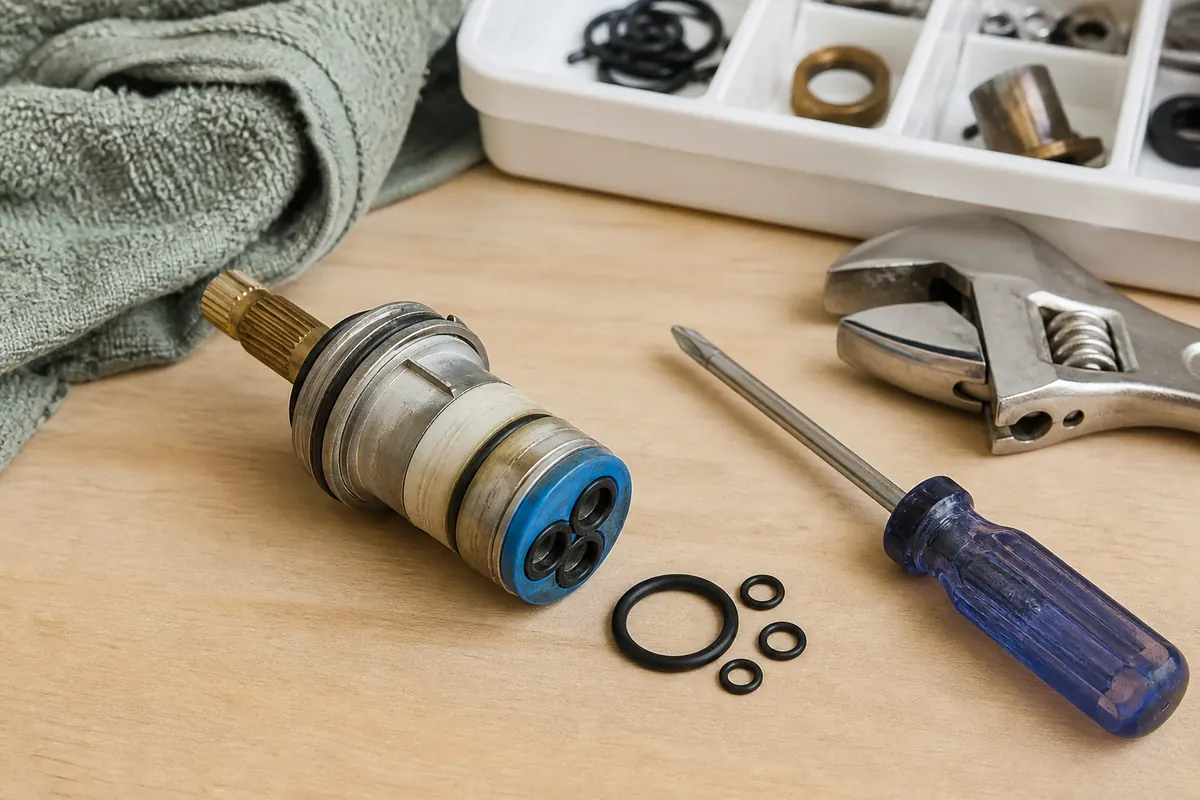
- Cartridge or valve replacement: a common mid-range repair that depends heavily on the faucet brand and model.
- Complete faucet replacement: includes the new fixture and installation, with extra cost if the old fitting is seized or the sink deck needs modification.
What affects the cost of repairing a faucet?
The faucet type is one of the biggest variables. A basic two-handle bathroom faucet is often easier to disassemble than a single-handle ceramic-cartridge model. Kitchen pull-down and pull-out faucets add hoses, counterweights, spray switches, and sometimes a more complicated body. Touchless models may also have sensors, battery packs, control boxes, or wiring that must be checked before the faucet is blamed.
The location of the leak matters too. Water coming from the spout while the handle is closed often points toward an internal cartridge, valve seat, or seal. Water around the handle can indicate a stem seal or O-ring. Water under the sink may come from the supply connection, mounting hardware, spray hose, shutoff valve, or the faucet body itself. A plumber who diagnoses the exact location before replacing parts is less likely to swap an expensive component unnecessarily.
Access can change the labor. A clean, open cabinet with working shutoff valves is faster to service than a crowded cabinet with stored items, a corroded valve, or a faucet installed tightly against a backsplash. If the shutoff valve does not close, the plumber may need to repair that valve before safely removing the faucet. If the countertop or sink deck is damaged, the work may also become partly a mounting or surface repair.
Common faucet problems and their likely repair costs
A faucet is dripping from the spout
A drip from the spout after the handle is closed is often caused by a worn cartridge, valve seat, washer, or seal. The correct repair depends on the design. Replacing a generic washer in an older faucet can be simple, while finding the correct cartridge for a discontinued model may require a model number or a sample part. Do not assume every drip needs a new faucet.
Water is leaking around the handle
A handle leak may come from an O-ring, stem seal, retaining nut, or cartridge. The repair can be modest when the fastener is accessible and the part is available. Mineral buildup or corrosion can complicate removal. Before disassembly, shut off the supply, cover the drain, and take a photo of the handle and retaining pieces so reassembly is easier.
Water is leaking under the sink
Leaks under the sink deserve a careful inspection because the faucet may not be the source. Check the supply-line nuts, shutoff valves, sprayer hose, mounting nut, and the point where the faucet body passes through the sink. Dry everything with a towel, place a bowl below the connections, and run the faucet briefly. Watching the first wet point is more useful than tightening every fitting at once.
The faucet has low flow or a poor spray pattern
Low flow may be caused by a clogged aerator, blocked screen, kinked hose, partially closed shutoff valve, mineral buildup, or a cartridge restriction. Cleaning the aerator is often a sensible first step. If flow is weak only on hot or cold water, the restriction may be isolated to one supply side. If several fixtures have low flow, the problem may be broader than the faucet.
The faucet handle is hard to turn
A stiff handle can result from mineral deposits, a damaged cartridge, a loose or distorted retaining nut, or internal corrosion. Forcing it can break the handle or damage the valve body. A serviceable faucet may need cleaning and a new cartridge; an inexpensive faucet with a corroded body may be more economical to replace.
Repair or replace: which option is cheaper?
Repair is usually the better first choice when the faucet body is in good condition, the model is identifiable, replacement parts are available, and the problem is limited to a seal, cartridge, hose, aerator, or connection. A repair also makes sense when the faucet has a finish or design that matches the room and a replacement would require changes to the sink or countertop.
Replacement becomes more attractive when the body is cracked, the finish is badly corroded, the cartridge is unavailable, the mounting hardware is seized, or several parts are failing at once. It can also be the practical choice for a low-cost faucet that has already needed repeated repairs. Compare the repair quote with the installed cost of a suitable replacement, not just the sticker price of the new faucet.
When choosing a replacement, check the number and spacing of sink holes, the faucet height, spout reach, supply connections, spray-hose arrangement, and clearance behind the sink. A faucet that technically fits may still splash, hit a backsplash, or leave too little room to operate the handle.
DIY faucet repair versus hiring a plumber
A careful homeowner can often clean an aerator, replace a visible hose washer, tighten a loose connection, or install a cartridge when the shutoff valves work and the faucet model is known. The safe approach is to turn off the water, open the faucet to release pressure, protect the drain, keep parts organized, and test slowly after reassembly.
Call a plumber when the shutoff valve will not close, the supply line is damaged, the connection is corroded, the faucet body is leaking, water has entered the cabinet or wall, or you cannot identify the source. Stop work immediately if a fitting begins twisting the pipe inside the wall. A small repair can become a much larger leak when a concealed connection is damaged.
How to inspect a faucet before requesting a quote
- Dry the faucet, handles, supply lines, and cabinet floor completely.
- Run cold water, then hot water, and observe the first place that becomes wet.
- Check whether the leak occurs only while the faucet is running or also when it is closed.
- Photograph the faucet, handle, underside, brand mark, and any model number.
- Clear the cabinet so the plumber can reach the shutoff valves and mounting hardware.
- Ask whether the quote includes diagnosis, labor, parts, removal, disposal, and follow-up testing.
Ways to keep faucet repair costs under control
The most useful preparation is accurate information. A photo of the faucet and a clear description of when it leaks can help a plumber bring the right cartridge or seal. Keep the model paperwork if you have it, and do not discard an old part until the replacement has been confirmed. For older fixtures, ask whether the part is still supported before paying for a long diagnostic visit.
Get an itemized estimate when the repair is not urgent. Confirm whether the service-call charge is credited toward labor, whether there is a minimum labor period, and whether the quote changes if the shutoff valve also needs repair. Avoid choosing a quote based only on the lowest number; a clear scope is more valuable than a vague promise.
When is a faucet leak an emergency?
A slow drip from the spout is usually a maintenance issue. A pressurized leak under the sink, a supply line that sprays, water entering a cabinet wall, a sudden loss of shutoff control, or water near electrical equipment needs immediate attention. Close the nearest working shutoff valve. If it will not close, use the home’s main water shutoff and call a qualified plumber.
Frequently asked questions
Is it cheaper to repair or replace a faucet?
Repair is usually cheaper when the faucet body is sound and the failed part is available. Replacement can be better value when the fixture is corroded, discontinued, repeatedly failing, or so inexpensive that labor would approach the installed price of a new unit.
How much does a plumber charge to fix a leaking faucet?
The total depends on the service call, local labor rate, repair time, and parts. Many homeowners should plan for a low-hundreds starting point, with a higher total for cartridge work, difficult access, failed shutoff valves, or full replacement. Request an itemized quote before work begins.
Can I replace a faucet cartridge myself?
Often, yes, if the water can be shut off safely and the faucet model is known. Take photos during disassembly, protect the drain, and never force a seized cartridge. If the valve body moves, the shutoff fails, or corrosion is severe, stop and call a plumber.
How long does a faucet repair take?
A straightforward repair may take less than an hour, while a difficult cartridge, corroded connection, unavailable part, or replacement can take longer. The time estimate is more reliable after the faucet type and leak location have been identified.
Conclusion
Faucet repair cost is driven less by the drip itself than by the failed component, fixture design, access, and condition of the surrounding plumbing. Start by locating the first wet point, identify the faucet model, and confirm that the shutoff valves work. Repair a sound faucet when the part is available; replace it when corrosion, repeated failures, or unavailable parts make repair poor value. A clear, itemized quote helps you choose the safest and most economical next step.
Sponsored / affiliate links. As an Amazon Associate I earn from qualifying purchases. I may earn additional commission from eligible campaigns.
 BRING IT ON! CLEANER Professional Hard Water Stain Remover & Glass Shield Sealant, Tiles, grout, Windows, Fiberglass, Chrome, Tubs, Toilets
 Water Flow Control Shut Off Valve with Brass Adjustable Hand Level Water Pressure Regulator for Hand Held Shower Head & Bidet Sprayer, Brushed Nickel Water Saver G1/2