Bathroom Fan Energy Use: What Affects the Electricity Cost
A bathroom fan’s electricity cost is usually small: a 20–60 watt fan run about 15 minutes a day often costs around $1–$4 per year at typical U.S. electricity rates, though long runtimes and higher resistance can increase it. If you ignore runtime and ducting, the fan can run far longer than needed, waste energy, and move moisture poorly. This guide shows how to estimate cost, spot the biggest drivers, and cut usage without trapping humidity.
Fan cost worksheet
The table below uses the standard cost formula: watts × hours used ÷ 1000. Use three steps: convert watts to kilowatts, multiply by the hours of use, then multiply by your rate. It compares common fan-only wattages with two controls added, then shows what happens at three usage patterns and three electricity rates. The numbers are rounded to the nearest cent for monthly cost and the nearest cent for annual cost.
| Scenario | Note | $0.12/kWh | $0.16/kWh | $0.24/kWh |
|---|---|---|---|---|
| 20W fan-only | Small standard fan for a powder room or compact bath. | 20 min/day: $0.02/mo, $0.29/yr 1 hr/day: $0.07/mo, $0.88/yr 24/7: $1.73/mo, $20.74/yr |
20 min/day: $0.03/mo, $0.39/yr 1 hr/day: $0.10/mo, $1.17/yr 24/7: $2.30/mo, $27.65/yr |
20 min/day: $0.05/mo, $0.58/yr 1 hr/day: $0.14/mo, $1.75/yr 24/7: $3.46/mo, $41.47/yr |
| 30W fan-only | Common standard fan size for a typical single-bath home. | 20 min/day: $0.04/mo, $0.44/yr 1 hr/day: $0.11/mo, $1.31/yr 24/7: $2.59/mo, $31.10/yr |
20 min/day: $0.05/mo, $0.58/yr 1 hr/day: $0.14/mo, $1.75/yr 24/7: $3.46/mo, $41.47/yr |
20 min/day: $0.07/mo, $0.88/yr 1 hr/day: $0.22/mo, $2.63/yr 24/7: $5.18/mo, $62.21/yr |
| 50W fan-only | Upper end of a standard fan or a larger, higher-airflow unit. | 20 min/day: $0.06/mo, $0.73/yr 1 hr/day: $0.18/mo, $2.19/yr 24/7: $4.32/mo, $51.84/yr |
20 min/day: $0.08/mo, $0.97/yr 1 hr/day: $0.24/mo, $2.92/yr 24/7: $5.76/mo, $69.12/yr |
20 min/day: $0.12/mo, $1.46/yr 1 hr/day: $0.36/mo, $4.38/yr 24/7: $8.64/mo, $103.68/yr |
| 80W fan-only | Heavier-duty fan or a unit with more airflow than a basic bath fan. | 20 min/day: $0.10/mo, $1.17/yr 1 hr/day: $0.29/mo, $3.50/yr 24/7: $6.91/mo, $82.94/yr |
20 min/day: $0.13/mo, $1.56/yr 1 hr/day: $0.38/mo, $4.67/yr 24/7: $9.22/mo, $110.59/yr |
20 min/day: $0.19/mo, $2.34/yr 1 hr/day: $0.58/mo, $7.01/yr 24/7: $13.82/mo, $165.89/yr |
| 30W fan with timer | Fan set to shut off after a fixed run time, often 20 minutes after shower use. | 20 min/day: $0.04/mo, $0.44/yr 1 hr/day: $0.11/mo, $1.31/yr 24/7: $2.59/mo, $31.10/yr |
20 min/day: $0.05/mo, $0.58/yr 1 hr/day: $0.14/mo, $1.75/yr 24/7: $3.46/mo, $41.47/yr |
20 min/day: $0.07/mo, $0.88/yr 1 hr/day: $0.22/mo, $2.63/yr 24/7: $5.18/mo, $62.21/yr |
| 30W fan with humidity sensor | Automatic shutoff when humidity falls, useful for variable shower routines. | 20 min/day: $0.04/mo, $0.44/yr 1 hr/day: $0.11/mo, $1.31/yr 24/7: $2.59/mo, $31.10/yr |
20 min/day: $0.05/mo, $0.58/yr 1 hr/day: $0.14/mo, $1.75/yr 24/7: $3.46/mo, $41.47/yr |
20 min/day: $0.07/mo, $0.88/yr 1 hr/day: $0.22/mo, $2.63/yr 24/7: $5.18/mo, $62.21/yr |
If you want a fast check, start with your fan’s wattage, then pick the runtime that matches your bathroom. A 30-watt fan running one hour daily for a year costs about $1.64 at one common rate example, which is why long runtimes usually matter more than tiny wattage differences.
How much electricity does a bathroom fan use per hour?
A standard bathroom fan usually uses 10 to 50 watts, so its hourly electricity use is very low. Fan/light and fan/heater units draw much more. The correct unit for cost is kilowatt-hours, not “watts per hour,” because the bill is based on power used over time.
Typical wattage ranges
Standard bathroom fans typically consume 10 to 50 watts. Energy Star efficient fans can use as little as 10 to 30 watts. That range covers many fan-only models used in homes where the fan runs after showers rather than all day.
Why combination units change the picture
Fan plus light or heater units can consume 60 to 1200+ watts. The light adds some load, but the heater dominates. A heater-equipped unit can cost far more to run than a plain exhaust fan if the heating function is used often.
Why “watts per hour” is the wrong shorthand
The bill does not track watts alone. It tracks energy, which is watts times hours used divided by 1000. That is why a 30-watt fan left on all day costs much more than the same fan used only after a shower.
How do you calculate bathroom fan cost?
Use three steps: convert watts to kilowatts, multiply by the hours of use, then multiply by your electricity rate. This gives a realistic estimate that reflects both your fan model and your local utility price. The same fan can be cheap in one region and noticeably pricier in another.
Step 1: convert watts to kilowatts
Take the fan’s wattage and divide by 1000. A 30-watt fan becomes 0.03 kilowatts. A 50-watt fan becomes 0.05 kilowatts.
Step 2: multiply by hours of use
If a 30-watt fan runs 1 hour per day, it uses 0.03 kWh per day. If it runs 20 minutes per day, use 0.333 hours, which is about 0.01 kWh per day.
Step 3: multiply by your electricity rate
Multiply the kWh by the rate on your bill. Residential rates vary by region, and $0.12 to $0.16 per kWh is a common range in cost examples. Higher rates raise the monthly total in a straight line.
A quick example using one shower cycle
Suppose your 30-watt fan runs 20 minutes after one shower each day and your rate is $0.16 per kWh. The daily cost is about half a cent, and the monthly cost stays well under a dollar. The fan is not the problem if it runs only as long as needed.
- Check the fan’s wattage label or product sheet.
- Estimate how long it runs each day in your home.
- Convert minutes to hours.
- Use watts × hours ÷ 1000 to find kWh.
- Multiply by your utility rate from the bill.
What affects bathroom fan electricity cost most?
Runtime is often the biggest cost lever. Wattage matters, but a fan that runs twice as long often costs twice as much. After runtime, the next biggest drivers are your electricity rate, the fan’s efficiency, and how hard the duct system makes the fan work.
Runtime usually matters more than wattage
Minutes after a shower versus all-night operation can change the bill by a large factor. Leaving a fan on 24/7 turns a low-watt appliance into a steady monthly cost. Timers and sensors help most when the real problem is forgotten shutoff.
Motor efficiency and CFM per watt
Newer DC or ECM motors are usually more efficient than basic AC motors. Efficiency is often shown as CFM per watt, which helps compare how much airflow you get for each watt used. ENERGY STAR bathroom fans must meet efficiency requirements by CFM and wattage.
Electricity rate by region
The same 30-watt fan can cost much more in a high-rate area than in a low-rate area. That is why local utility price matters. A fan that seems trivial at $0.12 per kWh becomes less trivial at $0.24 per kWh, especially with long runtimes.
Duct length, bends, and static pressure
Long ducts and tight turns increase resistance. Higher static pressure can reduce real airflow, which may make the fan run longer to clear moisture. That does not change the fan’s wattage directly, but it raises indirect cost by extending runtime and keeping humidity in the room longer.
Picture a fan sized for a medium bath but vented through a long duct with two tight elbows. The fan may need more time to clear steam than the wattage label suggests. In that case, the hidden cost is extra minutes, not just extra watts.
Do bathroom fans with heaters cost much more?
Yes. Heater-equipped units cost much more to run when the heater is on, because the heater wattage overwhelms the fan wattage. Fan-only and fan/light units usually stay in low-cost territory, while a fan/heater can move into a completely different operating-cost bracket.
Why heater wattage dominates the bill
Fan plus heater units can jump to about 1200–1500 watts when heating. At that point, cost is driven mostly by the heater element, not the exhaust fan. Even short heating cycles can cost more than many days of plain fan use.
Fan-only versus fan/light versus fan/heater
A fan-only unit is usually the cheapest to run. Add a light and the draw rises. Add a heater and the load can rise dramatically. That is why two bathroom fans with similar housings can have very different electricity costs.
When a heater is worth the extra operating cost
A heater makes sense when you want quick warmth in a small bath and you will use it intentionally. It is less sensible if it runs by habit or stays on too long. The heater should be a targeted comfort feature, not a default background load.
How do timers and humidity sensors change cost?
Timers and humidity sensors reduce wasted runtime. A timer works best for predictable shower routines, while a humidity sensor fits variable moisture levels and users who forget to turn the fan off. Both can cut cost by trimming unnecessary minutes, which is where most savings come from.
Timer switches for fixed shower routines
A timer switch limits post-shower runtime to a set window, such as 20 or 30 minutes. That is useful when the shower schedule is predictable and the room clears on a regular timeline. It prevents the common error of leaving the fan running for hours by mistake.
Humidity sensors for variable conditions
A humidity sensor turns the fan on automatically when moisture rises and off when humidity drops. That helps in bathrooms with uneven use, steamy showers, or people who do not want to manage the switch every time. It is often the better fit when runtime varies widely.
When automatic control saves the most hours
Automatic control saves the most when the current habit is poor, such as a fan left on all night or after every shower “just in case.” If your fan already runs only as long as needed, the savings are smaller. Controls cannot save much if there is little waste to remove.
When a simple timer is enough
For a routine bath used the same way every day, a timer is often enough. It is simpler than a humidity sensor and still stops the most common waste: forgetting to turn the fan off. A humidity sensor becomes more useful when moisture levels vary or several people use the room differently.
What should you look for when buying a low-cost fan?
Start with airflow efficiency, not just wattage. A fan that moves air effectively can finish the job faster and with fewer wasted minutes. The best low-cost choice is usually one that matches the room size, uses an efficient motor, and avoids unnecessary features you will not use.
ENERGY STAR airflow efficiency
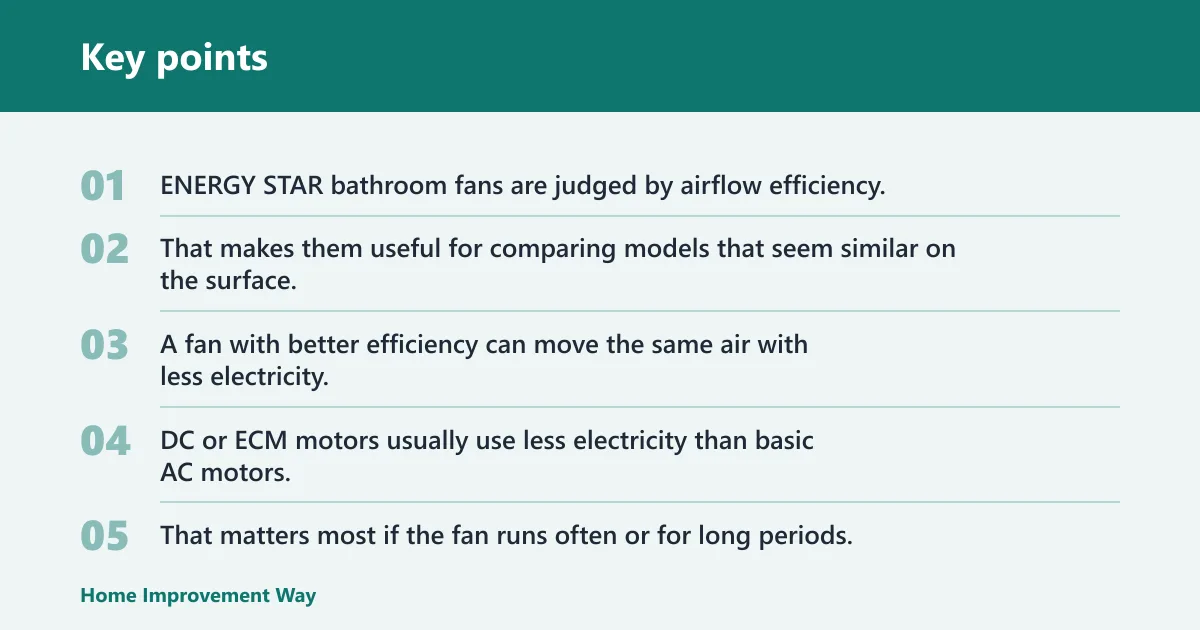
ENERGY STAR bathroom fans are judged by airflow efficiency, measured through CFM and wattage requirements. That makes them useful for comparing models that seem similar on the surface. A fan with better efficiency can move the same air with less electricity.
DC or ECM motors versus basic AC motors
DC or ECM motors usually use less electricity than basic AC motors. That matters most if the fan runs often or for long periods. Over time, a more efficient motor can lower operating cost without changing how you use the bathroom.
Match fan size to the bathroom
An undersized fan may run too long and leave moisture behind. An oversized fan may cost more up front and still not save much if the ducting is poor. Matching the fan to the bathroom helps avoid unnecessary runtime, which is usually the real cost issue.
Common failure cases
Low cost is not only about the fan itself. Bad ducting, long runs, tight bends, or a bathroom with frequent heavy steam can all make the fan work longer. In humid climates, continuous or near-continuous ventilation may be justified, but that should be a deliberate choice rather than wasted runtime.
A common first-timer mistake is buying a bigger fan because the room stays damp, then leaving the duct run unchanged. If the resistance stays high, the fan can still take too long to clear moisture. Better ducting or a timed control often solves more than size alone.
Frequently asked questions
How much does it cost to run a bathroom fan for 8 hours?
An 8-hour run can still be cheap for a fan-only unit, but the total depends on wattage and your rate. At 30 watts and $0.16 per kWh, 8 hours costs about 3.8 cents. At 80 watts, the same 8 hours costs about 10.2 cents.
Does a bathroom fan use a lot of electricity if left on all day?
Yes, compared with normal shower ventilation. A 30-watt fan left on 24/7 can cost several dollars a month, and a higher-rate utility area raises that more. The issue is not standby loss. It is the continuous runtime.
What wattage does a bathroom exhaust fan usually use?
Standard bathroom fans typically consume 10 to 50 watts. Energy Star efficient fans can use as little as 10 to 30 watts. Fan plus light or heater units can consume 60 to 1200+ watts, so the feature set matters as much as the fan label.
Do bathroom fans with heaters cost much more to run?
Yes. When the heater is on, a fan/heater unit can draw about 1200–1500 watts, which is far above a standard exhaust fan. That means even short heating cycles can cost much more than many hours of fan-only operation.
How do humidity sensors or timer switches affect bathroom fan cost?
They reduce wasted runtime, which is usually the biggest savings opportunity. Timers work well for predictable shower routines. Humidity sensors work better when moisture levels vary or when people forget to shut the fan off. Both can cut costs without sacrificing ventilation.
Sponsored / affiliate links. As an Amazon Associate I earn from qualifying purchases. I may earn additional commission from eligible campaigns.
 Lichamp Clear Duct Tapes Heavy Duty, Waterproof No Residue Clear Duct Tape for Packaging Taping Sealing Repairing Tying, Thick & Wide Tape for DIY or Commercial Use, 2 inches x 25 Yards
 YUCHENGTECH Ionizing Air Blower Static Eliminator Fan Desktop Ionizer Air Blower with Detachable Cord ESD Ionizer Electrostatic Discharge Fan 110V