Bathroom Ventilation Fans
Choose a bathroom ventilation fan sized to the room, then add capacity for high ceilings, longer duct runs, or frequent shower use. I have seen undersized fans leave mirrors fogged, paint peeling, mold starting at corners, and a room staying damp for hours after a shower. This guide covers sizing, sones, controls, duct limits, and the best replacement choices for common bathroom layouts.
What bathroom ventilation fans actually do


How an exhaust fan moves air to the exterior
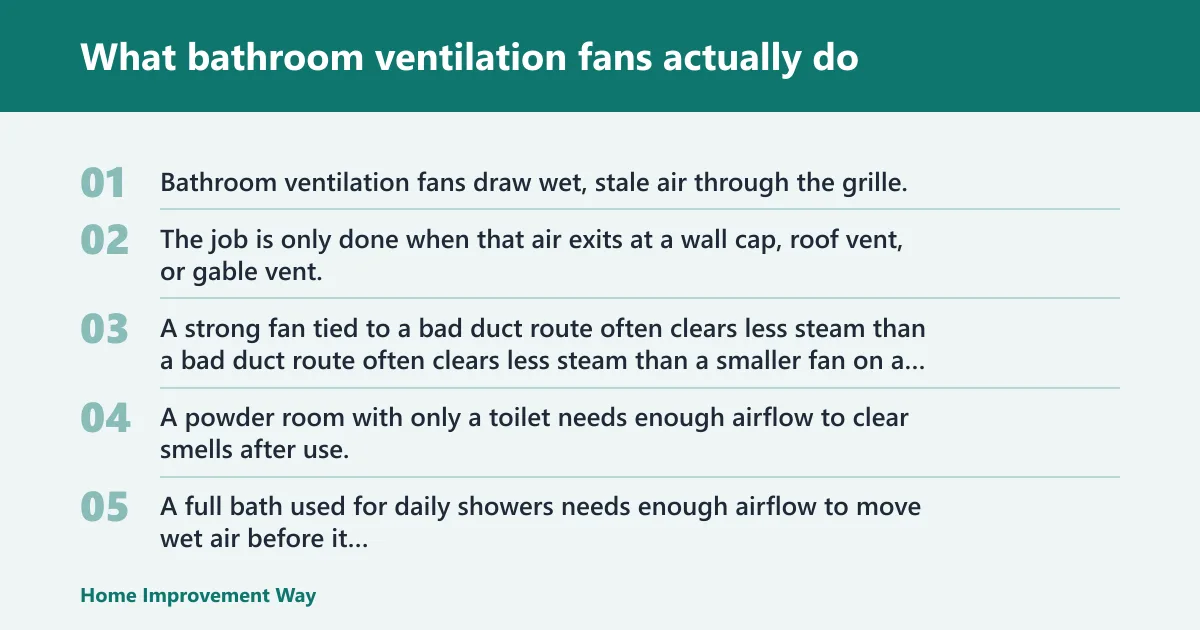
Bathroom ventilation fans draw wet, stale air through the grille, spin it through the housing, and send it into a duct that needs to end outdoors. The job is only done when that air exits at a wall cap, roof vent, or gable vent.
I see that last part missed all the time. A strong fan tied to a bad duct route often clears less steam than a smaller fan on a short, straight run.
Moisture control versus odor control
Odor removal is easy. Moisture removal is harder.
A powder room with only a toilet needs enough airflow to clear smells after use. A full bath used for daily showers needs enough airflow to move wet air before it condenses on mirrors, paint, trim, and framing. That is why two rooms with the same floor area can need different fan sizes.
Why installed performance matters more than the box label
CFM tells you how much air the fan is rated to move in cubic feet per minute. It is the right place to start, but I never trust the label alone, because small ducts, long runs, crushed flex duct, and too many elbows cut the airflow that actually reaches the outside.
Common failure points are simple: a 110 CFM fan reduced to a 3-inch duct, a six-bend attic run, or a termination buried in a soffit cavity. The motor may be fine, while the room still stays damp.
Is a vent fan required in a bathroom?
Usually, a bathroom fan is required when the room lacks an operable window, but local code decides the exact rule. Some jurisdictions allow a window in place of mechanical ventilation, while others still require a fan. Check local code before replacing a light-only fixture or removing an existing fan.
When local code requires mechanical ventilation
In many places, a bathroom without an operable window needs mechanical exhaust, depending on local code. Newer work is often held to tighter rules than older existing bathrooms. If a permit is involved, inspectors usually want the exhaust to terminate outdoors and the electrical work to match current requirements.
When a window may or may not satisfy the requirement
A window can satisfy ventilation rules in some places, but that does not mean it works well in daily use. Cold weather, privacy, security, and household habits all cut how often that window actually gets opened.
For selection purposes, a shower bath should usually get a fan even if a window exists. Real moisture control beats code minimums.
What to check before replacing or adding a fan
- Confirm whether the room has an operable window and whether local code accepts it.
- Check if the current wiring has a separate switched hot for fan, light, or heater.
- Measure the existing ceiling opening and housing depth.
- Find the duct size at the fan collar: 3-inch, 4-inch, or 6-inch.
- Trace where the duct actually terminates.
Do all bathroom fans need to be vented outside?
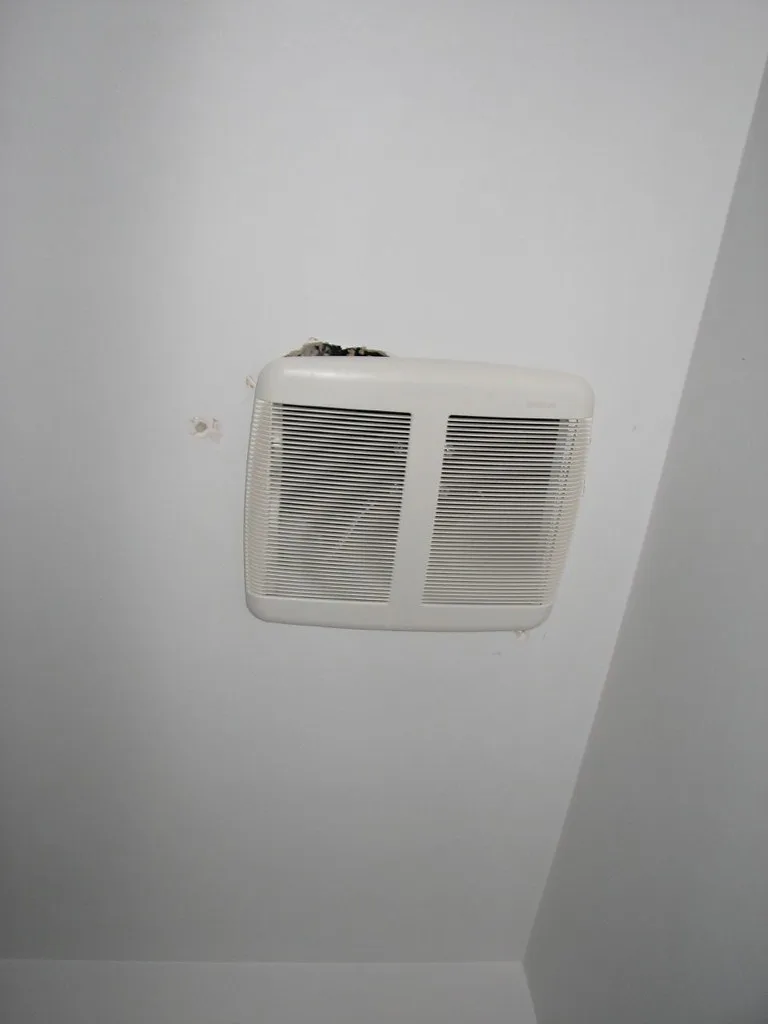
Yes. Bathroom exhaust should terminate outdoors, not into an attic, crawlspace, soffit cavity, wall cavity, or other concealed space. Dumping wet air indoors causes condensation, mold risk, and wood damage. Acceptable termination points are a wall cap, roof vent, or gable vent with a proper exterior damper.
Why indoor dumping causes moisture damage
Warm, wet air from a shower cools fast when it hits attic framing or cold sheathing. That leads to condensation. Over time, the result can be stained insulation, damp rafters, rusty fasteners, and mildew smells that seem to come from nowhere.
Soffit terminations can be bad too. Exhaust often gets pulled right back into the attic through the vented soffit nearby.
Acceptable termination points
- Wall cap: often the best option for short sidewall runs.
- Roof vent: common when the bath sits far from an exterior wall.
- Gable vent connection: sometimes workable if detailed correctly and allowed locally.
The best route is usually a short duct with as few bends as possible, ending at a real exterior cap with a working damper.
How to spot a bad existing vent setup
Warning signs include a loose duct ending in the attic, wet insulation below the run, a fan that blows but does not clear steam, dripping from the grille in winter, or a bathroom that still smells musty hours after a shower.
What size bathroom fan do I need for my room?
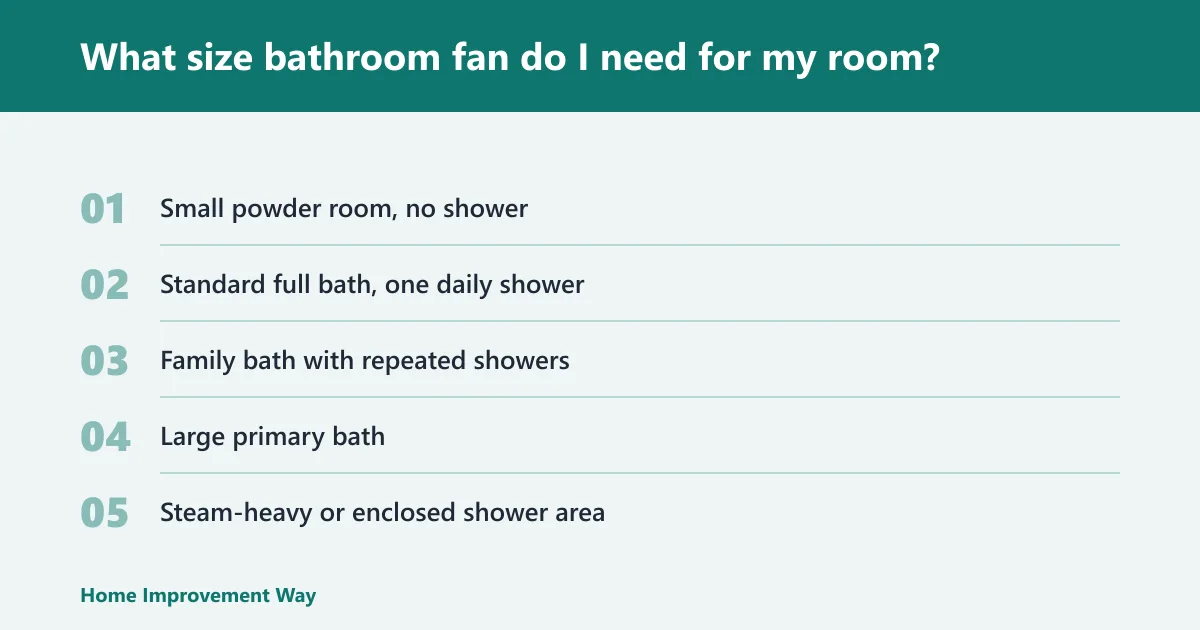
Start with about 1 CFM per square foot for a typical 8-foot ceiling, then increase for tall ceilings, daily showers, steam-heavy use, or long duct runs. Small powder rooms often land around 50 CFM, while large primary baths and steam-heavy spaces may need 110 to 150 CFM or more.
Use room dimensions and ceiling height, not floor area alone
The simple rule is a good base: length times width equals square feet, which often equals minimum CFM for an 8-foot ceiling. A small 5-by-8 bath is about 40 square feet, so a fan around the 50 CFM range is a practical minimum.
Tall ceilings change the room volume. A 6-by-10 bath with a 10-foot ceiling holds much more air than the same floor area with an 8-foot ceiling. In real selection, that room should move up a size.
Real sizing thresholds that work in houses
- Small powder room, no shower: 50 CFM is usually enough.
- Standard full bath, one daily shower: 70 to 80 CFM fits many rooms.
- Family bath with repeated showers: 80 to 110 CFM is safer.
- Large primary bath: 110 to 150 CFM is common, depending on volume and duct path.
- Steam-heavy or enclosed shower area: often 150 CFM or more, with careful duct design.
How shower frequency and moisture load change the target
A guest bath used twice a week does not need the same setup as a family bath handling back-to-back showers every school morning. The more often the room is used, the less margin there is for a barely adequate fan.
Daily shower rooms should usually be sized above the minimum, especially in cold climates and in bathrooms with little natural drying.
When more CFM helps and when it backfires
Extra airflow helps when the room has a long duct run, high ceiling, or heavy shower use. It can also help in basement baths where drying is slower. But oversized fans can create more noise, use a larger duct than the house can easily provide, and pull conditioned air out faster than needed.
If the fan is so loud that people avoid using it, the extra CFM solves nothing.
Bathroom fan decision matrix
How to use this matrix
Match the room to its real moisture load first, then adjust for ceiling height, duct run, and noise tolerance. The fan type, control, and minimum CFM range below assume outdoor venting. If the duct is long or bend-heavy, choose the higher end of the range and avoid undersized ducting.
| Room type | Shower frequency | Ceiling height | Duct run | Noise tolerance | Recommended fan type | Control | Minimum CFM range |
|---|---|---|---|---|---|---|---|
| Powder room | None | 8 to 9 ft | Short, straight | Medium | Basic ceiling-mount | Standard switch or timer | 50 |
| Guest full bath | Light | 8 ft | Short to medium | Medium | Ceiling-mount with 4-inch duct | Timer | 70 to 80 |
| Family bath | Daily, repeated | 8 to 9 ft | Medium with 1 to 2 elbows | Low | Quiet ceiling-mount | Timer or humidity switch | 80 to 110 |
| Large primary bath | Daily | 9 to 10 ft | Medium to long | Very low | Quiet high-CFM unit, often 6-inch duct | Humidity switch plus manual override | 110 to 150 |
| Basement bath | Daily | 8 ft | Long horizontal run | Medium | Higher-pressure ceiling-mount | Timer | 90 to 120 |
| Steam-heavy shower bath | Heavy | 9 ft or more | Short preferred | Low | High-capacity unit near shower zone if allowed | Timer plus humidity control | 150 or more |
| Mobile-home replacement | Varies | Low to standard | Short, tight cavity limits | Medium | Listed retrofit unit sized to cavity | Standard switch or timer | 50 to 80 |
Practical reading of the matrix
The same 80 CFM fan can be right in one house and weak in another. A short 4-inch wall run may let it perform well. A long, kinked flex run through a cold attic may leave the room wet after every shower.
That is why the vent path often matters as much as the fan label.
Should I choose a quiet bathroom fan?
Yes, in most main bathrooms a quiet fan is worth choosing because people actually use it. Sones are a way to describe perceived sound, and lower numbers are quieter. For a primary bath or night use, aim for a low-noise fan, ideally around 1.5 sones or less. Guest and powder rooms can tolerate higher sound if the room is lightly used.
How sones work in daily use
Sones are the standard noise rating for bathroom fans. Around 1.0 to 1.5 sones feels fairly quiet in a finished bath. Around 2.0 sones is still reasonable for many homes. Once numbers climb much higher, the fan becomes something occupants may rush to switch off.
Good noise targets by room type
- Primary bath: about 0.8 to 1.5 sones.
- Shared family bath: about 1.0 to 2.0 sones.
- Guest bath or powder room: about 2.0 to 3.0 sones can be acceptable.
Why a quiet fan can still sound loud after a poor install
Loose housing mounts, thin ceiling material, tight reducers, and hard elbows right off the fan all add noise. So does airflow turbulence from using a 3-inch duct on a fan designed around a larger connection.
A quiet label helps, but installation details finish the job.
Which mounting and ducting setup works best?
Ceiling-mount fans fit most bathrooms, wall-mount units help when ceiling venting is difficult, and window-mount fans are a niche option where allowed and practical. The best setup uses the shortest, straightest duct possible, matched to the fan’s collar size, with termination at an exterior cap.
Ceiling mount, wall mount, and window mount compared
Ceiling mount is the default because it catches rising humid air well and works with attic or joist-bay routing. Wall mount makes sense where an exterior wall is close and attic access is poor. Window mount is less common and should only be considered where product listing, window type, and local code all line up.
Choosing between 3-inch, 4-inch, and 6-inch ducts
Three-inch ducting is often found on older or very small fans. It chokes airflow fast in real installations. Four-inch ducting is a common choice for many standard bath fans and works well when the run is fairly short. Six-inch ducting is better suited to higher-capacity or quieter fans that need more air volume with less restriction.
If the existing fan uses a 3-inch duct and the replacement is rated for 4-inch, treat that as a real decision point. Adapting down may erase much of the upgrade.
Why short, straight runs perform better
Every foot of duct adds resistance. Every elbow adds more. Flex duct sags hold condensation and add drag, while smooth metal duct generally performs better on longer runs.
For replacement work, I often find it makes more sense to choose a fan around the actual vent path than to buy a high-CFM model and force it onto a poor duct route.
Replacement fit issues
Before buying, measure the housing width, length, and depth, plus the ceiling cutout. Check whether the new fan can be installed from below or needs attic access. Also verify the duct collar size and the location of the electrical compartment.
Service access matters too. A fan buried behind framing details or tight above a shower ceiling is harder to clean and replace later.
When is a humidity-sensor fan worth it?
A humidity-sensor fan is worth it when users forget to turn the fan on or off, when showers happen daily, or when moisture lingers long after bathing. In lightly used guest baths, a timer is often the better value because it is cheaper, simpler, and easier to predict.
Control types compared
- Standard switch: simple, cheap, depends on user habits.
- Timer switch: strong all-around choice for most homes.
- Humidity switch or built-in sensor: useful in shower-heavy baths.
- Motion or occupancy control: convenient in powder rooms or rentals, less ideal for moisture control alone.
Best control choices by household pattern
For kids and forgetful users, a timer solves a lot. It runs long enough after the shower without relying on memory. For rentals or guest baths, an occupancy feature can help with odors, but it should not replace post-shower run time in a full bath.
For daily-use primary baths, humidity sensing makes sense when conditions vary and the fan needs to keep running until the room dries.
Integrated lights, heaters, and night lights
Combo units save ceiling space, but they can complicate wiring and servicing. A fan-light-heater may need additional circuits or switch legs, and heater models often need careful electrical review. Decorative grilles and night lights are fine add-ons if the fan still fits the duct and housing constraints first.
What causes bathroom fan problems after installation?
Most post-installation problems come from bad duct design, poor termination, or the wrong control choice rather than a failed motor. Long runs, too many elbows, undersized ducts, and attic dumping cut airflow. Condensation, dripping grilles, and constant musty smells usually point to vent path issues first.
Weak airflow and false high-CFM expectations
A fan can be rated at 110 CFM and still feel weak if it is tied to a long 3-inch duct or a run packed with elbows. This is common in replacements where the old duct is reused without checking size or condition.
Condensation, dripping ducts, and backdraft issues
Cold attic runs can sweat if they are poorly insulated or if airflow is too weak to clear moisture quickly. A proper exterior damper helps block backdrafts. So does making sure the termination cap is not stuck closed with lint, paint, or insect screening that is too fine.
Dust buildup, cleaning access, and service life
The grille and blower housing collect dust. That slows airflow and adds noise. A bathroom fan should be easy to open, vacuum, and wipe down. If the replacement unit uses odd housing dimensions or hides fasteners in awkward spots, future maintenance gets skipped.
That matters more than it seems. A clean average fan often outperforms a dirty premium fan.
Frequently asked questions
Do bathroom fans vent outside?
They should. A bathroom exhaust fan is meant to move humid air outdoors through a duct and exterior cap. If it ends in an attic, crawlspace, soffit cavity, or wall cavity, moisture stays in the house and can lead to condensation, mold growth, and damaged materials.
How do bathroom exhaust fans work?
Bathroom exhaust fans pull air in through the grille, move it with a motorized blower through the housing, and send it through a duct to an exterior termination point. Good performance depends on the whole path: fan, duct size, duct length, bends, and the outside cap.
How much bathroom exhaust fans do I need?
For most standard bathrooms, start at about 1 CFM per square foot of floor area, with 50 CFM as a practical minimum for small rooms. Increase the target for ceilings above 8 feet, long duct runs, repeated daily showers, basement baths, or steam-heavy use.
What are bathroom vent fans for?
Bathroom vent fans remove humid air, odors, and stale air. In buying terms, the main job is moisture control, because that is what prevents mirror fog, slow drying, mildew, peeling paint, and condensation damage. Odor removal matters too, but it usually needs less airflow than shower moisture.
Is it illegal to not have a fan in a bathroom?
Sometimes, depending on local code and whether the bathroom has an operable window. Many places require mechanical ventilation when no code-accepted window is present. Some allow a window instead of a fan. Legal requirements vary, so local code or the building department should be checked for the exact rule.
Should I choose a quiet bathroom fan?
Yes, especially for a primary bath or any bathroom used at night. Lower sone ratings mean less perceived noise, and quieter fans are more likely to be used long enough to clear moisture. Aim around 1.5 sones or less for main baths, with higher numbers acceptable in powder rooms.
Sponsored / affiliate links. As an Amazon Associate I earn from qualifying purchases. I may earn additional commission from eligible campaigns.