
Window Bathroom Fan vs Ceiling Fan: Pros and Cons
For most bathrooms, a ceiling fan is the better choice because it removes shower moisture at the source; use a bathroom fan mainly when ducting a ceiling fan is impractical. If damp air stays after showers, you increase the chance of peeling paint, mold growth, and condensation on mirrors, trim, and cold walls. This comparison covers moisture control, code and ducting fit, noise, comfort, and when a bathroom fan makes sense in an existing bath.
| Decision factor | bathroom fan | ceiling fan | Winner |
|---|---|---|---|
| Moisture removal | Depends on open window area, wind, temperature difference, and whether air can cross the room | Mechanical exhaust moves a set amount of air through ducting | ceiling fan |
| Code flexibility | May satisfy the ventilation exception if it opens to the outside and meets local minimum openable-area rules | Usually accepted as mechanical ventilation when sized and vented correctly | tie |
| Noise and comfort | Can be quiet if the outside is calm, but traffic, wind, and street noise come in with the air | Motor noise is predictable; no open window means better privacy and winter comfort | ceiling fan |
| Installation and cost | Lower cost if an operable window already exists; portable window fans are temporary, not built-in ventilation | Higher installation cost when ducting, wiring, and termination are needed | bathroom fan |
| Best fit for daily shower use | Weak if the window is small, hard to open, or cannot stay open in bad weather | Strong, because it can run after every shower and exhaust humid air directly outdoors | ceiling fan |
What each option actually does
A bathroom window ventilates by opening the room to outdoor air. A ceiling fan ventilates by pulling humid indoor air through a duct and sending it outside. That difference matters more than the price tag, because shower steam, condensation dry-out time, and mold risk depend on how reliably moisture leaves the room.
Bathroom window ventilation
An open window can clear humidity well when outside conditions help and air can move through the room. It works best in a bath with a usable opening, some cross-breeze potential, and enough privacy to leave it open when needed.
Its limits show up fast after showers. If the outdoor air is still, damp, very cold, or the window is too small to move enough air, moisture can linger on mirrors, grout, caulk, and painted surfaces.
Ceiling bathroom exhaust fan
A ceiling exhaust fan is mechanical ventilation. It moves air, usually listed in CFM, and it does not depend on wind or outdoor temperature to work. A timer or humidity-controlled switch can keep it running long enough to dry the room after a shower.
Because the air is ducted outdoors, the fan can remove steam from the shower area more consistently than a window can. Placement, duct length, and termination still matter. A weak layout can turn a good fan into a mediocre one.
Bathroom fan decision table
The right pick depends on how the room is used. A windowed guest bath is a very different problem from a primary bath used for long daily showers, and a powder room has far less moisture to manage.

| Bathroom scenario | Moisture removal | Code flexibility | Noise and comfort | Cost | Winter comfort | Mold risk | Final recommendation |
|---|---|---|---|---|---|---|---|
| Windowed guest bath | Moderate if the window opens wide enough | Often workable if local code accepts an operable window | Usually quiet, but depends on outdoor noise | bathroom fan | Good if the window can stay closed in cold weather | Low to moderate | bathroom fan if the room sees only occasional showers |
| Shower-used-daily bath | High demand; needs dependable dry-out after each use | Mechanical ventilation is usually the safer fit | ceiling fan | Higher upfront cost | Better sealed and less drafty | Lower when sized and used correctly | ceiling fan |
| Powder room | Low moisture load; steam is usually not the main issue | Window often satisfies the need if allowed by code | Window can be acceptable if privacy is not an issue | bathroom fan | Window is usually fine because showers are rare or absent | Low | bathroom fan if there is an operable window |
| Cold-climate bath | Needs fast moisture removal before condensation forms on cold surfaces | Mechanical ventilation is more predictable | Open window can be uncomfortable and noisy | Higher upfront cost | ceiling fan | Lower if used after every shower | ceiling fan |
| Privacy-sensitive bath | Good only if the window can be opened without exposure | Mechanical option avoids the privacy problem | Open window may be a deal-breaker | ceiling fan | Better because the room stays closed | Lower with consistent use | ceiling fan |
How well does a window remove bathroom moisture?
A bathroom window can remove moisture well enough for light use, but only when outside conditions and room layout cooperate. It relies on natural airflow, so performance changes with weather, opening size, and whether air has a clear path in and out of the room.
Natural airflow and weather dependence
Openable area matters because a small crack at the top of a sash does far less than a wide-open casement. Cross-ventilation is better than a single stagnant opening, and cool, dry air moving through the room dries faster than warm, humid outdoor air.
Picture a 5-by-8-foot guest bath with one small slider window. If the window opens only a few inches and the air outside is still, shower steam can hang around long enough to leave condensation on the mirror and tile. The room vents, but slowly.
Privacy, security, screens, and insect control
Windows introduce trade-offs that a ceiling fan does not. You may need insect screening, and the screen itself can slightly reduce airflow. Privacy and security also matter, especially on ground-floor baths or rooms facing neighbors, alleys, or shared yards.
Why window ventilation can fall short after showers
After a shower, the goal is to clear humid air quickly before it condenses on cooler surfaces. A window may help, but it cannot guarantee that dry-out time is short. Cold glass, limited opening area, rain, wind-driven grit, and the need to close the window for comfort can all interrupt moisture control.
How well does a ceiling exhaust fan control humidity?
A ceiling exhaust fan is usually the more reliable humidity tool because it moves air on purpose. It does not wait for weather, and it can be left running after the shower to keep pulling steam out until walls, mirrors, and trim dry.
Mechanical ventilation and ducted discharge
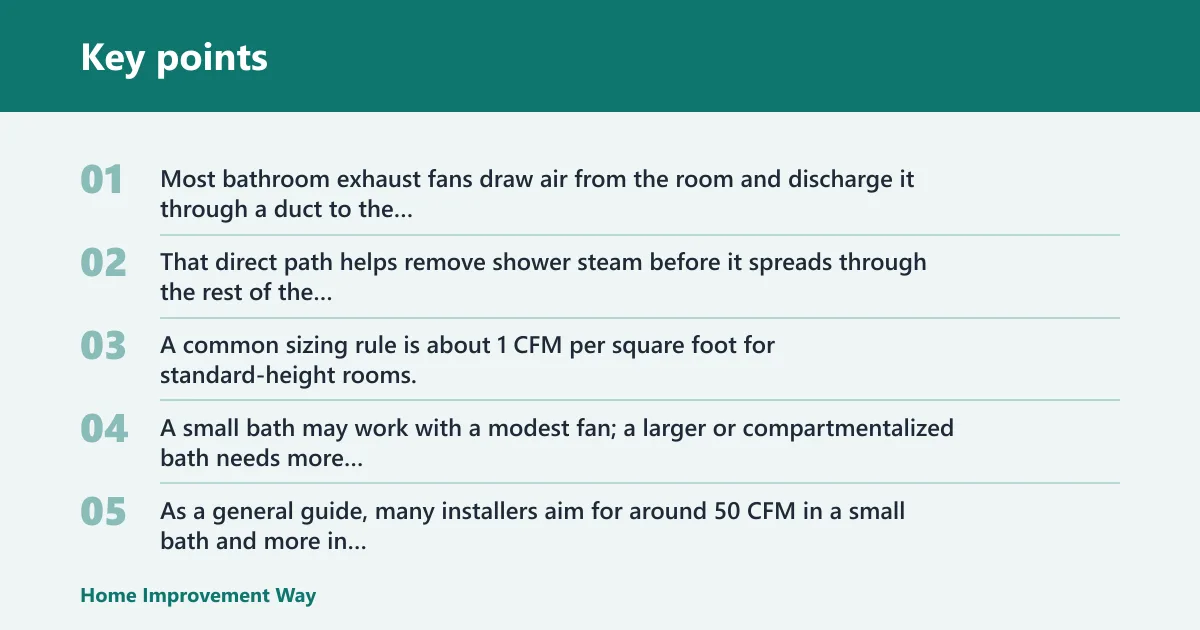
Most bathroom exhaust fans draw air from the room and discharge it through a duct to the attic, roof, or exterior wall. That direct path helps remove shower steam before it spreads through the rest of the bath or into adjacent rooms.
CFM sizing by room square footage
A common sizing rule is about 1 CFM per square foot for standard-height rooms, with more capacity often needed for larger baths, longer duct runs, or baths with separate toilet and shower zones. A small bath may work with a modest fan; a larger or compartmentalized bath needs more airflow to keep dry-out times short.
As a general guide, many installers aim for around 50 CFM in a small bath and more in larger rooms, but the right number depends on the room layout and duct resistance. A fan that is too small will run longer and still leave moisture behind.
Noise level, run time, and moisture removal
Noise matters because a fan that sounds too loud often gets turned off too early. Look at the sone rating and the controls, especially if you plan to run the fan for about 15 to 20 minutes after a shower with a timer or humidity sensor.
Suppose a primary bath has a long duct run to the roof. A properly sized fan can still work well, but a short, direct duct path will usually move air more efficiently than one with multiple bends and a slow termination cap.
Do you still need a fan if the bathroom has a window?
Not always. If local code allows an operable window and the room is lightly used, the window may be enough. But for shower-heavy bathrooms, a ceiling fan is still the safer moisture-control choice because it works regardless of weather, privacy, and whether anyone remembers to open the window.
When a window can satisfy ventilation rules
Many codes allow a bathroom window to substitute for mechanical ventilation if it opens directly to the outdoors and meets the local minimum openable-area requirement. That exception is not universal, and some jurisdictions still require a fan in certain rooms or remodels.
When a mechanical fan is the safer choice
If the bathroom gets daily showers, has cold exterior walls, or is used in winter with the window shut most of the time, a ceiling fan is the better risk-management choice. It also helps when grout, paint, and caulk are sensitive to repeated surface moisture.
How local code changes the answer
Bathroom ventilation rules vary by jurisdiction and by the code version adopted locally. Some areas accept a window exception, some require a mechanical fan for rooms without openable area, and some set minimum fan performance or discharge rules for any installed exhaust system.
Choose bathroom fan if… / Choose ceiling fan if…
Choose a bathroom fan if the room has an operable window, sees only light moisture, and can be opened without creating a privacy or security problem. Choose a ceiling fan if the bathroom gets daily showers, sits in a cold climate, or needs dependable drying after every use.
Choose bathroom fan if…
- The room is a powder room or an occasional-use guest bath.
- The window opens wide enough to move air and local code allows the window exception.
- Privacy, security, and insect control are manageable.
- You can open the window consistently when the room needs drying.
Choose ceiling fan if…
- The bathroom is shower-used daily.
- You want faster condensation control on mirrors, tile, and cold walls.
- The room is windowless, privacy-sensitive, or hard to ventilate with outdoor air.
- Weather or winter comfort makes an open window a poor option.

Bathroom ventilation code and placement basics

Code treatment usually comes down to one question: does the bathroom have a compliant opening to the outside, or does it need mechanical ventilation? The answer depends on local code adoption, room use, and whether the opening meets the minimum area and operability rules in your area.
Window exception rules and openable-area concepts
Many codes use a window exception that allows natural ventilation in place of a fan if the window opens directly outdoors. The exact minimum openable area differs by jurisdiction, so verify local requirements before treating a window as the final answer.
Ceiling mounting, shower airflow path, and duct length
A ceiling-mounted fan should be placed to pull moisture from the shower or bath area, not from the far side of the room. Long duct runs, too many bends, and poor termination can reduce airflow, so the route to the attic or roof matters as much as the fan body itself.
Roof or attic termination considerations
Exhaust air should go outdoors, not into an attic. Roof caps and wall terminations need proper backdraft control and weather protection, and they should be installed so condensate does not collect in the duct.
- Measure the room square footage and note whether the bath has a shower or tub used daily.
- Check local code for the window exception and any mechanical ventilation requirement.
- Look at privacy, security, and winter comfort before relying on an open window.
- If choosing a fan, match CFM to room size and duct length.
- Use a timer or humidity control so the fan keeps running after the shower.
Frequently asked questions
Is a window better than a ceiling fan in a bathroom?
Only in limited cases. A window can be enough for a lightly used bath or powder room, but a ceiling fan is usually better for shower steam because it removes moisture directly and works the same way in calm, cold, or humid weather. Reliability is the key difference.
Can I use a ceiling fan instead of opening the bathroom window?
Yes, if the fan is properly sized, ducted outdoors, and allowed by local code. In fact, a ceiling fan is often the better choice when you want predictable moisture removal without opening the room to weather, insects, or privacy concerns. Run it after showers, not just during them.
Which is better for mold prevention: window ventilation or ceiling exhaust?
Ceiling exhaust is usually better for mold prevention because it removes humid air before condensation has time to settle on paint, grout, caulk, and cold surfaces. A window may help, but it depends on weather, opening size, and whether you can leave it open long enough for the room to dry.
Do I still need an exhaust fan if my bathroom has a window?
Not always, but a window does not automatically replace a fan. If the bathroom is used for regular showers, or if your local code requires mechanical ventilation, a fan is still the safer choice. A window is more of a conditional substitute than a universal replacement.
What are the downsides of relying on a bathroom window for ventilation?
The main downsides are weather dependence, privacy, security, insect entry, and less predictable dry-out time. In winter, opening the window can also make the room uncomfortable and can slow how often you actually use the venting method, which raises condensation risk.
Can a bathroom window replace mechanical ventilation in a small bathroom?
Sometimes, yes. In a small bathroom with an operable window, light moisture load, and code that allows the window exception, it can be enough. The catch is that small rooms with daily showers still benefit from mechanical exhaust because steam buildup can happen quickly even in a compact space.
Sponsored / affiliate links. As an Amazon Associate I earn from qualifying purchases. I may earn additional commission from eligible campaigns.