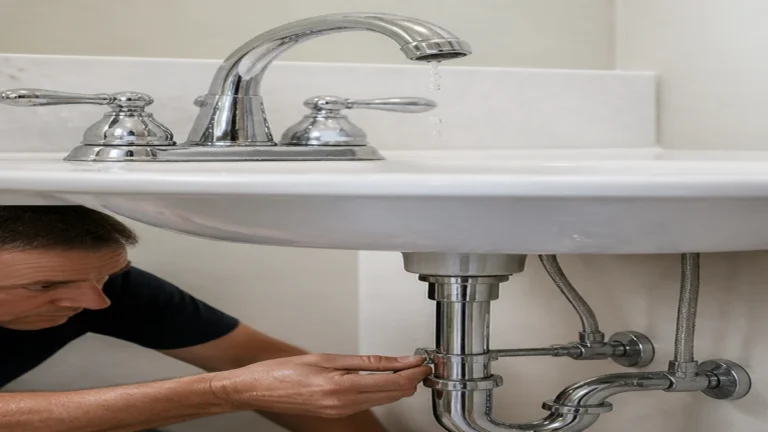
Bathroom Fan Timer Switch vs Humidity Switch: Which Wins?
A timer switch fits predictable shower use. A humidity switch fits hands-off moisture control. Many baths work best with both. Pick the wrong one, and you can get mold, peeling paint, noisy overrun, or a fan that shuts off before the room dries. This guide compares the two controls by bathroom use pattern, climate, and retrofit difficulty so you can choose the right setup.
Bathroom fan timer switch vs humidity switch: the core trade-off
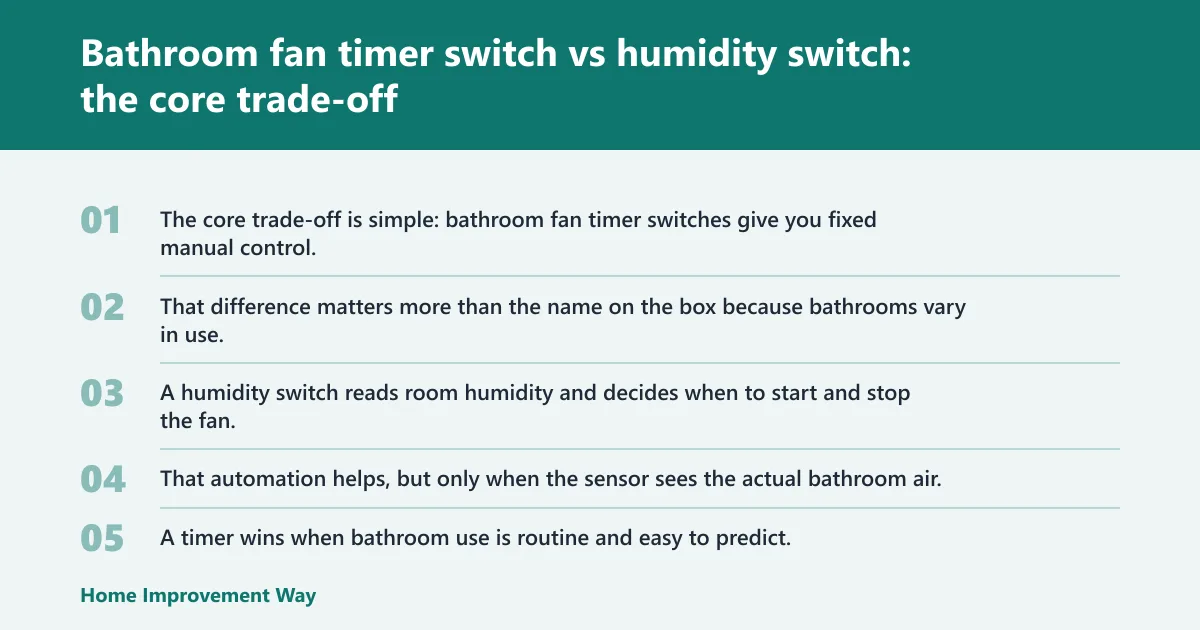


The core trade-off is simple: bathroom fan timer switches give you fixed manual control, while humidity switches turn the fan on and off from relative humidity. That difference matters more than the name on the box because bathrooms vary in use, moisture load, and wiring.
| Decision factor | Bathroom fan timer switch | humidity switch: which is better | Winner |
|---|---|---|---|
| Control behavior | User turns the fan on and sets a run-on delay, often 5 to 60 minutes. | Sensor starts and stops the fan based on a set relative humidity threshold. | Tie |
| Predictable shower routines | Strong fit for repeatable morning showers and known post-shower runtime. | Can work, but may react late if the sensor is placed poorly or the room is drafty. | Bathroom fan timer switch |
| Hands-off moisture control | Needs the user to press the switch and choose a delay. | Runs automatically when humidity rises and shuts off after the setpoint drops. | humidity switch: which is better |
| Retrofit complexity | Usually easier in basic single-pole wiring and shallow boxes. | More likely to need a neutral, enough box depth, and careful sensor placement. | Bathroom fan timer switch |
| Risk of false operation | Low. The main failure is user forgetfulness or too-short runtime. | Higher. Nearby showers, HVAC swings, and seasonal humidity can trigger false starts or long run times. | Bathroom fan timer switch |
Control behavior
A timer gives you a fixed run-on delay. A humidity switch reads room humidity and decides when to start and stop the fan, usually with an adjustable setpoint around 50% to 80% RH depending on the model. That automation helps, but only when the sensor sees the actual bathroom air, not a draft or a burst from another room.
Predictable shower routines
A timer wins when bathroom use is routine and easy to predict. If the same person showers every morning and the room dries in a known window, you can set a delay once and stop thinking about it. In that case, the control matches the habit instead of trying to guess it.
Retrofit complexity
Timers often fit older homes well because many models work as simple replacements and do not need much extra space in the box. Humidity switches may need a neutral wire, enough box depth, and a location where the sensor is not hit by direct supply air or blocked by a door swing. Labor can cost more than the switch itself.
How a bathroom fan timer switch works
A bathroom fan timer switch gives the fan a manual start and an adjustable run-on delay. Common delay settings include a few short options and, on some models, a longer one. That makes it easy to match post-shower run time to the size of the bath and how much steam the fan must remove.
Adjustable run-on delay and typical minute ranges
Most timer switches let you choose a fixed delay with a dial, buttons, or preset increments. A small powder room may only need a short delay after handwashing, while a steamy shower in a full bath may need 15 to 30 minutes or more, especially if the fan is undersized or the duct run is long.
Manual activation and user responsibility
The timer depends on the user pressing the switch. That is the strength and the weakness. You get predictable operation, but you also get missed starts and early shutoff if someone forgets or turns it off too soon.
Best fit for predictable shower routines
Timers fit daily family bath use, back-to-back showers, and any home where people can follow a simple habit: turn the fan on before or during bathing, then leave it on long enough to clear steam. They are also a good match when odor control matters as much as moisture control.
How a bathroom fan humidity switch works
A humidity switch uses a relative humidity sensor and a setpoint threshold to automate the fan. When bathroom RH rises above the chosen threshold, the fan starts. When RH drops below the cut-off band, it stops. That can be very convenient, but sensor placement and house climate strongly affect accuracy.
Relative humidity sensing and setpoint threshold
Many residential models offer an adjustable setpoint across a moderate humidity range. A lower setpoint starts the fan sooner, which can help in damp climates or winter condensation control. A higher setpoint reduces nuisance starts, but it may wait too long in a humid bathroom with poor ventilation.
Auto start/stop behavior
Auto start/stop is the appeal. The fan can react even when a user forgets to flip a switch, and it can keep running until humidity falls. That helps with moisture control in bathrooms that are used irregularly or by guests who do not know the routine.
Why sensor placement affects accuracy
Sensor placement is a real limit. A sensor too close to the shower can see a spike and run too long. A sensor near a supply vent can see dry air and shut off too early. Nearby laundry rooms, open windows, or whole-house HVAC cycles can also shift the reading away from the bathroom’s actual moisture load.
How long should a bathroom fan run after a shower?
A bathroom fan should run long enough to clear visible steam and bring the room back toward normal humidity, often for a short period after a steamy shower and for less time after quick handwashing. The right runtime depends on room size, fan capacity, duct length, and how much moisture the activity adds.
Quick handwashing vs steamy showers
Quick handwashing in a small half bath may only need a few minutes of fan time. A hot shower in a full bath can need a much longer run, especially if the mirror stays fogged after the water stops. A manual timer makes those differences easy to cover with a longer or shorter preset.
How room size and fan capacity affect runtime
Fan capacity matters. A fan should be matched to the room’s CFM needs, not just the switch. If the fan is weak for the space, neither a timer nor a humidity switch can fix that fully, and the runtime will need to be longer to remove the same amount of moisture.
When a manual timer override is useful
A manual override helps when conditions are outside the normal pattern. Suppose a 5-by-8-foot bath has two back-to-back showers on a winter morning. A timer lets you extend runtime without waiting for a sensor to decide whether humidity is still high enough.
Which control fits your bathroom use pattern?
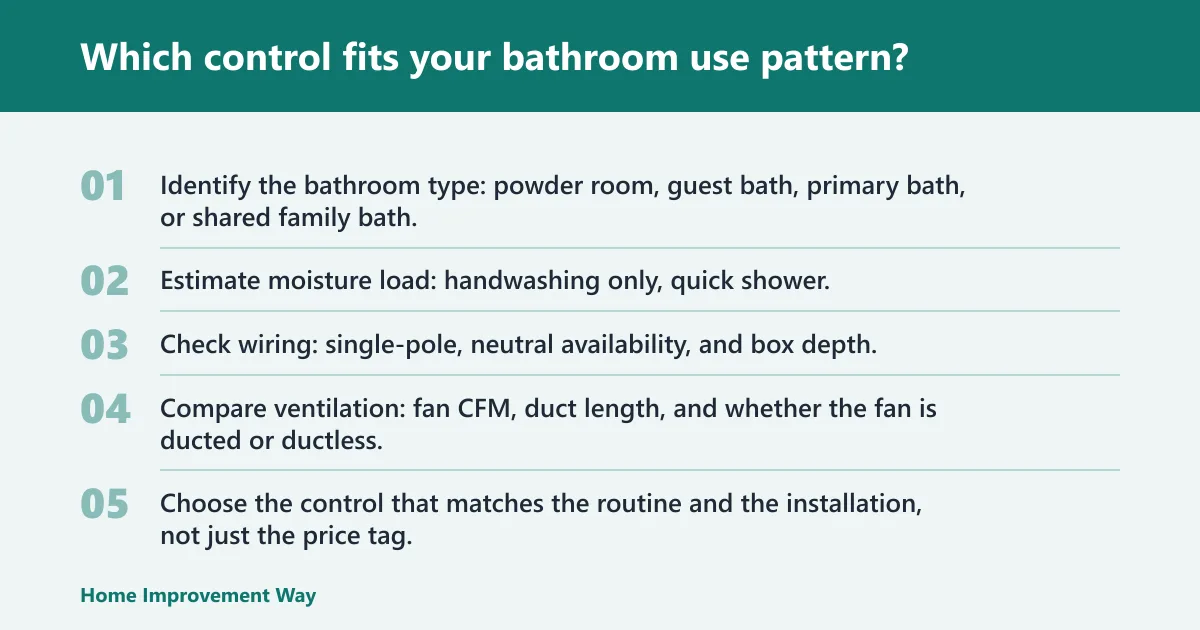
The best control depends on how often the room is used, who uses it, and whether the routine is predictable. A guest bath with occasional use, a primary bath with daily showers, and a kids’ bath with stop-and-start traffic each point to a different control strategy.
Guest bath and powder room
For a guest bath or powder room, a humidity switch often fits because people may forget to run the fan or may not know how long it should stay on. In a powder room with no shower, though, a timer can be simpler and less likely to misread normal humidity from handwashing as a moisture event.
Primary bath with daily use
A primary bath used daily often favors a timer if the shower routine is predictable and the fan is sized correctly. If the household prefers hands-off control, a humidity switch can work well, but the setpoint may need seasonal adjustment to avoid short cycling in winter or long run times in humid weather.
Kids’ bath, back-to-back showers, and irregular schedules
Kids’ baths and back-to-back showers are where the decision gets less obvious. A timer gives reliable post-shower run time even when several people use the room in a row. A humidity switch can also work, but it may cycle oddly if the door opens and closes often or another shower nearby changes the reading.
- Identify the bathroom type: powder room, guest bath, primary bath, or shared family bath.
- Estimate moisture load: handwashing only, quick shower, or steamy shower with repeated use.
- Check wiring: single-pole, neutral availability, and box depth.
- Compare ventilation: fan CFM, duct length, and whether the fan is ducted or ductless.
- Choose the control that matches the routine and the installation, not just the price tag.
Decision matrix: timer switch vs humidity switch by bathroom scenario
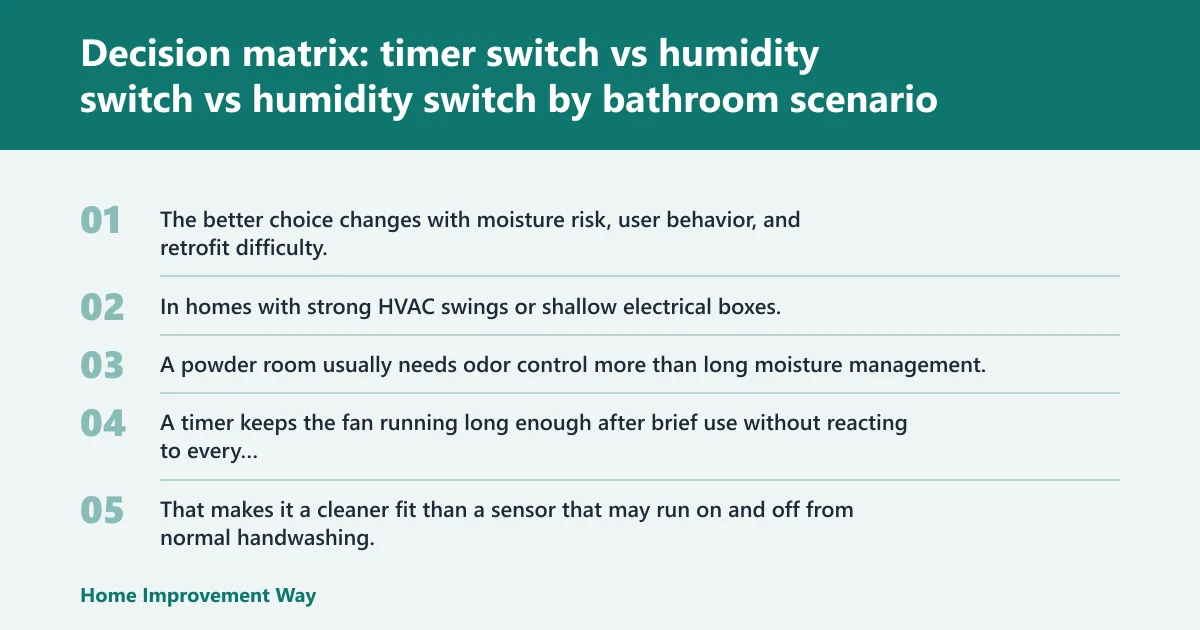
Use this matrix as a practical shorthand. The better choice changes with moisture risk, user behavior, and retrofit difficulty. In homes with strong HVAC swings or shallow electrical boxes, the “best” control is often the one that avoids installation headaches and false operation.
| Bathroom scenario | Moisture risk | User behavior | Retrofit difficulty | Best control | Common failure mode |
|---|---|---|---|---|---|
| Low-use powder room | Low, mostly odors and brief humidity spikes | Irregular, short visits | Low to moderate | Bathroom fan timer switch | Humidity switch may false-trigger from handwashing |
| Guest bath with occasional showers | Moderate | Unpredictable, different users | Moderate | humidity switch: which is better | Sensor placement too close to the shower or supply vent |
| Primary bath with repeated showers | High | Predictable, daily | Low to moderate | Bathroom fan timer switch | Timer set too short for steamy showers |
| Small bathroom in a humid climate | High | Often regular, but room stays damp | Moderate | humidity switch: which is better | Setpoint too high, fan starts late |
| Bathroom in a dry winter climate | Moderate, with winter humidity swings | Predictable heating-season use | Moderate | Bathroom fan timer switch | Humidity switch can shut off early when HVAC dries the room |
| Older retrofit with limited box space | Varies | Any | High | Bathroom fan timer switch | Humidity model may need a neutral or deeper box |
| Home with strong HVAC swings | Variable | Irregular sensing conditions | Moderate to high | Bathroom fan timer switch | Humidity sensor false-triggers from whole-house cycling |
| Bathroom with both odor and moisture concerns | High | Mixed, sometimes predictable | Moderate | Combination of both | One control alone may miss either odor or humidity control |
Low-use powder room
A powder room usually needs odor control more than long moisture management. A timer keeps the fan running long enough after brief use without reacting to every small humidity bump. That makes it a cleaner fit than a sensor that may run on and off from normal handwashing.
Guest bath with occasional showers
Guest baths benefit from automation because visitors may not know the house routine. A humidity switch can be better here if the sensor placement is sensible and the setpoint is tuned. If the room is used only for occasional showers and the wiring is simple, a timer still remains a strong option.
Primary bath with repeated showers
Primary baths with repeat use often favor a timer because the moisture load is predictable and the users can set a fixed post-shower run time. That is especially true if the fan capacity is already matched to the room and the goal is straightforward condensation removal and finish protection.
Small bathroom in a humid climate
In a humid climate, a humidity switch can earn its keep because it responds to the room’s actual moisture load and can help manage winter humidity too, if adjusted carefully. The downside is that a too-high setpoint may wait until condensation has already formed on tile or paint.
Wiring, compatibility, and install complexity
Installation constraints often decide the winner before the comfort argument does. Check whether the existing wiring is single-pole or multi-location, whether a neutral wire is present, whether the fan load matches the control rating, and whether the switch box has enough depth for the device and conductors.
Neutral wire requirement and single-pole wiring
Many humidity switches need a neutral to power the sensor and electronics. Some timer switches are simpler and work in more basic switch loops. If the box lacks a neutral, the timer is often the easier retrofit unless you are rewiring the circuit.
Fan load compatibility and switch box depth
Check the fan’s electrical load rating against the switch. Also check box fill. Smart controls and sensor switches can be physically deeper than a standard toggle, which matters in older boxes crowded with conductors. A control that fits poorly is a bad choice regardless of features.
Multi-location control and retrofit limits
If the fan is controlled from more than one location, such as a bath entry and a bedroom hall, the wiring can complicate both options. In those cases, retrofit limits may matter more than the moisture-control preference. A simpler timer may be the practical answer even if a humidity sensor sounds smarter on paper.
Choose Bathroom fan timer switch if… / Choose humidity switch: which is better if…
Choose a timer switch if your shower routine is predictable, your bathroom is dry enough to clear with a fixed run time, or your retrofit has wiring limits. Choose a humidity switch if you want hands-off control, your bathroom use is irregular, or you are trying to protect a room that stays damp after use. Combining both makes sense when the room sees both frequent bathing and frequent odor spikes.
Choose Bathroom fan timer switch if…
Pick a timer if you want fixed post-shower run time, especially in a primary bath or kids’ bath with repeatable habits. It is also the safer retrofit when the box is shallow, the neutral is missing, or the fan is on a basic single-pole circuit. Timers are also better when HVAC swings would confuse a humidity sensor.
Choose humidity switch: which is better if…
Pick a humidity switch if the bathroom is used by guests, the shower schedule is irregular, or users forget to run the fan. It is also useful in damp climates where moisture hangs around after the room is empty. Just expect sensor placement and setpoint tuning to matter a lot.
When combining both controls makes sense
Combination setups work well when you want auto-start from humidity plus a manual override or fixed run-on timer. That is useful in larger baths, steamy showers, or homes that need both moisture control and odor control. If the wiring supports it, a two-control approach can solve more problems than either switch alone.
Frequently asked questions
Should I use a bathroom fan timer switch or humidity switch?
Use a timer switch if the bathroom routine is predictable and you want fixed post-shower run time. Use a humidity switch if you want automatic operation and the room’s moisture load changes a lot. In many homes, the best answer is still the control that matches the wiring and the bathroom type.
How long should a bathroom fan run after a shower?
A quick handwashing session may only need a few minutes, while a steamy shower often needs 15 to 30 minutes or more. The exact time depends on room size, ducting, and fan capacity. If the mirror is still fogged, the fan probably did not run long enough.
Is a humidity sensor better than a timer for mold prevention?
Not always. A humidity switch can be better in damp or irregular-use bathrooms because it responds to moisture automatically, but a properly set timer can work just as well when the routine is predictable. Fan sizing, ducting, and runtime matter more than the label on the switch.
Can I use both a timer switch and a humidity switch on the same fan?
Yes, in some setups you can use both, especially when one control handles manual run time and the other handles automatic moisture response. The exact wiring depends on the switch models and circuit layout. This is a good option for bathrooms that need both reliable runtime and hands-off control.
How accurate are humidity-sensing bathroom fan switches?
They are only as accurate as the sensor’s placement and the room conditions around it. Nearby showers, HVAC airflow, and seasonal humidity swings can make the sensor read too high or too low. A good setpoint helps, but it does not eliminate placement problems.
What causes humidity switches to fail or run too long?
Common causes include a sensor placed too close to the shower, a supply vent blowing on the sensor, or whole-house HVAC changes that keep the reading elevated. Seasonal swings can also make a setpoint that worked in summer behave badly in winter. That is why some bathrooms still do better with a timer.
Sponsored / affiliate links. As an Amazon Associate I earn from qualifying purchases. I may earn additional commission from eligible campaigns.