Best Bathroom Fans for Powder Rooms (2026): Based on Specs
For a powder room with no shower, start with a quiet 50 CFM exhaust fan; choose about 80 CFM only if the room is over roughly 50 square feet or the duct run is long. A weak or noisy fan leaves odors behind and can make the room feel stale. This guide covers quiet fan picks, airflow sizing, duct compatibility, and installation limits for powder rooms.
Quick comparison
| Product | Badge | Best for | Price | ||
|---|---|---|---|---|---|
 |
Broan-NuTone Bathroom Exhaust Fan, 50 CFM Modern Grille,Broan-NuTone | Our pick | 50 CFM · 2.0 Sones · Energy Star | $21.98
Price as of 18 Oct 2026
|
View |
 |
Hendlabb Bathroom Exhaust Fan with Bluetooth Speaker andHendlabb | Also great | 190 CFM · 1.0 Sone · Bluetooth | $99.98
Price as of 18 Oct 2026
|
View |
 |
KAZE APPLIANCE SNP100 Bathroom Ventilation ExhaustKAZE APPLIANCE | Upgrade pick | 100 CFM · 0.8 Sones · Energy Star | $79.50
Price as of 18 Oct 2026
|
View |
The table below compares the three listed fans by airflow, noise, duct fit, and whether they solve a lighting or retrofit need. Use it as a quick screen before you compare the room-size rules in the next section.
How we chose
For a powder room, odor control matters more than shower steam. That is why airflow, noise, and duct fit matter more than moisture claims.
Use four checks: CFM range for the room size, sones target for quiet operation, duct compatibility for 3-inch or 4-inch runs, and install type for rooms without attic access. Light and efficiency features matter too, but they come after fit.
A timer switch is worth considering because it keeps the fan from running for hours after use.
Powder room fan decision matrix
This matrix turns the most common powder-room inputs into a practical starting point. It is for odor-first rooms with no shower load, so the airflow target is lower than many full-bath guides.
| Room and install input | Recommended CFM range | Noise target | Fan type | Avoid if |
|---|---|---|---|---|
| Small room, about 45 sq ft, 3-inch duct, low noise tolerance, no light needed | 50 CFM | 1.0 to 1.5 sones | Compact fan-only model | You need strong light output or the duct run is long and restrictive |
| Small room, about 45 sq ft, 4-inch duct, higher noise tolerance, no light needed | 50 to 80 CFM | Up to about 2.0 sones | Standard fan-only model | You want the quietest possible fan or the wall/ceiling path is short but undersized |
| Mid-size room, about 75 to 80 sq ft, retrofit install, no attic access | 80 to 100 CFM | About 1.0 to 1.5 sones | Retrofit fan with room-side brackets | The existing duct is 3-inch and cannot be upsized or adapted cleanly |
| Larger powder room, about 107 sq ft, light needed | 100 to 110 CFM | About 1.0 to 2.0 sones | Fan/light combo or adjustable-airflow fan | You have a very short, simple room and want the lowest noise possible |
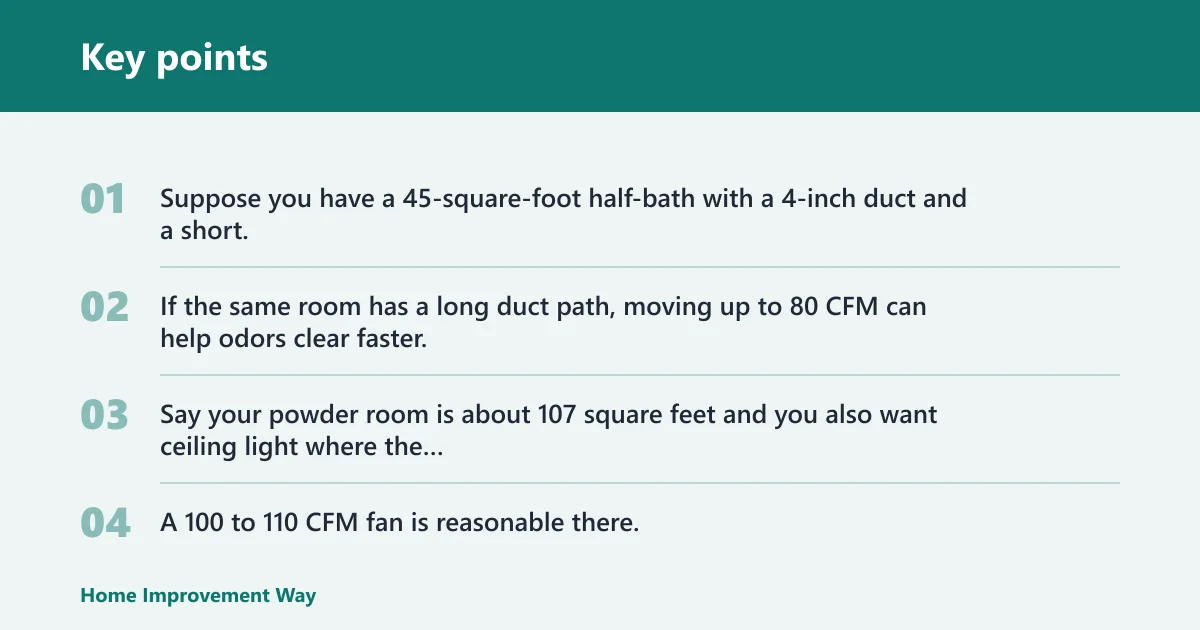
Suppose you have a 45-square-foot half-bath with a 4-inch duct and a short, straight exhaust run. A 50 CFM fan is usually the cleanest fit. If the same room has a long duct path, moving up to 80 CFM can help odors clear faster.
Say your powder room is about 107 square feet and you also want ceiling light where the room feels dim. A 100 to 110 CFM fan is reasonable there, especially if the unit has a 4-inch duct and a quieter motor.
Broan-NuTone 50 CFM modern grille fan: best for small powder rooms
This Broan-NuTone model fits the smallest odor-first powder rooms best. Based on the listed 50 CFM and 2.0 sones, it is a plain choice when you want basic ventilation, ENERGY STAR efficiency, and no extra features to complicate the install.
It stands out because 50 CFM lines up with the lower end of the powder-room range, and the 2.0 sone rating is still acceptable for many short-use rooms. The ENERGY STAR label also gives you a simple efficiency signal.
The drawback is its noise ceiling. Two sones is not loud, but it is not the quietest option here, and it may feel less refined than an ultra-quiet 0.8 to 1.0 sone model in a very small room.
KAZE APPLIANCE 100 CFM fan: best for no-attic-access retrofit installs
This KAZE model is the strongest fit when the powder room needs a retrofit install and you do not have attic access. The listed 100 CFM, 0.8 sone rating, ENERGY STAR certification, and no-attic-access requirement make it a good match for a mid-size powder room that needs quiet odor removal.
Its main advantage is balance. The airflow is high enough for larger half-baths, while the sub-1.0 sone claim puts it in the quiet end of the category. That makes it a useful pick when you want stronger ventilation without adding much noise.
The downside is that 100 CFM can be more fan than a tiny room needs, especially with a short duct path. If the room is only about 45 square feet and the duct is simple, a smaller model may be the better fit.
Hendlabb 190 CFM fan with Bluetooth and light: best fan/light combo
This Hendlabb model is for powder rooms that need a light more than they need a plain vent fan. The built-in light and Bluetooth speaker are the headline features, while the listed 190 CFM airflow goes far beyond a typical powder-room need.
It stands out as a feature-heavy ceiling-mount option for rooms where lighting is the priority and the buyer wants one fixture to do more than exhaust air. The UL certification is another useful buying signal.
The drawback is obvious: 190 CFM is very high for most powder rooms, and the extra electronics add complexity you may not want in a simple half-bath. It is also the least targeted option for a quiet, odor-first room.
Which one should you buy?
Choose the Broan-NuTone 50 CFM fan if your powder room is small, the duct run is short, and you want the simplest odor-control upgrade. It is the most conservative fit of the three.
Choose the KAZE 100 CFM fan if the room is mid-size, the install has no attic access, or you want a quieter fan with more airflow than a basic 50 CFM unit. This is the best all-around choice for many remodels.
Choose the Hendlabb unit only if the room needs a light and you are comfortable with a much stronger airflow package. For a basic half-bath, its 190 CFM output is usually more than necessary.
- Measure the room in square feet.
- Check whether the duct is 3-inch or 4-inch.
- Decide whether low noise matters more than faster air turnover.
- Choose a light only if the room lacks enough ceiling light already.
- If there is no attic access, look for room-side or retrofit brackets.
What CFM do you need for a powder room with no shower?
Start with 50 CFM for a small powder room with no shower, then move up to 80 CFM if the room is larger than about 50 square feet or the duct run is long. For a bigger half-bath, 100 to 110 CFM is reasonable when the fan must clear stale air faster.
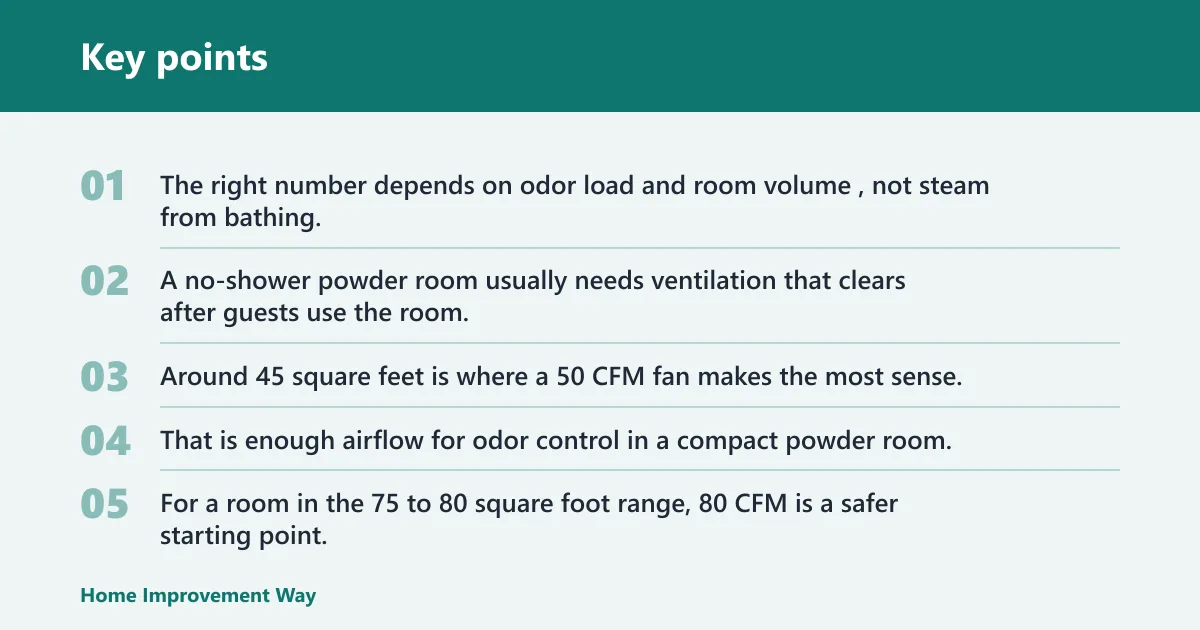
The right number depends on odor load and room volume, not steam from bathing. A no-shower powder room usually needs ventilation that clears after guests use the room, then shuts down before it becomes a background noise source.
45 sq ft rooms
Around 45 square feet is where a 50 CFM fan makes the most sense. That is enough airflow for odor control in a compact powder room, especially if the duct is short and the fan has a clean path to the exterior.
75-80 sq ft rooms
For a room in the 75 to 80 square foot range, 80 CFM is a safer starting point. The extra airflow helps move stale air out faster without jumping all the way to a full-bath level of capacity.
Around 107 sq ft rooms
That size can handle a higher-output fan without it being overkill, especially if the room has a longer run or the layout tends to hold odors.
When 110 CFM is reasonable
110 CFM is not automatically too powerful for a powder room. It can make sense in a larger half-bath, in a room with a long duct run, or when you want faster odor clearing and the fan is controlled with a timer or switch discipline.
How quiet should a powder room exhaust fan be?
A good quiet target for a powder room is about 1.0 to 1.5 sones. That range is low enough for everyday use without turning the fan into a distraction, yet it still allows useful airflow in a small, odor-first room.
About 2.0 sones is still acceptable if the fan delivers the airflow and fit you need. Once noise rises beyond that, the fan may start to feel noticeable during short visits, especially in a compact room with hard surfaces.
Best sones target for a powder room
If the room is used often and sits close to living spaces, aim for the quiet end of the scale. A 0.8 to 1.5 sone fan is easier to live with, especially when the bathroom door is open briefly after use.
When 2.0 sones is still acceptable
Two sones can be fine in a simple half-bath, especially if the run is short and the fan clears odors quickly. It is a fair trade when the room only needs occasional use and the fan is not running for long periods.
What noise tradeoff higher airflow can create
Higher airflow often brings more sound, though better motors can reduce that penalty. In a powder room, the tradeoff is usually worth it only when the room is larger, the duct is restrictive, or you need a fan that can clear air faster after guests use the space.
Do you need a 3-inch or 4-inch duct for a powder room fan?
Use the duct size you already have when possible, but know that 4-inch ducts generally move air better than 3-inch ducts. Older homes often have 3-inch ducts, while newer bathrooms tend to have 4-inch ducts or larger, and that difference affects which fan you should buy.
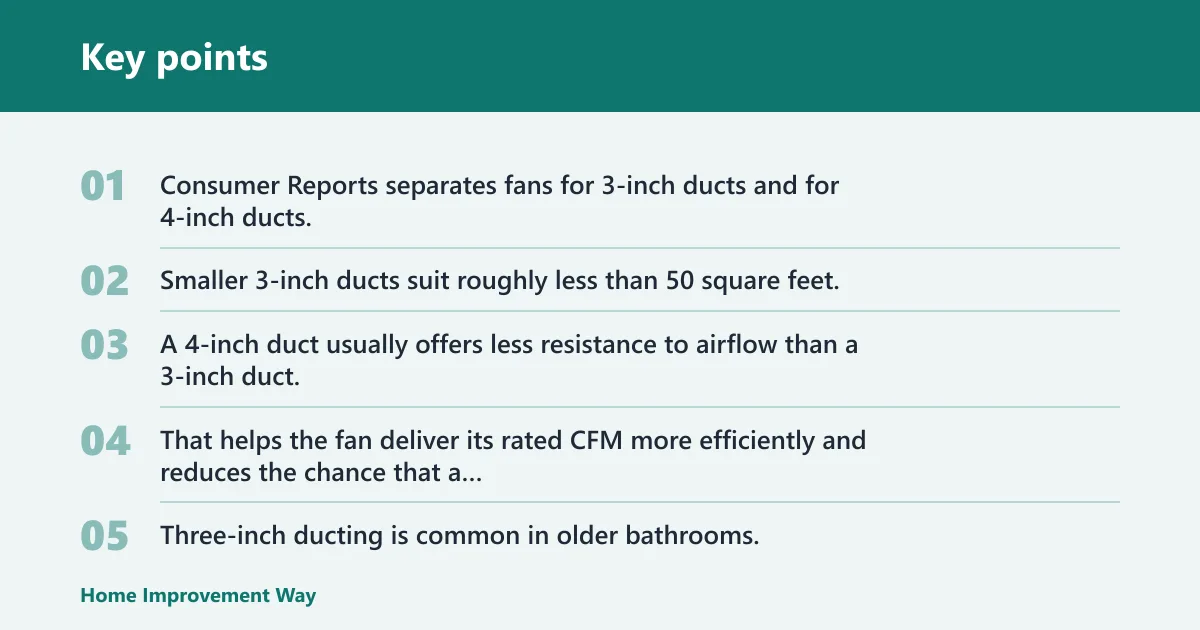
Consumer Reports separates fans for 3-inch ducts and for 4-inch ducts, which is a useful buying clue.
Why 4-inch ducting moves air better
A 4-inch duct usually offers less resistance to airflow than a 3-inch duct. That helps the fan deliver its rated CFM more efficiently and reduces the chance that a stronger motor gets choked by a narrow exhaust path.
When 3-inch ducting limits fan choice
Three-inch ducting is common in older bathrooms, but it can cap how much air a fan can move. If the duct is small and the run is long, a high-CFM fan may not perform as advertised and can become noisier than expected.
Retrofit cases with existing duct constraints
If you are replacing an old fan, do not assume a bigger motor solves everything. A mismatched duct diameter, a long run, or too many bends can reduce real-world performance, even when the box lists a strong CFM number.
A common first-timer mistake is buying an oversized fan for a tiny room with a restrictive duct. The room may still smell fine, but the fan can sound harsher than necessary and move less air than the label suggests once it meets the duct resistance.
Can you install a bathroom fan without attic access?
Yes. A no-attic-access retrofit fan is the right choice when the work must happen from the room side and the old fan has to come out without opening the ceiling above. Look for retrofit brackets or foldable mounting hardware that supports room-side installation.
That said, retrofit does not mean every replacement is easy. Oversized fans, long duct runs, and incompatible duct diameters can still create problems, so the existing opening and duct path matter as much as the fan label.
What to look for in a retrofit model
Choose a fan that explicitly says no attic access, retrofit, or room-side install. ENERGY STAR can be a useful efficiency signal here, especially if the fan is likely to run often or has a timer switch attached.
Where retrofit installs go wrong
Problems usually show up when the housing does not fit the old opening, the duct connection is the wrong size, or the exhaust run is too long for the fan’s real output. A powerful fan cannot fix a poorly matched installation path.
Should you choose a fan with a light for a powder room?
Choose a fan with an integrated LED light if the powder room needs a ceiling light and you want one fixture to do both jobs. If the room already has enough light, a fan-only model is often simpler, cheaper, and easier to size for quiet airflow.
An integrated LED light is especially useful in small powder rooms where ceiling space is limited. It can reduce the number of fixtures, but it should not force you into an oversized fan just to get illumination.
When a fan/light combo makes sense
A combo unit makes sense when the room lacks a separate light fixture or when you are replacing an aging unit with one ceiling opening. In that case, the built-in LED can solve two issues at once.
When fan-only is the better fit
If the room already has good lighting, choose the better vent fan instead of paying for extra electronics. Fan-only models are easier to match to the right CFM and sones target for an odor-first half-bath.
Frequently asked questions
Is 50 CFM enough for a half-bath?
Yes, 50 CFM is often enough for a small half-bath with no shower. It is the best starting point for a compact room, especially when the duct is short and the fan is meant mainly for odor control and stale-air removal.
Are 110 CFM fans too powerful for a powder room?
Not always. A 110 CFM fan can be a good fit for a larger powder room, about 107 square feet, or for a room with a long duct run. In a very small room, though, it can be more airflow than you need unless the controls and ducting are right.
Sponsored / affiliate links. As an Amazon Associate I earn from qualifying purchases. I may earn additional commission from eligible campaigns.