Ceiling vs wall bathroom exhaust fan: which to choose?
Choose the fan location that lets you run the shortest, straightest duct to outdoors, then place the intake closest to the shower or tub. If one option cuts the vent run a lot, pick that one. Poor placement keeps moisture in the room, and that can lead to peeling paint, stained ceilings, mold risk, and louder operation. This guide compares ceiling and wall exhaust fans, shows when each fits best, and gives a simple decision framework for remodels, replacements, and retrofits.
Choosing the Right Fan: Duct Path and Placement Factors
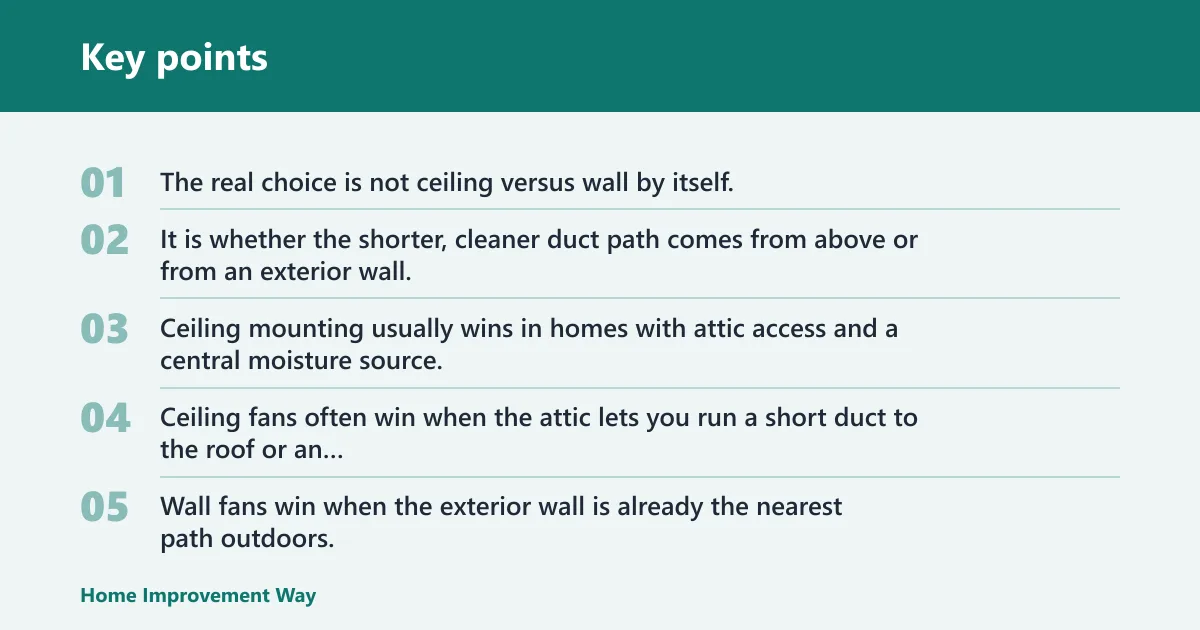


The real choice is not ceiling versus wall by itself. It is whether the shorter, cleaner duct path comes from above or from an exterior wall, while keeping the fan intake close to the shower or tub. Ceiling mounting usually wins in homes with attic access and a central moisture source; wall mounting wins when an exterior wall gives you a direct exit.
| Decision factor | Ceiling | wall bathroom exhaust fan | Winner |
|---|---|---|---|
| Duct path | Usually shorter when attic space allows a direct run to the roof or exterior | Usually short when the fan is on an exterior wall | Tie |
| Shower proximity | Better when the room’s moisture source is near the ceiling centerline | Better only when the shower or tub sits against the exterior wall | Ceiling |
| Retrofit complexity | Can be simpler with attic access; harder if ceiling framing or duct routing is blocked | Can be simpler in a single-story home; harder in thick walls or finished exteriors | Tie |
| Static pressure risk | Usually lower if the duct can stay short and straight | Can rise if the wall is thick or the termination path is constricted | Ceiling |
| Maintenance access | Depends on attic access and fan housing access | Depends on wall cavity access and exterior cap access | Tie |
Duct path and bend count
Ceiling fans often win when the attic lets you run a short duct to the roof or an exterior termination with few elbows. Wall fans win when the exterior wall is already the nearest path outdoors. Every extra bend adds resistance, so a location that seems simple can still underperform if the duct route becomes too indirect.
Shower proximity
Moist air rises quickly after a shower or bath, so the intake should sit close to the steam source. A ceiling fan near the shower zone usually captures that air before it spreads. A wall fan can be effective in a compact bath, but only if the shower or tub is already near that wall.
Retrofit complexity
Ceiling installations often need attic access, but that access can make routing and service easier. Wall installations avoid attic work, yet they can be harder in finished exterior walls, masonry, or thicker assemblies that leave less room for a direct termination.
📊 Dropped ceiling tiles are typically 2 by 2 or 2 by 4 feet. Source: 9 Types of Ceilings Every Homeowner Should Know.
How duct run length changes performance
Duct run length changes how much air the fan can actually move. Shorter runs with fewer elbows reduce resistance, so the fan works closer to its rated airflow and usually sounds less strained. Longer or twistier runs raise static pressure and can turn a properly sized fan into an underperformer.
Why shorter runs are easier to size
CFM is airflow capacity in cubic feet per minute. A short, straight run makes that rating easier to trust because the system does not waste as much of the fan’s output pushing air through resistance. That matters in bathrooms that see daily showers, long runtime, or heavy condensation.
How elbows and twists add resistance
Each elbow, offset, or crushed section can increase static pressure. In plain terms, the fan has to work harder to move the same air. That can reduce delivered airflow even when the nameplate CFM looks adequate.
Why thick wall assemblies can be a problem for wall fans
Wall-mounted units can struggle when the exterior wall is thick, crowded, or hard to terminate cleanly. The duct path may need an awkward transition through framing, insulation, and cladding before it reaches the vent cap. That extra resistance can erase the advantage of a direct wall exit.
How do CFM and static pressure affect your choice?
CFM tells you how much air the fan is designed to move, while static pressure tells you how much the duct system resists that airflow. You need enough CFM for the room size and moisture load, but you also need a duct path that lets the fan deliver that rated air in real conditions. A higher-rated fan is not always the fix if the duct route is the real problem.
Match CFM to room size and moisture load
A small powder room usually needs less airflow than a primary bath with a large shower or soaking tub. Wet rooms and shower-heavy bathrooms generally need more capacity and faster moisture removal. Fan placement should support that goal instead of fighting the duct route.
When a higher-rated fan is not the real fix
If the duct run is long, full of bends, or poorly insulated, a bigger motor may only hide the problem. The better solution is often a shorter path, better duct layout, or a location that reaches outdoors more directly. Choose placement first, then size the fan to the room.
Noise matters in both locations
Noise is often rated in sones, a measure of perceived loudness. A fan can be quiet on paper and still feel loud if the ducting forces it to work harder. For primary baths and adjacent bedrooms, the combination of location, duct length, and airflow is as important as the sone number itself.
Which layout favors a ceiling fan or a wall fan?
Different bathrooms point to different answers. A primary bath with a shower inboard from the exterior walls usually favors a ceiling fan and attic ducting. A small powder room on an exterior wall often favors a wall fan because the vent path can stay short and direct.
Primary bath with shower or tub
Ceiling mounting is usually the better fit when the shower or tub is away from an exterior wall. It places the intake nearer to the steam source and often lets you route through the attic with fewer turns. That usually means better moisture control and less strain on the fan.
Powder room or small bath
A compact powder room can work well with a wall fan if the room sits on an exterior wall and the duct exit is simple. The lower moisture load also makes the choice less demanding than in a shower-heavy bath. If the room has no shower, the placement problem is easier.
Basement bath or no-attic home
Basement baths and homes without attic access often push the decision toward a wall fan, but only if an exterior wall is available. If there is no usable exterior wall, a ceiling fan may still be possible, yet the duct path becomes a more technical retrofit. At that point, framing and termination details matter more than preference.
Common scenario examples
Say your 5-by-8 hall bath has a tub on the back wall and the only exterior wall is across the room. A ceiling fan near the center of the ceiling can usually shorten the duct and capture steam better than a wall unit on the far side.
Suppose a basement powder room shares one exterior wall and the ceiling above is blocked by joists, pipes, and finished space. A wall fan may be the cleaner solution because the duct can exit directly outdoors with less demolition.
What installation issues matter most?
Three things decide the install more than the fan style itself: attic or wall access, a weatherproof termination outdoors, and service access after the job is done. If those are poor, even a good fan placement can become noisy, difficult to maintain, or less effective at moisture control.
Attic clearance and roof or attic duct routing
Ceiling-mounted fans need enough attic clearance to run ducting without crushing insulation, kinked flex, or unnecessary turns. Ceiling installations are often the default in homes with reachable attic space because the fan can sit above the room and vent through the roof or another approved exterior path. That flexibility matters when the shower is not on an exterior wall.
Exterior wall availability and weatherproof termination
Wall-mounted fans generally need a true exterior wall and a weather-resistant exterior cap. The vent cap should prevent backdrafts and shed rain while allowing air to discharge cleanly outdoors. That termination detail matters as much as the fan itself.
Electrical access and future service access
The housing needs enough access for wiring, fasteners, and later maintenance. Suspended ceilings can make repair easier because panels can be lifted off, and dropped ceilings can provide room for mechanical and electrical piping, wiring and ducting. A flat ceiling is the simplest and most common ceiling type, but it may still need attic entry for service. (en.wikipedia.org)
Backdraft control at the vent cap
Both roof and wall terminations need backdraft prevention. Without it, outside air can enter when the fan is off, and that can add drafts, odors, and moisture problems near the duct end. The cap should also be sized and installed so the fan does not fight unnecessary resistance.
Decision matrix: choose the right fan location
Use a simple scoring method when both options are possible. Give 2 points to the better choice for each category, 1 point to the acceptable choice, and 0 points to the poor choice. The higher total usually points to the better location for that bathroom.
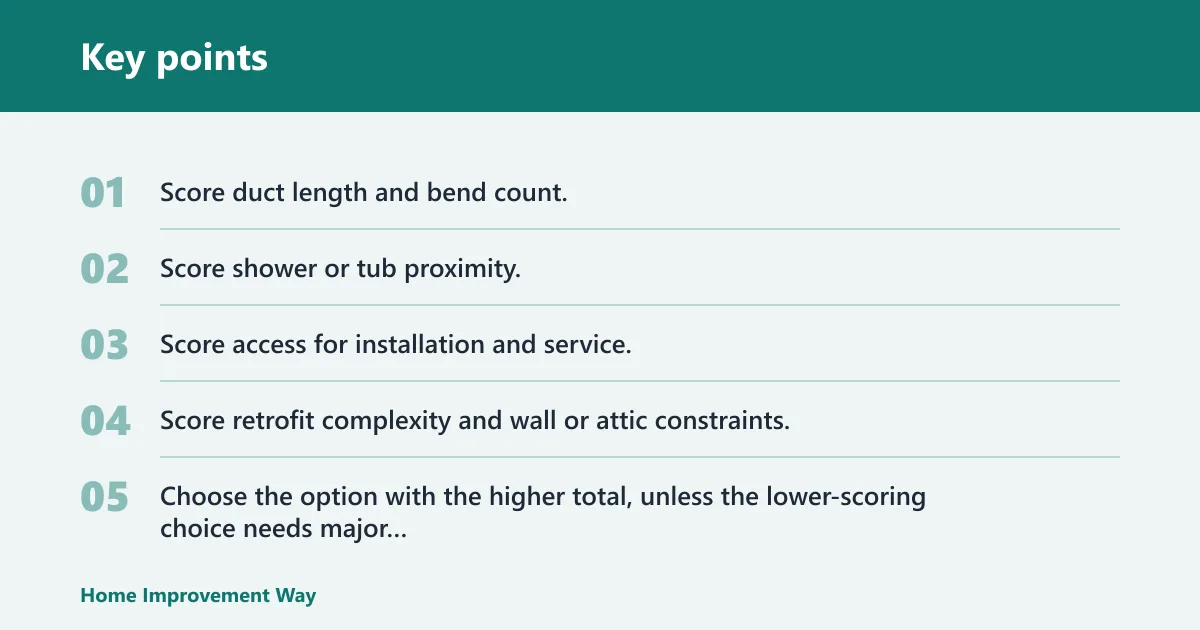
- Score duct length and bend count.
- Score shower or tub proximity.
- Score access for installation and service.
- Score retrofit complexity and wall or attic constraints.
- Choose the option with the higher total, unless the lower-scoring choice needs major framing or exterior work.
| Decision factor | Ceiling | wall bathroom exhaust fan | Winner |
|---|---|---|---|
| Duct length | Best when the attic gives a short route to outdoors | Best when the exterior wall is adjacent to the fan | Tie |
| Shower proximity | Usually closer to the moisture source in center-of-room layouts | Best only when the shower is on the same exterior wall | Ceiling |
| Attic access | Needs attic access or another feasible overhead path | Does not depend on attic access | wall bathroom exhaust fan |
| Exterior-wall availability | Can work without an exterior wall directly behind the fan | Requires a true exterior wall | Ceiling |
| Retrofit complexity | Can be easier in homes with open attic space | Can be easier in single-story or exterior-wall retrofits | Tie |
| Noise risk | Often lower when ducting stays short and straight | Can rise in thick walls or with restrictive caps | Ceiling |
| Maintenance access | Good if attic access is available | Good if the wall cap is easy to reach outside | Tie |
How to read the matrix
If ceiling wins on shower proximity and noise, that usually matters more than a small wall advantage in access. If wall wins because attic access is impossible, that can outweigh almost everything else in a retrofit. The goal is a short, direct path to outdoors, not the fan location itself.
Choose Ceiling if… / Choose wall bathroom exhaust fan if…
Choose the location that solves the duct problem with the fewest turns and the best intake placement. Ceiling is usually the better answer for a central shower area and usable attic space; wall is usually the better answer when a true exterior wall gives you a direct, short exit and ceiling routing would be disruptive.
Choose Ceiling if…
Choose a ceiling-mounted bathroom exhaust fan if the shower or tub sits away from an exterior wall, the attic is accessible, and the duct can run short and straight to a roof or wall termination. It also tends to be the better choice when you need the intake closest to the moisture source in a primary bath.
Choose ceiling when the wall option would require a long run, a thick-wall penetration, or awkward routing around framing. If the ceiling path is cleaner, that usually means better airflow and less noise.
Choose wall bathroom exhaust fan if…
Choose a wall-mounted bathroom exhaust fan if the bath has a suitable exterior wall where the fan should go, attic access is poor or absent, and the duct can terminate outdoors with little resistance. It is often the practical answer in powder rooms, some basement baths, and tight retrofits.
Choose wall when the alternative would mean major ceiling demolition, a long attic run, or multiple elbows that would hurt performance. In that case, the wall unit is not a compromise; it is the cleaner installation.
Frequently asked questions
Should a bathroom exhaust fan be mounted on the ceiling or wall?
Mount it where the duct can reach outdoors with the shortest, straightest path while keeping the intake near the shower or tub. Ceiling works best when attic access and a central moisture source line up. Wall works best when an exterior wall gives a cleaner exit.
Can you put a bathroom exhaust fan in an exterior wall?
Yes, if the wall is truly exterior and the termination is weatherproof with backdraft prevention. That approach is common when ceiling routing is difficult or impossible. It is less suitable when the wall is thick, crowded, or far from the moisture source.
Is a ceiling exhaust fan better than a wall exhaust fan for a shower?
Often yes, because a ceiling fan can sit closer to the shower’s rising steam and usually route through the attic with fewer bends. But if the shower is on an exterior wall and the wall path is short, a wall fan can work just as well or better.
What are the downsides of a wall-mounted bathroom fan?
The main downsides are limited placement, possible resistance in thick walls, and dependence on a good exterior termination. If the wall is not near the moisture source, the fan may miss steam that has already spread. Retrofit work can also be harder on finished exteriors.
Can you replace a ceiling fan with a wall fan without redoing the duct?
Usually no, not if the duct path was built for a ceiling exit. A wall fan typically needs its own route to an exterior wall, plus a weatherproof cap. If the old duct already reaches a wall termination in the right place, the change may be simpler, but it is still a rework.
Which is quieter, a ceiling-mounted or wall-mounted bathroom fan?
Neither is always quieter. The quieter setup is usually the one with the shorter, straighter duct, fewer elbows, and lower static pressure. A fan with a modest sone rating can still feel noisy if the installation forces it to work too hard.
Sponsored / affiliate links. As an Amazon Associate I earn from qualifying purchases. I may earn additional commission from eligible campaigns.