Bathroom fan with heater: when it’s worth the added cost
A bathroom fan with heater is worth the higher cost only when you want fast warmth after showers in a small, cold bathroom and you can vent and wire it the right way. Pick the wrong model or a poor install, and you may pay more for little comfort while adding noise, moisture risk, or code problems. This guide helps you decide by room size, climate, routine, and installation demands.
Verdict

- Pick-A-Flow variable airflow settings
- DC/ECM motor for energy efficiency
- Flex-Z Fast bracket simplifies install
The best case is a compact bath used daily in a cold season or cold climate, especially when the existing heat source leaves the room chilly after showers. In a larger bathroom, or one with a strong baseboard or central register already nearby, a standard exhaust fan plus a separate heat source is often the better buy.
Specs at a glance
| Spec | What it means for you |
|---|---|
| Bathroom fan heater combo | 2-in-1 ventilation and supplemental heating |
| CFM rating | Measures how effectively the fan can move air; higher CFM means more airflow |
| Heating element | Provides the extra warmth that sets a combo unit apart from a standard exhaust fan |
| Ducting | Must connect to a duct system and expel moist air outside |
| Humidistat | Detects humidity in the room; some models allow adjustable humidity settings |
| Timer control | Turns the unit on and off at specific times |
| Motion sensor | Turns on when it detects presence |
| Nightlight | Built-in LED light for soft nighttime lighting |
Who it is for
A heater fan makes the most sense in small primary baths and guest baths that feel cold after showers, especially in homes where the existing heat source does not warm the room quickly. It is also useful when you care about bathroom humidity control and want the fan to help prevent mold and mildew during cold months.
It is a weaker fit when the bathroom already stays warm from central heat or a nearby supply register. In that case, the heater becomes a convenience feature instead of a practical fix, and the ventilation part matters more than the warm-air function.
Small, cold baths with short routines
Picture a 5-by-8-foot bathroom with an exterior wall, tile floor, and a shower used every morning. The room drops cool fast. A heater fan can make those first minutes after showering more comfortable, while the exhaust side clears steam and reduces lingering moisture.
Bathrooms that already have good heat
If the room has a warm supply vent, baseboard heat, or radiant floor heat, the added heater often adds less value. In that setup, a strong standard exhaust fan may solve the moisture problem without paying for a heating element you will rarely need.
What works
The main value is fast comfort after a shower. A bathroom fan heater combo is a 2-in-1 unit that exhausts moisture and odors while adding supplemental heat, so it can make a cold room feel usable sooner without waiting for the whole house system to catch up.
It also supports bathroom humidity control. Since bathroom fan heater combos are designed to remove moisture and unpleasant odors, they can help reduce the damp conditions that support mold and mildew, provided the unit is ducted correctly and run long enough to clear humid air.
Controls that reduce wasted runtime
Humidistat models detect humidity in the room, and some allow adjustable humidity settings. Timer fan heaters can be set to turn on and off at specific times. Motion sensor models turn on when they detect presence. Nightlight models include built-in LED lights. These features can improve convenience and limit unnecessary operation.
Airflow still matters
Do not buy for heat alone. The fan motor is intended to handle both ventilation and heating functions, and the CFM rating still matters because it tells you how effectively the fan can move air. A higher CFM rating means more airflow, which is what clears steam and helps the heater fan earn its keep.
What does not
A bathroom fan with heater is not a good answer for whole-room heating in a medium or large bath. The heating element provides supplemental warmth, not a room-wide heat solution, so expectations matter. If you want the room to feel like a fully heated living space, the combo unit will usually disappoint.
Poor ducting can erase much of the value. These units need to be connected to a duct system, and moist air should be sent outside. Long, leaky, or badly insulated runs reduce efficiency and can leave humidity where you do not want it. That hurts both ventilation and heat delivery.
Common failure points
- Buying a heater fan for a large bath that needs real room heating.
- Ignoring duct quality and expecting dry, clean exhaust performance anyway.
- Choosing a model with the wrong CFM for the room size and ceiling height.
- Assuming a heater can substitute for a properly placed supply heat source.
When does a bathroom heater fan make sense?
A bathroom heater fan makes sense when your use pattern is frequent, your room is small, and cold air is part of the problem. If you take daily showers, dislike stepping onto cold floors, and need fast comfort before the room warms up on its own, the added heater can earn its cost.
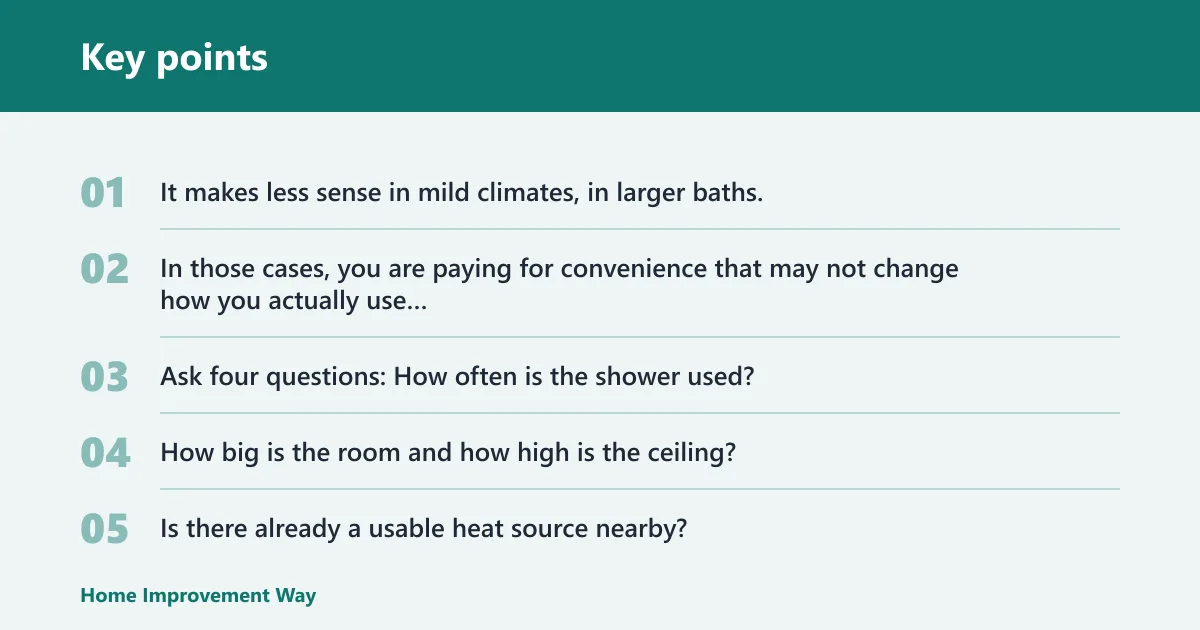
It makes less sense in mild climates, in larger baths, or where the heater would run only a few times each winter. In those cases, you are paying for convenience that may not change how you actually use the room.
Use pattern, room size, climate, and existing heat
Ask four questions: How often is the shower used? How cold does the room get? How big is the room and how high is the ceiling? Is there already a usable heat source nearby? Those answers matter more than brand names or accessory count.
| Factor | Score 0 | Score 1 | Score 2 |
|---|---|---|---|
| Bathroom size | Large primary bath | Mid-size bath | Small bath |
| Climate / season | Mild year-round | Mixed seasons | Cold climate or long cold season |
| Shower frequency | Occasional use | Several times a week | Daily or multiple daily showers |
| Ceiling height | Tall ceiling | Standard ceiling | Low or standard-low ceiling |
| Existing heat source | Strong room heat already present | Some nearby heat | No quick heat in the room |
How to read the matrix: 8 to 10 points usually supports a heater fan. 5 to 7 points suggests a standard exhaust fan may be enough unless you really value the extra warmth. 0 to 4 points points toward skipping the heater and spending on ventilation quality instead.
Say your bathroom is 6-by-7 feet, has an 8-foot ceiling, and sits on an exterior wall in a cold climate. If the shower is used every morning and the room has no nearby supply vent, a heater fan scores well because the comfort gain is immediate and the heat load is modest.
Suppose the bath is a 10-by-12-foot primary bath with a vaulted ceiling and a nearby register. The added heat becomes more of a feature than a solution. In that room, a stronger exhaust fan and a separate heat source usually make more sense.
Should you buy a bathroom fan with heater?
Buy it if your bathroom is small, cold, and used daily, and if you can install proper ducting and wiring. Skip it if the room is already warm, the ceiling is high, or the vent run will be long and hard to seal. In those cases, a standard exhaust fan is usually the cleaner purchase.
If your main goal is comfort, compare the combo unit against a separate heater plus a good exhaust fan. The combo wins when you want quick post-shower warmth in one compact fixture. The separate setup wins when you need flexibility, stronger room heating, or easier replacement later.
What size bathroom is a heater fan best for?
A heater fan is best for small bathrooms where the heated air can affect the room quickly. In compact spaces, a supplemental heating element can change the feel of the room fast enough to matter. In larger baths, the warm air spreads too thin, so the benefit drops sharply.
Ceiling height matters too. A standard-height ceiling keeps the warm air where you can feel it. Higher ceilings dilute the effect and make a combo unit feel less useful, even if the fan portion still handles moisture removal well.
Are bathroom fan heater combos safe?
They are safe when installed correctly, wired correctly, and ducted outside as intended. The safety issue is usually not the concept itself but improper installation, poor vent routing, or using the heater beyond its intended role. That is why code-compliant wiring and venting matter so much.
Do not treat the heater as a space heater for drying clothes or warming the whole house. Keep expectations realistic, follow the manufacturer’s electrical and mounting instructions, and make sure the fan can actually move moisture outdoors instead of trapping it in the assembly or attic.
Should I get a bathroom fan with heater or a separate heater?
Choose the combo if you want one ceiling-mounted unit to handle ventilation and short bursts of warmth in a small bathroom. Choose a separate heater if you need stronger comfort heating, already have a good exhaust fan, or want more flexibility in how you heat the room.
The combo is usually cleaner in a compact bath because it handles both moisture and warmth at the point of use. A separate heater is better when heating demand is higher than ventilation demand, or when the room layout makes a heater fan hard to place or vent correctly.
What features should I look for in a bathroom fan heater combo?
Start with CFM rating, then check the heater output, ducting plan, and control package. The best features are the ones that match how you use the room. A humidistat helps with automatic moisture control, a timer helps avoid wasted runtime, and a motion sensor adds convenience for quick entries.
A nightlight is useful in guest baths or hall baths used at night. It is not a core performance feature, but it can make the unit more practical without adding much complexity. Compare the noise data, durability notes, and installation details from each brand, then read owner feedback for those same points.
Do bathroom fan heaters need ducting?
Yes. Bathroom fan heater combos need to be connected to a duct system and should expel moist air outside. That is what lets the fan do its job, and it is essential for humidity control. Recirculating air does not solve the moisture problem in a bathroom.
Good ducting matters as much as the unit itself. Keep the run short and properly sealed when possible, and avoid leaks that waste airflow. If the vent path is poor, the heater fan loses value because the fan side cannot clear steam effectively.
Alternatives

- 1300W fast instant heat output
- 3-in-1 fan, light, and heater combo
- Quiet 1.5 SONE rating
The Osluken 3-in-1 Bathroom Exhaust Fan with Light and Heater, 110 CFM is a lower-cost way to get the combo idea in one fixture. Based on the spec sheet and reviews, its 1300W fast instant heat output and 110 CFM rating make sense for a small bathroom that needs quick comfort and solid airflow. A drawback is that 110 CFM may be more fan than some very small rooms need, and the 3-in-1 layout adds install complexity compared with a plain exhaust fan.
The Panasonic FV-0511VH1 WhisperWarm Bath Fan + Heater, 50-80-110 CFM is the more refined choice when you want airflow flexibility. Its Pick-A-Flow variable airflow settings and DC/ECM motor point toward efficient operation, and the Flex-Z Fast bracket should simplify installation. The drawback is price; at $298.00, it is a harder sell if you only want occasional warm-up in a tiny guest bath.
Frequently asked questions
Is a bathroom fan with heater worth it?
It is worth it mainly in a small, cold bathroom where you want fast post-shower warmth and need moisture removed at the same time. If the room is already warm, or if venting is difficult, the added heater is usually more convenience than value.
Do bathroom fan heaters use a lot of electricity?
They can draw a meaningful amount of power while the heating element runs, because the heater is doing more than a standard fan. The practical question is not just power draw, but runtime. Short bursts after a shower are easier to justify than long heating cycles.
Sponsored / affiliate links. As an Amazon Associate I earn from qualifying purchases. I may earn additional commission from eligible campaigns.