Best Bathroom Fans for Daily Shower Use: We Compared
For a shower used every day, choose a fan that moves at least about 1 CFM per square foot, consider 100+ CFM for enclosed or larger baths, and use a humidity sensor or timer so moisture is removed after every shower. Undersized or poorly controlled fans leave condensation on ceilings, feed mildew, and can damage paint, drywall, and framing. This guide shows the best fan profile for daily shower use, including airflow, controls, placement, and venting.
Quick comparison
| Product | Badge | Best for | Price | ||
|---|---|---|---|---|---|
 |
Broan-NuTone Bathroom Exhaust Fan with LED light – EasyBroan-NuTone | Our pick | 80 CFM · 1.5 Sones · LED Light | $76.26
Price as of 17 Oct 2026
|
View |
 |
JOEAONZ Bathroom Exhaust Fan 110 CFM Ceiling Mount, QuietJOEAONZ | Upgrade pick | 110 CFM · 1.0 Sones · Metal Motor | $59.99
Price as of 17 Oct 2026
|
View |
For daily showers, the right fan profile depends on bathroom size, shower enclosure, and how long the fan keeps running after the water stops. Airflow should come first. Control logic and duct quality decide whether that airflow actually clears moisture.
Use the comparison below as a short map, then match it to your bathroom size and venting path.
How we chose
The best fan for a shower used every day needs enough airflow for the room size, a control method that runs after the shower, and a noise level you can live with long term. Energy efficiency matters more when the fan runs often, and a backdraft damper matters when exterior air can push back through the duct.
Placement matters too. A fan near a shower needs the right enclosure listing and a GFCI-protected circuit where applicable, because good specs do not fix unsafe placement.
We prioritized these factors:
- CFM matched to bathroom size and shower frequency
- Humidity sensor, timer, or continuous-run logic for repeated daily use
- Sones rating balanced against airflow, not treated as the only goal
- Backdraft damper quality and duct performance
- ENERGY STAR efficiency for fans that run often
Quick picks
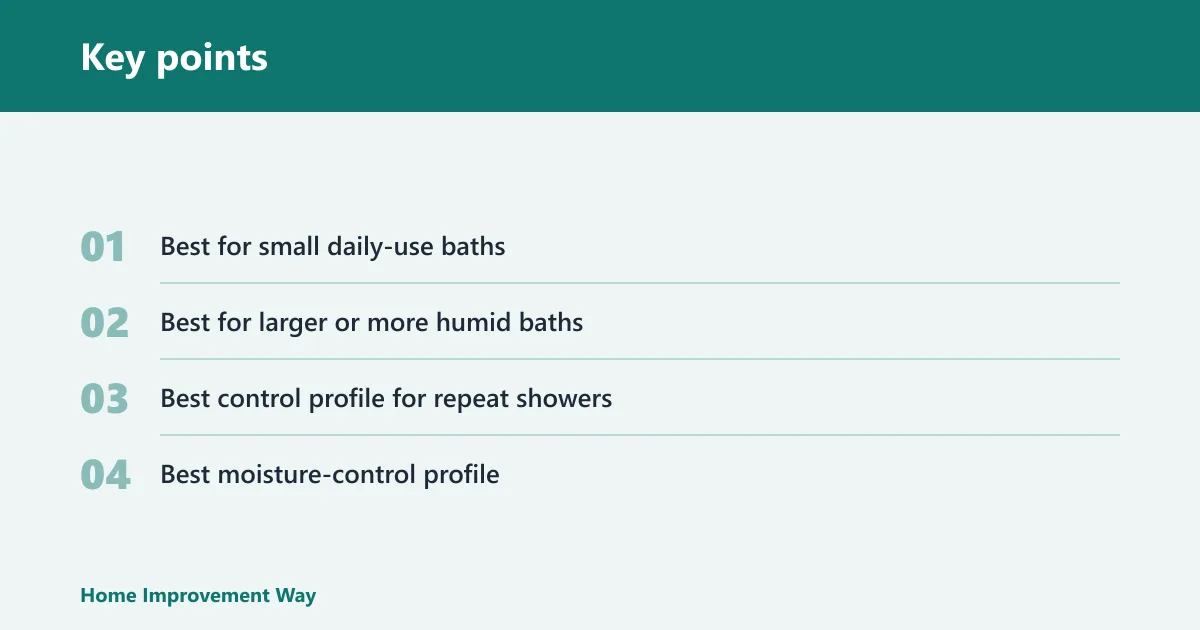
- Best for small daily-use baths: Broan-NuTone 80 CFM, under .3 Sone, ENERGY STAR. Strong if the room is compact and the duct run is straightforward.
- Best for larger or more humid baths: JOEAONZ 110 CFM, 1.0 sones. Better when you need more airflow without jumping to a loud unit.
- Best control profile for repeat showers: A humidity-sensor or timer-based fan that keeps running after each shower, especially when moisture hangs in the room.
- Best moisture-control profile: A continuous-running fan when the bathroom sees showers every day and the duct path is not ideal.
| Use pattern | Bathroom size | Enclosure placement | Venting quality | Recommended fan profile | CFM range | Sones target | Humidity sensor | Timer | Continuous run | Enclosure/GFCI caution |
|---|---|---|---|---|---|---|---|---|---|---|
| One daily shower in a compact bath | Up to 80 sq ft | Outside the direct spray zone | Short, straight duct run | Standard exhaust fan with post-shower timer | 80 to 100 | Under 1.5 | No or optional | Yes | No | Use the correct electrical listing if near a tub or shower |
| Primary bath with enclosed shower | 80 to 120 sq ft | Near the shower, but not in the spray zone unless listed | Moderate duct length | Humidity-sensor fan with timer backup | 100 to 110 | About 1.0 to 1.5 | Yes | Yes | Optional | GFCI-protected circuit and enclosure listing matter here |
| Large bath or weak duct run | 120 sq ft and up | Remote from spray but still close to the wet zone | Long duct run or multiple elbows | Higher-CFM fan with continuous-run or long-delay timer | 110 to 130+ | 1.5 or lower if possible | Yes | Yes | Yes | Check that the unit is approved for the installation location |
| High-moisture bath with long runtimes | Any size with heavy daily use | Standard ceiling mount | Poor exterior termination or backdraft risk | Continuous-running fan with damper | 100 to 130 | 1.5 or lower if practical | Yes | Yes | Yes | Placement near water needs the right listing and circuit protection |
Broan-NuTone 80 CFM: best for compact daily baths
This Broan-NuTone model fits a small bathroom that gets one daily shower and needs a balanced mix of airflow and low noise. Based on the manufacturer’s specs, it is rated at 80 CFM and under .3 Sone, and it is described as supporting a bathroom of up to 80 square feet.
That combination makes sense when the room is compact and the duct path is not fighting the fan. It is also ENERGY STAR certified, which helps if the fan will run often after each shower.
The drawback is simple: 80 CFM is not the right target for a larger primary bath or a shower that leaves the mirror, walls, and ceiling wet every morning. If the room is bigger, or if the duct run is long, this profile can be too modest even though it is very quiet on paper.
JOEAONZ 110 CFM: best for larger daily showers
This JOEAONZ fan fits bathrooms where airflow matters more than chasing the lowest noise figure. The published specs list 110 CFM and about 1.0 sone, and the model is described as having a humidity sensor that triggers at around 60% humidity, plus a rating for continuous running.
That makes it a strong fit for repeated shower use, especially in a primary bath where the shower is enclosed and the room stays damp after bathing. The heavier-duty motor housing is another plus for a fan expected to run a lot.
The tradeoff is that it is still a ceiling-mount fan that depends on good ducting. A weak exterior termination, too many elbows, or a leaky duct can erase the benefit of 110 CFM, so the install needs to support the spec.
What bathroom fan is best for a shower used every day?
The best bathroom fan for a shower used every day is usually a humidity-sensor or timer-controlled model sized to the room, with enough CFM to clear steam quickly after each shower. For many bathrooms, that means 80 CFM for compact spaces and 100 CFM or more for larger or enclosed showers.
Daily use changes the target. An occasional powder room can survive with a basic exhaust fan, but a shower-heavy bath needs airflow, after-run control, and a duct path that lets the fan keep working after the water stops.
Control logic matters as much as airflow
A fan that runs only while someone remembers to flip the switch off and on is easy to underuse. A timer or humidity sensor is better for daily showers because it keeps the fan on long enough to finish the job, not just for the length of the shower.
For repeated use, humidity sensors are often the most reliable choice. A common trigger point is around 60% relative humidity, which lines up well with a shower that drives the room above normal indoor moisture levels.
Why short runtimes fail
Suppose a 90-square-foot bath has a decent fan but the switch gets turned off two minutes after the shower. The mirror may look clearer, but moisture can still sit in the ceiling cavity, around trim, and inside the room air long enough to feed mildew.
That problem is more common than a weak CFM rating alone. Good specs do not help if the fan quits before the room dries.
Should I choose a quiet fan or a powerful fan for daily showers?
For daily showers, choose the most powerful fan that still keeps the sound level acceptable for the room. Lower sones are nice, but airflow matters more when the room gets steamy every day and you need moisture out fast.
A quiet fan with weak airflow can leave the bathroom damp. A louder fan with enough CFM may actually protect the room better, especially if it runs on a timer or humidity sensor after each shower.
How to balance noise and airflow
Sones measure noise output; lower numbers are quieter. CFM measures airflow, which is the quantity that removes moisture. If a bathroom is small and the duct path is good, a lower-sone fan can still be enough.
If the room is larger, enclosed, or used by multiple people each day, airflow should win. A fan that is slightly louder but sized correctly is usually the better long-term choice.
How many CFM do I need for a shower used every day?
A common starting point is about 1 CFM per square foot of bathroom floor area, then move higher when the shower is enclosed, the room is large, or the bathroom sees long or repeated showers. For many daily-use baths, 80 CFM is often the floor, and 100 to 130 CFM is commonly a better target.
If the room is 80 square feet or smaller, an 80 CFM unit can be enough when ducting is short and the after-run control is solid. Above that, or when the shower is a main daily shower, step up the airflow.
Bathroom size is the first sizing input
Start with square footage. That gives you a baseline before you think about noise, controls, or brand names. Then adjust upward for shower frequency, enclosure size, and duct length.
Here is a simple rule: more steam, more fan. A larger primary bath with a shower used every day should not be treated like a tiny guest bath used once a week.
Venting quality can cancel a good CFM rating
A high-CFM fan does not perform well if the duct is long, crushed, undersized, or filled with too many bends. Poor exterior termination can also make the fan work harder while moving less air out of the room.
That is why two 110 CFM fans can perform differently in real life. The one with the cleaner duct path usually wins.
Is a humidity sensor worth it for a shower bathroom fan?
Yes, a humidity sensor is worth it for most bathrooms with daily showers because it turns the fan on when moisture actually builds up, not just when someone remembers to flip a switch. A setting around 60% relative humidity is a common trigger point and works well for repeated shower use.
It is especially useful in homes where people shower at different times. The fan can respond to the room, not to a routine.
Sensor plus timer is the strongest setup
A humidity sensor handles the start of the cycle, and a timer can extend the run long enough to dry the room fully. That combination is better than a plain manual switch for a shower used every day.
If you are choosing between sensor-only and sensor-plus-timer, the second option is usually the safer bet for moisture control.
Do I need a fan rated for continuous running?
If the bathroom sees showers every day, a continuous-running fan can be a smart choice, especially in larger rooms or spaces with imperfect ducting. It keeps air moving all day, which helps control humidity more steadily than short bursts alone.
Not every daily-shower bathroom needs continuous operation, but it becomes more useful as the room gets larger, the shower gets more enclosed, or the moisture load rises.
When continuous run makes the most sense
This option works best in high-use primary baths, especially if the fan can run quietly enough to be left on for long periods. It is also helpful when the bathroom is connected to other damp spaces or tends to stay humid after showers.
Look for a unit described as rated for continuous running rather than assuming every exhaust fan can handle that duty cycle.
Can a bathroom fan be used inside or above a shower enclosure?
Only if the fan is specifically listed for that location and the circuit is protected as required. The article’s safety guidance allows tub or shower enclosure use when the unit is connected to a GFCI-protected circuit, but you still need to confirm the fan’s exact listing before placing it there.
Most bathroom fans belong outside the direct spray zone. Near-shower placement is a safety question first and a performance question second.
Placement limits near spray zones
Even a good fan should not be treated as a free-for-all above the shower. The location, product listing, and circuit protection all need to match the installation plan.
If the unit is not approved for that enclosure or zone, move it. Good moisture control does not justify an unsafe installation.
What matters more for a shower fan: CFM or sones?
For a shower used every day, CFM matters more first because moisture removal is the fan’s main job. Sones still matter, but a quiet fan that cannot move enough air will leave the bathroom damp and shorten the useful life of the install.
Once the fan has enough airflow for the room, then you narrow the options by sones, control type, and efficiency.
When airflow should win
If the bathroom is large, enclosed, or slow to dry, choose the higher-CFM option even if it is slightly louder. The JOEAONZ, for example, is rated at 110 CFM and 1.0 sones, which is a strong balance for many daily-use primary baths.
That is a better fit than a whisper-quiet model that cannot keep up with repeated showers.
When a quieter model is still enough
If the bathroom is small, the duct path is short, and the shower is not enclosed, a quieter fan can be the better buy. The Broan-NuTone model’s 80 CFM and under .3 Sone profile fits that kind of room well, especially with ENERGY STAR efficiency and a timer.
The key is to match the quiet option to a room that does not need a lot of airflow.
Which one should you buy?
Choose the Broan-NuTone 80 CFM model if your bathroom is small, the shower is used once per day, and you want a quiet fan with ENERGY STAR efficiency. Choose the JOEAONZ 110 CFM model if the bath is larger, the shower is enclosed, or you want humidity-sensor control with continuous-running support.
If the duct run is poor, prioritize the higher-CFM option and fix the vent path at the same time. A strong fan with bad ducting still underperforms, but a properly sized fan gives you room to recover some of that loss.
Best choice for a small daily-use bath
Start with the Broan-NuTone if the room is up to 80 square feet and you want a simple, quieter setup. It has enough airflow for a compact bath and adds ENERGY STAR efficiency for frequent operation.
Best choice for a primary bath
Start with the JOEAONZ if the bathroom is larger or the shower is enclosed. The 110 CFM rating, 1.0 sones noise level, humidity sensor at 60%, and continuous-running capability fit daily shower use better.
Best choice if your duct run is poor
Choose the stronger airflow option and inspect the duct path before installation. Long runs, too many elbows, and weak exterior termination reduce real-world performance more than many buyers expect.
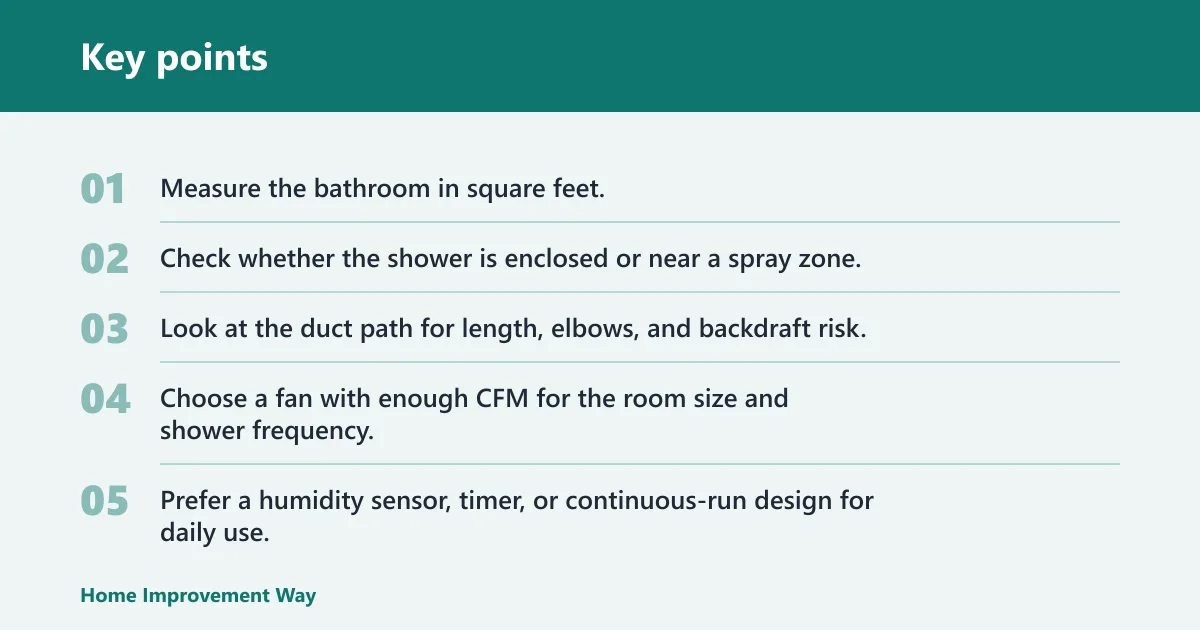
- Measure the bathroom in square feet.
- Check whether the shower is enclosed or near a spray zone.
- Look at the duct path for length, elbows, and backdraft risk.
- Choose a fan with enough CFM for the room size and shower frequency.
- Prefer a humidity sensor, timer, or continuous-run design for daily use.
- Confirm the electrical listing and GFCI protection if the unit is near the shower or tub.
Decision checklist table
| Check | What to look for | What it means for a daily-shower bathroom |
|---|---|---|
| Shower frequency | Every day, often twice a day, or multiple users | Move up to a fan with stronger airflow and automatic after-run control |
| Bathroom size | Square footage under 80, around 80 to 120, or above 120 | Use size to set the base CFM, then add margin for repeated showers |
| Enclosure placement | Outside spray zone, near shower, or in an enclosure | Use the correct listing and GFCI protection if the unit is near water |
| Venting quality | Short straight duct, moderate run, or long run with elbows | Poor venting pushes you toward higher CFM and better damper design |
| Control logic | Manual only, timer, humidity sensor, or continuous run | Daily showers need a control method that keeps the fan on long enough |
| Noise tolerance | Low, medium, or flexible | Choose the quietest model that still meets the airflow target |
| Efficiency | ENERGY STAR or not | More important when the fan runs often |
| Backdraft protection | Built-in damper or separate damper | Helpful when outdoor air can flow back into the duct |
What features help prevent mold in a daily-shower bathroom?
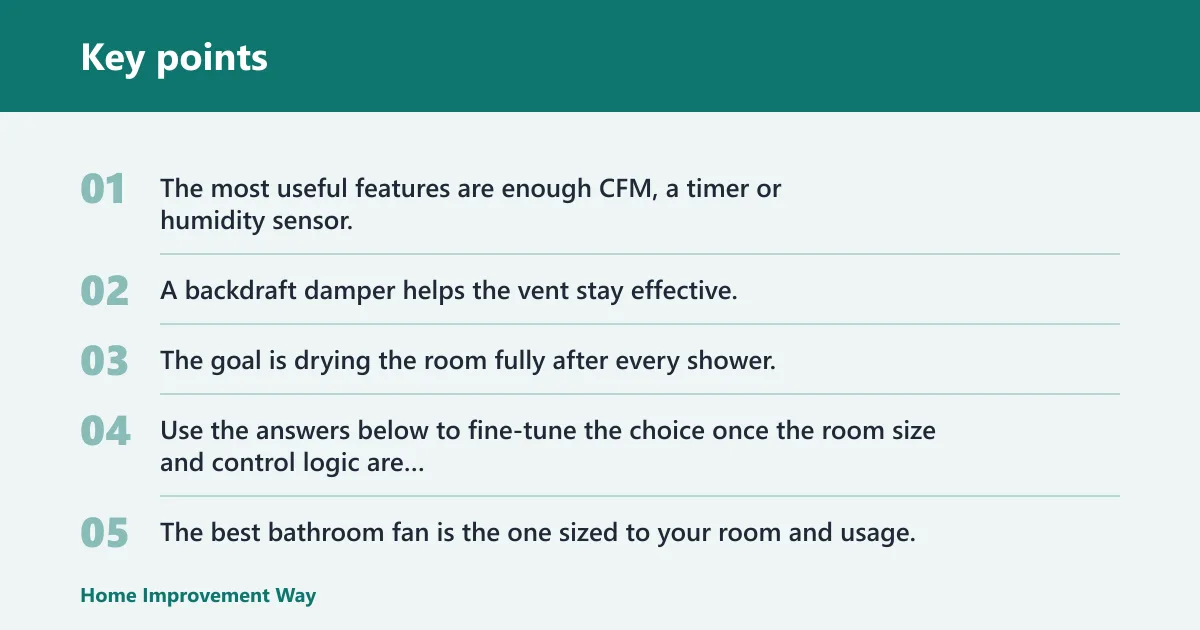
The most useful features are enough CFM, a timer or humidity sensor, and a duct system that actually carries moist air outside. A backdraft damper helps the vent stay effective, and ENERGY STAR can matter when the fan runs often. The goal is drying the room fully after every shower.
Frequently asked questions
Use the answers below to fine-tune the choice once the room size and control logic are set.
What is the best bathroom fan?
The best bathroom fan is the one sized to your room and usage, not the one with the lowest noise number on the box. For a shower used every day, that usually means 80 CFM for a small bath or 100+ CFM for larger, wetter rooms, plus a timer or humidity sensor.
What bathroom fan is best for a shower used every day?
A humidity-sensor fan with enough airflow for the room is usually the best fit, especially if it can keep running after the shower ends. A fan rated for continuous running is even better when the bathroom is used heavily or the duct path is not ideal.
Should I choose a quiet fan or a powerful fan for daily showers?
Choose the more powerful fan if the bathroom is medium or large, because moisture removal matters more than the last bit of quiet. In a small room with good venting, a quieter fan can work well, but only if it still clears steam quickly.
How many CFM do I need for a shower used every day?
Start around 1 CFM per square foot of bathroom area, then move up when the shower is enclosed, the room is larger, or the duct run is weak.
Is a humidity sensor worth it for a shower bathroom fan?
Yes. A humidity sensor is one of the best control upgrades for a daily-shower bathroom because it responds to actual moisture, not memory. A trigger near 60% relative humidity is a common starting point, and pairing it with a timer makes the fan more reliable.
Do I need a fan rated for continuous running?
Not always, but it is a strong option for high-use bathrooms. Continuous-running fans are useful when showers happen every day, the bathroom stays damp, or the duct path is not perfect. They help manage moisture steadily instead of waiting for short bursts.
Sponsored / affiliate links. As an Amazon Associate I earn from qualifying purchases. I may earn additional commission from eligible campaigns.