Bathroom fan CFM vs sones: choose airflow vs quiet
CFM measures how much air a bathroom fan moves in a minute. Sones measure how loud the fan sounds. For many bathrooms, start at roughly 1 CFM per square foot, then choose a lower-sone fan only if the airflow still suits the room and moisture load. Too little CFM leaves humidity behind, which can feed mildew, peeling paint, and fogged mirrors. This guide explains both ratings and when to favor quieter operation versus stronger ventilation.
| Decision factor | Bathroom fan CFM | Sones: what each rating means | Winner |
|---|---|---|---|
| Main job | Measures airflow, so it tells you how much air the fan can move. | Measures noise, so it tells you how loud the fan will sound. | Bathroom fan CFM |
| Best for sizing | Used to match fan output to square footage, fixtures, and duct losses. | Does not size the fan for the room; it only helps you choose how quiet it should be. | Bathroom fan CFM |
| Comfort during use | Can be louder if airflow is the priority. | Lower ratings are generally quieter, and around 1.5 sones or less is often described as quiet. | Sones: what each rating means |
| Moisture control | Better fit when showers, long duct runs, or multi-fixture rooms need more exhaust. | Quiet operation helps comfort, but it cannot make up for weak airflow. | Bathroom fan CFM |
| Selection priority | Should win when the room is larger, used often, or prone to humidity buildup. | Should win when the room is small, lightly used, and noise matters more than speed. | Tie |
What do CFM and sones mean on a bathroom fan?


CFM is the airflow rating. It tells you how much air a fan can move, and it is the number you use to size the fan to the room. Sones is the standardized loudness rating. Lower sones mean less noise, which matters most when the fan runs for longer periods or near sleeping spaces.
CFM is the number that moves moisture out
CFM matters because bathroom fans are ventilation devices first. If the fan does not move enough air, humidity hangs around after a shower and can leave fogged mirrors, damp corners, and slower-drying surfaces. That is where mildew risk rises.
Sones is the number you hear
Sones describes how noisy the fan feels in use. Bathify says most homeowners call 1.5 sones or less quiet, which makes that a practical target for many bathrooms. A low-sone fan is easier to live with, but it is still only a win if the airflow is enough for the room.
Bathroom fan CFM and sones solve different problems. One handles ventilation. The other handles comfort.
How many CFM do you need for your bathroom?
For bathrooms under 100 square feet, a simple starting point is 1 CFM per square foot. For larger or multi-fixture bathrooms, the fixture method is often a useful sizing check: roughly 50 CFM per toilet, around 50 CFM per sink, and about 50 to 100 CFM for a shower or tub. Round up irregular rooms instead of rounding down.
Use square footage first for small bathrooms
Bathify uses 1 CFM per square foot for bathrooms under 100 square feet, and that fits the HVI baseline sizing rule as a starting point. A 60-square-foot bath begins around 60 CFM. A 90-square-foot bath begins around 90 CFM.
Switch to the fixture method when the room is larger
Once a bathroom has multiple wet sources, square footage can understate the load. A primary bath with a toilet, sink, and shower may need more than the floor area alone suggests. The fixture method captures the fact that showers drive a lot more moisture than a powder room sink.
Suppose a 75-square-foot hall bath has a toilet, sink, and tub-shower combination. Square footage alone points near 75 CFM, but the fixtures support a stronger fan choice, especially if the duct run is long or the room fogs after every shower.
Why you round up irregular rooms
L-shaped layouts, alcoves, and partial walls can trap moisture in corners. Measure length times width for the usable bath area, then round up when the shape is not a simple rectangle. That keeps the fan from being sized to the smallest easy number instead of the real room.
Is a lower sone rating always better?
No. Lower sones are usually better for comfort, but they are not automatically better for the room. A fan that is quiet and weak may leave humidity behind, while a slightly louder fan can dry the space faster and protect paint, grout, and drywall.
What homeowners usually hear as quiet
For many homeowners, 1.5 sones or less feels quiet. That is a reasonable target for a guest bath, powder room, or primary bath where the fan may run late at night. Quiet matters when you want the fan on long enough to clear moisture without being annoying.
When a quieter fan is the right compromise
Choose lower sones when the bathroom is small, used briefly, or located near bedrooms. A powder room with a short duct run can often prioritize noise comfort over high airflow. In that case, the room is not asking the fan to clear heavy shower moisture.
When airflow should beat noise
Pick the higher-CFM fan when the bathroom sees daily showers, multiple fixtures, or persistent condensation. If mirrors stay fogged, corners stay damp, or surfaces dry slowly, airflow is the problem. Quiet operation cannot fix undersized exhaust.
How do I balance bathroom fan airflow and noise?
Balance them by starting with the required airflow, then choosing the quietest fan that still meets the room’s actual load after duct losses. For many homeowners, that means accepting a bit more sound to get enough drying power. The goal is not the quietest fan on the shelf; it is the right fan in the room.
Use use-case first, not the lowest number on the box
A kids’ bath with back-to-back showers needs more airflow than a rarely used guest bath. A primary bath used before work and again at night sits in the middle. The same CFM and sone rating will not feel right in both spaces.
Choose control type with the rating
A standard switch depends on the user remembering to turn the fan on and leave it running long enough. A timer helps because it keeps the fan on after the light goes off. A humidity-sensing auto-on setup is useful where shower steam is the main problem, because it starts ventilation when moisture rises.
A common first-timer mistake is buying a very quiet fan for a shower-heavy bath, then discovering that the mirror still fogs 20 minutes later. The fan may sound pleasant, but the room still needs more air movement.
How do duct run, elbows, and mounting type change real airflow?
Rated CFM is not the same as installed airflow. Long ducts, multiple elbows, and a poor mounting match can reduce real performance after installation. Ceiling-mount, wall-mount, and inline fans all fit different layouts, and the duct path often matters as much as the fan label.
Why rated CFM is not installed CFM
The package rating is a lab number, not a guarantee at the grille. Resistance from duct length and bends lowers delivered airflow. Bathify recommends a 20-30% buffer above the code minimum, which is a practical way to make room for those losses.
Ceiling-mount, wall-mount, and inline fit
Ceiling-mount fans suit most standard bathrooms with short, direct duct runs. Wall-mount fans can fit rooms where venting straight through an exterior wall is simpler. Inline fans are useful when the duct run is long or when you want the motor farther from the occupied room for lower perceived noise.
Quick way to account for long runs and bends
If the duct run is long or has several elbows, step up one size rather than buying at the bare minimum. A fan listed at 80 CFM may behave like a weaker unit once the duct path is added. More turns and more distance generally mean more resistance.
One-page rated vs installed performance checklist
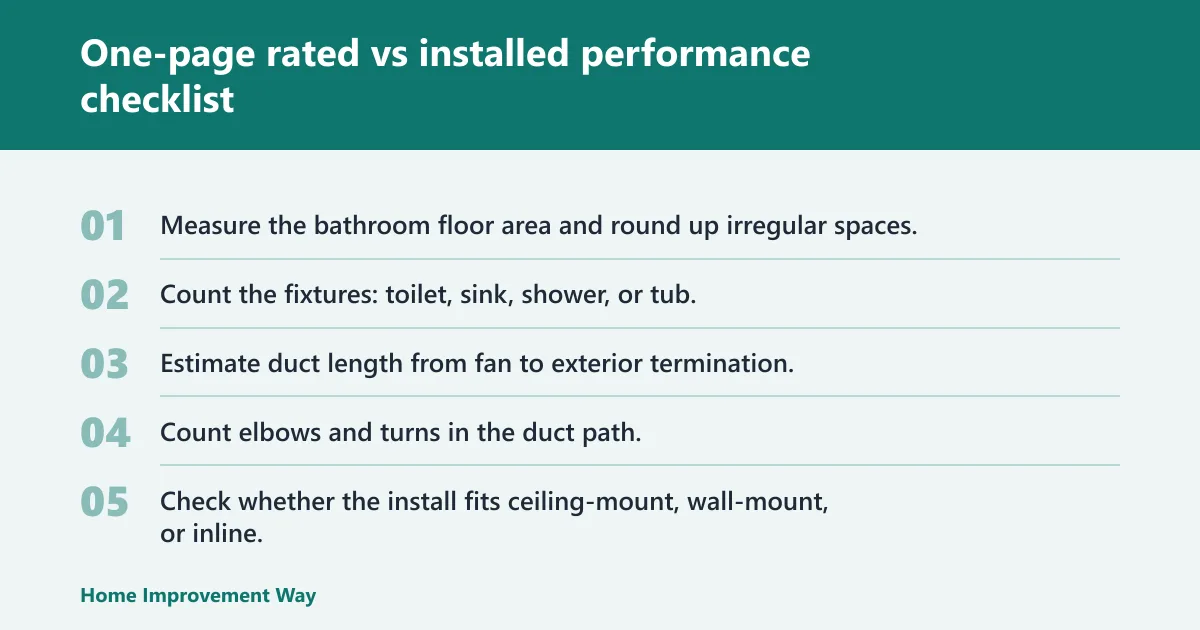
Use this checklist to compare the fan rating on the box with the airflow your bathroom is likely to get after installation. It is a one-page way to connect bathroom size, fixture count, duct run, elbows, and mounting type to a realistic target.
| Bathroom scenario | Bathroom size / fixtures | Estimated duct length | Elbows | Mounting type | Target CFM / sone range |
|---|---|---|---|---|---|
| Small powder room | 30-40 sq ft; toilet and sink | Short, under 10 ft | 0-1 | Ceiling-mount or wall-mount | 40-50 CFM; about 1.5 sones or less |
| Hall bath with shower | 50-80 sq ft; toilet, sink, shower | 10-20 ft | 1-2 | Ceiling-mount, or inline if access is tight | 80-100 CFM; 1.5-2.5 sones |
| Primary bath | 80-120 sq ft; toilet, dual sinks, shower or tub | 15-30 ft | 2-3 | Inline preferred for long runs | 100-150 CFM; 1.5-3.0 sones |
| Large or high-use bath | 120+ sq ft; multiple fixtures, frequent showering | 20+ ft | 2-4 | Inline or high-capacity ceiling unit | 150+ CFM; 2.0-3.0 sones |
- Measure the bathroom floor area and round up irregular spaces.
- Count the fixtures: toilet, sink, shower, or tub.
- Estimate duct length from fan to exterior termination.
- Count elbows and turns in the duct path.
- Check whether the install fits ceiling-mount, wall-mount, or inline.
- Choose a CFM target that clears moisture after losses, then choose the quietest sone rating that still fits that airflow.
When should I choose a higher-CFM fan over a quieter one?
Choose higher CFM when the room is larger, gets frequent showers, has multiple fixtures, or shows signs of lingering moisture. A quieter fan is fine for light use and small spaces, but airflow should win whenever condensation and drying time become a problem. That is the tradeoff that protects the room.
Signs your current fan is undersized
Look for fogged mirrors that clear slowly, damp drywall near the ceiling, moisture in corners, or mildew-prone trim. If the room still feels humid long after the fan shuts off, the fan may be moving too little air, running too briefly, or fighting too much duct resistance.
When the quieter option still makes sense
A quiet fan is a strong choice for a powder room, a guest bath, or a small bath with a short duct run. In those cases, the moisture load is lower, so you can favor comfort without giving up necessary ventilation. The room, not the noise rating, should set the limit.
Verdict: Bathroom fan CFM or sones: what each rating means?
Choose Bathroom fan CFM if you are sizing a fan for a 60-square-foot to 90-square-foot bathroom, a hall bath with a shower, or a primary bath with multiple fixtures and you need enough airflow to clear humidity, fogged mirrors, and damp corners.
Choose sones: what each rating means if you are picking the quieter fan for a small powder room, a guest bath, or a bathroom near bedrooms where 1.5 sones or less feels quiet and comfort matters more than maximum exhaust.
Frequently asked questions
What does CFM mean on a bathroom fan?
CFM means cubic feet per minute. On a bathroom fan, it is the airflow rating and the number used to size the fan to the room’s square footage. Higher CFM moves more air, which usually means faster moisture removal after showers.
What does sone mean on a bathroom fan?
Sones is the standardized loudness rating for the fan’s noise level. Lower sones are quieter. Many homeowners consider 1.5 sones or less quiet, but the best target still depends on whether the room is a powder room, hall bath, or primary bath.
How much extra CFM should I add for duct runs?
Bathify recommends a 20-30% buffer above the code minimum, which helps cover duct losses from length and elbows. Long runs, several turns, and inline routing can all reduce delivered airflow. If the duct path is complicated, stepping up in size is often the safer choice.
Sponsored / affiliate links. As an Amazon Associate I earn from qualifying purchases. I may earn additional commission from eligible campaigns.
 LIVOWALNY Portable Jobsite Fan Compatible with Milwaukee 18v Battery (Tool Only) 8" Cordless Works Fan Batteries Powered Fans 21W 3000RPM Portable Air Circulator, USB and Type C Charging Port
 VEVOR Tower Fan, 22 ft/s Velocity Quiet Floor Fan, 70° Oscillating Fans for Indoors with 3 Speeds, 4 Modes, 12H Timer, Portable Standing Bladeless Fan with Remote Control for Bedroom, Office, Home