Bathroom Fan Placement: Center of Room vs Near the Shower
Place a bathroom exhaust fan near the shower or tub whenever ducting allows, because that spot pulls steam out fastest. Center of room placement is a fallback for whole-room moisture control or easier framing, not the default. A poor location leaves moisture on tile, drywall, and paint longer, which can lead to stains, mildew, and slower drying. This guide compares moisture capture, duct routing, and installation limits so you can choose the right spot.
| Decision factor | center of room | near the shower | Winner |
|---|---|---|---|
| Moisture capture speed | Good for mixing and whole-room pull, but farther from the steam plume | Intercepts rising steam sooner, before it spreads across the ceiling | near the shower |
| Duct routing | Often easier to keep straight if the attic access and joists line up | Can require a longer run or extra offsets if the shower is off-center | center of room |
| Retrofit difficulty | May fit existing framing better in older baths with a central joist bay | Can be harder if joists, wiring, or a light fixture already occupy the ideal bay | center of room |
| Wet-location flexibility | Usually avoids the stricter rules tied to over-shower mounting | Can be used over a tub or shower only if the fan is listed for that location and installed to the instructions | center of room |
| Control strategy dependence | Timer or humidity control helps remove leftover humidity after the shower ends | Still benefits from a timer, but its placement already does more of the capture work | near the shower |
Where bathroom fan placement makes the most difference
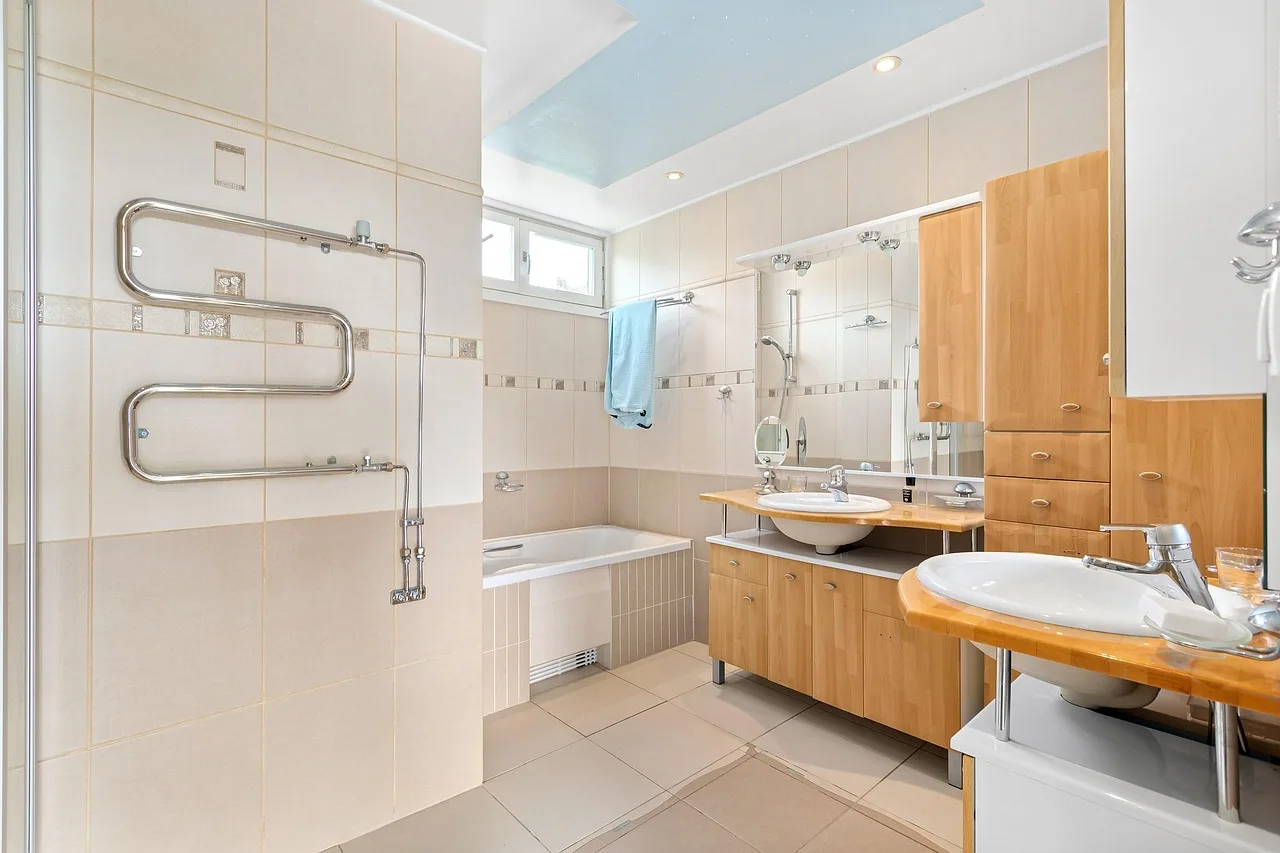
Near the shower is usually the better pick because the fan can catch steam before it spreads across the ceiling and condenses on cooler surfaces. Center of room placement can still work, especially in a small or symmetrical bath, but it is mainly a compromise when framing or ducting makes the shower-side spot impractical.
What each location is trying to catch
A fan near the shower is aimed at the highest moisture source, so it grabs warm, humid air while it is still concentrated. A center-of-room fan is trying to pull from the whole room evenly, which can be fine for odors and general humidity, but it may miss the thickest part of the shower plume.
Why distance to the shower matters more than symmetry
Shower steam rises quickly, spreads under the ceiling, then cools on the first cold surfaces it reaches. If the fan sits too far away, much of that moisture reaches the ceiling, corners, mirror, and drywall before the fan can move it out.
Say your bathroom is 5 feet by 8 feet with a single shower on one short wall. A fan centered over the room may still dry it eventually, but a fan placed closer to the shower can start removing humid air before condensation forms on the opposite wall and ceiling trim.
When the room center is still the better choice
Center of room can win when the ceiling joists make the shower-side bay impossible, or when the room is so compact that the center is already close to the shower. It can also be the cleaner solution in a hall bath where the toilet, vanity, and shower all share the same small volume.
How steam moves
Shower steam does not stay in one neat column. It rises fast, spreads under the ceiling, then drifts toward cooler surfaces and small air currents, which is why placement matters more than visual balance. The fan works best when its intake sits near the path that humid air naturally follows.
Where the moisture plume rises
Hot shower air rises above the enclosure, then spreads sideways once it hits the ceiling plane. In an open shower, that plume can fan out quickly across the room; in a glass enclosure, it may stay trapped until the door opens or the fan starts pulling.
Where condensation tends to form first
Condensation usually shows up on the nearest cool surfaces, the ceiling above the shower, painted drywall near the upper wall, mirror edges, and any trim or recessed detail that does not dry quickly. If the fan is far away, those surfaces can stay wet long enough to support mildew growth.
Why ceiling height and airflow path matter
A taller ceiling gives the steam more room to spread before it reaches the fan intake. A short, direct path from shower to fan reduces that spread, while door swings, half walls, and partitions can block or redirect the air the fan needs to capture.
How close can a bathroom exhaust fan be to the shower?
As close as the fan’s listing, manufacturer instructions, and local code allow. If the unit is installed over a tub or shower, it must be specifically listed for that location, and shower-area installations commonly involve wet-location rules and GFCI protection where required by the listing or code authority having jurisdiction.
Listed-over-shower requirements
Do not assume any ceiling fan can go over a shower. The fan housing, trim, and electrical parts must be approved for that wet location, and the installation has to match the manufacturer’s instructions exactly. If the fan is not listed for over-shower use, move it out of that zone.
Clearances, GFCI, and code checks
A common example is about a 3-foot clearance from the tub or shower opening for fixtures that are not listed for direct wet-location installation. That is not a universal rule, so the fan’s listing and your local electrical and mechanical code still control the final decision.
- Check the fan box and installation sheet for an over-tub or over-shower listing.
- Confirm the clearance rules that apply in your jurisdiction.
- Verify whether the circuit needs GFCI protection for the intended location.
- Match the housing size to the joist bay before cutting drywall.
- Keep the duct run as short and straight as practical.
Center placement limits
Center of room placement can fail when the shower sits at one end of a long bath, because the fan is too far from the moisture source to catch the plume early. It works best in compact rooms, in layouts with a central shower, or where framing makes a shower-side location impossible without major duct penalties.
When the center leaves steam behind
Long narrow bathrooms are the most obvious problem. In those rooms, the center may be several feet away from the shower opening, which gives steam time to spread and settle before the fan intake sees it.
Rooms where the center works well
Small square bathrooms can be forgiving because the center is still close to the shower, toilet, and vanity. If the room volume is small and the duct run stays short, center placement can dry the space acceptably without major tradeoffs.
How door swings and partitions affect capture
A door that opens across the plume path can block airflow or send humid air into the hall before the fan grabs it. Half walls, glass panels, and toilet partitions can also guide the steam away from the intake, which matters as much as the raw distance.
Fan placement comparison table
This table compares eight common layouts. The right answer changes with the room shape, joist direction, and how hard it is to route the duct to the exterior.
| Layout | Best fan location | Why it wins | Likely duct-routing penalty | Retrofit difficulty | Can a timer or humidity switch offset a weaker spot? |
|---|---|---|---|---|---|
| 5 x 8 hall bath, shower on one short wall | near the shower | Shortest path to the steam plume and less ceiling spread | Low if the attic bay lines up; moderate if the exterior termination is off to one side | Low to moderate | Yes, but only partly |
| Long narrow bath, 5 x 12, shower at the far end | near the shower | Center placement leaves too much distance for steam to travel | Moderate to high if the shower-side bay needs extra offsets | Moderate | Partly, but it cannot fix poor capture |
| Small square bath, shower and vanity on adjacent walls | center of room | The center is still close enough to pull from the whole room | Low | Low | Usually yes |
| Primary bath with enclosed shower and separate toilet compartment | near the shower | The shower is the main moisture source, so capture there matters most | Moderate if the enclosure blocks the best joist bay | Moderate to high | Yes, but the fan still belongs near the shower |
| Toilet-adjacent layout with a tub-shower opposite the door | near the shower | Over the toilet helps odors, but not the steam plume from bathing | Moderate | Moderate | Yes for odor control, no for missed steam |
| Retrofit with joists crossing the ideal shower-side bay | center of room | Framing limits may make the shower-side location too disruptive | High if rerouting around joists would force multiple bends | High | Yes, if the center is still reasonably close |
| Bath with attic access directly above the shower | near the shower | Gives the shortest practical run and the fewest bends | Low | Low | Rarely needed |
| Vaulted ceiling with a remote exterior wall termination | center of room | May be easier to duct cleanly without long angled runs | High either way; the cleaner route usually decides it | High | Sometimes, but only if the fan still reaches the shower air |
Ducts, joists, and damper
The best location still loses ground if the duct run is long, kinked, or poorly terminated. A short, straight path to the exterior keeps static pressure down and helps the fan deliver more of its rated airflow in the real room, not just on paper.
Shortest practical duct run
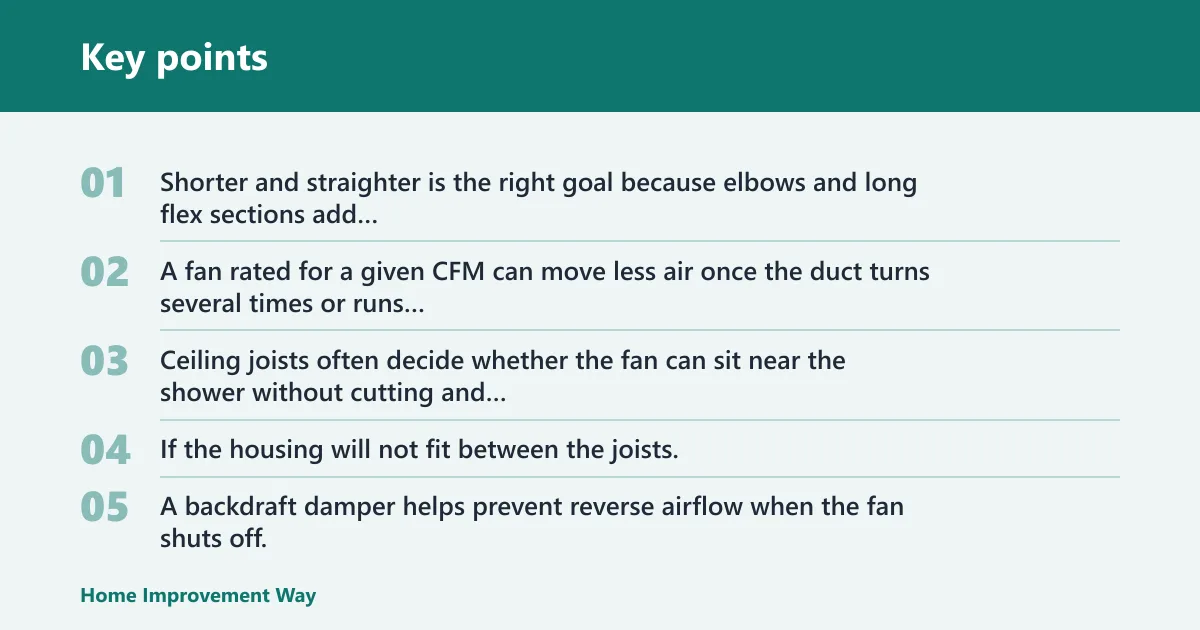
Shorter and straighter is the right goal because elbows and long flex sections add resistance. A fan rated for a given CFM can move less air once the duct turns several times or runs a long distance through an attic or soffit cavity.
How joists can block the ideal spot
Ceiling joists often decide whether the fan can sit near the shower without cutting and reframing. If the housing will not fit between the joists, or if the duct would need a string of offsets to reach the exterior, the installation may be easier in a different bay even if that is not the perfect capture point.
Backdraft damper and termination basics
A backdraft damper helps prevent reverse airflow when the fan shuts off, which keeps outside air and attic moisture from drifting back into the room. The duct should terminate outside with a proper wall cap or roof cap, not in an attic or crawlspace, so moisture does not collect in hidden cavities.
Fan airflow rating still matters. A stronger CFM rating cannot fully rescue a bad location, but it can help when the room is larger than average or when the duct route adds some penalty. Start with the room volume, then choose the closest practical fan location that the framing and code allow.
Suppose a primary bath has a shower tucked into one corner and the nearest joist bay is blocked by a ceiling light. If the installer moves the fan six feet to the center to avoid rerouting the framing, a humidity switch may help run the fan long enough after the shower ends, but it will not pull steam from the shower as quickly as a fan placed closer to the plume.
Verdict
Choose near the shower if you can keep the duct run reasonably short, the fan is listed for the intended location, and the framing allows a clean installation. Choose center of room only when it is the better compromise for joists, duct routing, or a compact bath where the center is still close to the moisture source.
For mold and condensation control, the best fan location is the one that reaches the shower air first, not the one that looks most balanced on the ceiling. Use a timer or humidity switch to finish drying the room, but do not rely on controls to make up for a fan that is too far from the shower.


Frequently asked questions
Should a bathroom fan be centered in the room or placed near the shower?
Near the shower is often better because it can capture the moisture plume before it spreads across the ceiling. Center of room placement can work in small baths or when framing leaves no good shower-side option, but it is generally the backup choice, not the first one.
Is it better to put the fan over the toilet or over the shower?
Over the shower is usually better for moisture control because that is where the steam starts. Over the toilet may help with odor removal, but it can leave the shower plume to spread across the room before the fan gets to it.
Does a bathroom fan need to be in the ceiling center of the room?
No. A fan does not need to be centered if a different spot captures moisture better. The real test is whether the location works with the shower plume, the joists, and the duct route while still following the fan’s listing and the local code.
What happens if the bathroom fan is too far from the shower?
Steam has more time to spread, cool, and condense on tile, paint, and drywall before the fan removes it. That can leave the room damp longer, which is exactly the kind of condition that supports mildew and lingering odors.
Where should a bathroom fan go in a small bathroom with one shower?
In a small bathroom, the best spot is usually the one closest to the shower that still allows a short, direct duct run. If the room is compact enough, center of room placement may be acceptable, but the shower-side option usually captures moisture faster.
Sponsored / affiliate links. As an Amazon Associate I earn from qualifying purchases. I may earn additional commission from eligible campaigns.