Bathroom Fan Retrofit vs Full Replacement: Which Is Smarter?
Choose a retrofit when the housing, duct, and wiring are sound and the labor is simple; choose full replacement if the fan is noisy, undersized, corroded, or the ceiling will already be opened. A bad call can mean repeated repairs, weak ventilation, mold risk, and paying twice for labor. This guide compares cost, ceiling access, and the condition checks that make retrofit the better move over replacement.
| Decision factor | Bathroom fan retrofit | full replacement | Winner |
|---|---|---|---|
| Installed cost | Usually lower when the existing housing stays in place and the job is limited to a motor assembly, blower, grille, or kit swap. | Usually higher because the whole unit comes out, and labor for replacing a fan typically runs between $250–$400. | Bathroom fan retrofit |
| Ceiling disruption | Can avoid drywall repair when the kit matches the housing and the work stays within the existing opening. | May require a new cutout, ceiling patching, or changes to the mounting opening during the swap. | Bathroom fan retrofit |
| Fit and compatibility risk | Higher risk if the model number, housing dimensions, or wiring style do not match the kit. | Lower fit risk for the fan unit itself, but the duct and ceiling opening still need adaptation. | full replacement |
| Housing or duct damage | Poor choice when the housing is rusted, warped, or the duct connection is failing. | Better when the housing, duct path, or ceiling opening has visible damage or poor fit. | full replacement |
| Work scope | Best for a targeted repair or upgrade with minimal teardown. | Best for a remodel, a failed housing, or a system that needs a fresh start. | full replacement |
The cost, disruption, and fit gaps between the two paths
The main trade-off is simple: retrofit is usually less disruptive when the housing, wiring, and duct path are still sound; full replacement is smarter when the housing, duct, or ceiling opening is compromised. That difference matters more than the motor itself, because weak airflow often comes from fit, duct layout, or damaged parts, not only from a tired fan.
Installed cost
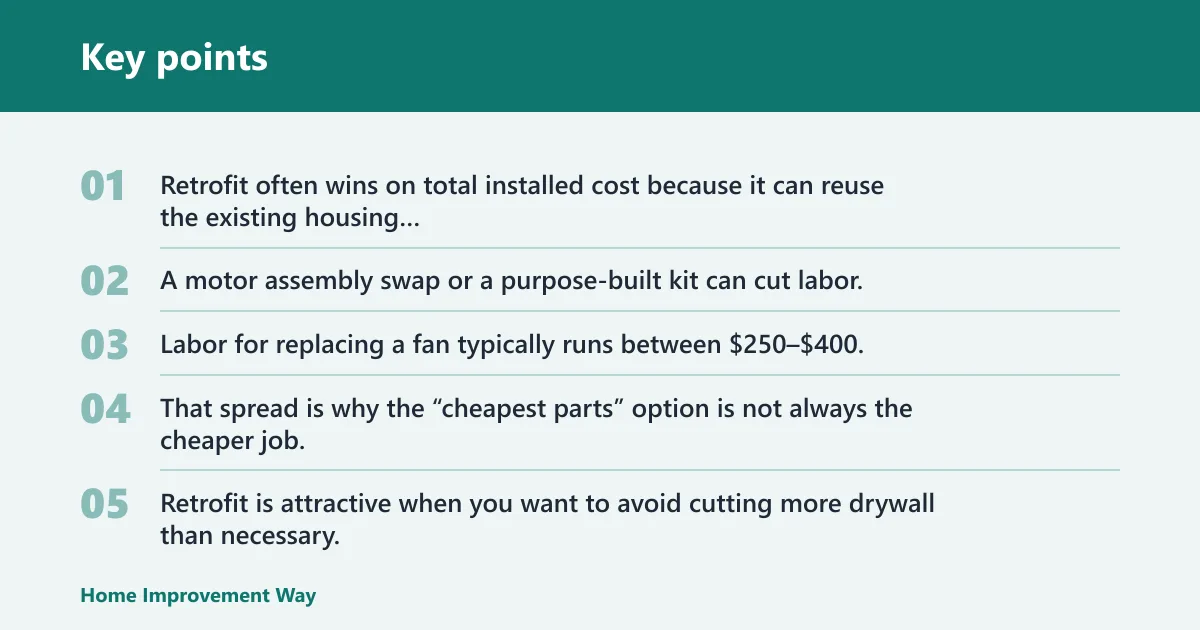
Retrofit often wins on total installed cost because it can reuse the existing housing and ceiling opening. A motor assembly swap or a purpose-built kit can cut labor, while full replacement adds removal work, adaptation, and a higher chance of patching.
Labor for replacing a fan typically runs between $250–$400, and some changeouts start at $500. New installs can start around $800. That spread is why the “cheapest parts” option is not always the cheaper job.
Ceiling disruption
Retrofit is attractive when you want to avoid cutting more drywall than necessary. Broan-NuTone’s QuicKit line is built for replacement work with no wiring, cutting, or drywall repair, which shows how much disruption a well-matched kit can avoid.
Full replacement is the better move when the existing opening is the wrong size for available units, when the housing is rusted, or when the remodel already includes ceiling repair. If the ceiling has to come open anyway, the disruption gap shrinks.
Fit and compatibility risk
Retrofit has the tighter fit requirements. The model number matters more than CFM alone, and the housing dimensions must match the kit. Broan-NuTone’s BKR60 supports 7-1/2″ x 7-1/4″ and 8-1/16″ x 7-3/8″ housings, but it does not fit 8″ x 8-1/4″ housings.
Full replacement lowers the risk of mismatched internals, but it does not remove all fit work. Duct diameter, duct length, bends, and mounting layout still affect the job, and a bad duct path can limit performance even after a new fan goes in.
Bathroom fan decision table
| Scenario | Recommended action | Likely labor level | Disruption level | Key inspection checkpoint |
|---|---|---|---|---|
| Dead motor | Start with a motor assembly swap or retrofit kit if the housing and wiring are still sound. | Low to medium | Low | Confirm the exact model number and whether the motor assembly is sold separately. |
| Noisy but functional fan | Retrofit if the noise comes from worn internals and the housing fits the kit. | Low to medium | Low | Check the sones rating and inspect the housing for looseness, rust, or vibration points. |
| Rusted housing | Full replacement is usually the smarter move. | Medium to high | Medium to high | Look for corrosion, warped mounting points, and damage around the ceiling opening. |
| Undersized airflow | Choose the option that truly meets the required CFM, which may be full replacement if the current housing cannot support it. | Medium | Medium | Measure room size, then check whether the existing duct can support the higher airflow target. |
| Failed duct connection | Full replacement with duct correction is usually the safer choice. | Medium to high | High | Inspect the duct collar, joints, and route for leakage, collapse, or disconnection. |
Dead motor
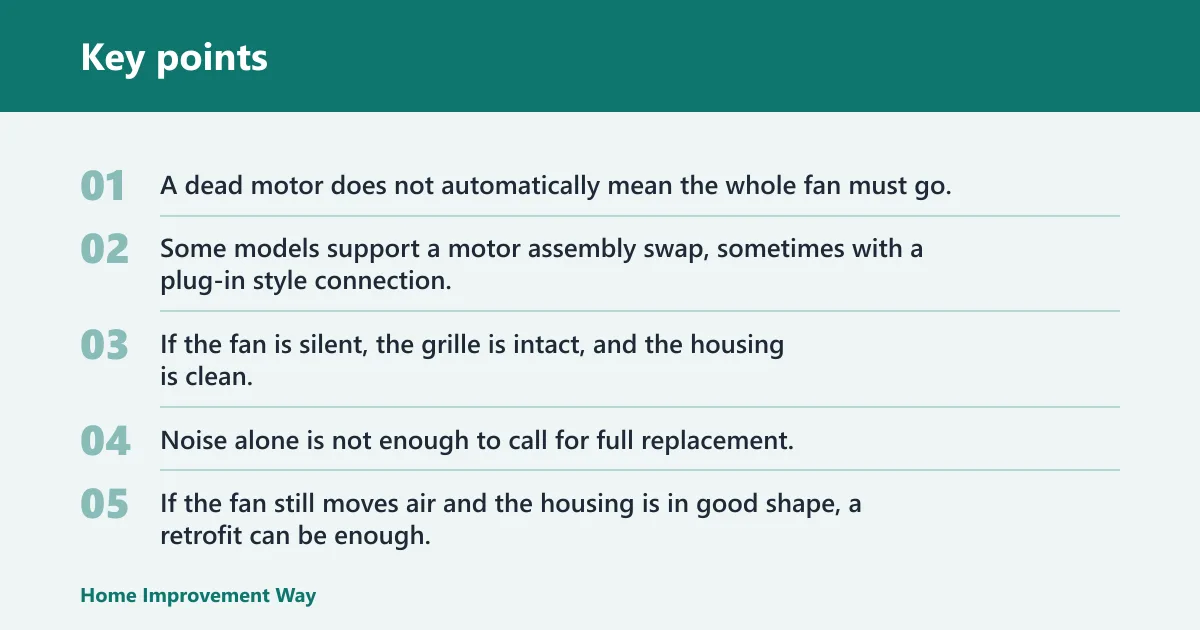
A dead motor does not automatically mean the whole fan must go. Some models support a motor assembly swap, sometimes with a plug-in style connection, which keeps the ceiling work small and avoids a full tear-out.
If the fan is silent, the grille is intact, and the housing is clean, but the motor no longer starts, a matched assembly or retrofit kit can solve the problem with less labor than full replacement.
Noisy but functional fan
Noise alone is not enough to call for full replacement. If the fan still moves air and the housing is in good shape, a retrofit can be enough, especially when the issue is worn bearings, loose parts, or an outdated grille assembly.
Use the sone rating to judge how much noise you are trying to remove. 0.5 sone or lower is nearly silent, 1.0–2.0 sones is quiet, and 4.0+ sones is loud and potentially disruptive.
Rusted housing
Rust changes the decision fast. Corrosion can weaken the housing, damage mounting points, and make a tidy retrofit a short-term fix that leaves the real problem in place.
When the enclosure itself is failing, a full replacement is usually smarter because it removes the damaged shell and gives you a clean base for the new fan and duct connection.
Undersized airflow
Airflow has to match the room, not just the old fan’s label. A common rule of thumb is about 1 CFM per square foot, and some bathrooms may need roughly 20% more airflow, especially when moisture load is high.
A 10′ x 10′ bathroom needs at least a 100 CFM fan by that rule. If the current housing or duct path cannot support that target, a retrofit may improve noise without fixing the actual ventilation problem.
Failed duct connection
A broken or leaking duct connection often hides behind “weak fan” complaints. If the fan is moving air but the duct is disconnected, too long, kinked, or undersized, the actual exhaust performance drops well before the air reaches outside.
That is where full replacement and duct correction beat a quick swap. A quieter fan will not solve a bad duct path.
When is a retrofit worth it?
A retrofit is worth it when the exact housing model is still supported, the enclosure is sound, and the job can stay within the old opening. It is also the right call when the main reason to avoid full replacement is drywall repair, not a damaged fan body.
Model number and housing match
Start with the label, not the brochure. The model number tells you far more than CFM alone, because two fans with similar airflow can have different housings and mounting patterns.
Measure the housing opening and compare it to the kit’s approved sizes. If the kit excludes your housing size, force-fitting it is not a good plan.
Motor assembly or kit-only repair
Some fans only need a motor assembly, blower, or grille. That is often cheaper in labor terms than a full teardown, and it can be the most sensible fix when the rest of the unit is still serviceable.
Say your 30-square-foot bath has a dead motor but a clean, solid housing and accessible wiring. A matched motor swap may solve the issue without opening the ceiling further than necessary.
When drywall repair is the main risk to avoid
Retrofit works best when opening the ceiling would trigger a larger mess than the actual repair. If the existing housing can stay put and the work can be done from below or with limited attic access, the savings are mostly in labor and finish work.
That advantage disappears if the housing is bent, rusty, or badly aligned. At that point, avoiding drywall repair can cost more later.
When is full replacement the smarter move?
Full replacement is the smarter move when the housing, duct system, or ceiling opening is compromised. It is also better when the planned remodel already includes ceiling work, because the added disruption is already part of the job.
Housing damage or rust
Rust, cracked mounting points, and warped metal are strong signs that the enclosure has reached the end of its useful life. A retrofit can hide the symptom, but it cannot restore a weakened housing.
If the old shell cannot hold the new parts securely, replacement protects the whole installation.
Duct system problems
Duct problems are one of the most common reasons a fan still performs poorly after a swap. Diameter, length, bends, and leakage all add resistance, and the fan’s rated airflow may not be what reaches the outdoors.
Fantech’s BFRK ships with a 110 CFM ENERGY STAR rated inline fan, but it needs attic access and includes duct reducers and insulated flex duct. That shows how much duct layout can shape the final result.
Ceiling opening changes during a remodel
If the bathroom is already being opened for tile, lighting, or ceiling repairs, full replacement often makes the most sense. The extra labor is lower because the ceiling work is already happening.
That is also the best time to correct an undersized opening or reroute a bad duct path. A clean reset now is usually cheaper than a partial fix followed by another repair later.
Can a retrofit fit my opening?
Yes, if the kit is made for your housing size, your model number matches, and the wiring path is compatible. If any of those three checks fail, a retrofit may still be possible in theory, but it is no longer the cleanest choice.
- Look up the exact model number on the housing label.
- Measure the housing opening and compare it with the kit’s approved dimensions.
- Check for rust, warped corners, or broken mounting points.
- Verify whether attic access exists if the kit needs above-ceiling work.
- Confirm the wiring path and connector style before buying.
Do not assume every “same-size” kit will fit. Broan-NuTone’s BKR60 supports some housing sizes but excludes others, and that kind of exclusion is common across retrofit products.
Do you need attic access to replace a bathroom fan? Not always, but you may need it for duct corrections, inline conversion, or a cleaner install above the ceiling. If the job includes duct reducers or a new insulated flex run, attic access becomes much more important.
What specs should you verify first?
Check airflow, noise, duct layout, and control features before you buy anything. Those four items tell you whether the new fan will actually solve the problem or just change the sound it makes.
CFM airflow sizing
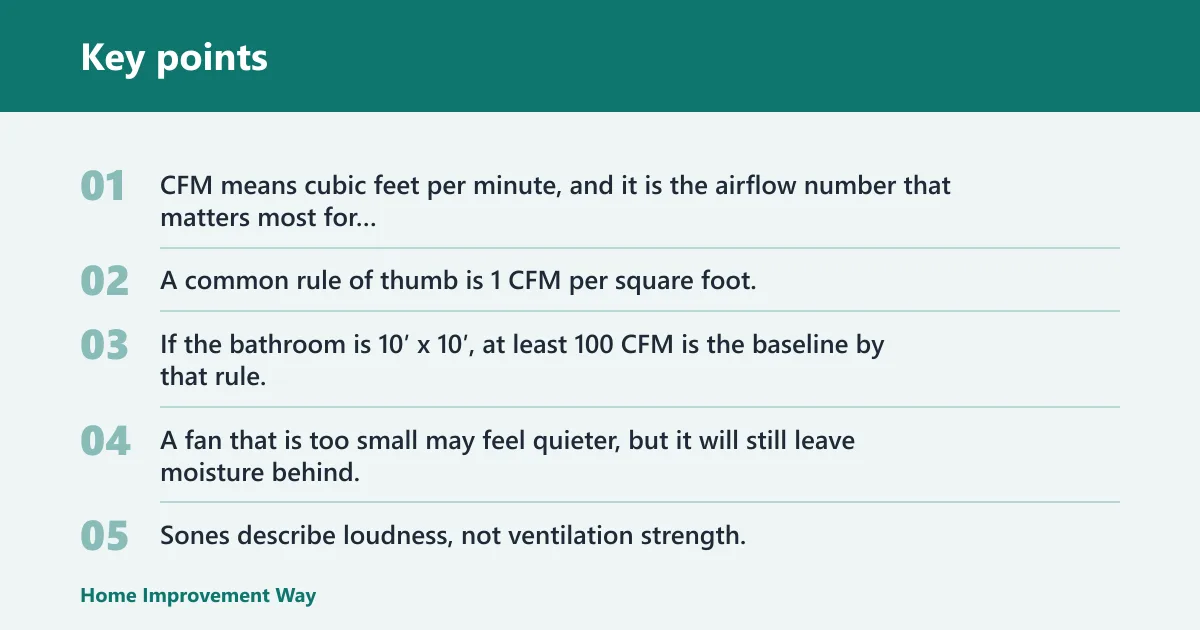
CFM means cubic feet per minute, and it is the airflow number that matters most for ventilation power. A common rule of thumb is 1 CFM per square foot, with some bathrooms needing up to 20% more to keep moisture under control.
If the bathroom is 10′ x 10′, at least 100 CFM is the baseline by that rule. A fan that is too small may feel quieter, but it will still leave moisture behind.
Sones noise rating
Sones describe loudness, not ventilation strength. 0.5 sone or lower is nearly silent, 1.0–2.0 sones is quiet, and 4.0+ sones is loud enough to be disruptive in everyday use.
When comparing options, do not let low noise hide a weak airflow rating. A quiet fan that cannot move enough air is the wrong fix.
Duct diameter and layout
Duct system compatibility can make or break the result. Diameter, length, bends, and leakage all affect actual airflow after installation, even when the fan label looks right.
If the old duct is crushed, too long, or poorly sealed, replacing only the motor may change little. In that case, full replacement or a duct correction plan is the better route.
Humidity-sensing control
Humidity-sensing control is useful when moisture is the main complaint. It can turn the fan on and off automatically based on room humidity, and it may be built into the fan or added through a switch.
That control does not fix a bad duct path, but it can help keep a moisture-heavy bathroom ventilated without relying on manual timing alone.
Choose Bathroom fan retrofit if… / Choose full replacement if…
Choose Bathroom fan retrofit if the housing is sound, the model number matches a supported kit, and you want to avoid drywall repair or a larger ceiling opening. It also makes sense when the fix is a motor assembly, blower, or grille swap and the duct path is already working.
Choose full replacement if the housing is rusted, the duct connection is damaged, the ceiling opening no longer fits practical replacement options, or the bathroom needs a bigger airflow correction than the old shell can support. It is also the better choice when attic access is available and the job already calls for duct or ceiling changes.


Frequently asked questions
Is it cheaper to retrofit a bathroom fan or replace it completely?
Retrofit is usually cheaper when the existing housing stays in place, because you avoid more labor and finish repair. Full replacement costs more because it removes the whole unit and may require opening the ceiling, adapting the duct, or patching drywall. The lower parts price alone does not tell the full story.
What bathroom fan parts can be replaced without cutting drywall?
Some models allow a motor assembly, blower, or grille swap without cutting drywall, especially if the housing is still sound and the replacement matches the original model. Broan-NuTone’s QuicKit line is built for this kind of work with no wiring, cutting, or drywall repair. Compatibility still matters.
How do I know if my bathroom fan housing is still usable?
Check the model number, measure the housing opening, and inspect for rust, warped metal, or broken mounting points. If the enclosure is straight, solid, and compatible with a supported kit, it may still be usable. If the housing is corroded or the opening has changed shape, replacement is usually safer.
When should I replace a noisy bathroom fan instead of repairing it?
Replace the fan when the noise comes from a damaged housing, a failing duct connection, or a unit that cannot meet the airflow needed for the room. If the fan is simply loud but otherwise healthy, a retrofit may be enough. Use sones, not guesswork, to judge how disruptive the fan is.
Can a retrofit bathroom fan fit my existing ceiling opening?
It can, but only if the kit is made for your exact housing size and model. Measure the opening, confirm the label, and check whether the kit excludes your housing size. If attic access is needed for the conversion or duct correction, the fit question includes more than the visible ceiling cutout.
Do I need attic access to replace a bathroom fan?
Not always, but attic access helps when the job involves duct changes, inline conversion, or a new insulated flex run. Some retrofit kits are designed for simpler replacement work from below, while others need above-ceiling access to complete the install correctly. Plan for the hardest part, not the easiest one.
What should I check before buying a bathroom fan retrofit kit?
Verify the exact model number, the housing dimensions, the wiring style, and whether the kit fits your ceiling opening. Then check airflow and sones so the new fan solves the real problem, not just the noise. If the housing is rusty or the duct is failing, a kit may not be the right purchase.
Sponsored / affiliate links. As an Amazon Associate I earn from qualifying purchases. I may earn additional commission from eligible campaigns.