Bathroom Fan Motor Types: AC vs DC Differences
For most bathrooms, AC fan motors are the better value. DC is worth the extra cost when you want lower noise, variable-speed control, or long run times where efficiency matters. Pick the wrong type, and you can pay for features that barely change your bill or end up with a fan that sounds louder than it should. This guide compares AC vs DC bathroom fan motors by noise, efficiency, runtime, and control compatibility.
| Decision factor | AC | DC | Winner |
|---|---|---|---|
| Upfront cost | Usually lower purchase price and simpler parts | Usually higher cost because of electronics and controls | AC |
| Noise potential | More motor hum is common | Usually quieter, with finer speed control at low output | DC |
| Speed control | Often single-speed, two-speed, or a few stepped settings | More speed options and smoother control are more common | DC |
| Efficiency at partial load | Can waste more power when run at lower output | Usually better when the fan spends time at low or medium speed | DC |
| Short bathroom duty cycles | Well matched when runs are brief | Savings are often small if the fan only runs a few minutes | AC |
| Compatibility with simple switches | Direct connection to home power is straightforward | May need a compatible controller or built-in driver | AC |
Which bathroom fan motor type suits your daily routine?
AC motors connect directly to home power and keep the design simple. DC motors use a built-in converter that turns incoming AC power into DC, which usually adds speed options, lower noise, and better part-load efficiency. In a bathroom, that trade-off matters most when the fan runs longer than a quick post-shower burst.
What changes in real bathroom use
Bathroom fans do not run full blast all day. Many are reported to run for about five minutes after a shower, or to start and stop on a humidity sensor. That means comfort, low-speed noise, and control behavior often matter more than the motor label alone.
Picture a hall bath that clears steam in a few minutes, then goes quiet. An AC fan that is properly sized and not overly loud may be the better buy there. A primary bath used before bed or after every shower is different, because a DC fan’s lower-speed operation can matter more.
Bathroom fan comparison table
| Factor | AC | DC | Winner |
|---|---|---|---|
| Typical purchase cost | Lower upfront cost | Higher upfront cost | AC |
| Motor design | Direct connection to home power supply | AC-to-DC conversion with built-in electronics | AC |
| Speed options | Often 3 or 4 speed settings, and many bath fans are single-speed or two-speed | Ten-speed control is common in some product lines | DC |
| Noise | More motor hum is common | Can be nearly silent at low speeds | DC |
| Efficiency | Usually lower at part load | Can use up to 70% less electricity in some designs | DC |
| Control compatibility | Often works with basic wall switches and timers | Often works with remote or smart-home controls, but needs the right controller | AC |
Upfront cost and control hardware
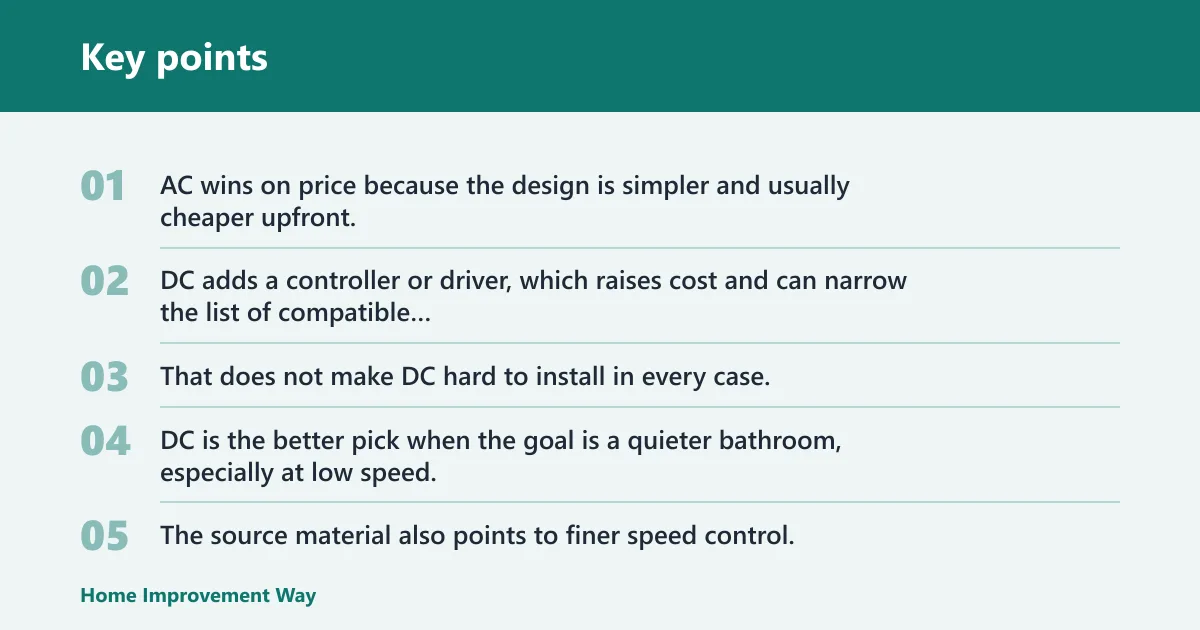
AC wins on price because the design is simpler and usually cheaper upfront. DC adds a controller or driver, which raises cost and can narrow the list of compatible switches. That does not make DC hard to install in every case, but it does make the parts stack more complex.
Noise, airflow, and low-speed comfort
DC is the better pick when the goal is a quieter bathroom, especially at low speed. The source material also points to finer speed control, which helps the fan stay in the low, quiet range instead of jumping from off to loud. In a bathroom, that often matters more than peak output.
Efficiency and runtime fit
DC can use less electricity, but the savings depend on how long the fan runs and at what speed. A short shower cycle does not give efficiency much time to pay back the higher purchase price. Longer or more frequent runtimes give DC a better case.
Installation and replacement fit
AC is usually easier to understand because it ties directly to household power and often works with a standard wall switch or timer. DC fans can still use standard line voltage, but the built-in electronics mean you should confirm the control method before buying. A mismatched switch can cancel the value of the motor choice.
Are DC bathroom fans quieter than AC fans?
Usually, yes. DC fans are generally quieter because the motor can run with finer control and less hum, especially at low speed. In a bathroom, that difference is most noticeable at night, when a fan that is only moving enough air to clear moisture should not sound like it is working hard.
Motor hum versus airflow noise
Not all fan noise comes from the motor. Grille shape, duct length, and backdraft damper noise also matter. A DC motor can reduce the motor hum, but a poorly ducted fan can still sound loud because the air path is noisy.
Why low-speed operation matters at night
Bathroom fans often need to run after bedtime showers or for overnight moisture control. That is where DC has its strongest comfort advantage. If the fan can stay on a very low setting without drawing much attention, it is easier to leave it running long enough to clear humidity.
Vibration, housing, and duct noise
Noise ratings in sones reflect more than the motor alone. Loose mounting, thin ductwork, and sharp duct bends can add vibration and airflow noise. DC helps with the motor side of the equation, but the whole installation still matters.
Do DC bathroom fans use less electricity?
Often, yes, but the size of the savings depends on runtime and speed. DC designs can be more efficient, and some sources say they can use up to 70% less electricity in certain products. That does not mean every bathroom will save much, especially if the fan only runs for a few minutes a day.
Why runtime matters more than motor type alone
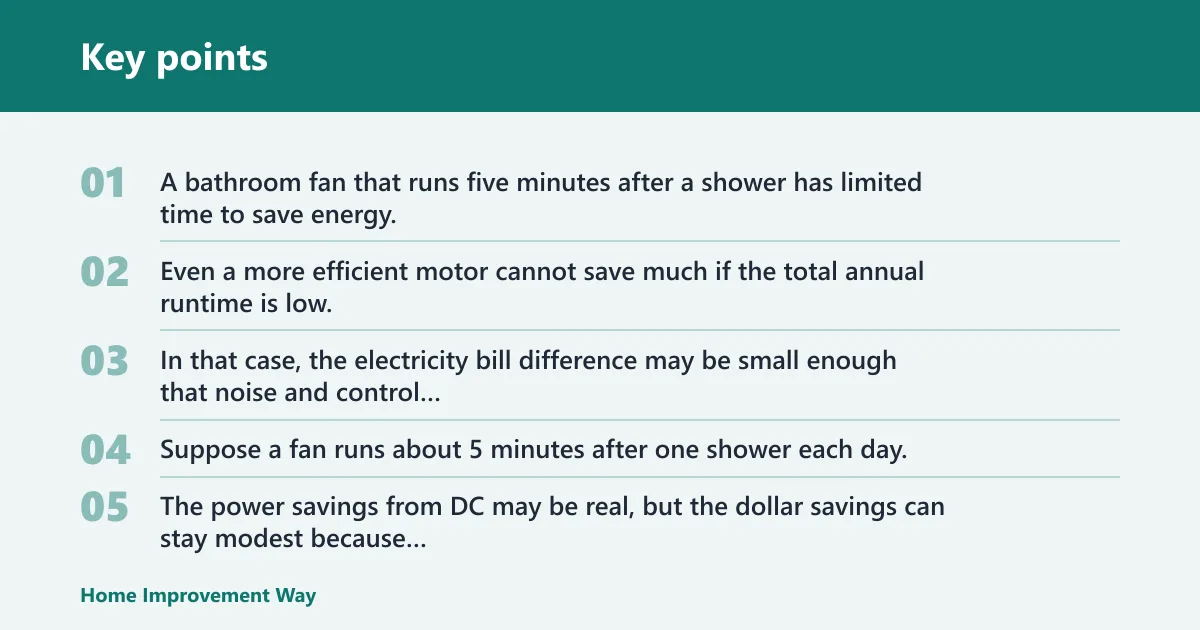
A bathroom fan that runs five minutes after a shower has limited time to save energy. Even a more efficient motor cannot save much if the total annual runtime is low. In that case, the electricity bill difference may be small enough that noise and control quality matter more.
Suppose a fan runs about 5 minutes after one shower each day. The power savings from DC may be real, but the dollar savings can stay modest because the operating window is short. Add a humidity sensor that extends runtime after every shower, and the case for DC gets stronger.
When long or frequent runs can make efficiency matter
DC can be easier to justify when the fan runs about 30 minutes at a time, runs overnight at low speed, or handles multiple showers per day. Those are the situations where partial-load efficiency begins to matter. The longer the fan runs, the more its lower watt draw can offset the higher purchase price.
How do speed settings and controls differ?
AC fans usually keep control simple, with fewer stepped speeds and basic switch options. DC fans usually offer more speed settings and more precise control, which helps when you want a very quiet low setting or automatic control through a humidity sensor or remote. The catch is that the controller has to match the motor.
Single-speed, two-speed, and multi-speed designs
Many bath fans are single-speed or two-speed, even when they use AC. Some AC models offer a few stepped settings, while DC models more often support a wider range of speeds. The practical question is not how many labels appear on the box, but whether you can choose a quiet low setting that still moves enough air.
Wall switches, timers, and humidity sensors
Humidity or timer switches are especially useful in bathrooms because they automate the runtime after a shower. AC fans often pair well with simple timers. DC fans can also work with these controls, but the fan’s built-in electronics must accept the signal type and power arrangement.
When a DC controller adds value
A DC controller is useful when you want variable speed, remote control, or smart-home scheduling. It also helps keep the fan at a low, efficient speed instead of forcing on-off behavior. The trade-off is one more electronic part that can fail.
Bathroom fan motors and failure risks
Bathrooms are rough on fan parts. Steam, lint, condensation, and corrosion exposure can affect both AC and DC motors, but DC systems add a controller and driver that also need protection. That makes installation quality and venting conditions important, not just the motor label.
Steam, condensation, lint, and corrosion exposure
Moist air can condense inside the housing if the ducting is cold or poorly sloped. Dust and lint can collect on the grille and blades, which adds load and noise. Corrosion risk rises when moisture lingers inside the housing, so proper ducting and regular cleaning matter for either motor type.
Electronics, drivers, and added failure points
AC is simpler because there are fewer electronic parts between the switch and the motor. DC needs a converter and control electronics. That can be a plus for speed control, but it also adds a failure point if moisture, heat, or dust affects the driver.
What to check before replacing a motor
- Check the fan housing label for the motor type and voltage requirements.
- Confirm whether the existing switch is a plain on-off, timer, humidity sensor, or smart control.
- Match the new fan’s control needs to the wiring in the bathroom.
- Inspect the duct for condensation, lint buildup, and restricted airflow.
- Confirm the replacement can meet the room’s CFM needs without forcing a noisy high setting.
Bathroom fan motor decision table
| Bathroom use case | AC | DC | Best fit |
|---|---|---|---|
| 5-minute post-shower run | Usually the better value because savings are limited by short runtime | Better noise control, but efficiency gains are often small in dollar terms | AC |
| 30-minute humidity-sensor cycle | Works well, especially with a timer or humidity switch | Better if you want lower noise during a longer automatic cycle | DC |
| Overnight low-speed operation | Can be acceptable, but motor hum may be noticeable | Usually the stronger choice because low-speed quietness matters most | DC |
| Powder-room intermittent use | Usually best because runs are short and budget matters | Rarely worth the extra cost for brief, occasional use | AC |
| Daily primary-bath use | Good if the fan is sized correctly and noise is acceptable | Better if the fan runs often, late at night, or at low speed for long periods | DC |
Choose AC if… / Choose DC if…
Choose AC if you want the lower upfront price, your fan runs only a few minutes at a time, you are replacing a simple switch-controlled fan, or the bathroom is a powder room with intermittent use. AC also makes sense when you care more about getting the job done than about variable speed or near-silent low operation.
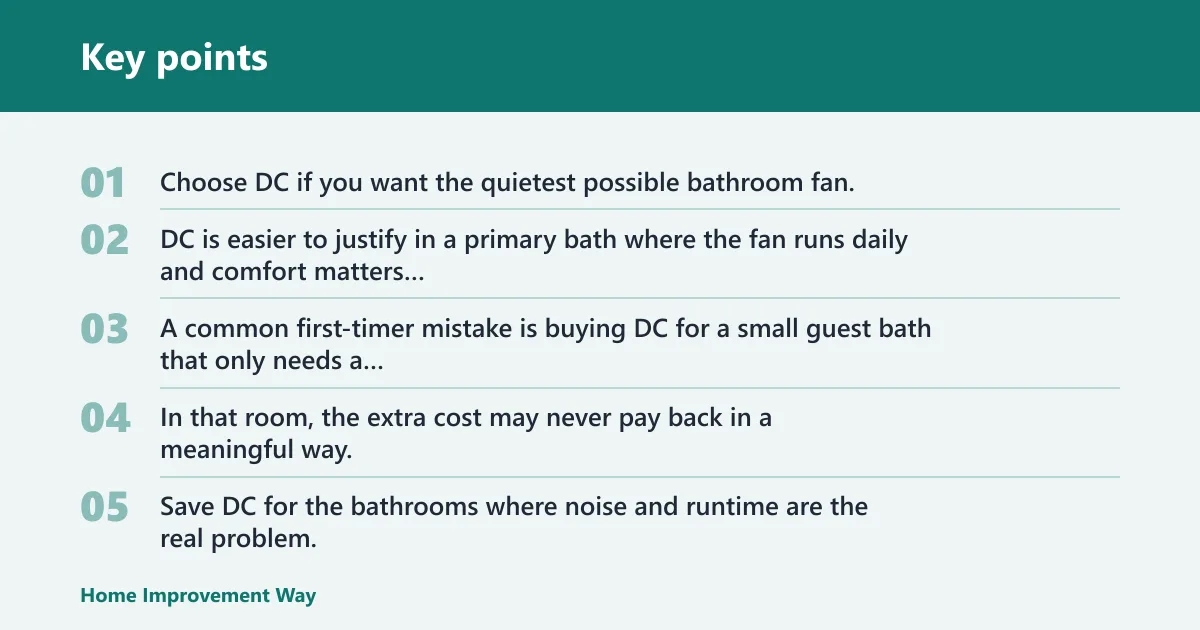
Choose DC if you want the quietest possible bathroom fan, plan to run it for longer periods, use a humidity sensor or timer often, or want more precise speed control. DC is easier to justify in a primary bath where the fan runs daily and comfort matters more than the initial price gap.
A common first-timer mistake is buying DC for a small guest bath that only needs a five-minute run after showers. In that room, the extra cost may never pay back in a meaningful way. Save DC for the bathrooms where noise and runtime are the real problem.


Frequently asked questions
What is the difference between an AC and DC bathroom fan motor?
An AC bathroom fan motor connects directly to home power. A DC motor uses a built-in converter that changes incoming AC power into DC. In practice, AC is simpler and usually cheaper, while DC usually brings quieter operation, more speed options, and better part-load efficiency.
Are DC bathroom exhaust fans quieter than AC fans?
Usually yes. DC fans are commonly quieter because they use electronic control that can reduce motor hum and support smoother low-speed operation. The fan housing and duct still matter, though, so a bad installation can stay noisy even with a DC motor.
Is a DC motor worth the higher upfront cost for a bathroom fan?
It can be, but mostly in bathrooms where noise and runtime matter. A primary bath, a bedroom-adjacent bath, or a fan tied to a humidity sensor is a stronger DC candidate. For a powder room or a brief post-shower run, AC often makes better budget sense.
How many speed settings do AC and DC bathroom fans usually have?
AC fans often have one, two, or a few stepped settings, and some sources describe traditional fans as having three speeds or AC fans as having 3 or 4 speed settings. DC fans usually offer more, with some sources describing ten speeds and more precise control. The exact count varies by model.
Can I replace an AC bathroom fan motor with a DC one?
Sometimes, but not as a simple motor swap. You need to check the housing, wiring, controller, and switch compatibility. Many DC fans still use standard line voltage, but the built-in electronics and control requirements mean the replacement has to match the whole system, not just the motor slot.
Sponsored / affiliate links. As an Amazon Associate I earn from qualifying purchases. I may earn additional commission from eligible campaigns.