Ceiling Fan with DC Motor vs AC Motor: Key Differences
A DC ceiling fan usually draws less power, runs with less motor noise, and gives you finer speed steps; an AC fan usually costs less up front and is often the better pick for garages, rentals, or short-run use. Pick the wrong motor and you can pay more in purchase price, electricity, or noise for years. This guide compares DC and AC fans by room type, comfort, operating cost, controls, and repair tradeoffs.
DC motor vs AC motor: the core trade-off
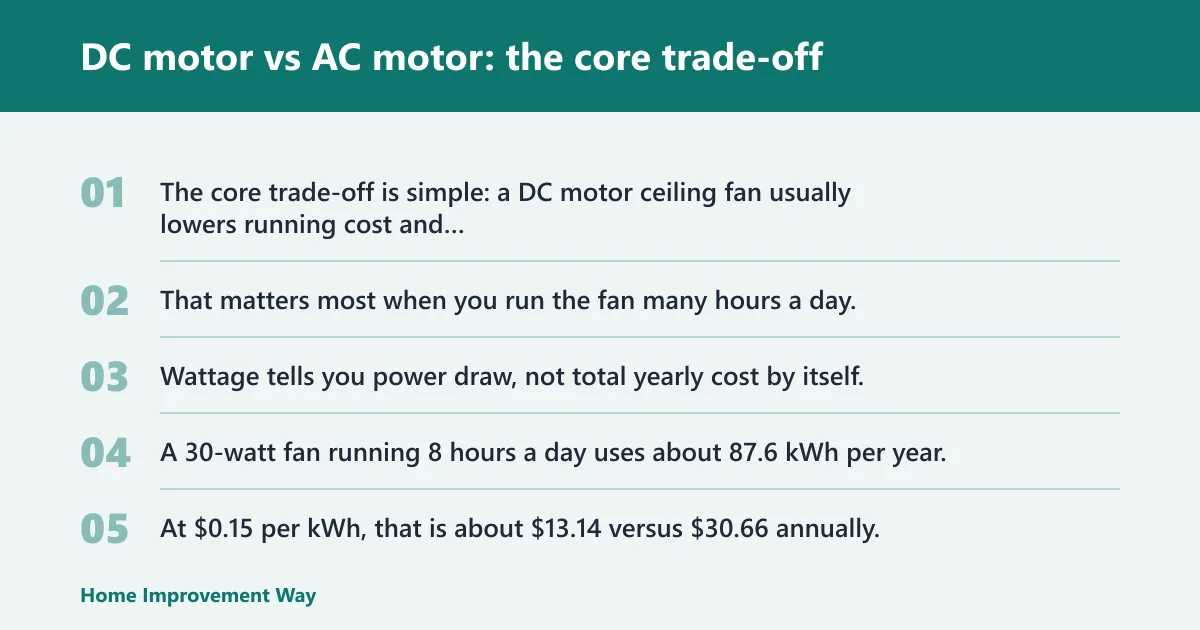


The core trade-off is simple: a DC motor ceiling fan usually lowers running cost and noise, while an AC motor ceiling fan usually lowers purchase price and keeps control systems simpler. That matters most when you run the fan many hours a day, or when the room only needs occasional airflow.
| Decision factor | Ceiling Fan with DC Motor | AC Motor | Winner |
|---|---|---|---|
| Typical wattage example | 20 to 40 watts | 50 to 90 watts | DC motor |
| Noise and smoothness | Usually quieter, with smoother low-speed operation | Standard motor sound | DC motor |
| Speed control | Often 5 to 6 speed settings | Usually fewer settings | DC motor |
| Remote control | Commonly included | Depends on model | DC motor |
| Upfront price | Usually higher upfront cost | Often more affordable upfront | AC motor |
| Long-term operating cost | Usually lower | Usually higher | DC motor |
Typical wattage and cost are not the same thing
Wattage tells you power draw, not total yearly cost by itself. A 30-watt fan running 8 hours a day uses about 87.6 kWh per year, while a 70-watt fan at the same runtime uses about 204.4 kWh per year. At $0.15 per kWh, that is about $13.14 versus $30.66 annually.
Why the motor type changes comfort
DC fans usually use a brushless motor design, which cuts friction and wasted energy. Less friction usually means less noise, and the extra speed steps make it easier to find a low setting that keeps air moving without a draft.
Where AC still wins
AC motors are common and reliable, and AC motor fans are often more affordable upfront. That makes them a reasonable choice when the fan will not run long each day, or when the room matters less than the budget.
How DC and AC ceiling fan motors work
DC and AC fan motors do the same job, but they handle electrical power differently. That difference affects efficiency, control, and sometimes compatibility with wall switches and smart controllers.
Direct current motor basics
A DC motor ceiling fan uses direct current, usually through an internal control system that converts household power for the motor. The practical result is often lower energy use, finer speed control, and quieter operation than a comparable AC fan.
Alternating current motor basics
An AC motor ceiling fan runs on alternating current directly from the home’s wiring. The design is widely used, generally straightforward, and often easier on the purchase budget.
Why brushless DC designs usually waste less energy and make less noise
Brushless DC motors avoid some of the friction and electrical loss seen in older motor styles. Less wasted energy usually means less heat and less sound, though blade balance, ceiling box support, and installation quality still matter.
Do DC ceiling fans use less electricity?
Yes. DC motor fans are described as using less electricity than traditional AC motor fans, but the savings depend on wattage, runtime, and your utility rate. The bigger the daily use, the more the gap matters on the bill.
Typical wattage ranges for DC and AC fans
Competitor examples place DC fans at 20 to 40 watts and AC fans at 50 to 90 watts. Those are example ranges, not guarantees for every model, because fan size, blade design, speed setting, and motor quality all affect draw.
How to estimate annual kWh from watts and runtime
Use this formula: watts ÷ 1,000 × hours per day × 365 = annual kWh. A 40-watt DC fan running 6 hours a day uses about 87.6 kWh per year. A 90-watt AC fan at the same runtime uses about 197 kWh per year.
How utility rates change the yearly cost gap
Multiply annual kWh by your electricity rate. At $0.12 per kWh, the 40-watt fan above costs about $10.51 a year, while the 90-watt fan costs about $23.65. At $0.20 per kWh, that becomes roughly the high teens versus around forty dollars.
Are DC ceiling fans quieter and smoother?
Usually, yes. DC motor fans are described as running more quietly than AC motor fans, and many also feel smoother at low speeds because they offer more control steps. That said, blade imbalance, loose mounting hardware, and a bad ceiling box can still create noise.
Why lower friction can reduce motor noise
Brushless DC motor designs usually create less friction than older motor designs, so they tend to waste less energy and make less noise. The motor is only part of the story, though, because rattles from the canopy, blades, or downrod can cancel that advantage.
What speed control feels like on 5- or 6-speed DC fans
More speed steps make it easier to find a comfortable middle setting. On a bedroom fan, that can matter more than top speed, because a lower, steadier airflow often feels better overnight than a fan that jumps between a few coarse settings.
When blade design or installation causes noise even on a DC fan
A quiet motor will not fix a poor install. If the blades are unbalanced, the screws are loose, or the fan is mounted to a weak box, the fan may hum, wobble, or click even with a DC motor.
Where motor type matters most in real homes
Motor type matters most in rooms that run for hours and need quiet comfort. In short-use spaces, the savings may be too small to justify a higher purchase price.
Bedrooms and nurseries
Bedrooms are a strong fit for DC fans because quieter operation and finer speed control matter at night. The remote is also useful when you do not want a wall chain or pull switch interrupting sleep.
Say your bedroom is 12 by 14 feet and you run the fan every night for 8 hours. In that case, a lower-watt DC fan can trim yearly operating cost enough to matter, especially if the room stays occupied year-round.
Living rooms and home offices
Living rooms and offices benefit from smoother speed steps and lower sound, especially if the fan runs during work or TV time. If the room is used daily, DC often makes the most sense on comfort and operating cost.
Rental units, garages, and low-use spaces
AC fans are often the better buy in rentals, garages, and spare rooms used only now and then. The lower upfront price can matter more than yearly savings when the fan runs for only a short time.
Suppose a garage fan runs 1 hour a day in warm months and sits off the rest of the year. The yearly bill difference may be small enough that the cheaper AC fan wins on total ownership cost.
Are DC motor ceiling fans worth the higher price?
They can be, but only when the fan runs enough hours for the lower wattage to matter. If the fan is a daily appliance in a bedroom, living room, or office, the running cost gap can help offset the higher purchase price over time.
Daily run time is the biggest cost factor
The more hours you run the fan, the more important wattage becomes. A fan used 8 to 12 hours a day can create a meaningful annual cost gap, while a fan used briefly on hot weekends often will not.
When energy savings can offset the purchase price
If the price gap between DC and AC is modest, the operating savings can narrow the difference over a few years. The exact break-even point depends on your rate, runtime, and the actual watt draw of the models you compare.
When remote control and finer speed steps matter
Remote control is commonly included with DC fans, and that can be a real comfort advantage in bedrooms and high ceilings. More speed steps also help if you want one fan to cover light airflow on mild days and stronger circulation in hot weather.
How much power does a DC ceiling fan use?
Many DC fan examples in competitor material appear to fall in the low-to-mid watt range, but actual draw changes with size, blade design, speed, and motor quality. The best way to judge cost is to combine the wattage on the spec sheet with your daily runtime and local utility rate.
Annual operating cost by room, runtime, and rate
| Room type | Daily runtime | Utility rate | DC fan example | AC fan example |
|---|---|---|---|---|
| Bedroom | 8 hours/day | $0.15/kWh | 30 watts, about $13.14/year | 70 watts, about $30.66/year |
| Living room | 6 hours/day | $0.20/kWh | 40 watts, about $17.52/year | 90 watts, about $39.42/year |
| Garage or guest room | 2 hours/day | $0.12/kWh | 20 watts, about $1.75/year | 50 watts, about $4.38/year |
What the table means in practice
The cost gap is small in low-use spaces and more visible in daily-use rooms. That is why DC often makes more sense for bedrooms and family rooms, while AC remains a sensible choice for spaces that do not run long enough to matter much.
What should I look for besides the motor type when buying a ceiling fan?
Motor type matters, but it is not the only thing that determines comfort or value. Blade span, ceiling height, airflow, mounting style, and compatibility with your existing controls can matter just as much in the right room.
Blade span and room size
Match the fan size to the room so the airflow fits the space. A small bedroom usually needs less span than an open living area, and an oversized fan can feel awkward in a tight room.
Ceiling height and mounting style
Low ceilings may call for a flush-mount fan, while taller ceilings may use a downrod for better airflow and clearance. Poor clearance can make even an efficient fan feel uncomfortable or unsafe.
Compatibility with old wall switches, dimmers, and smart controls
This is a common failure point in older homes. Some DC fans need their own controller and may not behave well with standard wall dimmers, while AC fans may work with simpler switch setups depending on the model. Check the control method before you buy.
Repairability and replacement parts
AC fan systems are often simpler and common in older homes, so repair options and replacement parts can be easier to find for some models. DC fans may have more integrated electronics, which can mean more control features but also a more model-specific replacement path.
- Measure the room and confirm the blade span you need.
- Check ceiling height, downrod length, and blade clearance.
- Compare wattage at the speeds you will actually use.
- Confirm whether you want remote control, wall control, or smart control.
- Verify compatibility with existing switches, dimmers, and ceiling wiring.
- Decide whether daily runtime justifies a higher upfront price.
Choose Ceiling Fan with DC Motor if… / Choose AC Motor if…
Choose Ceiling Fan with DC Motor if you plan to run the fan every day, want lower operating cost, prefer quieter operation, or care about finer speed control in a bedroom, living room, or home office. It is also the better fit when a remote is important and the wiring setup is compatible.
Choose AC Motor if you want a lower upfront price, need a simple fan for a rental, garage, or guest room, or do not expect long daily runtime. AC is also a practical choice when you want a common, familiar setup with fewer control features to sort out.
Frequently asked questions
What is the difference between a DC motor ceiling fan and an AC motor ceiling fan?
A DC motor ceiling fan uses direct current through an internal control system, while an AC motor ceiling fan runs on alternating current from the home’s wiring. In practice, DC fans usually use less electricity, run quieter, and offer more speed control, while AC fans usually cost less up front.
Do DC ceiling fans use less electricity than AC fans?
Yes, DC motor fans are described as using less electricity than traditional AC motor fans. Competitor examples place DC fans at 20 to 40 watts and AC fans at 50 to 90 watts, so runtime and local electricity rates determine how much that difference affects your bill.
Are DC ceiling fans quieter than AC fans?
Usually, yes. DC motor fans are described as running more quietly than AC motor fans, and brushless DC designs often waste less energy and make less noise. Installation quality still matters, because loose parts or bad balancing can create sound on any fan.
How many speed settings do DC ceiling fans usually have?
DC ceiling fans often have several speed settings, while AC fans usually offer fewer. More steps make it easier to dial in gentle airflow for sleep or stronger circulation for hot afternoons without jumping between large changes in speed.
Can a DC ceiling fan work with a remote control?
Yes. Remote control is commonly included with DC fans, which is one reason they are popular in bedrooms and high-ceiling rooms. The remote may be required for full speed control on some models, so check the control package before buying.
Sponsored / affiliate links. As an Amazon Associate I earn from qualifying purchases. I may earn additional commission from eligible campaigns.