Are Solar Motion Sensor Lights Good for Security?
Yes, solar motion sensor lights are good for deterrence and entryway visibility, but they are not full security coverage. Use them as a first layer, not the only one. Bad placement or weak batteries leave dark gaps that reduce both safety and deterrence. Here’s how they work, where they help most, and when wired lights are the better choice.
How motion lights deter intruders—and where they fail
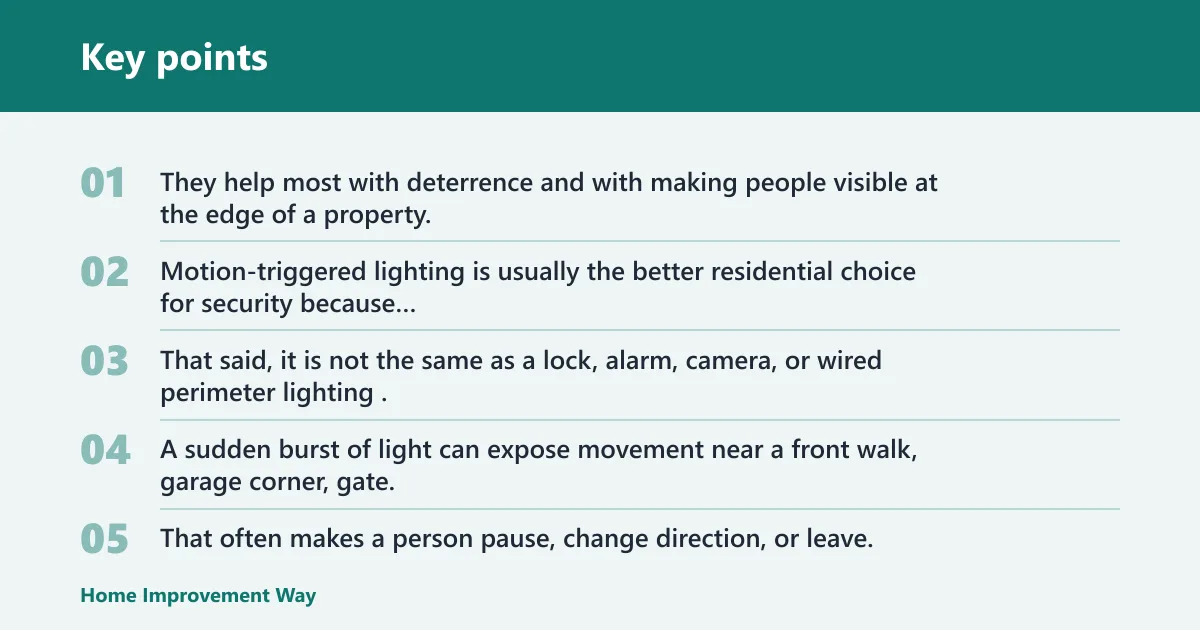


They help most with deterrence and with making people visible at the edge of a property. Motion-triggered lighting is usually the better residential choice for security because the sudden light draws attention. That said, it is not the same as a lock, alarm, camera, or wired perimeter lighting.
What deterrence can do
A sudden burst of light can expose movement near a front walk, garage corner, gate, or shed. That often makes a person pause, change direction, or leave. It also helps residents see what is outside before stepping out.
Solar motion sensor flood lights fit best where you want a quick alert and a visible response: front entrances, driveway edges, side yards, and backyard access points. LED lighting uses at least 75% less energy than traditional incandescent lighting, and LED lighting can last up to 25 times longer than traditional incandescent lighting, so the light source itself suits outdoor fixtures well.
Where security coverage still falls short
Motion lights do not watch an area continuously. A person can still move between trigger zones, stand in a shadow, or approach from a blind side the sensor does not cover. A light may also miss a route entirely if the sensor points at the wrong path.
One homeowner’s motion light failed because the sensor faced the street instead of the approach path. That is a placement error, not a product failure. It is also why solar fixtures can leave dark gaps if the mount height, angle, or range does not match the route.
When solar lights are enough on their own
Solar motion lights are enough when the goal is basic deterrence, a safer walk to the door, and low-cost coverage of a small area with a clear approach path. They work best when the area gets good sun, the sensor can face the entry route, and the light does not need to stay on for long periods.
If you need steady coverage for a long driveway, repeated nighttime use, or a property with deep shade and frequent motion, add wired lighting. A solar unit can still help, but it should be treated as one layer in the system.
Solar motion sensor lights versus always-on lighting
Motion-activated lights are often the better residential choice when the goal is to catch attention only when someone approaches. Always-on lights still make sense where you need constant visibility, such as a dark side yard used every night or a long path where people need uninterrupted light.
Energy use and operating cost
Solar fixtures avoid trenching wires and do not add to the electric bill, which is a practical reason homeowners choose them. LEDs also use far less power than incandescent bulbs, so the battery lasts longer between charges. That matters most when the light must survive short winter days or partial shade.
Visibility when someone approaches
Motion sensor lights have higher attention-grabbing power than always-on lights. That makes them useful at a front door, garage corner, or fence gap where a sudden flash matters more than constant brightness. Continuous lighting still wins where you want the area visible all night without waiting for motion.
Say your garage sits 30 feet from the house and the side path gets used after dark. A motion light at the garage corner can expose someone at the door, but a second always-on fixture may be needed to keep the whole path visible from start to finish.
What matters when you buy one
Look at the whole system, not just the fixture. Brightness, sensor shape, battery type, and shut-off timing all affect whether the light helps or annoys you. A strong-looking light with poor range or weak solar charging can still leave the area underlit.
Lumens and glare
Lumens measure brightness. Low output can be fine for a narrow walkway or small stoop, while higher output is better for a driveway, garage apron, or broad backyard entry. More lumens are not always better if the beam creates glare or washes out the approach path.
Match output to the space. A small front landing needs less light than a wide driveway or fence line. If the beam is too bright and aimed too low, it can blind visitors and still miss the moving person farther out.
Sensor range and coverage angle
Motion sensor lights work within a detection zone, not everywhere around the fixture. Some sensors detect movement at a 90° angle, while others cover 180° or even 360°. Some sensors have a 60-foot detection range, but a long range can cause false alarms from passersby.
| Specification | Why it matters | Practical buying check |
|---|---|---|
| 90° to 360° coverage | Sets how much of the approach path is watched | Use narrower angles for a single doorway; wider angles for corners and yard edges |
| 60-foot range | Can catch movement early, but may pick up people outside the property | Shorten the practical aim if roads, sidewalks, or neighbors are close |
| 15-second shut-off | Saves battery, but may go dark too fast for a long walkway | Best for quick pass-through zones |
| 30-second shut-off | Common balance of visibility and battery life | Good starting point for most entry points |
| 1, 5, or 10 minute modes | Longer visibility, more battery use | Use longer modes only where repeated motion is expected |
| Rechargeable batteries | Lower maintenance than frequent disposables | Check chemistry and replacement access before buying |
Battery type and shut-off timing
Battery type affects runtime and replacement frequency. Many solar fixtures use rechargeable batteries, and lithium-ion packs usually hold up better than disposable alkaline batteries in a solar light application. Longer shut-off settings also use more stored power, so a 5- or 10-minute mode can shorten the useful night-time runtime if the light triggers often.
Some motion sensor lights turn off after 30 seconds without movement. Others stay on for 15 seconds after someone leaves the sensor range, and some offer 1, 5, or 10 minute illumination modes. If the light sits in a busy area, longer timing can drain the battery faster, especially in winter sun or partial shade.
Solar security checklist
Use this as a placement-and-spec filter before buying. The goal is to match the sensor to the actual intrusion path, not just to the nearest wall.
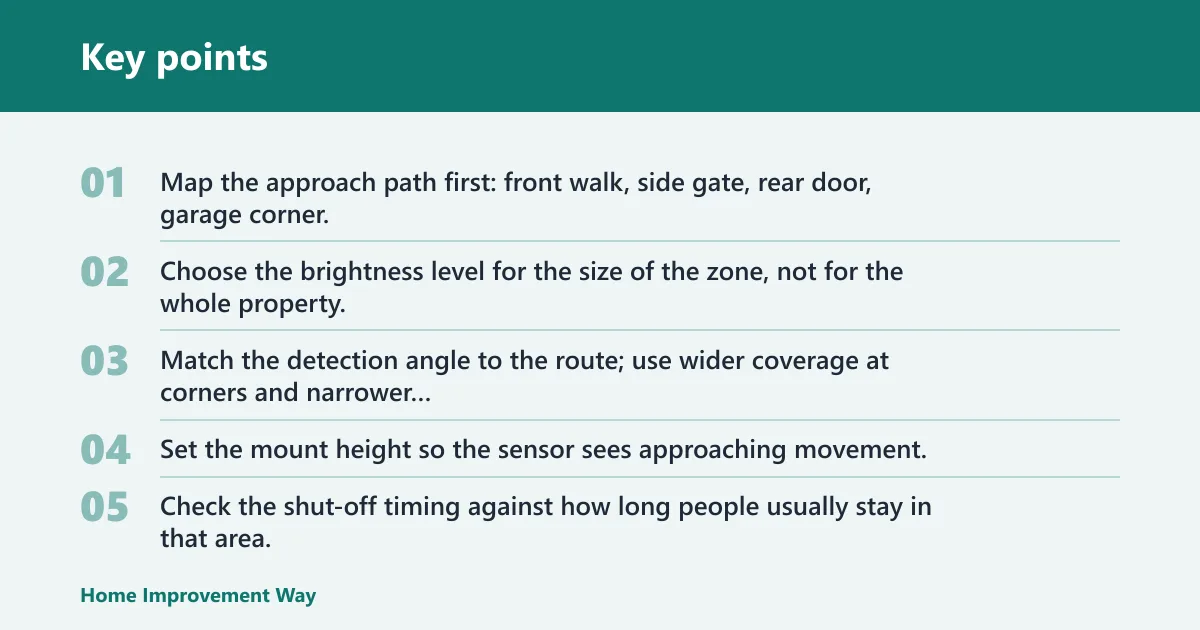
- Map the approach path first: front walk, side gate, rear door, garage corner, or shed access.
- Choose the brightness level for the size of the zone, not for the whole property.
- Match the detection angle to the route; use wider coverage at corners and narrower coverage at straight entries.
- Set the mount height so the sensor sees approaching movement, not only very close movement.
- Check the shut-off timing against how long people usually stay in that area.
- Look for battery access and a rechargeable pack if the fixture will trigger often.
Solar motion sensor lights checklist
For a front entrance, a mount height around 6 to 8 feet is a practical target because it can help the sensor see the path without aiming straight into eye level. Aim the sensor across the walkway, not at the street. A 30-second setting often works well here. If the entrance is small, a moderate lumen output is usually enough.
| Zone | Recommended mount height | Sensor aim | Trigger range | False-trigger risks | Sufficient? |
|---|---|---|---|---|---|
| Front | 6 to 8 feet | Across the walkway and porch approach | 20 to 30 feet | Passing cars, sidewalk traffic, reflective windows | Often sufficient for entryway visibility; add wired light if the driveway is long |
| Side | 7 to 9 feet | Along the side path or gate line | 15 to 25 feet | Pets, trees, moving shadows, narrow alley reflections | Usually needs careful aiming; add wired light if the side yard is dark or wide |
| Rear | 8 to 10 feet | Toward fence gaps, deck steps, or shed access | 20 to 40 feet | Wind-blown branches, animals, yard tools, reflective siding | Good as a first layer; wire it if the rear area is large or heavily used |
Side zone
Side yards are a commonly overlooked security area. They often hide the best approach route because they run beside the house and out of view from the street. For that reason, solar lights here should point along the path, not out toward open space. If the sensor sees the road instead, it may trigger too often or miss the real route.
Rear zone
Backyard access points, fence lines, and storage sheds benefit from a wider detection pattern. A 180° or 360° sensor can help at a corner or open yard edge, but only if the trigger range does not spill into neighboring traffic or moving branches. Use a longer shut-off only if the battery and sun exposure can support it.
Where to place them around the home
Place fixtures where a person would naturally approach, pause, or turn. That usually means corners, doors, gates, and path bends. The light should strike the entry route before someone reaches the threshold.
Front entrance and driveway
The front entrance benefits from a light that watches the walkway and porch steps. A driveway needs coverage closer to the point where a vehicle stops or a person exits. If the drive is long, one solar light rarely covers it well enough on its own, so a wired supplement may be better.
Side yards, garages, and gates
Side yards, garages, and gates are common use cases for motion sensor solar flood lights because they often have no easy wired power source. A corner-mounted fixture can watch the turn into the driveway or the side access route. Just keep the sensor off the street side when possible.
Will solar motion lights work on side yards, garages, and fences? Yes, if the sensor faces the approach path and the area gets enough sun to recharge. They are less reliable if trees, walls, or roof overhangs block the panel or if the space gets frequent motion from beyond the property line.
Backyard access points, fence lines, and sheds
Rear gates, fence breaks, and storage sheds are good places for motion lighting because they are common approach paths and easy to miss from the house. If the shed sits in deep shade, a solar fixture may still help as a trigger light, but a wired light is better for regular night use.
How to cut false triggers
False alarms waste battery life and reduce trust in the light. They also make it harder to tell whether the light came on for a real approach or for a passing distraction. The main fix is better aiming, not just a different brand.
Road traffic and passing cars
Keep the sensor from pointing at roads, sidewalks, or driveways where people pass outside the property line. A long range can catch cars, walkers, or bikes that do not matter to the household but still turn the light on. If needed, reduce the practical detection distance by angling the sensor inward.
Pets, trees, and moving shadows
Pets, tree branches, and shifting shadows are common false-trigger sources. Mounting too low can let a small animal cross the zone and trigger the light repeatedly. Mounting too high can flatten the coverage pattern so the sensor sees swaying leaves or shadows instead of the entry path.
Picture a side gate with a low fence and a maple tree nearby. If the sensor points at the branches, every windy evening can keep the light cycling on and off. Move the aim toward the gate opening, then shorten the range until the tree stops triggering it.
Mounting height and sensor aim
Do motion sensor lights need to be installed high or low? Usually somewhere in the middle: high enough to watch the approach path, low enough to keep the zone shaped correctly. Too high narrows the useful detection pattern on the ground. Too low increases nuisance triggers from pets, plants, and close movement.
Aim the sensor across the expected path, not straight down and not straight out to the street. That one adjustment often matters more than a brighter bulb or a longer timer.
Frequently asked questions
Are solar motion sensor lights good for security?
Yes, for deterrence and visibility. They are best at exposing movement at entry points and along side or rear approaches. They are not full security coverage, so they should be paired with good locks, cameras, or wired lighting where continuous light is needed.
Do motion sensor solar lights actually deter intruders?
They can. Sudden light often makes an approaching person pause because it removes cover and draws attention. That effect is strongest when the sensor is aimed at the real approach path and the light is bright enough for the size of the area.
How bright should a solar security light be?
The right brightness depends on the zone. A small porch needs less light than a wide driveway or rear yard. More lumens can improve visibility, but too much brightness can create glare and still leave corners dark if the sensor is aimed poorly.
How far should a motion sensor detect movement?
It should cover the actual approach path, not the whole block. Some sensors reach 60 feet, but that can create false alarms from passersby. A shorter practical range is often better near sidewalks, roads, or neighbor traffic.
Can solar motion lights replace wired security lights?
Sometimes, but only for limited coverage. They are usually enough for a doorway, gate, or small side path. Wired lights are better when you need steady illumination, wide-area coverage, or dependable performance in shade, winter weather, or frequent-trigger locations.
What should I look for when buying solar flood lights for security?
Check lumens, sensor angle, trigger range, battery type, and shut-off timing. A good fixture matches the property zone: narrower for doors, wider for corners, and longer timing only where repeated motion is expected. Rechargeable batteries are often the better maintenance choice.
Sponsored / affiliate links. As an Amazon Associate I earn from qualifying purchases. I may earn additional commission from eligible campaigns.