Solar Path Lights vs Hardwired Landscape Lights: Pick Better
Choose solar path lights for easy installs in full sun and light-use areas; choose hardwired outdoor lighting when you need brighter, steadier, all-night output, dimming control, or reliable security lighting. Skip that tradeoff and you can end up with dead fixtures, uneven paths, and higher long-term upkeep. This guide compares performance, wiring, runtime, cost, and the best hybrid layouts for walkways, beds, steps, patios, and accents.
Solar path lights vs hardwired outdoor lighting: the core trade-off


The decision comes down to runtime, consistency, and upkeep. Solar path lights keep installation simple because they usually stake into loose soil with an included plastic stake, charge in daylight, and often turn on automatically at dusk. Hardwired outdoor lighting takes more work up front, but it stays steadier and is easier to build into longer, more demanding lighting plans. (consumerreports.org)
What solar lighting gives you
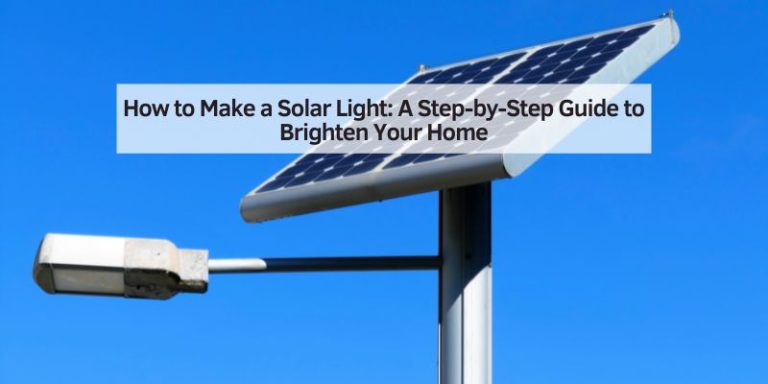
Solar outdoor lights store power in a battery during daylight hours, so they avoid trenching and transformer placement. That makes them useful for quick walkway upgrades, garden-bed accents, and spots where running wire would be awkward. Many models also support manual on/off control, though dusk-to-dawn automation is common.
What hardwired lighting gives you
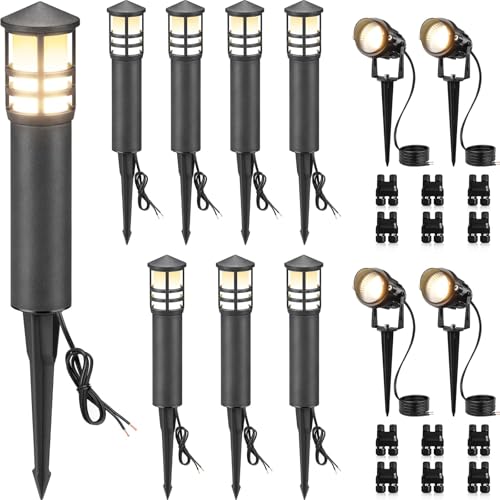
Hardwired outdoor lighting uses low-voltage wiring and a transformer, which adds labor but also gives you more consistent output. It fits longer paths, steps, and areas where you want stronger illumination for safety or security. The fixture family is broader too, including path lights, spotlights, and wall-wash styles.
Why the installation environment matters
Shade, winter sun angle, and soil conditions change the outcome more than many buyers expect. Solar lights need a sunny area to work well, and mower or edger traffic can knock over stake-mounted fixtures or damage nearby panels. In damp or exposed areas, outdoor ratings matter, and IP65 or higher is the right target for year-round use.
Solar path lights vs hardwired outdoor lighting at a glance
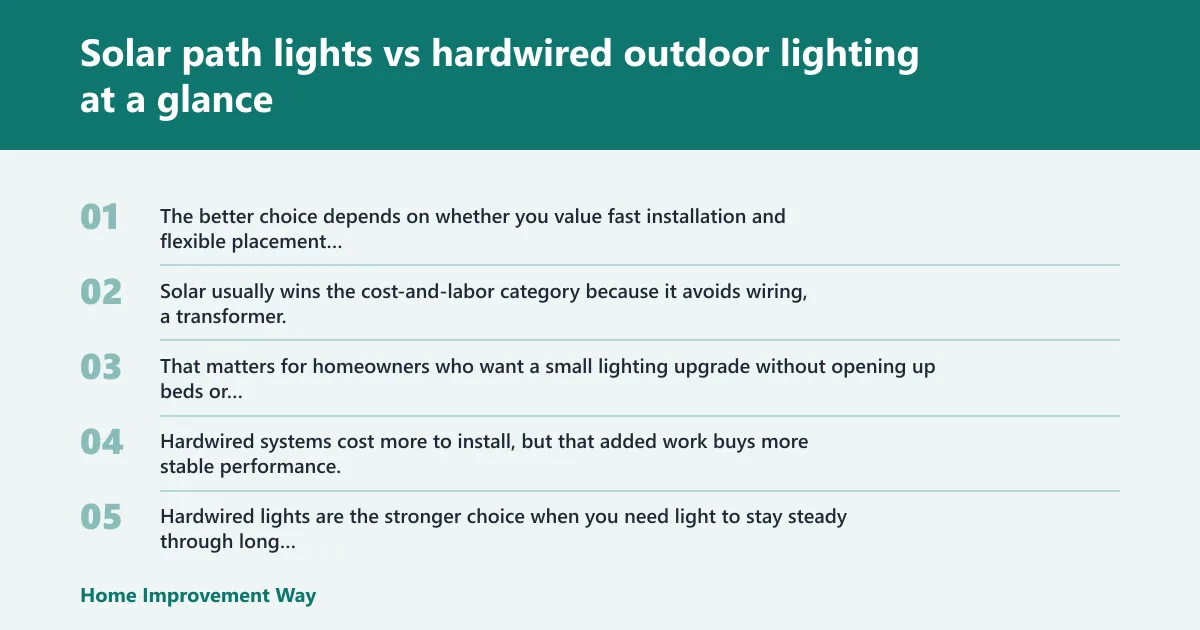
Here is the practical comparison. The better choice depends on whether you value fast installation and flexible placement more than steady light output and lower day-to-day sensitivity to weather, shade, and battery aging.
| Factor | Solar Path Lights | Hardwired Landscape Lights | Winner |
|---|---|---|---|
| Cost | Lower upfront hardware cost and no trenching | Higher upfront cost for wire, transformer, and labor | Solar Path Lights |
| Installation / labor | Simple stake-in installation; often quick to place in loose soil | Requires low-voltage wiring and transformer setup | Solar Path Lights |
| Runtime / consistency | Limited by battery capacity, season, and available sun | Steadier long run times with power from the transformer | Hardwired Landscape Lights |
| Brightness consistency | Can dim as the battery drains or after cloudy stretches | More consistent output across the night | Hardwired Landscape Lights |
| Shade tolerance | Poorer in shaded yards or under tree cover | Works regardless of daytime shade | Hardwired Landscape Lights |
| Winter performance | Runtime often drops in short-day, cloudy conditions | More reliable in winter and higher latitudes | Hardwired Landscape Lights |
| Maintenance / upkeep | Panel cleaning, battery aging, stake resets, seasonal checks | Fixture cleaning and occasional wiring or transformer checks | Hardwired Landscape Lights |
| Code / system complexity | Usually simpler because there is no line-voltage work | More planning and installation complexity around wiring and transformer placement | Solar Path Lights |
| Expandability | Easy to add single fixtures where sun is available | Better for larger, coordinated systems with multiple fixture types | Hardwired Landscape Lights |
| Best-fit use | Short runs, accents, sunny walkways, walkway markers, and garden-bed borders | Long paths, steps, security, wider coverage, and stronger illumination needs | Tie |
| Best environment | Sunny yards with loose soil and clear direct sun | Areas where reliable, steadier light is needed regardless of shade | Tie |
Install cost and labor
Solar usually wins the cost-and-labor category because it avoids wiring, a transformer, and trenching. That matters for homeowners who want a small lighting upgrade without opening up beds or hardscape. Hardwired systems cost more to install, but that added work buys more stable performance.
Runtime, brightness consistency, and winter performance
Hardwired lights are the stronger choice when you need light to stay steady through long evenings. Solar battery capacity matters because the battery stores daytime energy, and runtime changes with season and available sun. Wintertime solar runtime averages may hover around five hours, which is fine for accent lighting but often short for security or all-night paths.
Maintenance and code complexity
Solar can reduce electrical complexity, but it does not eliminate upkeep. Dirty panels, poor panel angle, and aging batteries can cut output, and replacement batteries become part of the 3- to 5-year ownership picture. Hardwired systems need more installation planning, yet they often need fewer seasonal corrections once they are set correctly.
Expandability and best use case
Solar is easy to scatter through a yard, but it works best where each fixture gets enough sun. Hardwired systems scale better when you want several light types working together. A long driveway edge, a set of front steps, and a patio perimeter are more naturally handled by wired lighting than by a patchwork of solar units.
When do solar path lights make more sense?
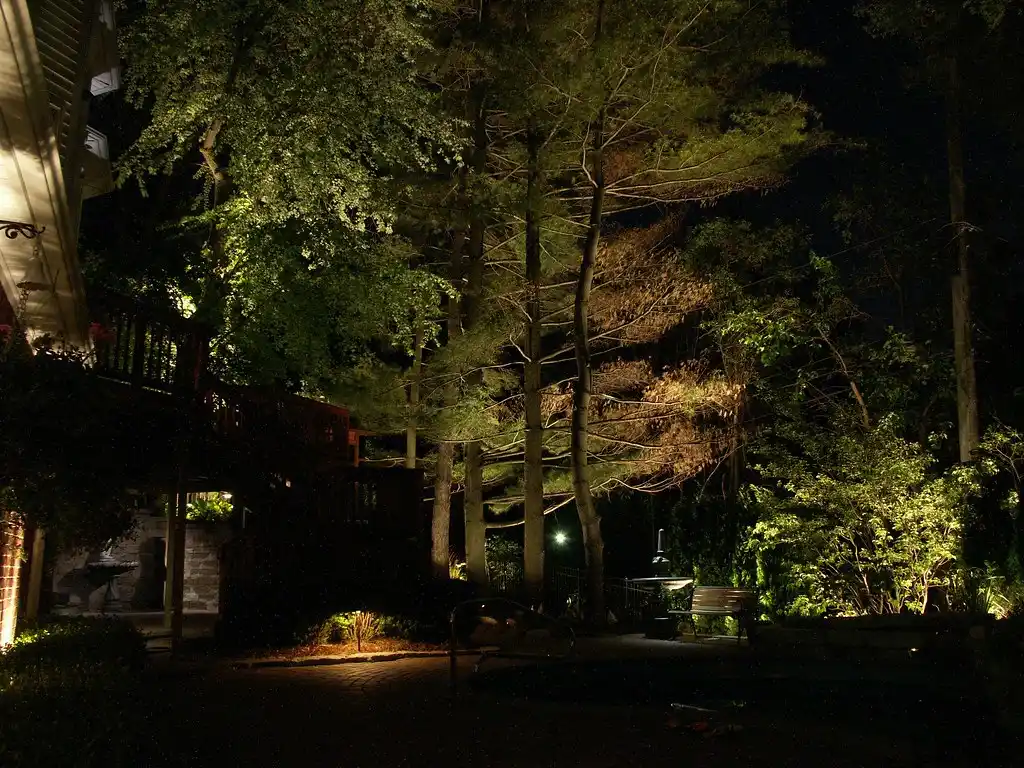
Solar path lights make the most sense in sunny yards, on short lighting runs, and where you want the simplest installation possible. They fit accent jobs, walkway markers, and garden-bed borders where a soft glow is enough. If the fixtures get reliable daytime sun, the tradeoff is usually worth it.
Best placements for sun exposure
Put solar lights where panels can see direct sun for much of the day and where soil lets the stake sit firmly. Path lights are meant to illuminate walkways, garden beds, or a patio’s perimeter, so sunny edges around those areas are the natural fit. Loose soil works better than packed rock or root-heavy beds.
Why solar fits short runs and accent lighting
Solar works well when the goal is gentle visibility rather than broad coverage. A landscaping ambience light is about five lumens, which is enough for a soft edge marker, while stronger decorative or security needs call for more output. Solar fixtures are often best used where you want a little light, not a full task-lighting plan.
Where solar struggles: shade, winter, and high-use paths
Shade is the biggest limiter. Tree cover, north-facing beds, cloudy stretches, and winter sun all reduce the energy stored in the battery, so output can fall before midnight. A common first-timer mistake is placing solar lights under shrubs or beside a tall porch column, then expecting the same runtime as a clear, open bed.
When do hardwired outdoor lighting systems make more sense?
Hardwired outdoor lighting makes more sense when you want steady brightness, longer run times, and less dependence on weather. It is the better fit for steps, high-use walkways, and lighting plans that need dependable coverage every night. The extra installation work often pays back in performance and predictability.
Why low-voltage wired systems stay more consistent
Low-voltage wired systems do not depend on daylight to recharge a battery. That means the fixture output is more stable from dusk to late evening, and it is not tied to how cloudy the previous day was. For security lighting or frequently used circulation routes, that consistency matters more than install simplicity.
Where a transformer and wiring are worth the effort
A transformer is the heart of a hardwired outdoor-lighting system. It lets you distribute power to path lights, spotlights, and wall-wash fixtures in a controlled layout. If your yard needs multiple zones or a longer run, the transformer and wire become worthwhile because they support broader, more even coverage.
Best uses for steps, long paths, security, and wider coverage
Hardwired lights are usually the safer choice for steps and driveways because those areas demand dependable, visible light. They are also better for security and accent lighting where you want more than a small pool of illumination. A floodlight delivers about 350 lumens, which is far closer to task or security needs than a small solar path light.
How do brightness, IP ratings, and winter performance affect your choice?

Brightness is only part of the picture. Beam spread, color temperature, weather resistance, and seasonal runtime all change how useful a fixture feels in the yard. Ignore those details, and a light can look bright on paper while still failing in the place you need it most.
How many lumens do I need for path lighting?
For soft pathway ambience, about five lumens is a common target. That level marks an edge without turning the path into a runway. If you need stronger visibility for security or steps, you need more output, but brightness should still match the use case instead of chasing the highest number available.
How beam spread and color temperature change the result
Lumens alone do not tell the whole story. A narrow beam can look brighter on the ground than a wider beam with the same rating, and cool color temperatures often feel brighter than warm ones even at similar output. Warm light usually suits patio edges and garden beds; cooler light can improve visibility where you want clearer definition.
What IP65 or higher means for outdoor durability
For year-round outdoor exposure, look for IP65 or higher. The first IP number rates dust resistance on a scale of 1-6, and the second rates water resistance from 1-7. That rating is a practical benchmark for outdoor fixtures that will face rain, spray, and seasonal grime.
How short days and cloudy weather affect solar battery runtime
Solar lights need a sunny area to work well because the battery can only store what the panel gathers. Short daylight hours, winter sun angles, and cloudy stretches all reduce charging time. Poor panel placement also matters; if the panel faces the wrong direction or gets dirty, runtime and brightness fall together.
Choose solar path lights if… / choose hardwired outdoor lighting if…
Choose solar path lights if you want low labor, flexible placement, and light use in a sunny area. Choose hardwired outdoor lighting if you need steady output, longer runtime, and more reliable performance through winter or shade. A mixed layout often gives the best balance of cost, convenience, and durability.
Choose solar path lights if…
- You have full sun for most of the day.
- You want a quick install with stake-in-ground fixtures.
- You are lighting a short walkway, garden bed, or patio perimeter.
- You can accept lower winter runtime and occasional battery replacement.
Choose hardwired outdoor lighting if…
- You need dependable light on steps, long paths, or high-use routes.
- You want steadier brightness for security or late-evening use.
- Your yard has shade, short winter days, or cloudy weather.
- You plan to add multiple fixture types and expand the system later.
When a hybrid layout is the smartest compromise
Mixed systems solve the most common real-world problem: not every part of a yard has the same light demand. Use hardwired lighting for steps, driveways, and primary walk routes, then add solar fixtures for beds, borders, and accent points where wiring would be overkill. Suppose a front walk is about 40 feet long, with several shaded steps near the porch and sunny beds along the edge; wired lights can cover the steps, while solar can handle the border without more trenching.
Frequently asked questions
Are solar path lights better than hardwired outdoor lighting?
Solar path lights are better when you want fast installation, flexible placement, and simple accent lighting in a sunny area. Hardwired outdoor lighting is better when the priority is steady brightness, longer runtime, and dependable performance for paths, steps, or security. The better option depends on the job, not the label.
How long do solar path lights last at night?
Nighttime runtime depends on battery capacity, panel exposure, season, and weather. Solar outdoor lights store power in a battery during daylight hours, so cloudy stretches and short winter days reduce run time. Wintertime solar runtime averages may hover around five hours, though some fixtures will do more or less.
Do hardwired outdoor lighting systems need a transformer?
Yes, low-voltage hardwired outdoor lighting typically uses a transformer. The transformer steps power down and lets you feed multiple fixtures from one source. That setup adds installation work, but it also supports more consistent output and makes it easier to build a larger lighting plan.
Which is better for shady yards: solar or hardwired lights?
Hardwired outdoor lighting is usually better in shady yards because it does not depend on sunlight to recharge a battery. Solar lights need a sunny area to work well, and shade from trees, fences, or rooflines can shorten runtime and dim output. In shaded spaces, wired lights are the safer bet.
What IP rating should outdoor lights have?
For year-round outdoor use, look for IP65 or higher. The first number rates dust resistance from 1 to 6, and the second rates water resistance from 1 to 7. That level is a solid target for fixtures exposed to rain, spray, and seasonal dirt.
Sponsored / affiliate links. As an Amazon Associate I earn from qualifying purchases. I may earn additional commission from eligible campaigns.