How Many Lumens Do You Need for Solar Outdoor Lights?
A common rule of thumb for solar outdoor lights is about 10 to 50 lumens for paths and steps, 50 to 150 for decks and patios, 100 to 300 for yards, and 300 to 800+ for driveways or security. Too few lumens leave hazards in shadow; too many can look bright at dusk, then fade fast after a weak charge. This guide gives practical lumen ranges, plus how sunlight, beam angle, and runtime change what you actually see.
Solar light lumen ranges


What do lumens mean for outdoor lighting?
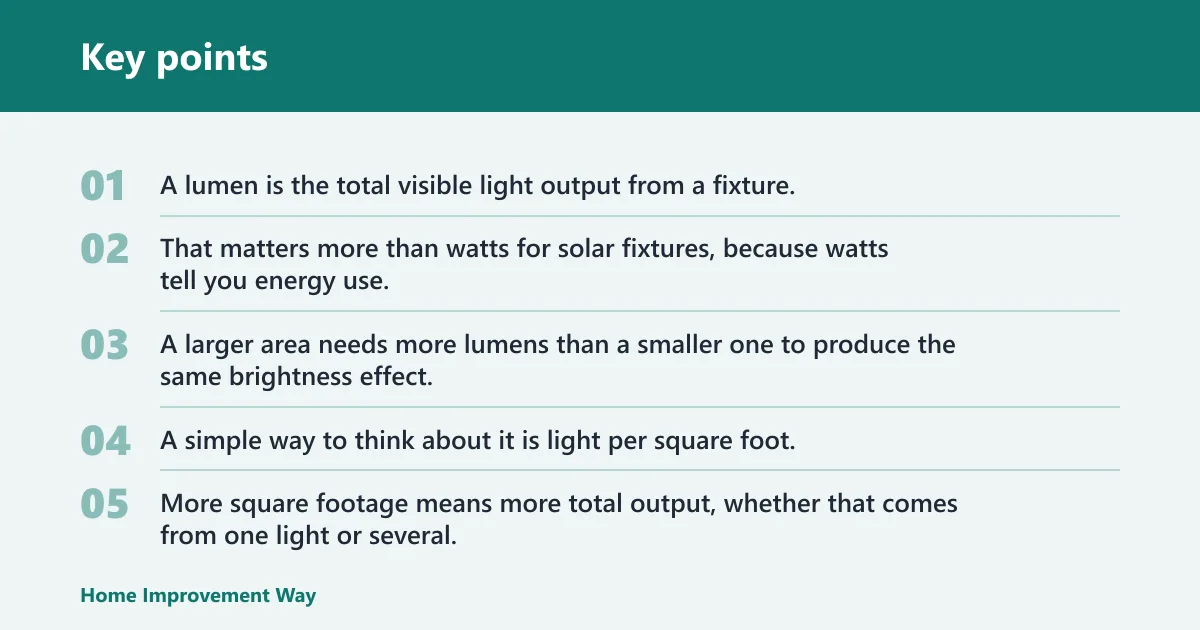
A lumen is the total visible light output from a fixture. Higher lumen ratings mean brighter lights. That matters more than watts for solar fixtures, because watts tell you energy use, not how much light reaches the ground, wall, or walkway.
For home lighting, area matters too. A larger area needs more lumens than a smaller one to produce the same brightness effect. A simple way to think about it is light per square foot, measured in foot-candles: one foot-candle equals one lumen of light spread over one square foot. More square footage means more total output, whether that comes from one light or several. The Illuminating Engineering Society and university extension lighting guides use foot-candles as a practical way to estimate needed light on a surface.
For indoor comparison only, a 100-square-foot living room would need 1000 to 2000 lumens total if you were using the bedroom or living-room range of 10-to-20 lumens per square foot. Outdoor solar lighting usually needs different numbers because you are lighting edges, steps, and points of entry instead of a whole room.
How can foot-candles help estimate area coverage?
Foot-candles describe light on a square foot of surface, so they help estimate how much total light a path, landing, or driveway needs. Multiply the target brightness per square foot by the area you want to light, then divide that total across the fixtures you plan to install. Lighting reference guides commonly use this approach to match light levels to the task rather than to a wattage label.
A short path may need modest output spread across several fixtures. A wider driveway needs either stronger fixtures, tighter spacing, or both. The goal is not the highest number on the box. It is enough light where your feet, tires, or eyes need it.
Why can the same lumen rating look different outside?
Two solar lights with the same lumen rating can look very different in real yards. Beam angle, mounting height, nearby surfaces, and charging quality all change perceived brightness. A narrow beam looks brighter in one spot. A wide beam spreads the same light over more ground and can look softer. Manufacturer lighting guides consistently note that beam spread changes how a rated output appears on the target area.
Solar-specific losses matter too. Shade, winter sun angle, dirty panels, and poor panel placement reduce charging. Battery capacity and runtime matter after sunset, because a light may be bright for a short burst and much weaker later in the night. Solar product guidance commonly notes that real-world output depends on how much charging the panel gets, not just on the advertised lumen number.
How bright should solar path lights be?
Most solar path lights fall in the low-to-moderate range, usually enough for visibility and edge marking rather than full-area lighting. A practical starting point is about 10 to 50 lumens per fixture, with the lower end for decorative edging and the higher end for longer walks, darker mulch, or wider spacing.
What is the typical lumen range for paths and edges?
For a narrow garden path, 10 to 20 lumens per light is often enough to mark the route. For a longer walkway or one with dark pavers, 20 to 50 lumens gives more usable visibility. If the path is wide, has steps, or sits beside deep shade, move toward the upper end. University and landscape-lighting references generally place small path fixtures in a low-lumen range because the job is guidance, not flood coverage.
How do spacing and beam spread affect walkway coverage?
Beam spread matters as much as rating. A wider beam spreads light across more walkway, which helps if you want even edging. A narrow beam puts more light in one spot and can leave gaps between fixtures. For path lights, spacing and beam width usually decide whether the walkway feels usable or patchy. Manufacturer beam-angle guides consistently show that beam spread changes how much ground a fixture can cover at a given brightness.
Suppose a 30-foot garden walk uses six 20-lumen path lights. If the fixtures have a broad beam and are spaced evenly, the walk can feel brighter than a single 120-lumen light at one end. Multiple lower-lumen fixtures often work better because they cover the route instead of one bright point.
When should you choose more output for longer runs?
Choose more output when the path is longer, the ground is darker, or the surrounding plants absorb light. Long runs also need better spacing discipline. If the lights are too far apart, the walkway can still feel dim even when the total lumens look high on paper. In extension and manufacturer lighting references, the practical answer is usually more fixtures, a wider beam, or both.
How many lumens do step and deck lights need?
Step and deck lights are task lights, not display lights. Low output can still be enough if the fixture is aimed well and the beam is controlled. For safe footing, many installations use about 10 to 50 lumens per fixture, and many deck applications sit in the 50 to 150 lumen range when the goal is comfortable general visibility rather than decoration alone.
What is the right low-output task lighting for safe footing?
Steps need just enough light to define the edge of each tread and the change in height. Too much output can create glare and make the step harder to read. A small beam can be the right choice when the fixture sits close to the surface and points down or across the step face. Lighting references for stairs and circulation areas typically emphasize visibility at the tread edge over raw brightness.
How do glare control and fixture placement change the result?
Placement changes everything. Mounting a step light too high can throw light into the eyes instead of onto the tread. On decks, a low-mounted fixture or tucked-under rail light usually works better than a bright exposed lamp. The surface color matters too; light-colored decking reflects more light than dark boards. Fixture makers commonly note that beam aim and shielded placement can matter more than a higher lumen number.
A common first-timer mistake is putting a bright deck light at eye level on a dark stair run. The result can feel harsher than a lower-lumen fixture placed lower and aimed at the tread edge.
When is a small beam enough for decks and steps?
A small beam is enough when the only job is to mark a step edge, a landing corner, or a short change in level. If the area is shaded, has dark materials, or sees frequent use after dusk, move up within the range rather than jumping to a very bright spotlight. For many decks and patios, 50 to 150 lumens is the more useful starting point because it balances visibility with comfort.
How many lumens do you need for security lights?
Solar security lights usually need more output than decorative fixtures because they cover larger areas and often use motion activation. A common starting range is about 300 to 800+ lumens, depending on yard size, mounting height, and whether the light stays on all night or only turns on with motion. Security-light product guides and lighting references generally favor higher output for broader coverage and identification.
What is the difference between motion-activated and always-on brightness?
Motion-activated security lights can use higher lumens because they do not need to stay at full brightness for hours. An always-on security light needs a more careful balance, because full output drains the battery faster. If the unit must run all evening, runtime matters as much as peak brightness.
How do coverage area, mounting height, and beam angle interact?
Higher mounting height spreads light over a bigger area but can make a weak light look smaller on the ground. A narrow beam concentrates brightness and helps with distance, while a wide beam covers more of a driveway apron or side yard. For security, coverage area usually matters more than raw lumen count alone. Beam-angle guidance from lighting manufacturers consistently shows the same output can either reach farther or cover wider, depending on spread.
If a driveway corner feels dark, a single low-mounted light may not solve it. A brighter motion light mounted higher, or two fixtures aimed from different directions, often gives better coverage than one very bright point source.
When should you increase output for driveways and side yards?
Increase output for larger driveways, deep side yards, tall hedges, and areas with dark mulch or dark siding nearby. Those surfaces absorb more light and make the same fixture seem weaker. You also need more output when you want faces, parked cars, or package drop zones to be easier to see.
Solar outdoor lighting decision table
| Job | Recommended lumens | Minimum beam width | Best starting point | Runtime risk | Expected tradeoffs | When to go brighter |
|---|---|---|---|---|---|---|
| Front yard | 100 to 300 | 30° to 90° | 100 to 150 lumens for basic area definition | Medium; longer nights and shade can cut late-evening output | Balanced coverage for entry edges, planting beds, and curb appeal | Deeper shade, larger frontage, darker surfaces, winter use |
| Driveway | 300 to 800+ | 60° to 120° | 300 to 500 lumens for motion coverage at the apron or turn-in | High; large area and long runtime demands can drain undersized systems | Better for cars, curb cuts, and identification; may need multiple fixtures | Long driveways, dark paving, tall hedges, security focus, winter nights |
| Path lights | 10 to 50 per fixture | 30° to 90° | 10 to 20 lumens for decorative edging; 20 to 50 for practical visibility | Low to medium; usually manageable unless the panel sits in shade | Better for edging than full coverage; spacing matters more than peak output | Long runs, dark pavers, shaded walks, winter use |
| Step lights | 10 to 30 per fixture | 20° to 60° | 10 to 20 lumens for tread definition; use the upper end for wider steps | Low; short run times are usually enough, but glare can still be an issue | Low glare is the priority; too much light can wash out tread edges | Dark stairs, wide steps, frequent use after dark |
| Deck lights | 20 to 50 per fixture | 30° to 90° | 50 to 150 lumens for many decks and patios when general visibility matters | Medium; always-on use can reduce late-night brightness | Must balance task lighting and glare; placement often matters more than lumens | Large decks, dark boards, rail-mounted fixtures, winter nights |
| Spotlights | 100 to 300 | 15° to 45° | 100 to 150 lumens for accenting small features; higher for deeper shade | Medium; narrow beams can look bright but still depend on good charging | Narrow beams look brighter at one point and less useful for broad coverage | Dark landscaping, tall shrubs, accenting large features, deeper shade |
| Security lights | 300 to 800+ | 60° to 120° | 300 to 500 lumens for motion zones; higher for broader coverage | High; larger coverage areas and longer runtime needs can expose weak batteries | Higher output helps coverage, but runtime drops if the panel and battery are undersized | Driveways, side yards, motion zones, long winter nights, shaded panel placement |
This table is a starting point, not a fixed rule. If the yard is dark, the beam is narrow, or the light sits in shade, move up one range. If the area is small and the fixture sits close to the target surface, the lower end may be enough.
Why do solar lights look dimmer than the label?
Rated lumens do not guarantee the same real-world brightness outdoors. Solar panel charging conditions, battery runtime, beam angle, mounting height, and surface color all change what you see after sunset. A fixture that looks strong at dusk may fade after a weak charge or a long night. Lighting manufacturers and solar product guides consistently note that output on paper is only part of the result.
What solar panel charging conditions matter most?
Shade is the biggest solar-specific problem. Even partial shade from trees, fences, gutters, or nearby walls can cut charging. Winter sun sits lower in the sky, so panels may receive less direct light and shorter charging windows. Dirty panels also reduce charging, so grime can make a rated light feel underpowered.
Panel placement matters as much as panel size. A panel pointed toward the wrong direction or hidden behind a rail may never fully recharge the battery. That means the fixture may never reach the brightness printed on the label for long, if at all.
How do battery capacity, runtime, and aging change brightness?
Battery capacity determines how long the light stays bright after sunset. Many solar lights can reach full output only for part of the night, then dim to conserve power. Battery aging adds another loss over time, so the same light may look weaker after months of use than it did when new. Manufacturer runtime charts typically show that higher lumens often mean shorter runtime unless the panel and battery are sized to match.
A common first-timer mistake is choosing a high-lumen security light for a shaded side yard and expecting all-night full brightness. The light may still work, but a shorter runtime can leave the end of the night dimmer than expected.
How do beam angle, height, and surface color affect perceived brightness?
Beam angle changes perceived brightness outdoors. Wide beams spread light across more area, so each square foot gets less light. Narrow beams concentrate output and look brighter on the target. Height also changes the result: a light mounted higher covers more ground, but the light can seem less intense at foot level. Lighting references commonly describe beam spread as a coverage tradeoff, not just an appearance choice.
Surface color matters too. Light-colored concrete, pale siding, and reflective trim bounce light back. Dark mulch, black fences, and stained decking absorb it. That is why the same 100-lumen spotlight can look strong on a pale wall and weak beside a dark hedge.
How do you choose lumens for a mixed yard?
- Identify the job first: path, step, deck, accent, or security.
- Estimate the surface size and how much of it must be lit.
- Pick a lumen range from the matching use case, not from watts.
- Check beam angle, because wide beams spread light and narrow beams concentrate it.
- Confirm panel placement gets direct sun for most of the day.
- Account for shade, winter sun, dark surfaces, and longer runtime needs.
- Choose multiple lower-lumen fixtures when coverage matters more than one bright point.
Say your front walkway is 24 feet long, with dark pavers and a maple tree that shades half the panel location by afternoon. Several 20- to 30-lumen path lights can be a better choice than one bright lamp, because the route needs even coverage and the charging conditions call for extra margin.
For a front yard or driveway, start by separating the tasks. Use path lights for edges, step lights for footing, and one stronger motion light for the entry or parking zone. That mixed approach usually works better than trying to make one fixture do every job.
Frequently asked questions
How many lumens do I need for solar outdoor lights?
The right number depends on the area, beam angle, mounting height, and how much sunlight the panel gets each day. Those ranges line up with common lighting guidance for task, accent, and security use.
How many lumens are good for solar security lights?
Solar security lights often need 300 to 800+ lumens, especially for driveways, side yards, and motion-triggered coverage. Motion-activated lights can use higher output because they do not stay on all night. If the panel sits in shade or the battery is small, runtime may limit real brightness.
Are higher lumens always better for solar lights?
No. Higher lumens can be too bright for steps, decks, and narrow paths, and they can drain the battery faster. A well-placed low-lumen light with the right beam angle often works better than a brighter fixture that spreads light poorly or fades before morning.
How many lumens do I need for a front yard or driveway?
The right choice depends on how much ground you need to see, if the light is always on, and how high it mounts.
Why do solar lights look dimmer than the lumen rating suggests?
Solar lights can look dimmer because shade, winter sun angle, dirty panels, and poor panel placement reduce charging. Battery runtime also matters, since some lights only hold peak brightness briefly. Beam angle, mounting height, and dark surfaces can make a rated light seem weaker at night.
Sponsored / affiliate links. As an Amazon Associate I earn from qualifying purchases. I may earn additional commission from eligible campaigns.