Best Solar Lights for Walkways: Based on Specs and Reviews
The best solar lights for walkways with heavy foot traffic are low-profile path lights with replaceable batteries, sealed housings, stable stakes or mount plates, and spacing that keeps the beam off the walking line. Weak stakes, disposable batteries, and tall fixtures fail fast, create trip hazards, and leave dark gaps where people walk. This guide compares durable solar walkway lights by mounting, battery serviceability, weather sealing, brightness, and spacing for front paths, side yards, and entry steps.
Quick comparison
| Product | Badge | Best for | Price | ||
|---|---|---|---|---|---|
 |
SOLPEX 10 Pack Solar Ground Lights Outdoor, Backyard DecorSOLPEX | Our pick | 10 pack · IP65 waterproof · stainless steel | $21.59
Price as of 25 Oct 2026
|
View |
 |
DOESLAG Solar Pathway Lights Outdoor 8 Pack, Warm WhiteDOESLAG | Budget pick | 8 pack · IP44 water resistant · warm white | $25.64
Price as of 25 Oct 2026
|
View |
 |
SHONELIGHTING Solar Paver Lights, 6×9 Ground LED, 12-Color,SHONELIGHTING | Upgrade pick | 6 pack · IP67 waterproof · RGBW | $284.99
Price as of 25 Oct 2026
|
View |
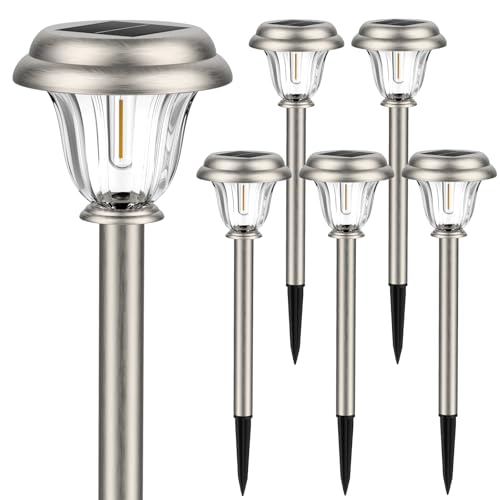 |
Solar Lights Outdoor Waterproof Stainless Steel Glass SolarDERAYSION | Pair with it | stainless steel · glass · dusk-to-dawn | $39.99
Price as of 25 Oct 2026
|
View |
For busy walkways, fixture type matters more than lumen claims alone. The table below compares traffic risk, mounting depth, spacing, and common failure points that show up when people step near or on the lights.
How we chose
The main filter was traffic tolerance: low profile, stable mounting, and a lower chance of being kicked, tilted, or crushed. Weather resistance and battery serviceability came next, because a light that is hard to clean or repair is harder to keep usable over a season.
We also weighed beam pattern, automatic operation, and whether the fixture fits the path. Path lights spread light in a circular pattern around the fixture, while spotlights throw all their light into one area. That difference matters when you want edges visible without glare.
SOLPEX 10 Pack Solar Ground Lights: best for front paths
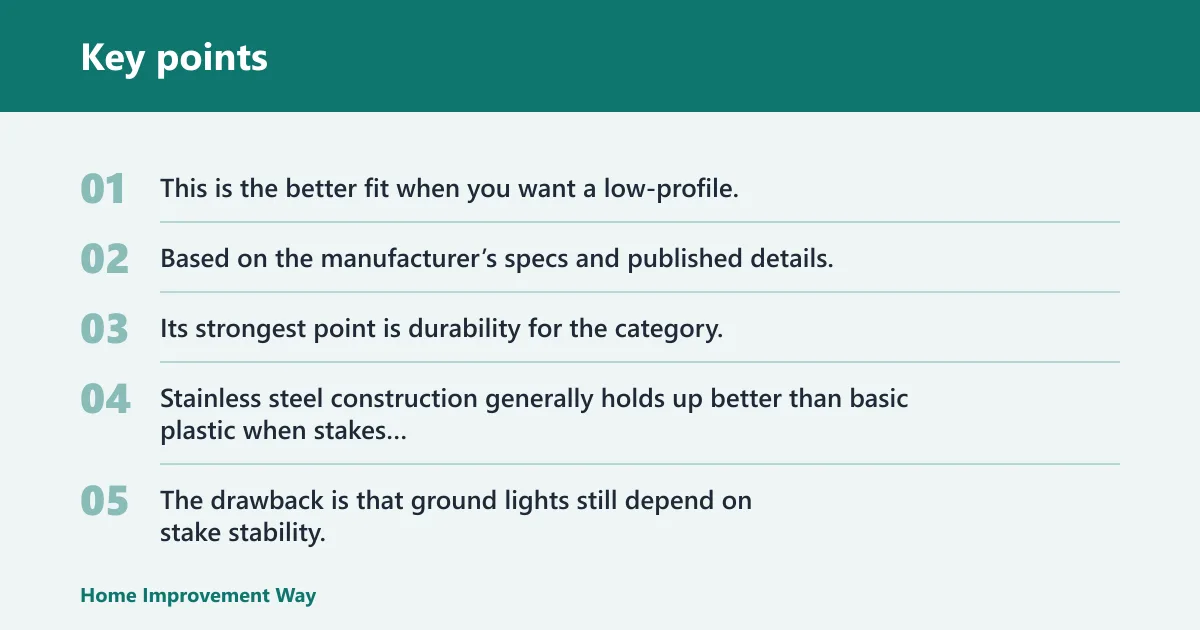
This is the better fit when you want a low-profile, traffic-friendly path light with a stainless steel and ABS build, IP65 waterproofing, and dusk-to-dawn auto on/off. Based on the manufacturer’s specs and published details, it suits front paths where repeat foot traffic calls for a fixture that sits low and stays visually clear.
Its strongest point is durability for the category. Stainless steel construction generally holds up better than basic plastic when stakes get bumped, soil shifts, or people step too close. The drawback is that ground lights still depend on stake stability, so they are better beside the walking line than in it.
Why this type fits busy walkways
Solar ground lights are also called path lights or walkway lights, and they are typically installed in loose soil with an included plastic stake. That works well for edging, but repeated contact changes the risk profile. The best versions use a lower body, a firmer stake, and a beam pattern that stays off the foot path.
Path lights disperse light evenly in a circular pattern around the fixture. That helps define the edge of the walk without forcing a spotlight effect that can leave the surrounding area dark. For a front path, that even spread usually matters more than raw output claims.
What to look for in the fixture
Look for a sealed housing, a stake that seats deeply, and a body that does not sit tall above the soil line. A tall decorative lamp can catch a shoe, a bag, or a mower deck. A lower profile reduces that risk and makes it easier to keep the row aligned.
Rechargeable battery design also matters. Solar lights store daytime power in a battery or batteries, and runtime depends on charge quality, weather, and the battery type. If the battery is easy to replace, the light is easier to keep in service after the first season of decline.
Where it works best
Use this style for front paths, garden-bed edges, and patio perimeters where the light stays just outside the main stride line. A common first-timer mistake is placing stake lights directly in the center of a narrow path. That looks tidy on day one and creates tilt, breakage, and dark gaps later.
DOESLAG Solar Pathway Lights: best for side yards
This model fits side yards that need an easy install, warm white light, and an automatic dusk-to-dawn cycle. Based on the product details, it is a practical pick when the goal is a simple walkway marker rather than a fixture that must survive frequent direct contact.
The drawback is its IP44 water resistance, which is lower than the IP65 benchmark many outdoor solar lights use. That does not make it unusable, but it gives less confidence for wet, exposed routes that see mud splash, snow, and hard use.
Why side yards need a different standard
Side yards often have narrower clearances, less light, and more casual traffic from trash bins, pets, or carrying loads. That makes fixture height and spacing more important. If the light stands too tall, it becomes a collision point. If spacing is too wide, the path disappears between pools of light.
Warm white can be a good fit for side-yard use because it gives a softer perimeter glow. But for safety, you still want the beam to define the edge. Light color alone does not solve poor placement.
What limits this option
Push-in stake installation is convenient, but convenience can be a tradeoff in loose or repeatedly disturbed soil. Stake-mounted lights are the first to tilt when the ground softens after rain or frost. If the path gets regular cart traffic or frequent foot brushes, a lower marker or a step-mounted light is often safer.
Some solar lights come on automatically at dusk, while others must be turned on manually. For a side yard used daily, automatic operation is preferable because it avoids the “forgot to switch it on” problem when the route is needed after dark.
SHONELIGHTING Solar Paver Lights: best for high-traffic entries
This is the strongest choice when the walkway sees repeated contact and the fixture needs to sit recessed rather than standing on a stake. Based on the listed specs, the recessed in-ground design, IP67 waterproof rating, and heavy-duty build make more sense for entries where a standard path light would get crushed or knocked out of line.
The main drawback is cost. At $284.99, it is far above typical stake-light pricing, and the format only makes sense when the walkway justifies the expense and installation work.
Why recessed lights matter near constant use
Heavy foot traffic changes the buying decision because it raises the chance of crushed stakes, repeated tilting, and lights being knocked out of alignment. A recessed paver light moves the fixture out of the strike zone, which is often more useful than chasing a higher lumen figure.
For an entry walk, that matters more than decorative detail. A fixture that sits flush with the surface can keep the walking line clear and reduce trip hazards where people are most likely to carry bags, step quickly, or cut across the corner.
What makes the tradeoff different
Recessed units need a better fit in the surface and a more careful install. They are not the quick drop-in solution that simple stake lights offer. In return, they remove the two biggest failure modes of outdoor path lights: bent stakes and knocked alignment.
If your path gets snow clearing, scooters, strollers, or constant short trips, this type is worth considering before any decorative stake light. The format is less forgiving to install, but more forgiving to traffic.
DERAYSION Solar Pathway Lights: best for shaded walkways
This is the better match when you want a stainless steel and glass fixture with dusk-to-dawn automatic operation and a more traditional walkway-light look. Based on the product details, it suits people who need a sturdier build than basic plastic while keeping the install simple.
The drawback is the same one that affects many path lights: it still depends on good solar panel exposure. If the walkway sits under trees, roof overhangs, or long afternoon shade, runtime and brightness will drop.
When more light helps
How bright a solar walkway light feels is hard to judge from lumens alone. Perceived brightness depends on projection, reflection, and color temperature. That means a lamp with a modest lumen rating can look better on a path than a brighter model with a narrow or poorly aimed beam.
That is why path lights are usually a better fit than spotlights for edges. A spotlight casts all its light in a single area. A path light spreads light around the fixture in a circular pattern, which is better for marking the route.
Limits of shade performance
Shade affects output more than many buyers expect. Solar panel exposure needs direct sunlight or strong exposure to charge well, and shaded yards reduce runtime and brightness. A light may still work, but it will usually run for fewer hours and with less output after a weak charge.
Pixelfy reports a 200-lumen solar light option, and also notes an integrated 2100mAh rechargeable battery and runtime up to 12 hours on some walkway lights. Those figures are useful as reference points, but they still do not override poor panel exposure or deep shade.
Panel placement tips
Place the panel where it gets the longest clear sun path you can manage, even if the fixture itself stays along the edge of the walk. In many setups, the panel position matters as much as the fixture choice. A light with a good battery and a poor panel location will still underperform.
Suppose a 20-foot side path sits under a maple canopy for half the day. A low-profile fixture may still be the right shape, but you should expect reduced runtime unless the panel gets a clear window of sun. In that case, a step-mounted or recessed option may be the safer answer.
Are solar walkway lights durable enough for heavy foot traffic?
Not all of them. Standard solar path lights are durable enough for the weather, but repeated foot traffic changes the wear pattern. The main problems are crushed stakes, leaning from loose soil, broken lenses, and lights that drift out of alignment and leave dark gaps along the route.
Common failure modes
The first failure is often mechanical, not electrical. A stake that goes into loose soil can loosen after rain, frost, or a single hard step near the base. Once it tilts, the beam points away from the edge and the fixture becomes easier to hit again.
Another failure is battery decline. Rechargeable battery performance depends on charge quality, weather, and battery type, so a fixture can look fine physically while runtime fades. If the battery cannot be replaced, that decline usually ends the whole unit.
When stake lights are too fragile
Stake lights are too fragile when people walk directly over the install line, when the walkway is narrow, or when maintenance traffic is frequent. In those cases, a path light becomes a temporary obstacle instead of a guide. Decorative stake lights should not be treated as traffic-rated fixtures.
For those layouts, choose a low-profile marker, a recessed paver light, or a stair-mounted fixture. Stainless steel stake light construction is better than basic plastic, but stainless steel alone does not fix a bad placement or a soft substrate.
Safer alternatives for repeated contact
For repeated contact, look for lower fixture height, a deeper mount, or a surface-mounted light that is not sitting in the foot line. If the path includes steps or railings, solar deck lights can reduce the trip hazard more effectively than stake lights.
Solar deck lights come in two common varieties. One is designed to be installed on stair risers. The other is mounted on top of posts in deck handrails and railings. Both are better for fixed edges than for a soil stake in a busy walking lane.
Do solar walkway lights need direct sun?
They do not need perfect all-day sun to work, but direct sun or strong exposure makes a big difference. Shade reduces charging, which lowers runtime and brightness. If the walkway gets only filtered light, choose a smaller load on the battery, shorter expected runtime, or a different mounting style.
What shade does to runtime
Solar lights store daytime power in a battery or batteries. If the panel gets a weak charge, the light may still turn on at dusk, but it can dim early or shut down before late evening. That matters more on a path used after dark for mail, trash, or pets.
Some solar lights come on automatically at dusk, while others can or must be turned on manually. Automatic operation is a convenience feature, but it does not replace charging. A poorly charged light can still switch on and fail early.
How panel placement changes output
Set the panel where it avoids shade from shrubs, fences, roof edges, or parked vehicles. Even a few hours of better exposure can improve runtime enough to matter on a busy walkway. If the path is shaded most of the day, place the panel first and the fixture second.
That order prevents a common mistake: choosing a fixture for its appearance and then discovering the panel lives in a bad spot. For solar walkway lights, the panel location is part of the product choice, not an afterthought.
When to choose a different fixture type
If the path is shaded and people step near the lights every day, a recessed or step-mounted fixture is usually the safer choice. It tolerates impact better and does not depend as much on a tall stake staying upright. In low sun, durability should outrank decorative style.
Walkway traffic table
This table turns the traffic question into a placement decision. Use it to separate decorative path lights from fixtures that can handle repeated contact on front paths, side yards, and high-use entries.
| Fixture type | Stake depth | Impact risk | Recommended spacing | Likely failure mode | Best-use scenario |
|---|---|---|---|---|---|
| Standard solar ground/path light | Shallow to moderate stake set in loose soil | Medium to high if placed in the stride line | About 6 to 8 feet apart on the edge of a straight walk | Crushed stake, tilt, beam misalignment | Front paths and garden edges with light foot traffic |
| Low-profile walkway marker | Very low or partially recessed | Low to medium | About 4 to 6 feet apart where edge definition matters | Lens scuffing, panel shading, battery fade | Side yards, narrow routes, paths with frequent brushing contact |
| Solar deck light on stair riser | Mounted to a fixed vertical surface | Low for steps, higher if mounted too low | One per step or according to stair width | Loose screws, dirt on lens, mis-aimed output | Entry steps and grade changes where trip hazards matter |
| Solar deck light on post cap | Mounted to posts or rail tops | Low on railings, medium in exposed corners | At each post or along the rail run | Water ingress around mount, battery decline | Deck perimeters and railings near frequent use |
| Recessed paver light | Flush or near-flush installation | Lowest for repeated crossing | About 3 to 5 feet apart on main routes | Debris buildup, install fit issues, moisture at the seam | High-traffic entries, drive-adjacent walks, constant use zones |
Which one should you buy?
For a front path, start with a low-profile path light that has stainless steel construction, a sealed housing, and automatic dusk operation. That is the best mix of edge definition and normal walkway use. If the path is narrow or often brushed by feet, move toward a recessed or lower marker style.
For a side yard, choose a simpler path light only if the route gets enough sun and traffic is light to moderate. If the yard stays shaded or sees bins, pets, or frequent shortcuts, pick a lower fixture or a step-mounted solution instead of a tall stake light.
For a high-traffic entry, a recessed paver light or a solar deck light is the safer buy. A stair riser light works well where the risk is vertical movement on steps. A post cap light works where railings or posts need visibility without touching the walking surface.
In plain terms: buy path lights for edges, deck lights for steps and railings, and recessed fixtures for the busiest approaches. Do not buy a decorative stake light and expect it to behave like a traffic-rated marker.
Frequently asked questions
What are the best solar lights for walkways with heavy foot traffic?
Low-profile path lights, recessed paver lights, and solar deck lights are the best choices. Heavy use punishes tall stakes and decorative fixtures. Look for stable mounting, sealed housings, replaceable batteries, and a beam pattern that marks the edge without sitting in the walking line.
How bright should solar walkway lights be for safety?
There is no safe answer from lumens alone. Perceived brightness depends on projection, reflection, color temperature, and LED layout. For a walkway, a light that spreads evenly and keeps the edge visible is usually more useful than a narrow beam with a bigger claimed output.
What type of solar light is best for a walkway, path light or spotlight?
Path lights are usually the better fit because they disperse light in a circular pattern around the fixture. Spotlights cast all their light in a single area, which can leave the rest of the path dim. For walkway edges, even coverage is the better goal.
Do solar lights need to be in direct sun to work well on a walkway?
They do not need perfect all-day sun, but direct sun or strong exposure is important for good runtime. Shade lowers the charge, which reduces brightness and the number of hours the light stays on. If the route is shaded, choose placement carefully or use a different fixture type.
What waterproof rating should solar walkway lights have?
IP65 is a common benchmark for outdoor solar lights because it signals resistance to rain and dust. That makes it a practical target for year-round use on exposed paths. Lower ratings can work in sheltered spots, but they offer less confidence in wet, dirty conditions.
Can solar walkway lights stay on automatically at dusk?
Yes. Some solar lights come on automatically at dusk, which is useful for busy paths because you do not have to remember a switch. Others must be turned on manually, so check the operating mode before buying if you want a set-and-forget setup.
Sponsored / affiliate links. As an Amazon Associate I earn from qualifying purchases. I may earn additional commission from eligible campaigns.