How to Choose Solar Lights for Shaded Yards
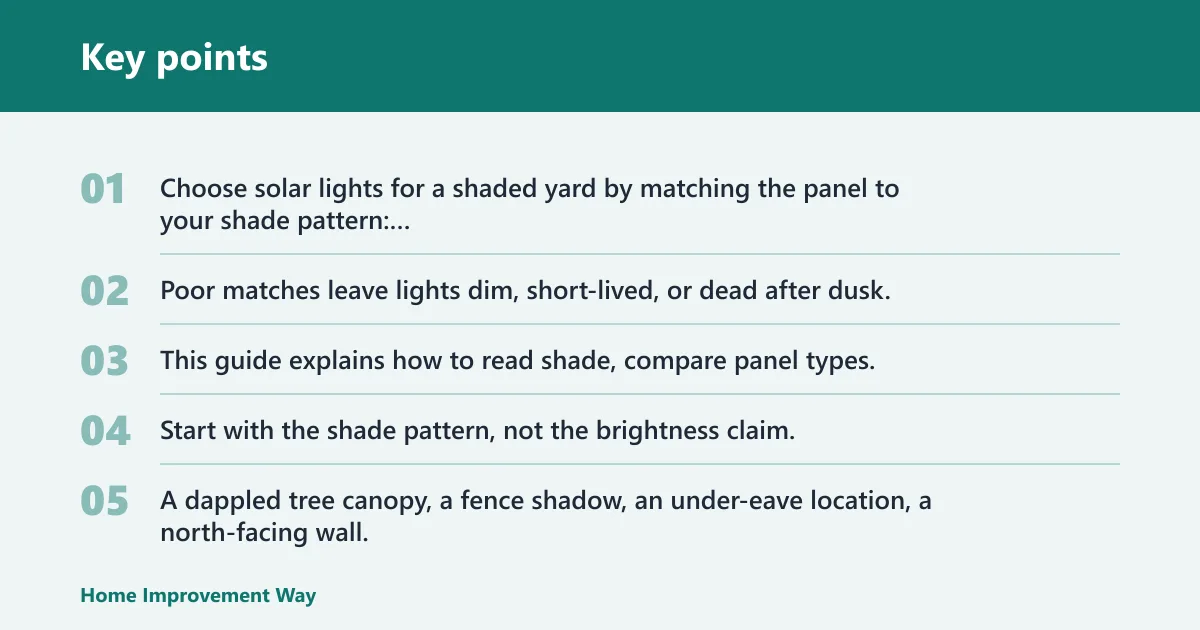
Choose solar lights for a shaded yard by matching the panel to your shade pattern: full-sun path lights for about 6 or more peak sun hours, partial-shade models for about 3–5, and hybrid or wired lights when daily shade drops below about 3. Poor matches leave lights dim, short-lived, or dead after dusk. This guide explains how to read shade, compare panel types, and decide when solar still makes sense.
Start with the shade pattern, not the brightness claim. A dappled tree canopy, a fence shadow, an under-eave location, a north-facing wall, and an open area with partial sun all limit charging in different ways, and they do not fail the same way.
How much sun does your yard actually get?


Solar lights contain a photovoltaic cell, battery, light bulb, and photosensor, so charging and lighting depend on all four parts working together. The panel may be fine while the battery is too small, or the battery may be adequate while the panel cannot collect enough light.
Map the shade pattern first
Dappled tree shade is different from deep shade. Dappled light can still feed a panel for part of the day, while dense canopy cover often leaves the light undercharged and weak after dusk. Fence shade and under-eave shade are even more specific, because the blocking often happens at the same time each day.
North-facing walls deserve special caution. In many yards, they get the least direct sun and the longest periods of indirect light, so a fixture mounted there may never fully recharge even if the rest of the yard looks bright.
Decide what the light has to do
Decorative lights can tolerate more compromise than pathway or security lighting. If the goal is mood light along a planting bed, shorter runtime may be acceptable. If the goal is safe footing on a walk or visibility near a gate, the light has to charge well enough to stay useful after dark.
One common mistake is buying a decorative string set for a walkway in a shaded side yard. It may look fine for a short stretch after sunset, then fade before the path is actually needed.
Spot the warning signs
Heavy canopy cover is the first warning sign. Seasonal angle changes matter too, because a location that gets some winter sun can lose it when leaves fill in. Overhang shadowing is another common failure mode, especially when the panel sits under an eave or behind a fascia board.
Picture a side yard where a maple tree shades the lawn by midafternoon and a fence casts a second shadow by evening. That location may still support a low-output path light, but it is a poor match for a fixture expected to run all night.
Shade decision matrix
This matrix turns yard conditions into a buying decision. It favors fit over spec-sheet brightness, because panel placement, battery size, and control mode matter more in shaded yards than in open ones.
| Yard condition | Best light type | Minimum panel preference | Battery expectation | Runtime risk | Solar viable? |
|---|---|---|---|---|---|
| Dappled tree shade | Path light or low-output spotlight | Monocrystalline, with the largest panel the fixture can accept | Medium to high capacity; lithium preferred for longer usable runtime | Medium; leaf occlusion and seasonal canopy growth can cut charge fast | Yes, for pathway or decorative use; avoid security use unless the panel gets several direct hours |
| Fence shade | Fence light or ground disk with separate panel if possible | Monocrystalline; panel should face the clearest sky exposure | Medium capacity; runtime drops if the fence blocks morning or late-day sun | Medium to high; shadow length changes through the year | Sometimes; better for accent light than for all-night function |
| Under-eave shade | Wall light with remote panel, or hybrid/wired light | Monocrystalline or a larger separate panel placed in direct sun | High capacity if solar is the only power source | High; overhang shade often limits charging every day | Usually marginal; hybrid or wired is better for reliable lighting |
| North-facing wall | Wall light only if panel can be placed elsewhere | Monocrystalline, separate panel strongly preferred | High capacity; expect shorter runtime in winter | High; indirect light may not fully recharge the battery | Often poor; solar is better only if panel placement is moved to sun |
| Open partial sun | Path light, spotlight, or wall light | Any type can work, but monocrystalline is the safest choice | Medium capacity usually fits daytime charging better | Low to medium; still drops in cloudy stretches | Yes; this is the best solar-friendly condition in this group |
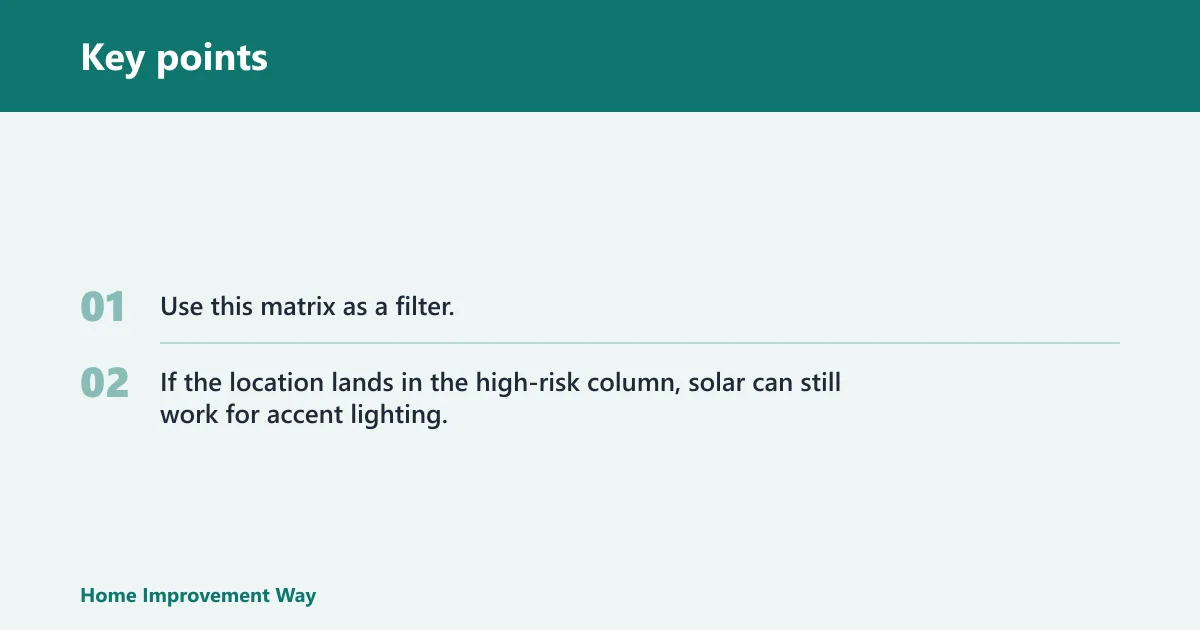
Use this matrix as a filter. If the location lands in the high-risk column, solar can still work for accent lighting, but it is a poor fit for dependable night lighting.
What panel type works best in shade?
Monocrystalline panels are the best choice for limited sun because they usually turn more of the available light into charge than cheaper panel types. Amorphous panels can still work in lower-light conditions, but they trade performance for lower cost. Polycrystalline panels sit in the middle.
Amorphous panels
Amorphous panels are often the lower-cost option. They can be useful when the light only gets indirect sun or short daily exposure, but they usually deliver less power than better panels of similar size. That makes them a fit for small decorative lights, not for high-demand security fixtures.
Polycrystalline panels
Polycrystalline panels are the middle-ground choice. They usually cost less than monocrystalline panels and perform better than basic amorphous panels, but they are not the first pick for a yard that already struggles with shade. They make the most sense when the location gets mixed sun and the fixture does not need long runtime.
Monocrystalline panels
Monocrystalline panels are the strongest choice for shaded areas because they tend to produce more output from limited light. That does not fix bad placement. A small monocrystalline panel under a deep overhang can still undercharge if the panel never sees enough sky.
Panel size matters as much as panel type. A larger panel can collect more light over the day, which helps when shade cuts down the total charge window. Separate panel placement also matters, because it lets the lamp sit in shade while the panel sits in sun.
How many lumens and how much battery do you need?
Lumens are the better brightness measure than wattage. Use-case matters more than raw output, because pathway lights, decorative lights, and security lights need different levels of illumination and different runtime expectations.
Match brightness to the job
- Pathway lighting: Choose lower to moderate lumen output for safe footing and wayfinding.
- Decorative lighting: Lower lumen output is usually enough for mood or accent use.
- Security lighting: Choose higher lumen output, wider coverage, and a control mode that preserves charge.
A reviewed pathway light set is rated at 15 lumens, which fits accent use more than task lighting. A 40 watt incandescent bulb equals about 3 watt LED output in the comparison chart, which shows why wattage alone is a weak guide for brightness.
Battery capacity shapes runtime
Higher battery capacity usually means longer runtime, but only if the panel can refill it. In partial shade, a large battery can still end the night undercharged if the panel never gets enough recharge time. That is why battery size and panel size need to be read together.
Recharge time and runtime should be checked as a pair. Full-sun charging is faster than partial-shade charging, and slow charging shortens nightly runtime. A light that claims long hours on paper may not deliver them when the panel spends the afternoon under leaves.
Solar lights with poor charge conditions often shift from all-night use to partial-night use. That change is most noticeable in winter, on cloudy stretches, and in yards where one shadowed corner drags down the panel every day.
Battery chemistry matters
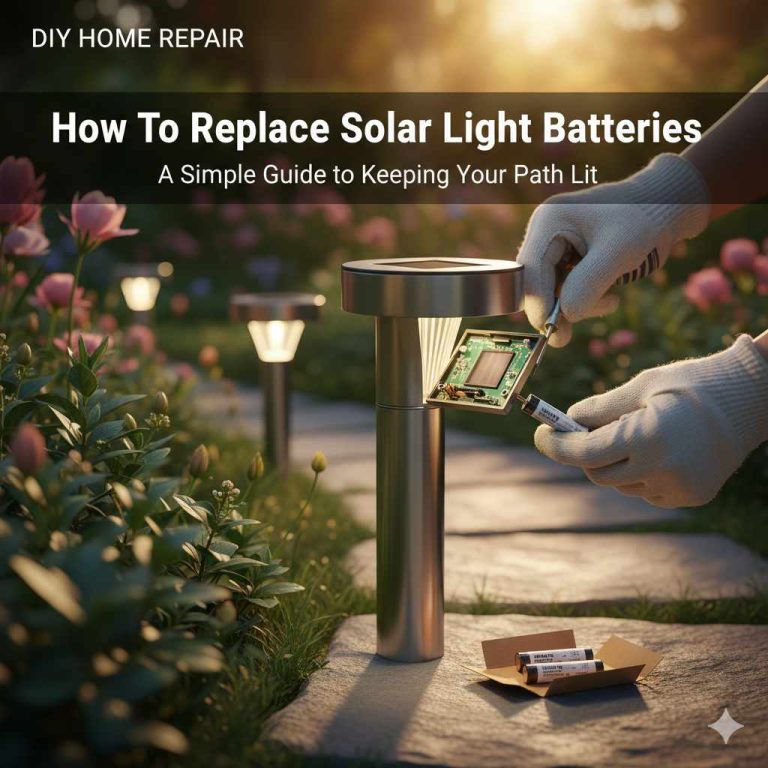
NiCad, NiMH, and lithium batteries are common in solar lights. NiCad and NiMH are familiar options, but lithium batteries are often preferred when longer usable runtime and better capacity-to-size balance matter. Replacement timing matters too, since battery performance drops as cells age.
Replacement planning should not be ignored. If the light uses a replaceable battery, the owner can extend service life by swapping it when runtime drops. If the battery is sealed, a weak battery often means replacing the whole fixture sooner.
Say your side path gets four hours of weak winter sun and you want light for the first few hours after dusk. A low-output path light with a larger lithium battery is a better fit than a bright decorative spotlight that cannot recharge enough to stay on.
Can controls and weather rating make a shaded light work better?
Dusk-to-dawn sensors help by turning the light on automatically and off in daylight, which is useful in yards where manual switching is inconvenient. Motion sensors help conserve battery in low-sun conditions by keeping the light dim or off until movement triggers it.
Dusk-to-dawn sensors
A dusk-to-dawn sensor gives hands-off operation. That matters in low-light yards, because the light can turn on without a switch and turn off when morning returns. It does not create extra charge, though, so it cannot fix an underpowered panel.
Motion sensors
Motion sensor solar lights are often better for security use in shaded spots because they stretch battery life. The light can stay low or off most of the night and only switch to full brightness when someone passes. That lowers drain when charging is limited.
Motion control is not a substitute for adequate charging. If the panel barely fills the battery, even a motion sensor may only buy a small amount of extra runtime. It works best when the goal is targeted security light, not continuous illumination.
IP rating and build quality
IP rating is the weather-resistance marker to check for outdoor fixtures. Wet-exposure locations, such as fence posts, walls, and open paths, need outdoor-rated housing, sealed panels, and durable materials that can handle rain, splash, and dust.
Shaded yards are often damp yards, too. A light mounted under trees may face extra moisture and debris, so weather resistance matters as much as charging performance.
Where should you place solar panels and fixtures?
Place the panel where it gets the most direct sun you can give it. Avoid foliage, overhangs, and fence shadow whenever possible. If the fixture itself must sit in shade, use a separate panel so the lamp and the collector do not compete for the same small patch of light.
Check the whole day, not one hour
- Look at the area in morning, midday, and late afternoon.
- Mark shade from trees, fences, roof edges, and nearby walls.
- Choose the spot that gets the longest direct exposure window.
- Mount the panel where leaves and seasonal growth will not block it.
- Recheck the location before drilling or staking anything permanent.
Seasonal sun angle changes can turn a good spring location into a weak winter one. That is why a panel that looks acceptable in July may still underperform once the sun drops lower and nearby shadows stretch farther.
Know when solar is a poor fit
Solar is often a poor fit when shade is heavy, when the fixture needs all-night performance, or when there is no practical way to move the panel into direct sun. It is a poor fit when shade is heavy, when the fixture needs all-night performance, or when the location has no practical way to move the panel into direct sun. In those cases, hybrid or wired lighting is the better choice.
Do not buy decorative lights for a safety job in a shaded yard. Do not expect a motion sensor to rescue a panel that barely charges. And do not assume a monocrystalline panel can overcome a bad mounting location.
Frequently asked questions
How do I choose solar lights for a shaded yard?
Start with the shade pattern, then match the panel type, battery size, and light form factor to the job. Choose monocrystalline panels for limited sun, larger batteries for longer runtime, and motion sensing for security use. If the location stays shaded most of the day, hybrid or wired lighting is usually the better choice.
Will solar lights work in partial shade?
Yes, but partial shade reduces charge and often shortens runtime. Lights that get several hours of usable sun can work for paths, accents, and some motion-triggered security uses. If shade cuts daily charging too far, expect dimmer output, shorter nighttime run, or both.
What kind of solar panel is best for shaded areas?
Monocrystalline panels are usually the best pick for shaded areas because they tend to perform better in limited light. Amorphous panels can work in lower-output decorative fixtures, while polycrystalline panels sit between the two. Panel size and placement still matter, even with the better panel type.
How many lumens do I need for shaded outdoor lighting?
Choose lumens based on the job, not the label alone. Lower output can fit decorative lighting, moderate output works for paths, and higher output is better for security lighting. In shade, the safest choice is often a lower-lumen fixture that can actually recharge enough to stay on.
Can solar lights charge under trees or near fences?
They can, but charging is usually weaker under trees or near fences because leaves and shadow block direct sun. Dappled light may be enough for low-demand fixtures, while dense shade often is not. A separate panel placed in sun gives much better odds than a panel fixed in the shaded spot.
What battery capacity should I look for in solar lights?
Look for enough capacity to cover the hours you need after dusk, then confirm that the panel can recharge it. In shaded yards, a larger battery can help, but it cannot make up for poor charging. Replaceable batteries are easier to maintain when runtime starts to slip.
Are motion sensor solar lights better for shaded spots?
Often yes, especially for security lighting. Motion sensors save battery by keeping the light from running at full output all night. They work best when the panel still receives enough sunlight to refill the battery, so they reduce drain but do not fix a bad charging location.
Where should I place solar lights in a yard with limited sun?
Place the panel where it gets the clearest direct sun, away from foliage, roof overhangs, and fence shadow. If the lamp must stay in shade, use a separate panel and run the cable to the sunniest mount point. Check the site through the day before committing to permanent placement.
Sponsored / affiliate links. As an Amazon Associate I earn from qualifying purchases. I may earn additional commission from eligible campaigns.