
Ceiling Fan Airflow Guide: How to Compare CFM Ratings
Compare ceiling fan CFM by room size and speed: a common screening range is about 1,500 to 2,000 CFM per 100 square feet, but the number only makes sense when you also check fan diameter, ceiling height, and mounting height. A high rating can still move air poorly in a real room if the fan is too close to the ceiling or the stated test point is not the one you plan to use. This guide shows how to compare CFM ratings by room size, speed, efficiency, and installation height before you buy.
What CFM means on a ceiling fan
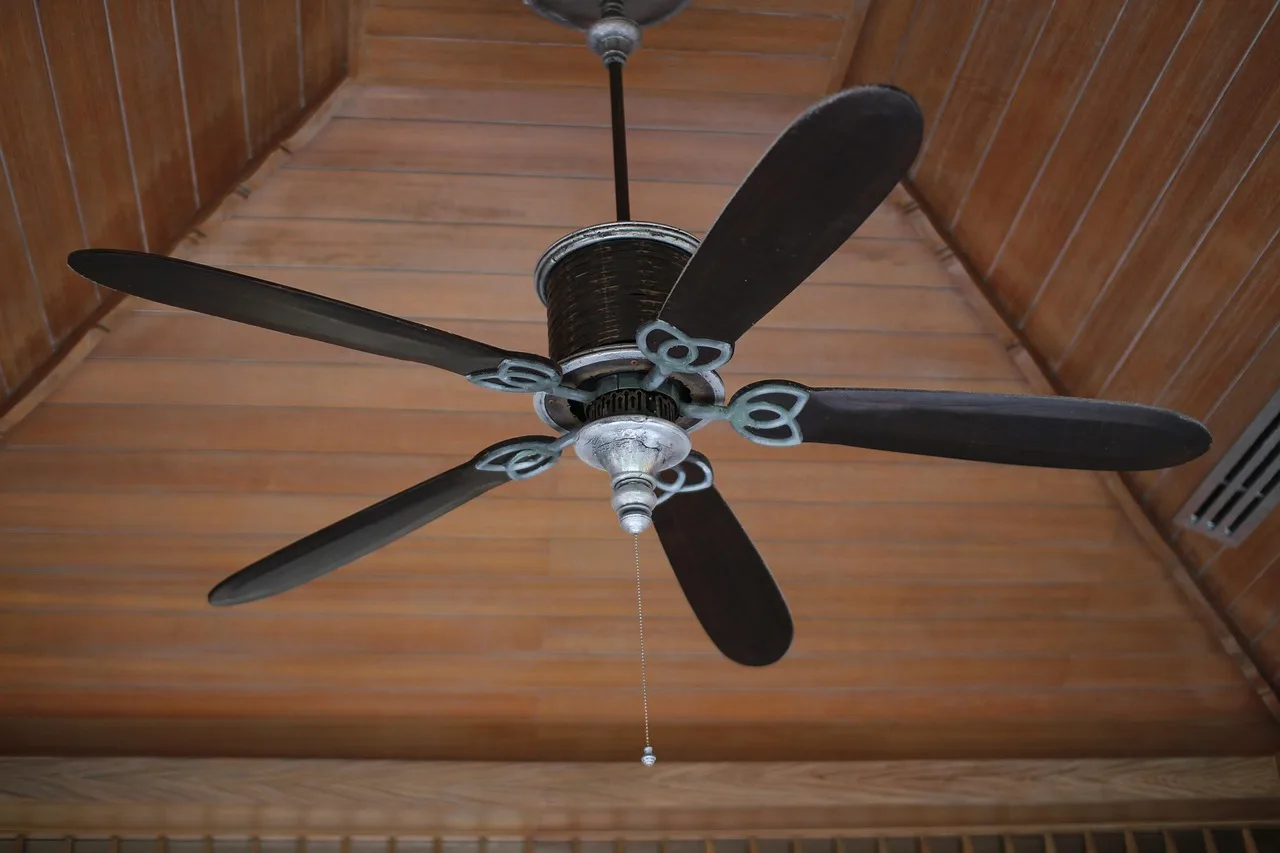


CFM on a ceiling fan is the amount of air the fan moves per minute under a specific manufacturer test condition. A fan rated at 6,000 CFM moves 6,000 cubic feet of air each minute at that stated test point. That number helps you compare airflow, but only if you also check the operating speed, fan size, and mounting setup.
Do not treat CFM as a room-temperature rating. Consumer Reports says ceiling fans do not lower room temperature, though they can let you raise the thermostat or turn off AC. That is why airflow matters for comfort, not cooling in the literal sense. (Consumerreports)
Where manufacturers list CFM and watts
Many manufacturers list airflow on the spec sheet, the EnergyGuide label, or both. The EnergyGuide label may also list watts, airflow efficiency, and estimated yearly energy cost. That makes it useful when you want to compare airflow against power draw instead of judging by one number alone.
CFM numbers are standardized only when the underlying test point is the same. If one model reports high-speed airflow and another reports medium-speed airflow, the numbers are not directly comparable. Check the speed, test basis, and mounting setup, not just the headline figure.
How do you compare two CFM ratings?
Compare two fans at the same operating point, then check CFM per watt before choosing the winner. A fan with higher max CFM is not automatically the better fit, especially if it uses more power, has a larger blade span than the room needs, or performs better only at a speed you will rarely use.
The most useful comparison asks three questions: how much air does each fan move, how much power does it take, and does the fan size fit the room? That is the difference between a spec-sheet winner and a better real-room choice.
Use CFM per watt as the tie-breaker
CFM per watt is a common airflow-efficiency measure: divide the fan’s CFM by its watts at the same operating point. Higher is better. If two fans move similar air, the one with the better CFM per watt usually gives you more airflow for each watt of power used.
When comparing specs, rely on manufacturer data tied to a stated test standard or EnergyGuide information rather than unsupported marketing claims. If the source does not clearly state the speed or test point, leave the number out of the comparison.
Watch for blade span and motor differences
Blade span is the diameter from blade tip to blade tip. It helps with room sizing, but it is not interchangeable with CFM. Two fans can share a 52-inch span and still move air differently because of blade pitch, motor design, and operating speed.
RPM, or rotational speed, also does not predict airflow by itself. A faster fan can move less air than a slower one if the blade shape or motor setup is different. That is why RPM belongs in the comparison, but not as the deciding number.
How many CFM do I need for my room size?
Room size should guide the choice, but not through a single universal number. For a large room or great room, the practical target depends on ceiling height, layout, and whether you want the fan to move air in the occupied zone rather than just near the ceiling. A fan that is oversized on paper can still underperform if the ceiling is high, the downrod is wrong, or the blades sit too close to the ceiling.
For a worksheet-style starting point, use room size as a fit screen: smaller bedrooms often need less airflow than open-plan rooms, and larger spaces usually need a bigger span or more careful placement. Match the airflow to the room, not the headline number.
What CFM is good for a large room or great room?
For a large room or great room, look for enough airflow to reach the occupied zone with a comfortable margin, then verify that the fan’s stated CFM is measured at the speed you plan to use. In practice, a large room often needs a higher CFM fan than a bedroom, but the best choice still depends on ceiling height, blade span, and the fan’s efficiency at the speed you will actually run.
Because manufacturers test under different conditions, a room-size chart is best used as a screening tool. Start by placing a fan into fit, borderline, or poor-fit buckets based on room size, then use CFM per watt and mounting height to break ties.
Blade span, RPM, watts, and motor type
Blade span affects coverage area, not airflow alone. Watts measure power draw, not direct airflow. RPM shows blade speed, but not how much useful air reaches the occupied zone. Those numbers matter together, and the comparison changes again when you factor in the motor type.
DC motors often hold better low-speed performance, use lower wattage, and run more quietly than many AC motors. AC motors are common, but the better comparison is the stated airflow and wattage at the same speed and test point. That difference matters if you plan to run the fan at medium or low speed most of the time.
Do DC motors change ceiling fan airflow?
DC motors can change the way a ceiling fan performs, but they do not automatically guarantee more airflow at every speed. What they often change is efficiency, low-speed control, and sound level. The most useful comparison is still the stated CFM, watts, and speed on the label or spec sheet.
Why strong max CFM can still feel weak
Many fans advertise a high maximum CFM, yet feel weak on the speeds people actually use. The gap usually comes from one or more of these factors: the published number is tied to high speed only, the fan is mounted too high, or the blades do not move air effectively into the occupied zone.
Consumer use also changes the result. A fan that performs well at high speed may feel soft at medium speed if the motor drops off quickly, while a DC fan may hold useful airflow better at the lower settings people choose for daily comfort.
Ceiling fan airflow worksheet

Use this worksheet to compare fans side by side. It keeps the focus on room size, blade span, airflow, efficiency, and mounting height. A fan only earns a pass when the room fit and the installation both make sense.
| Room size | Fan diameter | High-speed CFM | CFM per watt | Mounting-height note |
|---|---|---|---|---|
| 120 sq ft bedroom | 44 in | 4,500 | 150 | Pass if blades clear the floor and leave comfortable headroom; fail if the fan sits too high to move air into the occupied zone |
| 150 sq ft bedroom | 52 in | 4,800 | 160 | Pass if the fan hangs at a usable height with a proper downrod; fail if a flush mount leaves airflow trapped near the ceiling |
| 325 sq ft living room | 56 in | 6,200 | 145 | Pass if the blades are not crowding a high ceiling; fail if placement forces the fan too close to the ceiling surface |
| 700 sq ft great room | 60 in | 11,000 | 180 | Pass only if the install height lets the airflow reach the occupied zone; fail if ceiling height or placement keeps the air out of reach |
| Sample fan | Room size | Blade span | High-speed CFM | Watts | CFM/W | Motor type | Mounting-height pass/fail | Winner |
|---|---|---|---|---|---|---|---|---|
| Sample Fan A | 150 sq ft bedroom | 52 in | 4,800 | 30 | 160 | DC | Pass with proper downrod and clear ceiling clearance | Winner if the room is a medium bedroom and efficiency matters most |
| Sample Fan B | 325 sq ft living room | 56 in | 6,200 | 42 | 148 | AC | Pass only if the fan is mounted low enough to move air into the occupied zone | Winner if the room is larger and higher airflow matters more than efficiency |
Simple scoring rule: pick the fan with the better overall fit score. Give 2 points for a room-size match, 1 point for better CFM per watt, and 1 point for a pass on mounting height. If a fan has higher CFM but a poor room fit or a failed mounting-height note, choose the lower-CFM fan only if it scores higher overall.
- Check the room size first.
- Check fan diameter against that room.
- Compare high-speed CFM at the same operating point.
- Divide CFM by watts to compare efficiency.
- Mark mounting height as pass or fail.
- Choose the fan with the better total score, not the biggest airflow number.
Why a fan can feel weak even with a high CFM rating
A fan can feel weak if the high CFM number is tied to a speed you rarely use, or if the blades sit too close to the ceiling. Ceiling height and downrod length matter because they affect whether the moving air reaches the space where people are sitting or standing.
Picture a great room with a high ceiling and a short mount. The fan may have a strong published CFM, yet the air mainly swirls near the ceiling instead of where you feel it. A longer downrod may improve that, but check the manufacturer’s listing for your model before changing the install plan.
Lights, remotes, and other tradeoffs
Lights, remote controls, and outdoor ratings can change the comparison even when the airflow number looks attractive. Those features may affect weight, wiring, noise, or operating convenience, so read the full listing instead of comparing only the fan motor section.
The same source rates ceiling fans on air flow, noise, and adjustability. That is a useful reminder that airflow is only one part of the buying decision. A fan that moves air well but is awkward to control may be a worse fit than a slightly less powerful model with better everyday use.
Frequently asked questions
What does CFM mean on a ceiling fan?
CFM is the airflow number for a ceiling fan, measured in cubic feet of air moved per minute. It should be read with the test conditions in mind, because the number comes from a specific speed and setup, not from every possible installation or room.
Is a higher CFM ceiling fan always better?
No. Breezary says a higher maximum CFM is not automatically the better fit for a smaller room. A fan can be too large, too powerful at the top speed, or poorly matched to the way you actually use it. Room fit and efficiency matter too.
How do I compare CFM ratings between two ceiling fans?
Compare the two fans at the same speed, then check CFM per watt and blade span. If one fan has more airflow but worse efficiency or a poor room-size match, the better choice may be the fan with slightly lower CFM and better overall fit.
What is the difference between CFM and CFM per watt?
CFM is airflow. CFM per watt is airflow efficiency, found by dividing CFM by watts at the same operating point. Use CFM to judge volume moved, and use CFM per watt when two fans move similar air but one uses less power.
Where can I find a ceiling fan’s CFM rating?
Look on the manufacturer’s spec sheet, the product listing, or the EnergyGuide label. The EnergyGuide label is especially useful because it also lists watts, airflow efficiency, and estimated yearly energy cost, which makes side-by-side comparison easier.
Sponsored / affiliate links. As an Amazon Associate I earn from qualifying purchases. I may earn additional commission from eligible campaigns.