How Much Clearance Does a Ceiling Fan Need From the Wall?
A ceiling fan should sit about 18 inches from the wall, measured from the blade tip at its closest point. Larger fans need more room, or the blades can hit trim, furniture, or the wall itself. This guide turns blade span into a wall-distance check you can use in real rooms.
What you need to measure first


Start with the fan’s blade span, the room’s shape, and the ceiling height. A long rectangular room needs different placement than a square one, and a low ceiling can change the blade path enough to affect clearance. Check nearby fixtures too.
- Tape measure
- Paper or phone for a ceiling sketch
- Fan spec sheet with blade span
- Step ladder
- Pencil or painter’s tape
- Fan-rated electrical box for new installs
How to measure blade span
Blade span is measured tip to tip across opposite blades, not across the motor housing. The sweep radius is half that number, so a 52-inch fan has a 26-inch blade reach from center to tip. That blade tip is the point that matters near a wall.
- Read the fan’s stated blade span on the spec sheet.
- Measure from the center of the fan location to each nearby wall.
- Mark the closest point the blade tip will pass during rotation.
- Compare that mark with the safe minimum clearance.
- If the room is tight, redraw the fan center before wiring or mounting.
A common first-timer mistake is measuring from the housing instead of the blade tip. Suppose a 48-inch fan is centered 20 inches from a side wall. The housing may look clear, but the blade tip reaches much farther, so the fan can still sit too close once it spins.
How far should a ceiling fan be from the wall?
Use the blade tip, not the motor housing, and keep at least 18 inches between that tip and the wall at its closest point. That is the safe minimum. In narrow rooms, a few extra inches helps the fan move air instead of pushing it straight along the wall.
If the fan is offset from center, measure from the blade tip to every nearby wall, cabinet, and tall shelf. A fan that clears one wall may still sit too close to another side. In a corner, the tighter angle often needs more than the bare minimum.
Safe minimum versus better airflow
The safe minimum keeps the blade from contacting nearby surfaces. Better airflow clearance gives the room more usable circulation, especially when the fan is off-center or the room is narrow. For tight spaces, aim beyond the minimum whenever the layout allows it.
How ceiling height changes clearance
Ceiling height affects both blade-to-floor clearance and blade-to-wall geometry. A standard-height ceiling often works with a flush mount, while taller ceilings usually need a downrod. The longer the downrod, the more carefully you should check wall distance, light fixtures, and furniture below.
Flush mount versus downrod
A flush mount keeps the fan closer to the ceiling, which helps in low rooms. A downrod lowers the fan body and blades, which may improve airflow in taller rooms but also changes the blade path relative to walls. Recheck every nearby side after choosing the mount.
Low ceiling and sloped ceiling notes
Low ceilings limit your options because the blades still need enough open space to rotate freely. Sloped ceilings can shift the fan centerline toward one side of the room, so the closest wall may be closer than it looks from the floor. Measure from the blade path, not from the ceiling peak.
Ceiling fan clearance calculator
This table translates common blade spans into practical wall-distance targets. The safe minimum keeps the blade out of trouble. The better-airflow number leaves more room for circulation, which matters more in narrow rooms, corner placements, and offset mounts.
| Blade span | Approximate sweep radius | Safe minimum from wall | Better airflow distance | Layout notes |
|---|---|---|---|---|
| 36 inches | 18 inches | 18 inches | 24 inches | Works better in smaller rooms; keep it out of corners. |
| 42 inches | 21 inches | 18 inches | 24 to 30 inches | Use the larger spacing if the fan is offset from center. |
| 52 inches | 26 inches | 18 inches | 30 inches or more | Good for many living rooms; check light kits and nearby cabinets. |
| 60 inches | 30 inches | 24 inches | 36 inches or more | Best in larger rooms or vaulted ceilings; avoid cramped corners. |
| 72 inches | 36 inches | 24 to 30 inches | 36 to 48 inches | Often used in great rooms; off-center installs need extra checking. |
For room sizing, a living room between 225 and 400 square feet often takes a 50–54 inch fan. Past 400 square feet, many guides move to a 60-inch fan or two smaller fans. Some sources reserve the 60–72 inch range for great rooms or vaulted ceilings.
Can a ceiling fan be too close to a corner?
Yes. Corners restrict airflow more than flat walls because they block two directions at once. A fan that seems fine in the middle of a room may move poorly in a corner, and the blade tip can also end up too close to trim, angled ceilings, or nearby light fixtures.
Picture a 52-inch fan placed 16 inches from one wall and 20 inches from the other in a corner. That may meet a rough visual check, but the air pattern will be uneven and the closest blade path is still too tight. Move the fan center or choose a smaller fan.
When an offset mount is better
If the room layout forces the fan off-center, shift it so the blade tip keeps the same clearance from every nearby wall. That usually works better than leaving one side tight and another side open. Offset mounting also helps when a dining table, cabinet, or beam blocks one side.
What to check before you install
Check the electrical box, nearby fixtures, and wiring access before you cut or mount anything. A fan-rated electrical box is required because ceiling fans weigh more and move more than a standard light fixture. A loose box can create noise, wobble, or a safety hazard.
Also look for light fixtures, tall bookcases, cabinets, and closet doors in the rotation zone. Those objects need their own clearance, not just the wall. If the fan includes a light kit, add that hardware into your layout because it can change how low the assembly hangs.
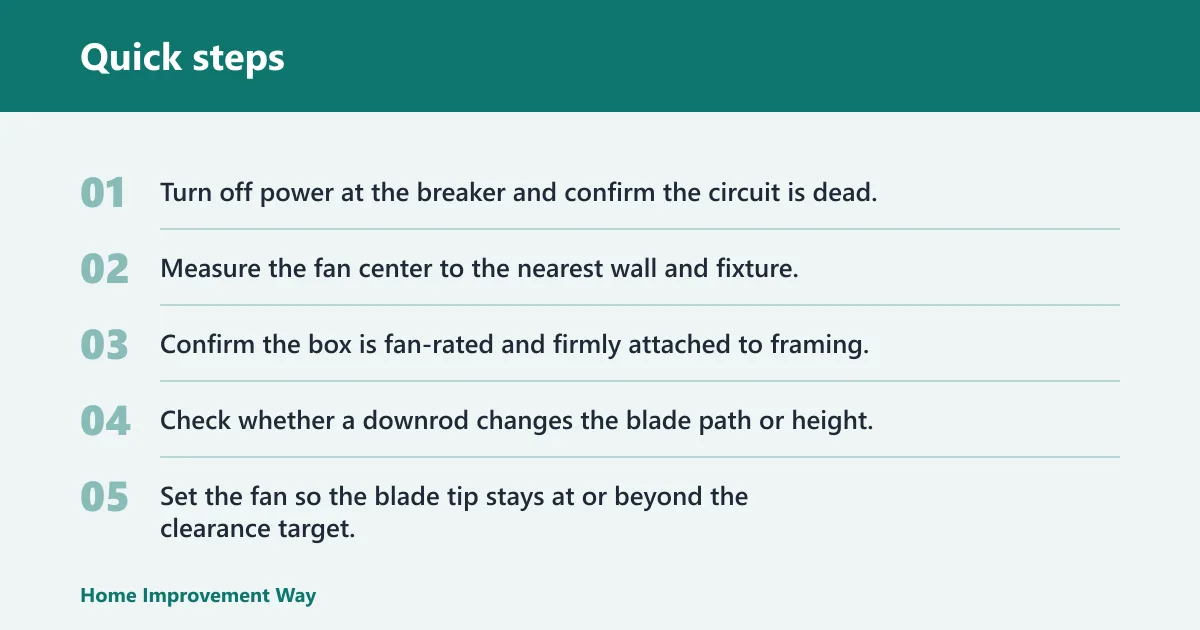
- Turn off power at the breaker and confirm the circuit is dead.
- Measure the fan center to the nearest wall and fixture.
- Confirm the box is fan-rated and firmly attached to framing.
- Check whether a downrod changes the blade path or height.
- Set the fan so the blade tip stays at or beyond the clearance target.
Installation labor and cost
Ceiling fan installation costs range from $134 to $352, and many homeowners spend around $247. Typical labor costs run between $50 and $200. If the job is complex, the cost can jump as high as $600, and a ceiling fan with light installation adds $100 to $300.
Replacement work is usually simpler than new wiring. Hard-to-reach ceilings, new circuits, and box replacement add time and cost. Residential ceiling fans can cost between $50 and $1,400, while commercial models can fetch $3,500 or more.
Common mistakes that reduce clearance
Most clearance problems come from measuring the wrong point or ignoring the room layout. The blade tip is the governing point, not the motor housing. A fan can also be too close after a downrod change, a light kit addition, or a move from center to offset mounting.
- Measuring to the motor instead of the blade tip
- Using the same clearance for every blade span
- Ignoring corners, sloped ceilings, or low beams
- Forgetting nearby cabinets, shelves, or pendant lights
- Installing a fan without a fan-rated electrical box
If that did not work, remeasure from the blade tip at its closest point, then move the mounting point by 2 inches and check again. That small adjustment often fixes a borderline layout without changing the entire room plan. Recheck after any blade or downrod change.
Prevention is simple: sketch the room before you buy the fan, mark the center point, and compare that sketch with the blade span and ceiling height. That keeps you from picking a fan that fits the ceiling but crowds a wall or fixture.
Frequently asked questions
How much clearance does a ceiling fan need from the wall?
Use 18 inches as the safe minimum from the wall to the blade tip at its closest point. If the room is narrow, a larger fan, a corner install, or a long downrod may call for more space so the fan can move air cleanly without clipping trim or furniture.
Can a ceiling fan be too close to a wall?
Yes. A fan too close to a wall can throw air unevenly, increase noise, and risk blade damage if the room shifts or the fan wobbles. If the blade tip comes within the minimum clearance, move the mount point, use a smaller fan, or change the room layout.
How do you measure ceiling fan blade clearance?
Measure from the wall to the outermost blade tip at the closest point in rotation. Do not measure to the motor housing. A tape measure and a simple ceiling sketch are enough for most rooms. Mark the fan center, then draw the blade radius to each nearby wall.
What happens if a ceiling fan is near a wall or corner?
Airflow usually weakens on the crowded side, and the fan may feel less effective even when it spins safely. Corners are worse because they block movement in two directions. If the fan is near a corner, move it toward the room center or choose a smaller blade span.
Does fan size change the wall clearance you need?
Yes. Larger blade spans sweep farther and need more room to keep the blade tip away from the wall. A 52-inch fan can fit many rooms, but a 60-inch or 72-inch fan usually needs a wider open area, especially when the mount is offset or the ceiling is low.
Sponsored / affiliate links. As an Amazon Associate I earn from qualifying purchases. I may earn additional commission from eligible campaigns.