Ceiling Fan Energy Star Guide: What the Label Means
Energy Star on a ceiling fan means the model met EPA efficiency rules, but you should still compare CFM per watt, motor type, and room size before buying. Skip that check and you can end up with a fan that wastes power, moves too little air, or feels noisy and ineffective. This guide explains what the label does and does not tell you, how to read CFM/W, and how to match a fan to your room.
Energy Star as a screening tool, not a final verdict
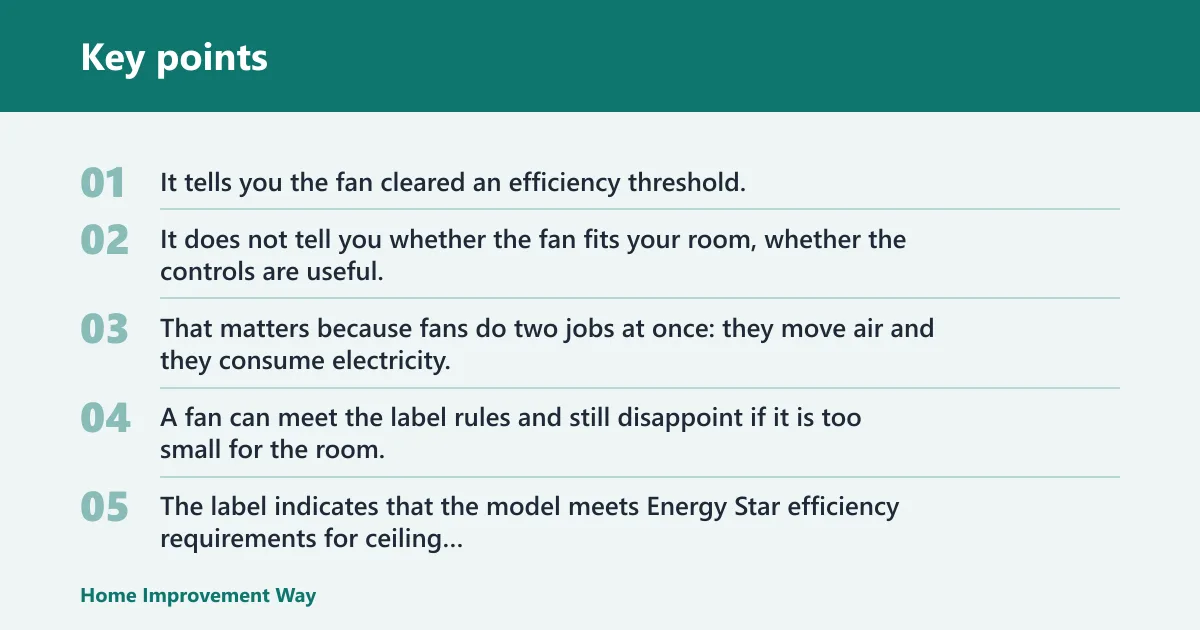


The Energy Star label is a screening signal. It tells you the fan cleared an efficiency threshold, so you can rule out weak performers faster. It does not tell you whether the fan fits your room, whether the controls are useful, or whether the airflow will feel right at the speed you actually use.
That matters because fans do two jobs at once: they move air and they consume electricity. A fan can meet the label rules and still disappoint if it is too small for the room, too large for the ceiling height, or tied to a speed you will never use.
What the label does verify
The label indicates that the model meets Energy Star efficiency requirements for ceiling fans. In practical terms, that makes it a fast comparison tool when you are sorting through many models. It is especially useful when two fans look similar but one has a better airflow-per-watt result.
What the label does not tell you
The label does not tell you whether the fan fits a 12-by-12 bedroom, a vaulted living room, or a long open plan. It also does not tell you whether a remote, wall control, or automation setting will keep the fan from running longer than needed. Read it as a gatekeeper, not a final verdict.
Why it is a screening tool, not the finish line
Energy Star helps narrow the field, but CFM per watt, motor type, size, and controls decide how the fan will behave in your home. If those four pieces do not line up, the label alone can mislead you.
Ceiling fan label decoder
This label decoder shows what the common fields mean in plain English. Read the whole label once, then compare it with the room the fan will serve.
| Label field | Plain-English meaning | What to do with it |
|---|---|---|
| Energy Star mark | The fan met the program’s efficiency rules. | Use it to remove obvious low performers. |
| Model and size | Shows the fan’s blade span and version. | Check that the size matches the room. |
| CFM | The airflow number, or how much air the fan moves. | Compare airflow when two fans are the same size. |
| CFM per watt | The airflow efficiency metric shown on the energy label. | Use it to compare how much air you get for each watt. |
| Watts | How much electricity the fan draws at a listed speed. | Lower watts are better only when airflow stays useful. |
| Speed count | How many steps the fan offers between off and high. | More speeds can make it easier to find the lowest useful setting. |
| Control notes | Mentions remote, wall, smart, or reversible control features. | Look for controls that help you shut the fan off or schedule it. |
One-line decision rule: trust the Energy Star label for a first pass, put CFM per watt first once the size fits the room, and treat the label as less useful when the fan is clearly too large or too small for the space.
How to read the label in one pass
- Check the blade span first.
- Check the room size the fan is meant to serve.
- Look at CFM per watt, not watts alone.
- Note the motor type and speed count.
- Confirm the control method you will actually use.
Suppose a fan has a good Energy Star mark, but its size is meant for a large open room and you plan to put it in a small bedroom. The label still passes, but the result can feel off because the fan may need to run on a lower speed than the controls make comfortable.
How CFM per watt compares fans
CFM means airflow, and CFM per watt is the efficiency metric on the label. It shows how much air the fan moves for each watt of power used. That makes it more useful than watts alone, because a low-watt fan that barely moves air is not a good buy.
Why watts alone can mislead
Watts tell you electrical draw, not comfort. A fan that draws less power but delivers weak airflow may need to run longer or at a higher speed, which can erase part of the advantage. Compare airflow and power together.
Why you should compare fans at the same size
CFM comparisons only make sense when the fans are the same size or intended for the same room. A larger fan can move more air at lower speed, so a bigger CFM number is not automatically better unless the room can use it.
A common mistake is comparing a 42-inch fan with a 60-inch fan by size alone and choosing the larger number on the label. That can backfire in a small room, where the bigger fan may need to stay on a very low setting to feel comfortable.
DC motor vs AC motor
DC motors usually use about a third to half the power of AC motors, and many efficient fans use a 6-speed DC motor. AC motors typically draw 50–75 watts on high and often offer fewer speed settings. DC is not automatically better in every room, but it often gives you more flexibility and less power draw.
Typical watt draw differences
AC-motor ceiling fans typically draw 50–75 watts on high. DC motors use about a third to half the power of AC motors. That difference matters most when the fan runs often, runs for long stretches, or replaces an older high-draw model.
Why DC fans often offer more speed settings
More settings help you find the lowest effective speed. Many efficient fans use a 6-speed DC motor, and one listed smart fan uses a 10-speed brushless DC motor. Those extra steps can reduce the need to jump from “too weak” to “too much” airflow.
When AC fans still make sense
AC fans can still fit the job when you want a familiar wall switch setup, a lower upfront price, or a simple replacement for an existing fan box. In a room where the fan runs only occasionally, the energy gap may matter less than fit, control type, and installation compatibility.
Does fan size affect efficiency?
Yes. Fan size and room size shape both comfort and energy use. A bigger fan can run slower and still move enough air, but only if the room and ceiling height can support it. An undersized fan can look efficient on paper and still feel weak in the room.
Blade span and room size
Under 4,000 CFM is described as too weak for most large rooms. 4,000–7,000 CFM is presented as solid for medium-large spaces. 7,000+ CFM is described as ideal for big open-concept layouts. Those airflow ranges are more useful when matched to the room than when judged in isolation.
Why larger fans can run slower
When a larger fan fits the room, it can often move enough air at a lower speed. Lower speed can mean less noise and less power use. That is one reason room fit matters as much as the label.
When oversizing or undersizing wastes performance
An oversized fan can feel like it is fighting the room because you keep dropping to the lowest setting to avoid a draft. An undersized fan can feel inefficient because it has to run high more often to deliver usable airflow. Both cases make the label look better than the experience.
Controls that save energy
Controls turn purchase-time efficiency into real-world efficiency. Ceiling fans cool people, not rooms, and they can support about a 4°F higher thermostat setting when used correctly. That only helps if you use the fan where people are present and shut it off when they leave.
Thermostat setback and comfort targets
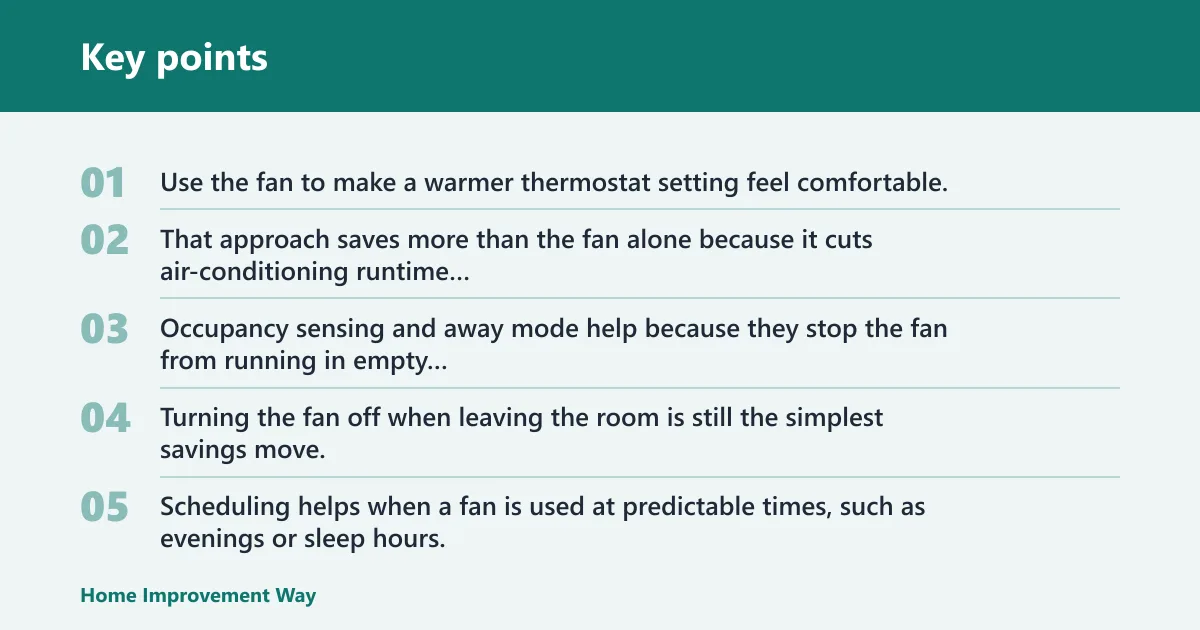
Use the fan to make a warmer thermostat setting feel comfortable. A common target is about 4°F higher. That approach saves more than the fan alone because it cuts air-conditioning runtime while the fan keeps occupants comfortable.
Occupancy sensing and away mode
Occupancy sensing and away mode help because they stop the fan from running in empty rooms. Turning the fan off when leaving the room is still the simplest savings move, but automation makes that habit easier to keep.
Scheduling, remotes, and the lowest useful speed
Scheduling helps when a fan is used at predictable times, such as evenings or sleep hours. Remote and smart controls can also make the lowest useful speed easier to choose. That matters because the quietest comfortable setting is often the one that uses the least energy.
Picture about a 14-by-14 bedroom with a 56-inch fan set up on a 10-speed control. If speed 2 feels comfortable and speed 3 feels like too much air, the extra steps let you stay at the lower setting instead of settling for a higher one all night.
How much can a ceiling fan help with cooling costs?
A ceiling fan can help lower cooling costs by making you comfortable at a higher thermostat setting, often about 4°F higher. Savings depend on how long the fan runs, what speed you use, whether the room is occupied, and how old the current fan is. A newer efficient fan helps most when it replaces an older power-hungry model.
Compared with older fans, a modern DC model can use far less electricity because DC motors use about a third to half the power of AC motors. That does not guarantee a huge bill drop on its own. Runtime and thermostat settings still control the size of the savings.
Frequently asked questions
What does the Energy Star label mean on a ceiling fan?
It means the fan met Energy Star efficiency requirements, so it passed a useful first screen. The label does not tell you whether the fan fits your room, which is why you should still check CFM per watt, motor type, and blade span before buying.
Is an Energy Star ceiling fan worth it?
Often yes, especially if you run the fan often and compare it with older models. The label can help you avoid weak performers, but the real value comes when the fan also has the right size, a practical speed range, and controls you will actually use.
How do I tell if a ceiling fan is energy efficient?
Check CFM per watt, motor type, and size together. A good efficiency score on the label matters, but a fan is only truly efficient if it moves enough air for the room without forcing you to use a higher speed than necessary.
What does CFM per watt mean on a ceiling fan label?
It is the airflow efficiency metric shown on the energy label. CFM is the amount of air moved, and the per-watt figure shows how much airflow you get for each unit of power. Higher is better when the fan size and room size are comparable.
Are DC motor fans always better than AC motor fans?
No. DC motors are usually more efficient, quieter, and offer more speed settings, but AC fans can still make sense for simpler controls or lower upfront cost. The better choice depends on room size, how often you run the fan, and what controls you want.
How many watts does a ceiling fan use?
It depends on the motor and speed. AC-motor ceiling fans typically draw 50–75 watts on high, while DC motors use about a third to half the power of AC motors. Lower speed settings usually draw less, which is why control range matters.
Sponsored / affiliate links. As an Amazon Associate I earn from qualifying purchases. I may earn additional commission from eligible campaigns.