Solar Wall Lights: Where They Work Best Around the Home
Solar wall lights often work best on south- or west-facing walls with several hours of direct sun; for shadier spots, choose a model with a removable panel or expect shorter runtimes. Poor placement means dim output, short evening coverage, and batteries that age faster. This guide sorts front doors, garages, side yards, patios, fences, and stair walls by sun exposure and tells you where each one is likely to work well or fail.
How solar wall lights work at a house wall


Solar wall lights collect sunlight with a photovoltaic cell, store that energy in a rechargeable battery, and use it after dark. The solar panel or module may be built into the fixture or mounted separately. Charging depends more on exposure time and angle than on bright daytime weather alone.
Photovoltaic cell, solar module, and battery basics
Solar technologies capture solar radiation and turn it into useful forms of energy. DOE identifies photovoltaics and concentrating solar-thermal power as the two main solar energy technologies, and PV is the technology used in solar panels. Solar panel energy becomes electricity when sunlight is absorbed by PV cells. (energy.gov)
The rechargeable battery stores that electricity for evening use. Bigger battery capacity usually means longer runtime and steadier brightness, but heat, deep discharge, and short winter charge cycles can shorten battery life. A wall light that charges weakly all week often looks fine at dusk and fails by late evening.
What motion sensors change
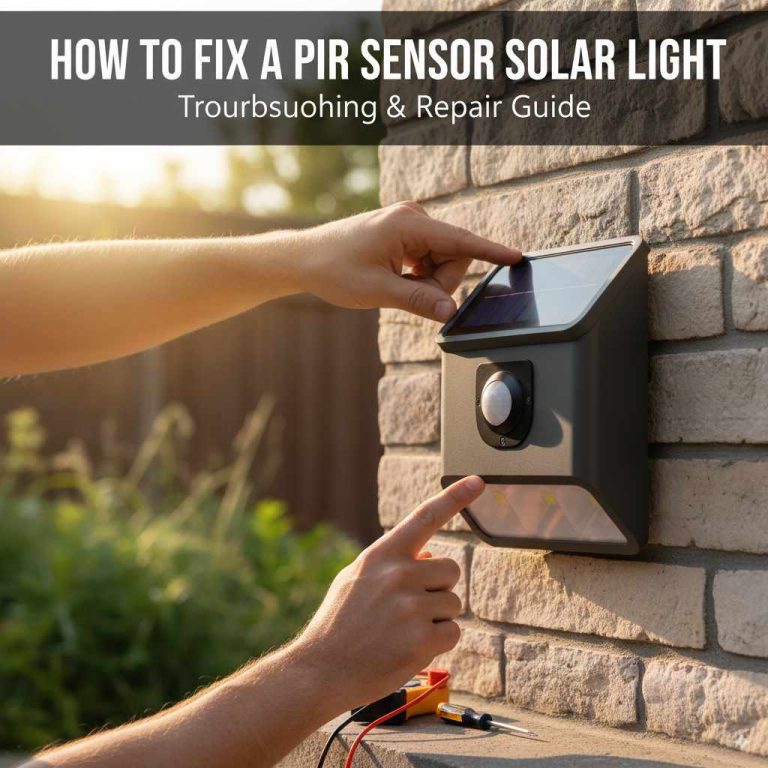
Motion sensors are common on wall lights because they save battery and turn light on only when someone approaches. Range and mounting height matter. If the sensor is too high, it may miss people near the wall; too low, and it may glare into eyes or trigger late.
Picture a side door under a deep overhang. The fixture turns on, but the sensor sees only a narrow slice of the walkway. The light fires after the person reaches the latch, which is not useful for keys or a safe step down.
📊 The Earth receives 174 petawatts of incoming solar radiation at the upper atmosphere. Source: Solar energy.
Where should you put solar wall lights around the house?
Put solar wall lights where the wall gets real sun and where the light job matches the site. Entry doors, garages, side yards, and rear paths often need task lighting. Fences and patio walls can work for accent light, but they are weaker choices when you need to see faces, steps, or hardware.
Best-fit locations by job
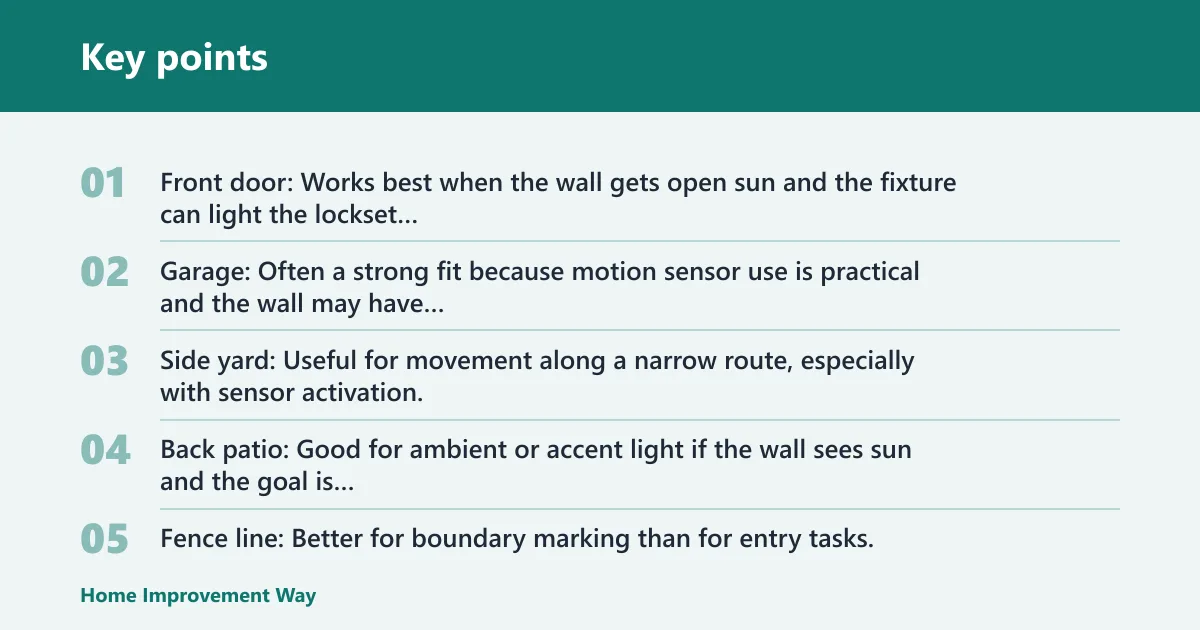
- Front door: Works best when the wall gets open sun and the fixture can light the lockset and step area.
- Garage: Often a strong fit because motion sensor use is practical and the wall may have better exposure than a porch wall.
- Side yard: Useful for movement along a narrow route, especially with sensor activation.
- Back patio: Good for ambient or accent light if the wall sees sun and the goal is general visibility, not detailed task light.
- Fence line: Better for boundary marking than for entry tasks; charging can be uneven if trees or structures block sun.
- Stair-adjacent wall: Only works well if it receives enough sun and the beam lands on the tread area, not just the wall.
Where decorative light is enough and where you need task lighting
Decorative light can look fine on a patio wall or fence, where the goal is soft visibility or a perimeter cue. Entry zones are different. Front, side, garage, and back doors often need more light for faces, steps, and keyholes, so a dim accent fixture is usually not enough.
When wall-mounted solar lights are a poor fit
A wall light is a poor fit when the wall stays shaded for most of the day, when an overhang blocks the panel, or when the only available spot would throw light away from the task. If you cannot give the panel enough exposure, the battery simply starts each night with too little charge.
House-zone placement matrix: best spots, weak spots, and why
The matrix below rates each location for charging conditions and lighting usefulness. Higher sun exposure and lower runtime risk are better for solar performance. Higher task-lighting need means the spot should not rely on weak decorative light. Motion-sensor fit shows where sensor control usually makes the most sense.
| House zone | Sun exposure | Runtime risk | Task-lighting need | Motion-sensor fit | Bottom line |
|---|---|---|---|---|---|
| Front door | 3/5 | 3/5 | 5/5 | 3/5 | Good only if the wall is open and the beam covers the latch and step |
| Garage | 4/5 | 2/5 | 4/5 | 5/5 | One of the strongest uses for solar wall lights |
| Side yard | 3/5 | 3/5 | 4/5 | 5/5 | Works well if the wall is not trapped under eaves or trees |
| Back patio | 3/5 | 3/5 | 2/5 | 2/5 | Better for mood light than for precise tasks |
| Fence line | 2/5 | 4/5 | 1/5 | 2/5 | Best for perimeter glow, not for dependable task lighting |
| Stair-adjacent wall | 3/5 | 3/5 | 5/5 | 4/5 | Needs careful beam placement and enough charge to stay useful |
How to read the matrix before you buy
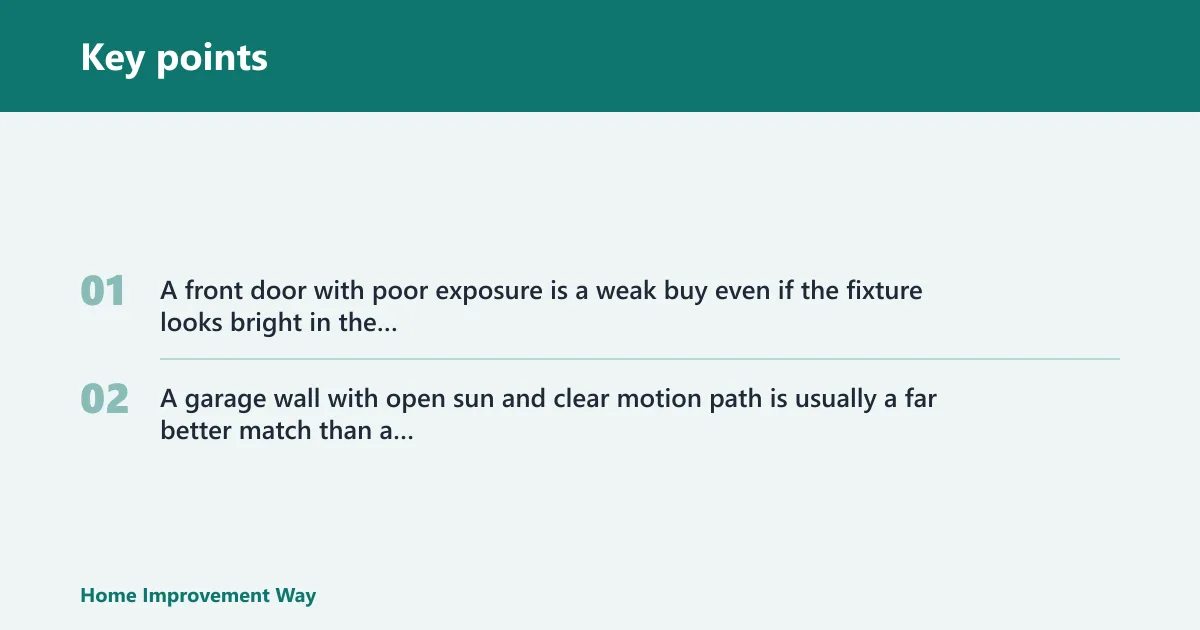
Start with sun exposure, then check the job. A front door with poor exposure is a weak buy even if the fixture looks bright in the product photos. A garage wall with open sun and clear motion path is usually a far better match than a shaded porch wall.
Do solar wall lights work on north-facing walls?
North-facing walls often charge poorly because they tend to get less direct sun and more shade from rooflines, trees, and nearby structures. They can still work in open sites with long ambient light exposure, but runtime is usually less predictable. For entry areas, that can mean weak evening performance.
When a north-facing wall can still work
An open north wall may still be usable if there is no overhang, no tree cover, and the panel gets strong ambient light for much of the day. This is more realistic for a low-demand fence marker or accent light than for a front door or stair landing.
What to do if the only available wall is shaded
- Check whether the module can be angled toward open sky or moved to a separate panel.
- Use the wall for decorative light only if task lighting is not required.
- Expect shorter runtimes and choose motion activation to conserve battery.
- Skip the location if faces, steps, or locks must be lit reliably.
How much sun do solar wall lights need to charge properly?
Many models need several hours of direct sun, and most do better with open exposure than with bright shade. The common 4 to 6 hour target is a practical starting point, but the real issue is how much light reaches the panel face. Orientation, tilt, and nearby shade matter more than midday brightness alone.
Direct sun versus strong ambient light
Direct sun charges a PV cell best because the panel gets concentrated exposure. Strong ambient light can still charge the battery, but usually more slowly. That matters in cloudy weather, on winter days, and on walls that face open sky but never get full sun.
Why orientation and tilt matter
A solar panel or module mounted on a fixture works best when it faces open light, not a wall or soffit edge. A separate panel gives more placement flexibility. If the panel sits flat under an overhang, it may still gather some light, but the exposure window shrinks fast.
How overhangs, trees, and winter sun reduce runtime
Roof overhangs, porch roofs, and soffits can block the charging window even when the wall below looks bright. Nearby trees can do the same. Winter sun sits lower, so a wall that charges well in summer may charge much less on short, weak winter days.
A common first-timer mistake is mounting a light under a tidy porch roof and assuming the open front yard will make up for the shade. The fixture may turn on at dusk, then fade early because the battery never received a full daytime charge.
Which walls or outdoor spots are too shaded for solar wall lights?
Deeply recessed walls, areas under porch roofs, and spots blocked by trees are often too shaded for reliable solar charging. These locations can still produce some light, but they are poor choices for anything that needs steady evening runtime. If the panel rarely sees direct or strong ambient light, performance falls off quickly.
Common shade problems around the house
- Deep eaves that shadow the entire fixture face.
- Porch roofs that cut the charging window to a small slice of the day.
- Dense tree cover that blocks both direct sun and open sky light.
- Walls facing narrow alleys or close neighboring structures.
- Fixture shadows from trim, gutters, or the housing itself.
Are solar wall lights good for front doors and garage sides?
Yes, but for different reasons. Garage sides are often the easiest wall-mounted use because motion sensors work well there and the light job is straightforward. Front doors can work too, but they need more careful placement, stronger output, and better sun exposure because people need to see faces, steps, and the keyhole.
Front-door placement needs more than decoration
Outdoor entry zones include front doors, side doors, garage entries, and back doors. These spots usually need enough light for faces, steps, and hardware. That means you should treat them as task-lighting locations, not as simple curb-appeal walls.
Garage sides are a strong use case
Garage side walls often suit motion sensors because people approach along a defined path and do not need constant light. If the wall sees good sun, the battery has a better chance of staying charged. This is one of the best matches for a solar wall light.
Which walls are best for motion-sensor wall lights?
Motion-sensor wall lights work best on garages, side yards, paths, and rear access points where people move in a clear approach line. The sensor can trigger without running the light all evening. Mounting height matters because it shapes detection range, beam spread, glare, and blind spots.
Mounting height and sensor reliability
Mount too high, and the sensor may watch over people instead of at them. Mount too low, and the beam can create glare or catch only feet and shadows. Place the sensor where the approach path is visible and where the light can reach the area that matters.
How sensor placement affects glare and false triggers
Directly facing reflective surfaces, moving branches, or traffic nearby can create false triggers. A fixture that points into a wall or railing can also create hard shadows. Keep the sensor aimed at the route of travel, not at the brightest part of the wall.
What should you check before you mount a solar wall light?
Check the weather resistance rating, the battery setup, and the fixture size before mounting. IP rating matters in rain exposure and splash zones. A sealed housing is important on uncovered walls. Also check whether the beam shape fits the wall, because a strong sensor light still fails if it shines in the wrong place.
Weather resistance and splash exposure
Uncovered walls, stair landings, and locations near hose spray need more protection than a sheltered patio wall. If the light sits near runoff, puddles, or splashback, the housing should be sealed well enough for that exposure. A weak rating in a wet spot is a short-lived choice.
Battery size, heat stress, and winter performance
Rechargeable batteries lose useful capacity over time, especially with heat and repeated deep discharge. In winter, short charge cycles leave less stored energy for the evening. If a wall only gets weak sun in December, expect shorter runtime even if the same light works better in summer.
Fixture size and nearby surfaces
Large housings can cast their own shadows on the panel or sensor. Small fixtures may avoid that problem but offer less beam spread. Match the light shape to the wall, and do not assume every compact fixture is suitable for a wide entry or stair zone.
Can solar wall lights work through cloudy weather or winter shading?
Solar wall lights can work through cloudy weather, but runtime usually drops because the panel receives less direct energy. Winter shading is harder to solve, especially on north-facing walls or under eaves. If the location only gets weak ambient light, expect shorter and less consistent evening output.
Cloudy weather and short charge cycles
Cloud cover does not stop charging, but it slows it. A battery that barely reaches full charge on a gray day may still light a path for a while, then fade early. Motion sensors help here because they reserve stored energy for actual use.
Winter shading is a placement problem, not a weather excuse
Winter sun angle lowers the effective charging window on many walls. A location that works in late spring may not work through a short winter day. If the wall is already shaded by a porch roof or tree canopy, the winter result is usually poor.
Frequently asked questions
Will solar wall lights work under eaves or porch roofs?
They may work, but often weakly. Eaves and porch roofs can cut the charging window enough to leave the battery short at night. If the panel sits under permanent shade, expect shorter runtime and less reliable output, especially in winter or cloudy weather.
How bright should solar wall lights be for entryways?
Entryways need enough light to see faces, steps, and keyholes, so very dim decorative fixtures are usually not enough. Brightness should match the task, not just the wall. A light that looks fine on a fence may be far too weak beside a front or back door.
Sponsored / affiliate links. As an Amazon Associate I earn from qualifying purchases. I may earn additional commission from eligible campaigns.