Warm White vs Cool White Solar Lights: Which Looks Better?
Warm white works best on patios, decks, garden beds, and front paths. Cool white fits driveways, task lighting, and security. Neutral white is the safest middle ground for mixed-use areas. Pick the wrong color temperature, and outdoor spaces can look harsh, flat, or harder to read at night. This guide compares warm, cool, and neutral white solar lights by zone, brightness, and the look each one gives outdoors.
Warm white vs cool white solar lights: the short answer


Warm white solar lights usually win where you want a softer night view. Cool white usually wins where visibility matters more than mood. Neutral white sits between them and is often the least risky pick for areas that need to feel pleasant and work well.
The better-looking option depends on the job. A patio, front porch, or planting bed usually benefits from warm white. A driveway, side path, or utility area usually benefits from cool white or neutral white.
📊 Warm white solar lights are described as 2700K to 3000K. Source: Warm White vs Cool White Solar Lights: Which Looks Right in Your Yard.
What color temperature means in outdoor lighting
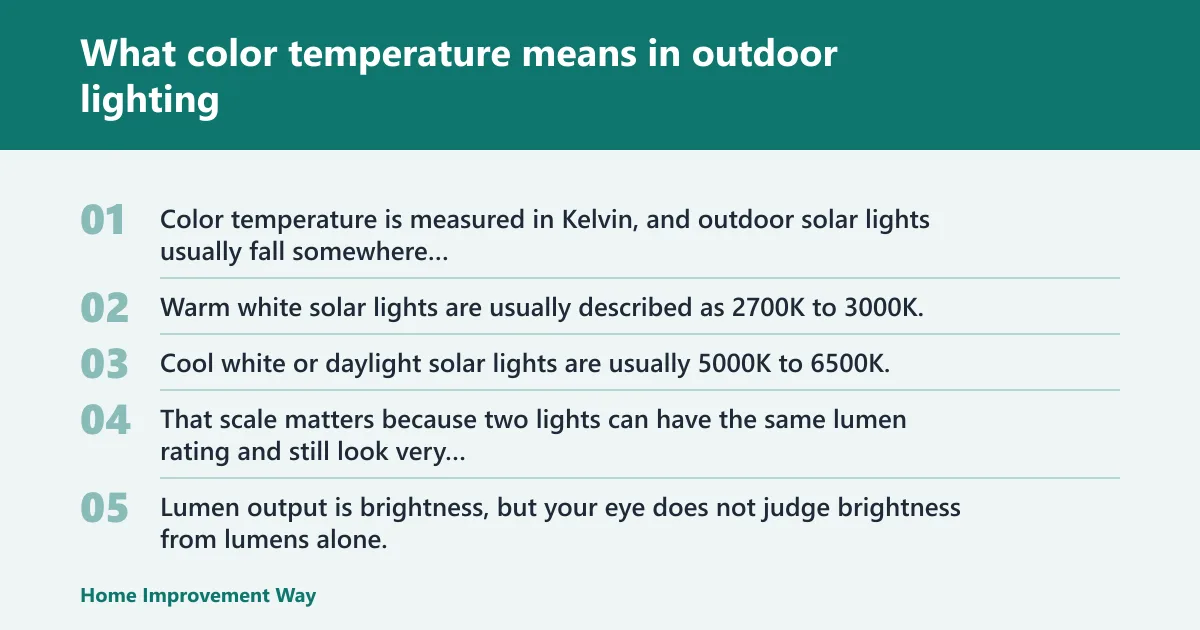
Color temperature is measured in Kelvin, and outdoor solar lights usually fall somewhere in the roughly 2000K to 6500K range. Lower Kelvin reads warmer and yellower. Higher Kelvin reads cooler and bluer.
Warm white solar lights are usually described as 2700K to 3000K. Neutral white is typically 3500K to 4000K. Cool white or daylight solar lights are usually 5000K to 6500K.
That scale matters because two lights can have the same lumen rating and still look very different. Lumen output is brightness, but your eye does not judge brightness from lumens alone. Color temperature changes how bright, crisp, or soft a light appears.

Which looks better in your yard?
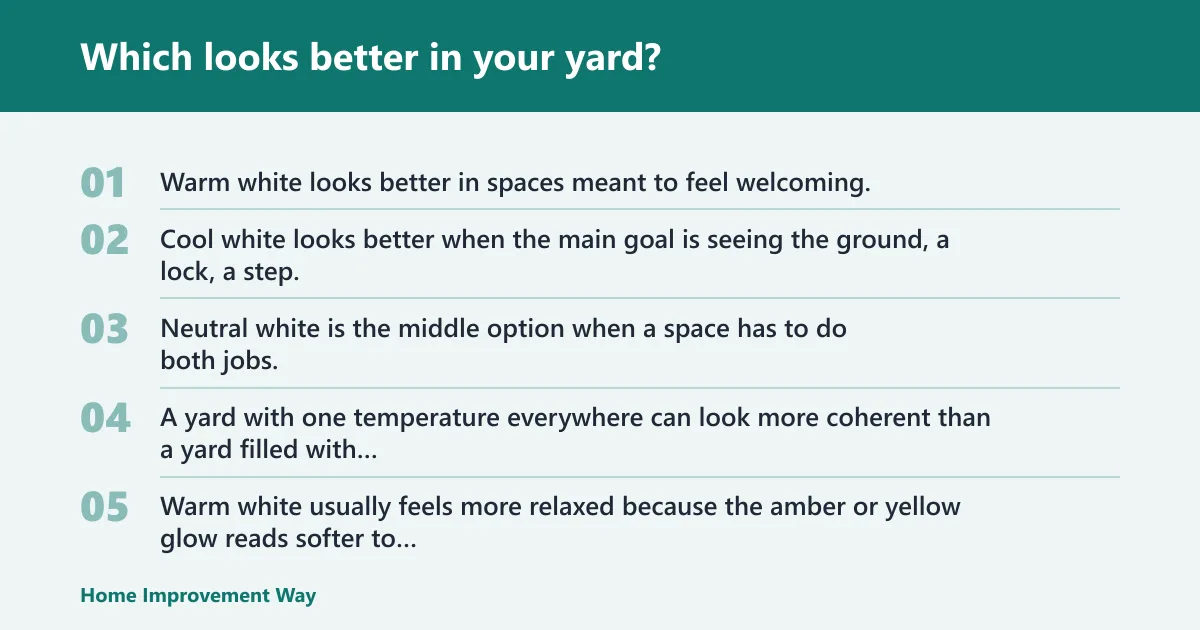
Warm white looks better in spaces meant to feel welcoming, especially near seating and entry points. Cool white looks better when the main goal is seeing the ground, a lock, a step, or a driveway edge more clearly. Neutral white is the middle option when a space has to do both jobs.
Think by zone, not by label. A yard with one temperature everywhere can look more coherent than a yard filled with mixed “white” lights that do not match.
| Decision factor | Warm White | Cool White Solar Lights | Winner |
|---|---|---|---|
| Best visual mood | Soft, amber, inviting | Crisp, blue-white, functional | Warm White |
| Best for visibility | Gentler, but less punchy on edges | Stronger contrast for paths and security | Cool White Solar Lights |
| Best near the house | Usually more comfortable for close-up viewing | Can feel stark against siding or stone | Warm White |
| Best for mixed-use utility zones | Can be too decorative | Can be too cool for relaxing areas | Cool White Solar Lights |
Best visual mood
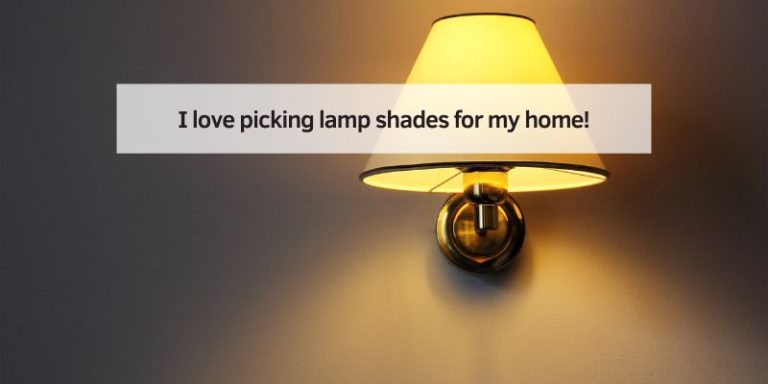
Warm white usually feels more relaxed because the amber or yellow glow reads softer to the eye. That makes it a stronger choice for front-yard curb appeal, seating areas, and decorative garden lighting. Cool white has a sharper look that can feel more commercial than residential.
Best for visibility
Cool white wins when the light has to help you judge distance, find a keyhole, or see where a curb begins. The blue-white daylight look creates stronger edge contrast on concrete, stone, and metal. Warm white can blur those edges a little, especially on dark paths.
Best near the house
Warm white usually feels easier on the eyes close to windows, doors, and seating. Cool white can make a front entry or patio look harsher, especially on pale siding, white trim, or glossy tile. That is why the same yard can benefit from both temperatures in different zones.
Best for mixed-use utility zones
Cool white usually fits better where function outruns decoration, such as side yards, driveways, and storage access. Warm white can be pleasant there if the goal is atmosphere, but it is not always the best choice when you need fast visual clarity after dark.
Why some solar lights look brighter even when the lumen rating is the same
Same lumens, different look. That happens often with solar lights because perceived brightness changes with color temperature, lens quality, diffuser color, and LED binning. A light sold as “white” may not match another “white” product at all.
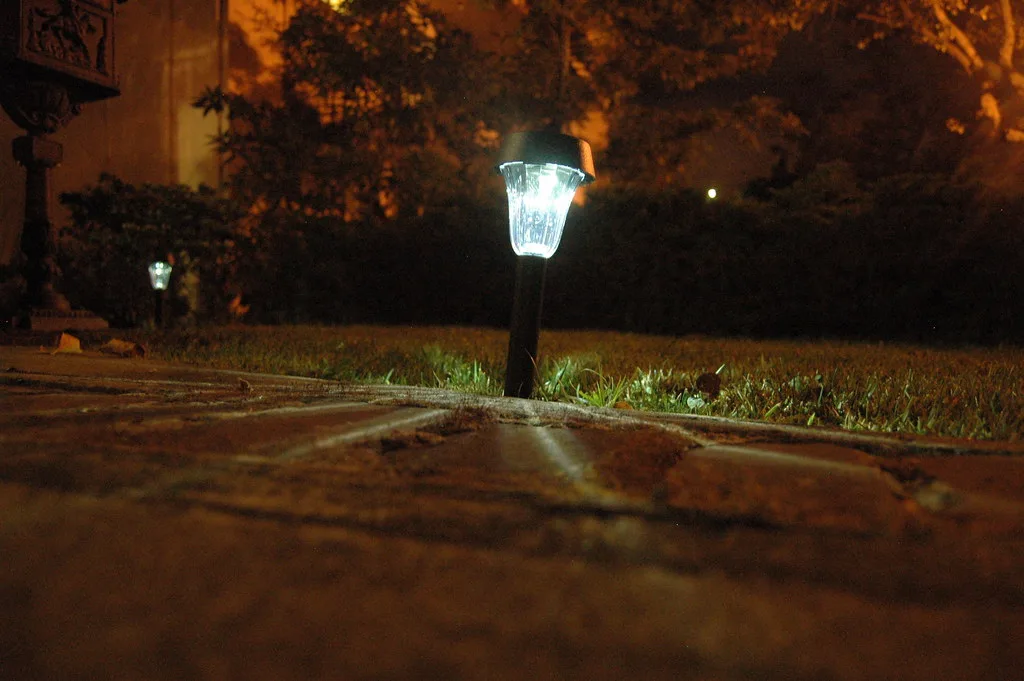
A common first-timer mistake is buying several “white LED” solar path lights and expecting them to match. One set may lean 3000K and another may land closer to 6000K, so the yard ends up with two different whites.
Solar floodlights show the same issue. Two floodlights with the same lumen rating can still read differently if one is warm white and the other is cool white. The cool one often appears brighter because the eye tends to read that blue-white tone as more intense.
Zone-by-zone decision table for common outdoor spaces

This table treats color temperature as a job choice. Use it to match the space, not the packaging label. If a product only says “white,” check the Kelvin value before you buy.
| Outdoor area | Recommended Kelvin range | Ideal beam purpose | Expected visual effect at night | Avoid if |
|---|---|---|---|---|
| Patio or seating area | 2700K to 3000K | Welcome and relaxed atmosphere | Soft glow that feels warm and social | You need crisp task visibility for cooking or reading |
| Driveway and front entry | 5000K to 6500K | Guide cars, show edges, support security | Bright, clean look with strong contrast | The facade already looks stark and you want a softer first impression |
| Walkways and garden beds | 2700K to 4000K | Guide foot traffic without glare | Clear enough to navigate, but still calm | The path is uneven or narrow and needs maximum edge clarity |
| Shed or utility area | 3500K to 6500K | Task visibility and access | Functional, work-ready light | The area is mostly decorative and close to a seating zone |
| Grill station or work area | 3500K to 5000K | See food, tools, and controls | Neutral to crisp light that helps with detail | You want a lounge-like feel more than a work surface |
| Steps and narrow paths | 4000K to 6500K | Mark edges and reduce missteps | Higher contrast and better step definition | The steps sit right beside a patio where softer light matters more |
Patio or seating area
Warm white is the better default here. It fits warm wood, brick, stone, and most traditional or cottage-style finishes. It also matches decorative outdoor lights that are sold for a soft glow and a twinkly shine.
IKEA’s SOLVINDEN outdoor solar lighting fits that positioning. The point is not the brand alone; it is the category. Decorative outdoor solar lights often aim for atmosphere first and visibility second.
Driveway and front entry
Cool white usually works better because it helps define edges, thresholds, and vehicle lines. That matters on long drives, steep approaches, and front walks where safety is the main concern. Warm white can make those same spaces feel too soft when you need immediate clarity.
Walkways and garden beds
This is the zone where neutral white often makes the most sense. Warm white is pleasant, but it can reduce contrast on dark mulch or dark pavers. Cool white can read too stark around plants and make a front yard feel less welcoming.
Shed or utility area
Neutral white to cool white is usually the better fit. These areas are about finding tools, checking latches, or moving safely after dark. If the area doubles as storage and display, neutral white is the safest compromise.
Grill station or work area
Neutral white is often the best middle ground. It gives you enough clarity for food prep without the icy feel that very cool light can bring. If the grill sits on a patio used for dining, keep the work light separate from the decorative lighting.
Steps and narrow paths
Cool white usually helps most here because it sharpens edges and makes changes in height easier to see. A warm glow can be attractive, but on steps it can flatten contrast. That is where a slightly cooler beam earns its keep.
Can you mix warm white and cool white solar lights in one yard?
Yes, but only if you keep each temperature tied to a specific zone. Mixing looks intentional when warm white stays in the social areas and cool white stays in the utility areas. Mixing looks mismatched when the same sightline contains both temperatures without a clear reason.
Use one temperature per zone. That is the easiest way to avoid the “some lights match, some do not” problem that happens when a yard is filled with generic white LEDs from different listings.
When mixing looks intentional
Mixing works when the yard has a clear visual boundary, such as a patio that opens to a driveway or a seating area that sits beside a side yard. Warm white can stay near the house while cool white handles the path to the garage. The result feels planned, not random.
When mixing looks mismatched
Mixing looks off when two different whites sit side by side on the same fence line, bed edge, or front walk. The eye notices the color jump before it notices the light itself. That is especially true with solar path lights sold only as “white LED.”
Choose warm white if… / choose cool white if…
Choose warm white for spaces where comfort matters more than sharp edge definition. Choose cool white for spaces where visibility and security matter most. If the space has both jobs, neutral white is often the safer compromise.
Choose warm white if…
- You are lighting a patio, deck, porch, or seating area.
- Your home has traditional, wood, brick, or softer exterior finishes.
- You want front-yard curb appeal to feel welcoming instead of stark.
- The lights are decorative first and functional second.
Choose cool white if…
- You are lighting a driveway, side yard, or security path.
- The space needs sharper contrast for steps, curbs, or entries.
- You are lighting a shed, utility area, or grill station.
- You want a cleaner, more modern night look.
Choose neutral white if…
- The area is both decorative and functional.
- You want one color that will not feel too yellow or too blue.
- The yard is small and visible from several rooms.
- You are unsure whether the space needs mood or utility more.
Frequently asked questions
Which looks better for solar lights: warm white or cool white?
Warm white usually looks better for relaxed outdoor spaces because it feels softer and more inviting. Cool white usually looks better where you need better visibility, such as driveways, steps, and utility zones. The better-looking choice depends on whether the space is meant to welcome people or guide them.
What Kelvin is warm white versus cool white outdoor lighting?
Warm white solar lights are usually 2700K to 3000K. Neutral white is commonly 3500K to 4000K. Cool white or daylight solar lights are usually 5000K to 6500K. Lower Kelvin looks warmer and yellower; higher Kelvin looks cooler and bluer.
Do warm white solar lights look dimmer than cool white ones?
Often they do, even at the same lumen rating, because the eye can read cool white as brighter and more intense. That does not mean the warm light is weaker in output. It means color temperature changes how brightness feels, especially outdoors after dark.
Which color temperature is best for a patio or seating area?
Warm white is usually the best choice for patios and seating areas. It gives the space a calmer, more social feel and tends to look better near house siding, deck boards, and furniture. If the patio also serves as a work area, neutral white may be the better compromise.
Which color temperature is better for a driveway or security lighting?
Cool white is usually better for driveways and security lighting because it helps reveal edges, obstacles, and movement more clearly. That blue-white look also tends to feel more alert and functional. For most utility-focused spaces, 5000K to 6500K is the practical range.
What is neutral white, and is it a better compromise?
Neutral white is usually 3500K to 4000K. It sits between warm and cool light, so it can work well in mixed-use spaces like walkways, grill areas, and utility corners. It is often the best compromise when you want one light that does not lean too yellow or too blue.
Why do some solar lights look blue-white even when sold as white?
Because “white” is often vague packaging language, not a precise color temperature. Many cheap solar lights default to 6000K, which reads blue-white to the eye. Lens color, diffuser material, and LED binning can also shift the final look, even when the box says the same thing.
Which color temperature makes a small yard look more welcoming?
Warm white usually makes a small yard feel more welcoming because it softens hard edges and reduces the sense of glare. In a tight space, cool white can feel harsh and expose every surface at once. If the yard also needs strong footing visibility, use neutral white instead.
Which color temperature is best for task areas like grills or steps?
Neutral white to cool white is usually best for task areas and steps. Those zones need clear visibility more than atmosphere, especially where height changes, hot surfaces, or small tools are involved. Warm white can work for accent lighting, but it is not the strongest choice for detail work.
Sponsored / affiliate links. As an Amazon Associate I earn from qualifying purchases. I may earn additional commission from eligible campaigns.