Solar Garden Spotlights vs Floodlights: Which Should You Buy?
Choose Solar Garden Spotlights for plants, walls, or features you want to pick out, and Floodlights for paths, driveways, and wider safety lighting. Match beam angle, lumens, and panel size to the job, not the label. Pick the wrong type and you get dark paths, wasted battery capacity, or harsh glare where you wanted clean coverage. This guide compares beam width, brightness, mounting, and solar panel setup so you can buy the right light the first time.
| Decision factor | Solar Garden Spotlights | Floodlights | Winner |
|---|---|---|---|
| Beam spread | Narrow to medium beam; the brief example lists a 5°–90° adjustable range | Wide beam coverage for larger ground areas | Floodlights |
| Brightness target | Low-lumen accent light; one example is 180 lumens | Higher output; listings shown at 450–3,000 lumens, 4,000 to 6,000 lumens, and 8,000 lumens | Floodlights |
| Best mounting | Ground-inserted or aimed from low positions | Wall-mounted or pole-mounted for broader coverage | Depends on the job |
| Panel placement flexibility | Integrated panel layouts are common and simple to place | Separate-panel options give more placement freedom; integrated versions also exist | Floodlights |
| Security coverage | Can mark edges, but limited for large-area visibility | Better for motion-triggered area lighting and wall coverage | Floodlights |
Solar garden lights: spotlight or floodlight?
Buy Solar Garden Spotlights when you want a narrow beam on a small target, and choose Floodlights when you need wide, usable light across a path, patio, driveway, or gate. The product name matters less than beam width, lumen output, mounting height, and where the panel can charge.
How the trade-off works
Spotlights put light on one feature. That makes foliage, statues, signposts, and bed edges stand out, but it can also throw glare into someone’s eyes or onto a nearby window if the aim is off. Floodlights spread light over a larger area, which helps movement and visibility, but spill becomes wasted output on a small yard.
Suppose a side yard is only a short walk from the garage to the back door. A tight spotlight can leave dark patches between stepping stones, while a floodlight with a wide beam can cover the whole route with less aiming fuss.
When should you buy solar spotlights?
Buy Solar Garden Spotlights when the goal is to point light at a feature, not to wash a whole yard. They fit trees, statues, shrubs, signs, and planting-bed edges best, especially when you want the light source to disappear and the object to stand out.
Best uses for spotlights
Ground-inserted spotlights work well beside beds and along borders because you can keep the beam low and send it upward or across a face. Adjustable heads matter here, since a small angle change can move the hotspot from a trunk to the canopy or from a wall to a sign.
The 180-lumen spotlight example is a useful reference point for accent work. It can mark a feature clearly, but it will not replace a floodlight for a driveway or a large patio. If you need to light a wide walk, the beam is too narrow and the output too modest.
Beam angle and glare control
Spotlights usually work best when the beam stays tight enough to avoid washing over windows, neighbors, or empty lawn. A narrower beam cuts spill, but aiming becomes more sensitive, so the head must be set carefully. The listed 5°–90° range shows how much control some models give you.
A common first-timer mistake is placing a spotlight too close to the target. That can create a bright hot spot at the base of a tree and leave the upper branches dim, or produce glare on glossy leaves and nearby glass. Backing the light up or opening the beam often solves that.
When should you buy solar floodlights?
Buy Floodlights when you need broad coverage, better visibility for movement, or a light that reaches across a patio, courtyard, garage area, or driveway. Wider beams and higher lumen output make them the stronger choice for security lighting and general area light.
Best uses for floodlights
Floodlights are the better pick for doors, parking areas, side yards, and other places where people need to see the ground and surroundings at the same time. Motion sensor modes are especially useful there, because the light can stay off most of the night and wake up only when someone enters the zone.
Listings in the brief show floodlight output from 450–3,000 lumens, with another at 4,000 to 6,000 lumens and a commercial unit at 8,000 lumens. That range is why floodlights suit open areas better than spotlights, but it also means runtime and battery size matter more as output rises.
Spill control and security coverage
Floodlights can waste light if the beam is too broad for the site. On a narrow side path, that spill may light fence boards and shrubs more than the walking surface. Mounted too low, they can also throw glare into the eye instead of across the ground.
A motion sensor wall light listed between 450 and 1,100 lumens, and a radar motion sensor wall and pillar-top light listed at 1,400 lumens, show the range that often fits home security better than a very small spotlight. For larger driveways or commercial entrances, pole-mounted floodlights can spread light more evenly from above.
How bright and wide should each light be?
Beam angle and lumen output should match the task together, not separately. A small beam with low output suits accent lighting, while a wider beam with higher output suits paths and open areas. If brightness rises without enough battery or sun exposure, runtime usually falls.
Beam angle from narrow to wide
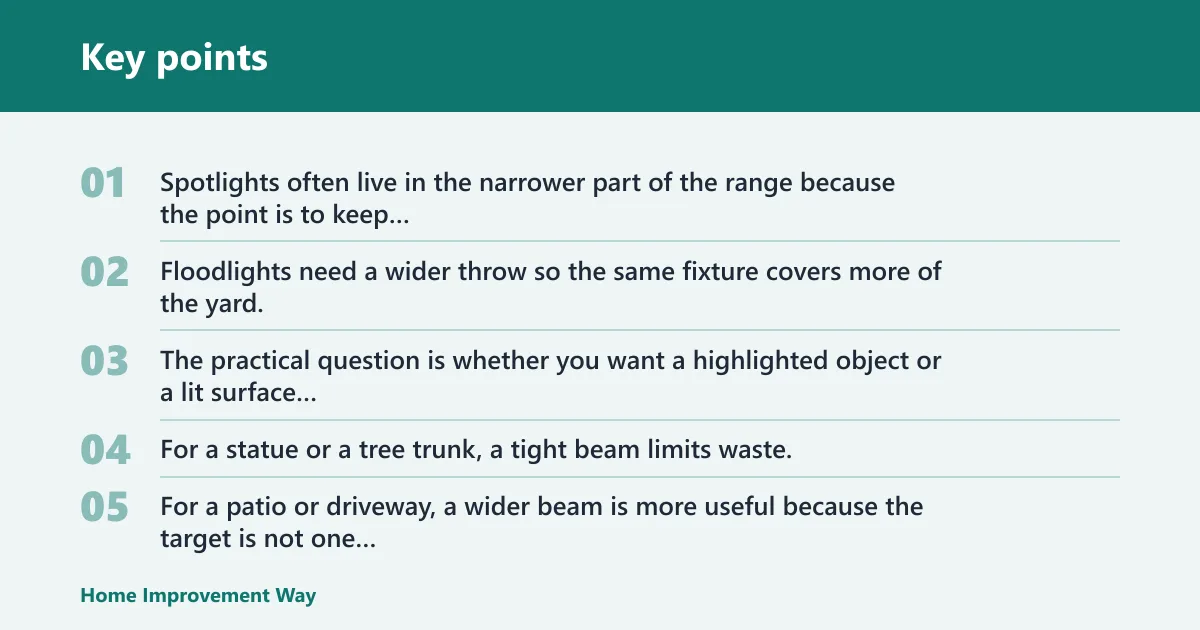
Spotlights often live in the narrower part of the range because the point is to keep light on one object. Floodlights need a wider throw so the same fixture covers more of the yard. The practical question is whether you want a highlighted object or a lit surface underfoot.
For a statue or a tree trunk, a tight beam limits waste. For a patio or driveway, a wider beam is more useful because the target is not one object but the whole usable area. Open the beam too much on a small feature and the effect disappears; keep it too tight on a walkway and you leave dark edges.
Lumen targets by task
For accent work, the 180-lumen spotlight example sits in the right zone. For path and edge lighting, the goal is usually higher than a tiny marker but lower than a security floodlight. For area lighting, the 450–3,000 lumen floodlight band gives more room to match the space and mounting height.
The 1,400-lumen motion sensor wall light is a useful middle reference. It is bright enough for many residential entries and garage approaches without jumping straight to a very large commercial unit. One pathway light option uses 50 lumens, which is enough for marking an edge but not for making a large zone feel open and safe.
Runtime tradeoff
Higher lumens usually mean more battery drain, and a wider beam spreads that energy over a larger surface. That is fine when the light is on briefly or has a strong panel and battery, but it becomes a problem in winter, in shade, or when the panel faces the wrong direction.
Shaded gardens and short winter days can shorten charge time enough that a bright floodlight does not last through the whole evening. In those cases, you may need a lower lumen setting, a separate panel with better sun exposure, or a motion sensor mode that saves power until movement appears.
Solar lighting decision matrix
Use this matrix when the yard has more than one job. If one fixture must do everything, the result is usually compromise: either a spotlight that misses the walking surface or a floodlight that wastes light on ornament only.
| Use case | Beam angle | Lumen target | Mounting height | Panel type | Recommended light type | Wrong choice note |
|---|---|---|---|---|---|---|
| Accent | 5°–30° | About 180 lumens | Low, aimed from the ground | Integrated panel is fine if the site gets direct sun | Solar Garden Spotlights | A floodlight will throw spill across the bed and flatten the feature |
| Path and edge | 30°–60° | 50 to 450 lumens, depending on spacing | Ground-inserted or low wall height | Integrated or separate panel, based on sun access | Floodlights for wider routes; spotlights only for short markers | A narrow spotlight can leave dark gaps between fixtures |
| Security and area | 60°–90° | 450–3,000 lumens, or more for larger sites | Wall-mounted or pole-mounted | Separate panel often helps when the light sits in shade | Floodlights | A spotlight creates a bright point but misses the surrounding approach |
Panel type, IP rating, and control choices
Panel layout, weather rating, and controls decide how well the light works after installation. The right setup can charge better, survive more weather, and waste less battery. The wrong setup can look fine on paper and underperform as soon as the garden gets shade or winter clouds.
Integrated panel versus separate panel
Integrated solar panels are simpler to install because the panel and light are one unit. They work well where the fixture can sit in direct sun. Separate-panel floodlights take more setup, but the panel can move to a brighter spot while the light stays where coverage is needed.
That placement freedom matters on shaded walls, under eaves, and in courtyards with awkward orientation. Separate-panel options are not always better, though. Extra wiring and mounting steps add complexity, so they make the most sense when the light position and the sun exposure are in different places.
IP65 and IP67 outdoors
Outdoor solar lights should generally have weather resistance rated at about IP65 or better. IP65 is suited to outdoor exposure and helps with rain and dust. IP67 is a stronger waterproofing rating, and one floodlight listing in the brief uses IP67, which is a good sign for exposed mounting points.
Use the rating as part of the decision, not as the whole decision. A durable housing does not fix a poor beam choice, weak charging location, or a panel that sits in winter shade.
Motion sensor, timer, manual on/off, and dusk-to-dawn
Motion sensor mode is the best fit for security and occasional use because it saves charge and gives full brightness only when needed. Dusk-to-dawn suits steady area lighting when you want the light to run all evening without handling a switch.
Timer mode works well for patios and courtyards where light is needed for a set window after sunset. Manual on/off makes sense for simple accent lights, especially spotlights that only need to run for a few evening hours. If runtime is tight, motion sensing usually stretches the battery the most.
Choose Solar Garden Spotlights if… / Choose Floodlights if…
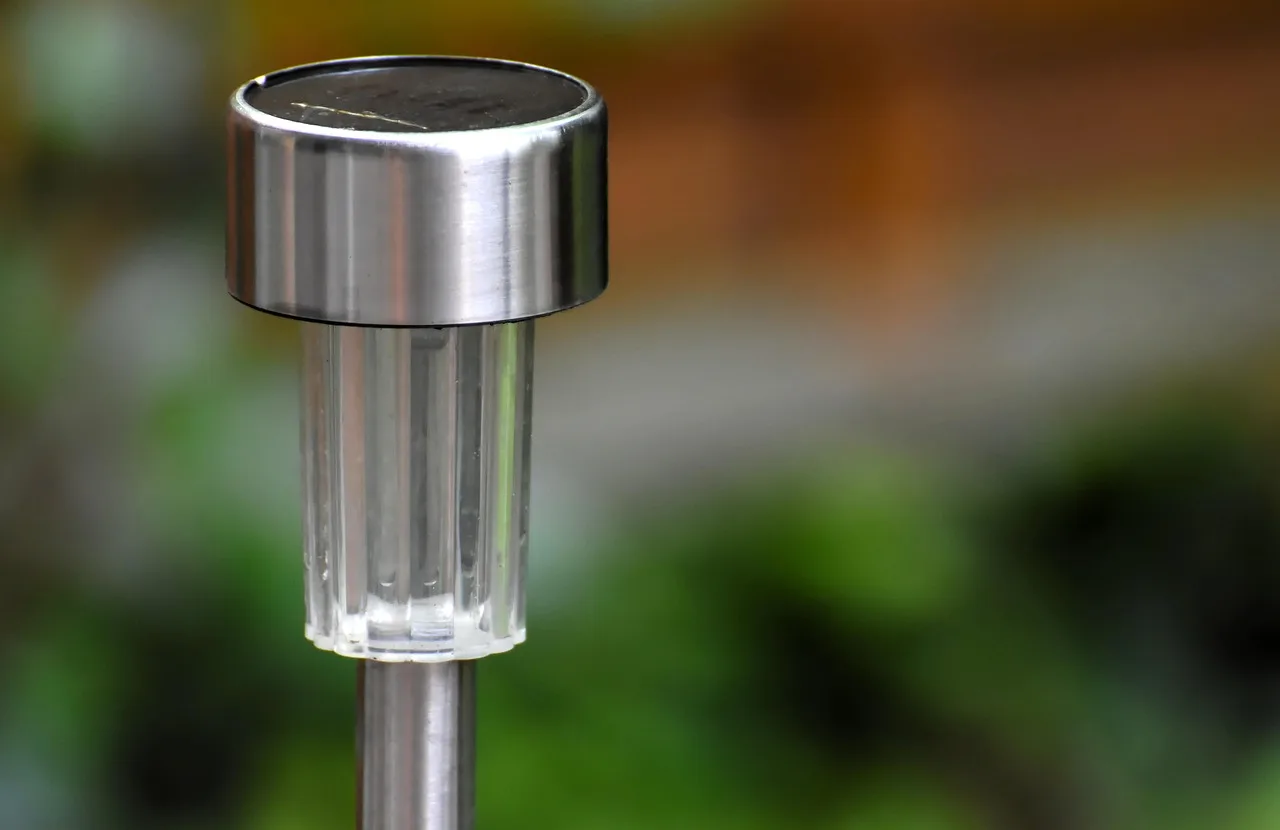
Choose Solar Garden Spotlights if you want a small target lit cleanly, if the feature is a tree, statue, shrub, or sign, or if you need low spill near walls and windows. Choose Floodlights if you need usable light across a path, courtyard, garage approach, or driveway, or if security visibility matters more than a decorative effect.
Mixed-use yards often need both. A front garden can use spotlights on trees and a floodlight near the steps; a long driveway may need flood coverage at the entry and small accent lights along planting beds. If the site is shaded, has winter sun, or needs an awkward panel position, favor the model that can place the panel where it will charge well.
- Measure the target area first.
- Match beam angle to the size of the lit surface.
- Choose lumens for the task, not the label.
- Check whether the panel gets direct sun where it must sit.
- Pick motion, timer, or dusk-to-dawn based on how often the light should run.


Frequently asked questions
Should I buy solar spotlights or floodlights for my garden?
Buy Solar Garden Spotlights if the garden goal is to call attention to a plant, wall, or ornament. Buy Floodlights if you need the ground, steps, or a larger patio to stay visible. The right choice depends more on beam width and mounting than on the product name.
How many lumens do I need for a solar garden spotlight?
A spotlight for accenting a tree, statue, or bed edge can work around the 180-lumen example in the brief. Lower output is fine for visual emphasis, while brighter output is only useful if the beam stays narrow enough to avoid spill. More lumens alone does not fix a poor aim.
What beam angle is best for solar floodlights?
Floodlights generally need a wider beam than spotlights because they cover paths, driveways, and open seating areas. A beam in the wider part of the 5°–90° range helps spread light across the usable surface. If the beam is too narrow, the edges stay dark and the light feels harsh.
Do solar floodlights work better than spotlights for security?
Yes, Floodlights usually work better for security because they cover a wider area and pair well with motion sensors. A spotlight may show a single feature clearly, but it can miss the approach around it. Higher mounting and wider beam spread matter as much as raw brightness.
Can I use solar spotlights to light trees and statues?
Yes, Solar Garden Spotlights are one of the best choices for trees and statues because the adjustable head lets you direct light where it matters. A narrow beam keeps the effect focused on the object instead of washing the whole yard. That is useful for both trunks and taller forms.
Are separate-panel solar floodlights better than integrated ones?
Separate-panel Floodlights are better when the light must mount in shade or under an eave while the panel can sit in sun. Integrated panels are simpler and faster to place, but they work best only when the fixture itself gets enough direct light. Choose based on placement, not prestige.
Sponsored / affiliate links. As an Amazon Associate I earn from qualifying purchases. I may earn additional commission from eligible campaigns.