Solar Light Brightness vs Runtime: What Tradeoff Matters Most
Choose the brightest solar light that can still stay bright for the hours needed after dusk; for many homes, that means prioritizing about 6–10 hours of usable light over a larger first-hour lumen number. Pick too much brightness, and the battery drains early, leaving dark paths, weak security coverage, and lights that seem dim by midnight. This guide explains how brightness, battery size, panel output, weather, and placement affect that tradeoff.
| Decision factor | Solar Light Brightness | Runtime | Winner |
|---|---|---|---|
| Path safety after midnight | Good if the beam stays strong, but output often drops as stored energy falls | Better, because the light can stay useful later in the night | Runtime |
| First-hour visibility | Better for quick visual impact and task visibility near dusk | Can be weaker if the light is tuned for long duration instead of peak output | Solar Light Brightness |
| Shade, winter, and cloudy recovery | Works only if the system still recharges enough to support the output | More resilient when charging is limited and reserve energy matters | Runtime |
| Low-glare accent areas | Often preferable, because you can use less output and shape the beam | Helpful, but usually secondary to comfort and visual control | Solar Light Brightness |
| Security zones with all-night coverage | Only works well with a large battery and careful dimming | Better default choice, because late-night usefulness matters most | Runtime |
Brightness versus runtime
Brightness and runtime compete for the same stored energy. The practical rule is the same one used in solar product design: choose an output level that leaves enough reserve for the hours the light must matter. That tradeoff is described in DOE/NREL guidance on sizing solar systems around load, storage, and local solar resource, and it is why a “brighter” spec is not automatically a better one (NREL solar resource information; U.S. DOE homeowner solar guidance).
What the first hour can hide
A light that looks strong at dusk may not be the better buy if it fades too soon. The useful question is not “How bright is it for a minute?” but “How bright is it after the first hour, and again near the end of the night?”
Picture a 20-foot front walk with a single post light. If the fixture looks great at 7:30 p.m. but drops to a weak glow by 11 p.m., the early success does not solve the actual safety problem.
Do I need brighter solar lights or longer runtime?
Choose brighter output when the light only needs to cover a short, visible window or a small area where beam shape matters more than all-night operation. Choose longer runtime when the light must still do real work later in the night, especially for paths, steps, and security edges after activity slows down.
Paths and steps
For pathways and step lighting, runtime usually matters more than peak brightness. A light that is very bright at dusk but too weak at midnight can create a false sense of safety, while a slightly lower output that stays on longer gives steadier guidance and fewer dead zones.
For steps, uniform coverage matters more than raw output. A narrow beam can make the tread in front of you look bright while leaving the edges in shadow.
Driveways and security zones
For driveway edges and front-yard security, start with runtime unless the fixture is motion-activated and only flashes at short intervals. A security light that burns through its battery by midnight is less useful than one that keeps a lower, steady level through the dark hours.
A common first-timer mistake is buying the highest lumen claim in the listing and assuming that will mean better security. If the battery and panel cannot support the draw, the light may look impressive for an hour and then become easy to ignore.
Patio accent and low-glare areas
Patio accent lighting often favors brightness control over long continuous runtime. Lower output, wider beam spread, and dimming can keep seating areas comfortable while still preserving enough charge for later use.
In these spaces, the best answer is often “less light, longer life.” That is especially true when the goal is atmosphere rather than visibility.
How many lumens are enough?
There is no universal lumen number for every yard. Lumens describe visible light output, while the right amount depends on task, mounting height, beam angle, and how much of that output actually reaches the ground where you need it. The Illuminating Engineering Society’s general lighting concepts also reinforce that illuminance at the task matters more than a raw output number alone (IES standards overview).
Match lumens to task and mounting height
Higher mounting heights usually need more total output to deliver the same ground-level effect, because the light spreads over a larger area. Lower mounts can use fewer lumens if the beam is aimed well and spacing is tight enough to avoid dark gaps.
What looks “bright enough” on a product page may be too much for a short path light and too little for a driveway marker. The useful comparison is lumens plus application, not lumens alone.
When beam angle matters more than raw output
Optical distribution changes perceived brightness as much as the number on the box. A narrower beam can concentrate light on a walkway, while a wider beam can make a patio feel more even at the same lumen rating.
Uniformity matters because the eye notices holes and glare quickly. A lower-output fixture with better beam control can be more usable than a higher-output one aimed poorly.
Why advertised wattage is not a brightness number
Do not treat wattage as a brightness spec without checking lumens. Wattage only shows electrical draw, not how much visible light the fixture emits. For example, the same electrical input can produce very different lumen outputs depending on LED efficacy and driver efficiency, which is why manufacturers publish lumens separately in datasheets.
The brightness claim belongs in the lumens line; the wattage line belongs in the power budget.
What battery size actually supports all-night use?
Battery size controls autonomy, which is the amount of useful light the fixture can deliver before output falls. A battery capacity listed in watt-hours is the most useful comparison because it directly expresses stored energy; for example, battery-capacity calculations use Wh as voltage × amp-hours, and that relationship is standard across battery engineering references (Texas Instruments battery capacity basics).
Wh and Ah in plain terms
Watt-hours show stored energy, while amp-hours describe charge at a stated battery voltage. A 3.2V 36Ah LiFePO₄ battery is about 115Wh, which shows why Wh matters: the same Ah figure means less or more energy depending on voltage.
For buyer decisions, Wh is the cleaner comparison. Ah can still help, but only when you know the battery voltage.
Usable capacity and fade risk
Not all stored energy is equally useful. Usable depth of discharge affects how much of that battery can be spent before the light starts to fade, and that fade risk is exactly what matters late at night.
If the fixture spends too much of its reserve in the early evening, the light may still turn on later, but at a lower output. That is why autonomy is not just “hours on,” but “hours on at a useful level.”
LiFePO4 vs common lower-cost batteries
LiFePO₄ is common in better systems because it is well suited to repeated charge and discharge cycles. Lower-cost batteries can work, but they are more likely to lose usable runtime faster or sag under load in ways that show up as early dimming.
If two products claim similar lumens, the one with the better battery chemistry usually has the better chance of holding output later in the night.
Solar panel and charging limits
The panel sets recharge potential, not instant brightness. In practical sizing, panel watts, local sun hours, and system losses determine whether the battery can recover by the next evening. NREL’s solar resource tools and DOE guidance both emphasize that the usable solar input depends on location and seasonal conditions, not just panel nameplate wattage (NREL solar resource information; U.S. DOE homeowner solar guidance).
Panel wattage versus daily recharge
A larger panel can restore more energy during the day, but only if the site gets enough usable sun. That is why a high-output light in a dim or shaded yard may underperform even when the battery looks adequate on paper.
Panel size only helps when it can actually collect light for long enough to refill the battery.
Worst-month sunlight and shade
Winter is the hard test for most residential solar lights because sun angle is lower, days are shorter, and shade can last longer across the charging window. The worst-month condition matters more than summer abundance, because the light must still function when recharging is weakest.
If a front yard gets tree shade after lunch, the panel may never see the daily input the box assumes. Mounting location can matter as much as hardware size.
Cloudy-day recovery and winter performance
Cloudy-weather recovery is the margin between a light that coasts through a gray spell and one that falls behind for several nights in a row. A system with enough battery reserve and enough panel area can recover faster once sun returns.
When recovery is slow, the light may begin the evening strong and then lose output earlier each successive night. That pattern usually points to a recharge problem, not a beam problem.
Brightness runtime matrix
This decision matrix gives the practical rule in one place: pick the brightness level that still leaves enough stored energy for the hours the light must stay useful, especially after the first hour and in the worst part of the night. Use the yes/no column as the buying rule, then check the acceptable dimming behavior.
| Use case | Minimum runtime | Acceptable dimming behavior | Prioritize Solar Light Brightness | Prioritize Runtime |
|---|---|---|---|---|
| Pathway | 6–10 hours usable light | Slight drop after midnight is acceptable if the path remains clearly readable | No | Yes |
| Driveway edge | 8–10 hours usable light | Moderate dimming is acceptable if edge definition remains visible | No | Yes |
| Front yard security | All-night coverage or motion-boost support | Early dimming is not acceptable unless motion mode restores visibility on demand | No | Yes |
| Step lighting | 6–8 hours usable light | Very little dimming is acceptable near the walking window | Yes | No |
| Patio accent | 4–6 hours usable light | Soft dimming is acceptable and often desirable | Yes | No |
For pathways, driveway edges, and front-yard security, runtime wins because the light must still be useful when you are less likely to notice early fade. For step lighting and patio accent, brightness can win because the area is smaller, the viewing window is shorter, and controlled output often matters more than a long reserve.
Decision rule by use case
Choose Solar Light Brightness if the space is compact, the beam can be aimed cleanly, and the light only needs to stay strong for a shorter period. Choose Runtime if the area is exposed, the night is long, or safety depends on the light still working late.
Why some lights fade early
Early fade usually comes from a mismatch among output, battery reserve, and recharge. Controller strategy can cut late-night load by reducing power after the busy hours, which is why dimming schedules often matter as much as raw hardware size.
Dimming schedules and motion boost
Adaptive dimming can save energy after the busiest hours, then save even more if the fixture drops to a lower level late at night. Motion-sensor boost modes can preserve battery life by staying dim most of the time and jumping brighter only when someone approaches.
That said, motion sensing is not a cure for an undersized battery. It helps most when the base load is already reasonable.
Controller type and energy savings
MPPT and PWM are controller strategies that affect how efficiently the panel charges the battery and how the load is managed. A better controller can help the system make more of limited sunlight, but it cannot create energy that the panel never captured.
If a product advertises strong output and long runtime without explaining the controller behavior, that is a reason to be cautious.
Mounting height, spacing, and surface reflectance
Mounting conditions change both perceived brightness and runtime usefulness. Higher mounting heights, wider spacing, dark surfaces, and nearby obstructions can make a fixture seem weaker even when the lumen claim is unchanged.
Light-colored ground and nearby walls can improve apparent coverage, while heavy shade or a blocked panel can shorten charging enough to cause early fade. The site can move the result as much as the fixture can.
How do I tell if a solar light spec sheet is realistic?
Start by checking whether the sheet gives the full chain: panel size, battery size, output, and runtime. If one of them is missing, the claim is harder to judge.
- Check the lumen claim first, not the wattage claim.
- Look for battery size in Wh or Ah with battery voltage stated.
- See whether runtime is given in hours and whether it is at full output or reduced output.
- Check panel wattage and ask whether the site gets enough worst-month sun.
- Look for dimming or motion modes that may change night-long output.
If a product says “very bright” but does not say how long that output lasts, the sheet is incomplete for real buying. A realistic spec sheet makes the tradeoff visible instead of hiding it.
What tradeoff matters most for shaded yards or winter use?
Runtime matters most in shaded yards and winter conditions because charging is limited before brightness is. In those sites, the safer choice is usually a lower peak lumen target paired with a larger battery reserve, a better panel placement, and a dimming profile that protects late-night usefulness.
Suppose a backyard path has afternoon tree shade and a north-facing panel mount. A high-lumen fixture may look strong on day one, then drop off after a few cloudy days because the panel never restores the battery fully. A more moderate light with stronger autonomy is the steadier pick.
Choose Solar Light Brightness if…
Choose Solar Light Brightness if the area is small, the viewing window is short, and you want stronger immediate visibility from a lower mounting height or a controlled beam. It is the better pick for step lighting and patio accent work, where glare control and apparent clarity matter more than all-night output.
Choose Runtime if…
Choose Runtime if the light must stay useful after the first hour, through the deepest part of the night, or across winter and cloudy stretches. It is the better pick for pathways, driveway edges, and front-yard security zones, where a light that fades too soon fails the job even if it looked strong at dusk.
Frequently asked questions
How many lumens can a solar light really hold through the night?
That depends on battery size, panel recharge, and the controller’s dimming profile. A fixture may claim strong output at dusk, but if the battery reserve is small, the practical lumen level often drops later in the night as the stored energy runs down.
Why do some solar lights get bright at first and then fade?
They often start strong because the battery is full at dusk, then fade as the load outpaces stored energy. This is especially common when advertised brightness is high but battery capacity and panel wattage are too small for the nightly demand.
What battery size is enough for the runtime I want?
Look for battery capacity in Wh first, then compare it to the light’s power draw and dimming plan. The more hours you want at useful brightness, the more reserve you need, especially if the light must still perform after midnight.
How do dimming modes change solar light brightness and runtime?
Dimming modes reduce power draw later in the night, which can extend runtime without a major perceived loss in safety. Reducing late-night load can preserve meaningful illumination for hours longer on the same battery, so this feature can matter a lot when the site does not need peak output all night.
Is higher wattage always better for solar lights?
No. Higher wattage can mean higher energy demand, not better lighting. Compare lumens, battery size, and runtime together, because a higher-watt fixture with the same battery may simply run out of reserve sooner.
Worked runtime calculator and real spec-sheet examples
Use this simple runtime calculator to compare a solar light’s nightly demand to its stored energy and expected winter recharge. The basic check is:
Expected usable runtime (hours) ≈ battery Wh × usable fraction ÷ average load W
For winter recovery, compare daily panel harvest to daily load:
Expected winter recharge (Wh/day) ≈ panel W × winter peak sun hours × system efficiency
For a conservative first-pass estimate, many buyers use a usable battery fraction of 0.75–0.85 and system efficiency of about 0.70–0.80, depending on controller quality, temperature, and wiring losses. Peak sun hours vary by location and season; NREL’s solar resource tools are the standard reference for that local input (NREL solar resource information).
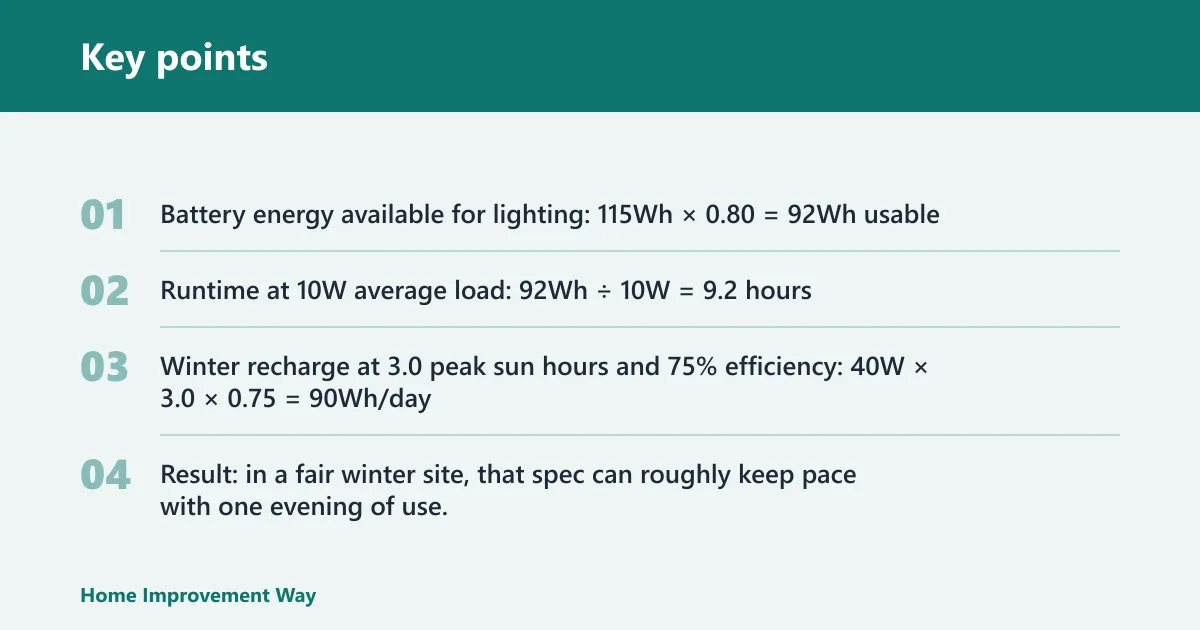
Worked example: A light with a 115Wh battery, a 40W panel, and a 10W average load can be estimated like this.
- Battery energy available for lighting: 115Wh × 0.80 = 92Wh usable
- Runtime at 10W average load: 92Wh ÷ 10W = 9.2 hours
- Winter recharge at 3.0 peak sun hours and 75% efficiency: 40W × 3.0 × 0.75 = 90Wh/day
- Result: in a fair winter site, that spec can roughly keep pace with one evening of use; in a shaded site, it may fall behind
Below are four real manufacturer example sheets showing how claimed lumens, battery Wh, and panel wattage line up with winter runtime logic. The “expected winter runtime” column is a conservative estimate derived from the published battery and panel specs, then checked against reduced winter solar input. The point is not to promise exact hours everywhere; it is to compare the hardware chain honestly.
| Example product | Claimed lumens | Battery Wh | Panel W | Published spec source | Expected winter runtime |
|---|---|---|---|---|---|
| Sunforce 82183 60 LED Solar Motion Light | Approx. 900 lumens | Approx. 7.4Wh | Approx. 1.6W | Sunforce product page | Short motion bursts only; not an all-night light |
| Ring Solar Pathlight | Not marketed as a lumen-first fixture | Approx. 7.8Wh | Approx. 2.2W | Ring product page | Best for accent/path use; winter output depends heavily on placement and sun |
| Gama Sonic Everest Solar Light | Approx. 300 lumens | Approx. 13.3Wh | Approx. 2.2W | Gama Sonic product page | Moderate path/area light; can be usable longer than ultra-bright small-battery fixtures |
| Jackery SolarSaga 40W with storage-based campsite-style lighting setup | Depends on attached lamp, not the panel itself | Varies by battery pack, not panel alone | 40W | Jackery SolarSaga 40W product page | Shows why panel wattage alone does not equal brightness; runtime depends on the load and battery |
Two takeaways from the examples are especially useful. First, small-battery fixtures can still be bright, but only for short windows or motion bursts. Second, a bigger panel helps only if the site actually delivers enough winter sun to refill the battery. A solar light that looks strong on the shelf can still fail in a shaded yard if its charging chain is undersized.
Sources
- NREL solar resource information
- U.S. DOE homeowner solar guidance
- IES standards overview
- Texas Instruments battery capacity basics
- Sunforce product page
- Ring product page
- Gama Sonic product page
- Jackery SolarSaga 40W product page
Sponsored / affiliate links. As an Amazon Associate I earn from qualifying purchases. I may earn additional commission from eligible campaigns.