Electricity Cost Calculator
Find your personal electricity rate by dividing the total amount due on a utility bill by the kilowatt-hours used; that all-in cents-per-kWh number is the right input for any electricity cost calculator. Using the sticker rate or skipping fixed charges can throw off appliance, heating, EV charging, and whole-home estimates by a lot. This guide shows how to read a bill, calculate your exact rate, and price real loads without guesswork.
How is this calculated?
Press Calculate to see the math with your numbers.
What this calculator does
This calculator turns watts, hours, and your own bill into a cost estimate. Use the bill’s total amount due, the kilowatt-hours used, and any fixed charges, delivery fees, or taxes so the rate matches what you actually paid, not a posted energy charge alone.
You can use it for a single appliance, a room heater, HVAC runtime, or EV charging. It also helps compare utility electricity with propane, natural gas, or fuel costs when you are choosing between equipment or energy sources.
Inputs you need from your bill
- Total amount due for the billing period.
- kWh used during that period.
- Fixed charges such as customer charges or minimum bill items.
- Delivery fees, riders, taxes, and other add-ons if they appear separately.
Inputs you need from an appliance label
- Wattage in watts or kilowatts.
- Usage hours per day, week, or month.
- Whether the load cycles, such as a refrigerator or HVAC unit that does not draw full power all the time.
When the estimate is most useful
It is most useful when you want to translate a label into a bill estimate, compare two appliances, or see why a bill jumped. It is less useful if you ignore runtime. A 1,500 W heater can cost far more than a 100 W device because hours matter as much as wattage.
How does electricity cost get calculated?
Electricity bills use kilowatt-hours, or kWh. One kWh equals 1,000 watts used for one hour, and utilities bill on that unit. Calculator.net follows the same basic approach: convert watts to kWh, then multiply by the electricity rate. Runtime changes the result just as much as wattage does. (Wikipedia)
KWh, watts, and hours
Watt is a power rating. It tells you how fast a device uses energy, not how much it costs by itself. To estimate cost, you need wattage and time. A 500 W device running for 2 hours uses the same energy as a 1,000 W device running for 1 hour.
The standard cost formula
Use this formula:
Cost = (watts ÷ 1,000) × hours × electricity rate per kWh
For daily cost, use hours per day. For monthly cost, multiply by days in the month. For yearly cost, multiply by 365. Omni gives an example using 1000 watts, €0.28/kWh, and 10 hours/day, and that example produces €1022.70 in annual electricity cost.
Why runtime changes the answer
The same appliance can cost little or a lot depending on how long it runs. That is why usage hours are a key input. A fan that runs 10 hours a day can cost more over a month than a higher-watt device that runs briefly. The timer matters.
Say your space heater is labeled 1,500 W and runs 4 hours a day. At your own all-in rate, the daily cost is based on 6 kWh per day, not on the label alone. Change the runtime to 8 hours, and the cost doubles.
Electricity cost calculator worksheet
This worksheet shows how to turn a utility bill into an all-in electricity rate. That matters because the average price per kWh on a bill is often not the same as the energy charge alone. Delivery fees, riders, taxes, and fixed charges can make the bill price higher than the line item rate.
| Bill-to-rate step | Example value | What it means |
|---|---|---|
| Total amount due | $132.48 | The full bill, including add-ons |
| Fixed charges | $18.00 | Customer charge or minimum bill item |
| Delivery fees and riders | $24.50 | Grid and utility charges beyond energy only |
| Taxes and local fees | $9.98 | Taxes or public-purpose charges on the bill |
| kWh used | 520 | Energy used during the billing period |
| All-in rate | $0.2548/kWh | $132.48 ÷ 520 kWh |
To build your own rate, start with the total amount due and divide by kWh used. If your bill separates energy charges from delivery fees and taxes, keep the full amount in the numerator for a true all-in rate. If you want the pure energy charge only, separate those items first and calculate them on their own.
- Find the total amount due on the bill.
- Find the kWh used in the same billing period.
- Divide total due by kWh used.
- Use that result as your all-in electricity rate.
- Use the same rate in appliance and charging estimates.
Price of Electricity lists the U.S. average residential rate at 18.16¢/kWh, and Billowatt lists 18.2¢/kWh. Those figures are useful as references, but your bill may land above or below them because delivery, riders, fees, and taxes can be 23–68% of a typical bill.
How do you price appliances from watts?

Start with the appliance wattage, convert it to kWh, then multiply by your all-in rate. That gives you a cost estimate for daily, monthly, or yearly use. For many appliances, the label wattage is a useful starting point, but it may be the maximum draw, not the average draw over time.
Using nameplate wattage
Nameplate wattage is the number printed on the label. It is a practical estimate for resistive loads such as toasters, kettles, and many portable heaters. For those devices, the nameplate figure is often close to the running draw.
A 1,500 W heater running about 5 hours a day at around $0.25/kWh works out to roughly $56.25 for 30 days. The daily cost is 1.5 × 5 × 0.25 = $1.88, and the 30-day cost is about $56.25. That estimate is simple and usually close enough for a steady load.
When measured watts are better
Measured watts are better for cycling or variable-speed equipment. HVAC, refrigerators, dehumidifiers, and some heat pumps do not draw the same power every minute. Their average draw can be lower than the nameplate rating. For those loads, runtime plus actual average watts gives a better estimate than label wattage alone.
A common first-timer mistake is to treat a refrigerator’s compressor rating as if it runs nonstop. It does not. The compressor cycles. A better estimate uses average watt draw across a full day, or a plug-in meter if the unit is small enough to measure that way.
Daily, monthly, and yearly cost
| Load | Daily cost at $0.25/kWh | Monthly cost at $0.25/kWh | Yearly cost at $0.25/kWh |
|---|---|---|---|
| 800 W for 3 hours/day | $0.60 | $18.00 | $219.00 |
| 1,500 W for 4 hours/day | $1.50 | $45.00 | $547.50 |
| 2,500 W for 2 hours/day | $1.25 | $37.50 | $456.25 |
Those values shift with your own rate. If your bill works out to $0.32/kWh instead of $0.25/kWh, every row rises by 28%.
Why does HVAC cost so much?
HVAC is often one of the highest-cost household loads because it runs for long periods and can pull large amounts of power. Seasonal weather changes make the bill swing hard. Heating and cooling also cycle on and off, so the label rating does not always reflect average use over the month.
Seasonal runtime and duty cycle
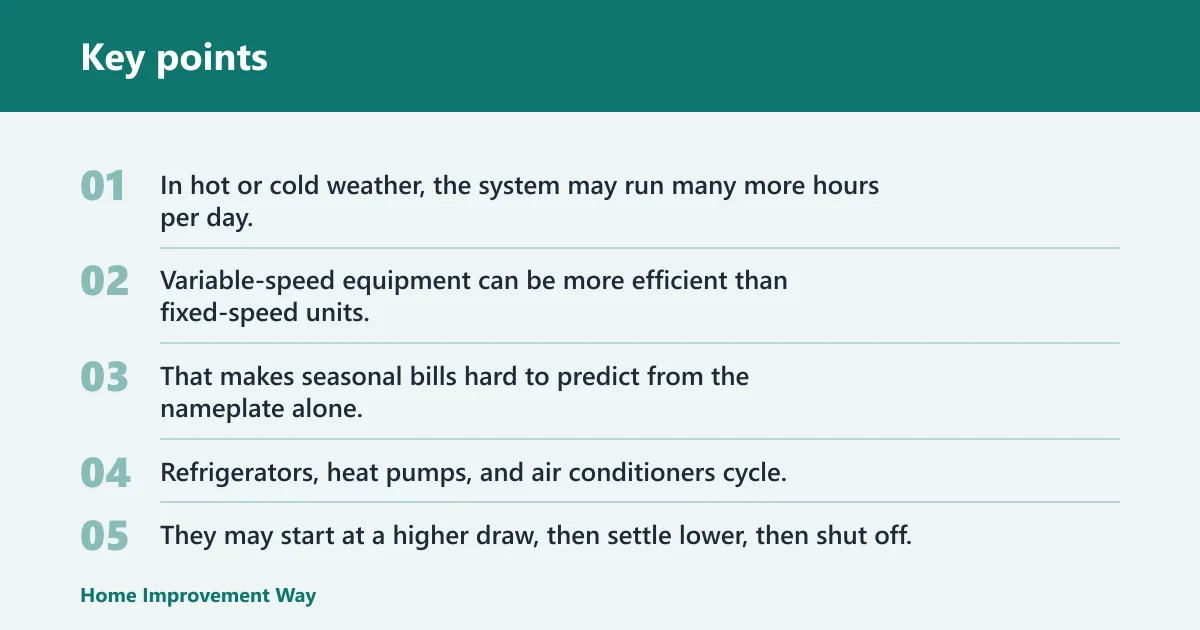
The main cost driver is runtime. In hot or cold weather, the system may run many more hours per day. Variable-speed equipment can be more efficient than fixed-speed units, but it still uses more electricity when demand is high. That makes seasonal bills hard to predict from the nameplate alone.
Why cycling loads are hard to estimate
Refrigerators, heat pumps, and air conditioners cycle. They may start at a higher draw, then settle lower, then shut off. A watt label gives you a ceiling, not a full month of use. For these loads, measured average watts or a utility interval read can give a better estimate than a label snapshot.
Spotting bill spikes from heating and cooling
If your bill jumps in a hot month or a cold snap, HVAC is a likely cause. Compare the kWh used against a milder month, then check whether the thermostat setting changed, filters clogged, or weather was harsher. Those changes usually matter more than small differences in appliance labels elsewhere in the home.
Electric vehicle charging costs
Electric vehicle charging can materially raise a monthly bill because the charger is a high-wattage load and the sessions are long. The best estimate is usually based on session length, charging power, and your all-in rate. Home charging is often easier to model than public charging, where pricing may include time, demand, or session fees.
Why session length matters
A charger rated at 7 kW does not add the same cost every day. The cost depends on how many kilowatt-hours the vehicle takes in each session. A longer commute, colder weather, or a larger battery can push monthly use up quickly even if the charger itself is unchanged.
Home charging versus public charging
Home charging usually tracks your electricity bill rate. Public charging may use a different rate structure, including per minute, per session, or a higher per-kWh price. For comparison purposes, use the charger session’s actual kWh if you have it, then price that against your own utility rate and the public charger’s tariff.
What changes the monthly total
The monthly total rises with more driving, lower efficiency, longer charging sessions, and higher per-kWh rates. If the charger shares a panel with HVAC or another major load, the home bill can rise in the same month for more than one reason. That is why the bill-to-rate step matters before estimating EV cost.
Electricity cost comparison worksheet
This worksheet converts common loads into daily and monthly cost using your own rate. It uses 800 W, 1,500 W, and 2,500 W because those figures are easy to compare across space heaters, small appliances, and larger portable loads. The table assumes a simple runtime so you can scale it to your own use.
| Load | Assumed runtime | Daily kWh | Daily cost at $0.25/kWh | Monthly cost at $0.25/kWh |
|---|---|---|---|---|
| 800 W | 4 hours/day | 3.2 | $0.80 | $24.00 |
| 1,500 W | 4 hours/day | 6.0 | $1.50 | $45.00 |
| 2,500 W | 2 hours/day | 5.0 | $1.25 | $37.50 |
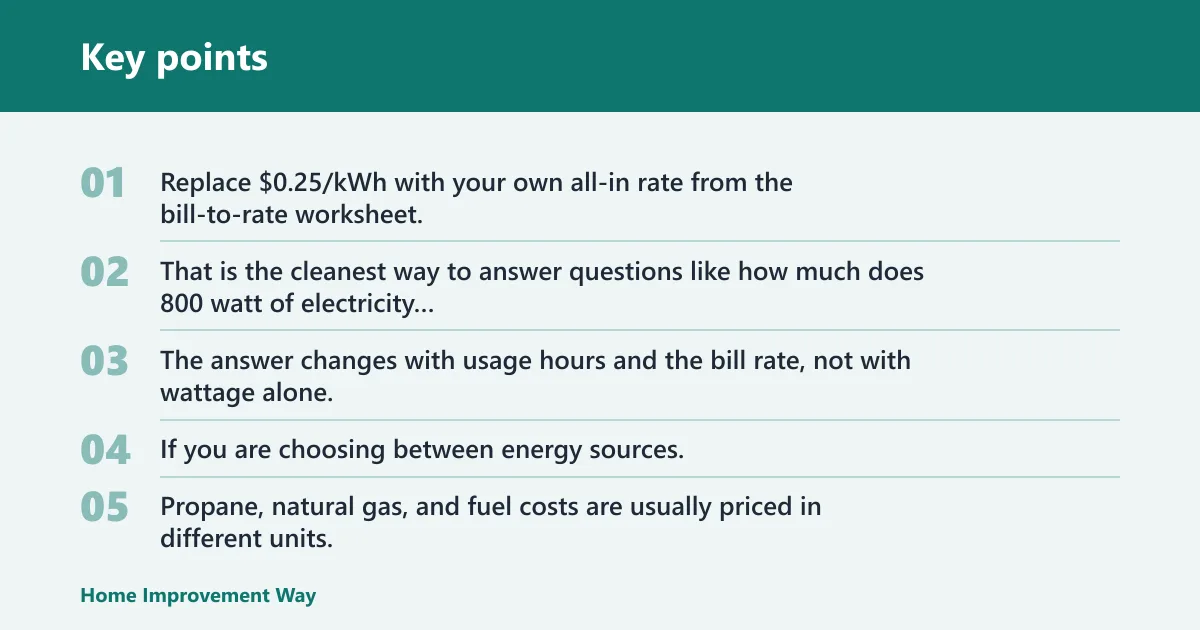
Replace $0.25/kWh with your own all-in rate from the bill-to-rate worksheet. That is the cleanest way to answer questions like how much does 800 watt of electricity cost. The answer changes with usage hours and the bill rate, not with wattage alone.
Comparing electricity with propane, natural gas, and fuel costs
If you are choosing between energy sources, compare cost per useful unit of heat or work rather than comparing sticker prices directly. Propane, natural gas, and fuel costs are usually priced in different units, so you need a common basis before deciding. A simple electricity cost calculator can still help by giving you the electric side first.
For heating comparisons, start with the electric cost per kWh, then convert the competing fuel into its usable output if you have the appliance efficiency. Natural gas and propane often look cheaper per unit on paper, but delivered heat depends on burner efficiency, standby losses, and seasonal runtime. Electricity can be more expensive per unit and still be the better fit for a specific appliance.
Picture a homeowner comparing a gas dryer with an electric dryer. The gas option may have lower fuel cost, but the final answer depends on local gas prices, electric rates, venting, and how often the dryer runs. The same logic applies to water heating and space heating.
Frequently asked questions
How electricity bill calculator
Enter your bill total, kWh used, and any fixed charges or delivery fees. Then divide the total amount due by the kWh used to get your all-in rate. Use that number in the watts-times-hours formula for appliances, heating, or EV charging.
How much electricity cost calculator
The calculator estimates cost by multiplying power use by time and then by your rate per kWh. For example, 800 W for 4 hours is 3.2 kWh. Multiply that by your own all-in rate to estimate daily, monthly, or yearly cost.
How is electricity price calculated?
Electricity price on a bill can include the energy charge plus delivery fees, riders, taxes, and fixed charges. That is why the all-in bill rate can be different from the posted energy charge. For true cost comparisons, use the full bill divided by kWh used.
Average price per kwh vs energy charge
The energy charge is only the rate for electricity itself. The average price per kWh on your bill can be higher because it includes fixed charges, delivery fees, taxes, and other add-ons. For household budgeting, the average bill price is usually the better number to use.
How much does 800 watt of electricity cost?
That depends on runtime and your own rate. An 800 W load uses 0.8 kWh per hour. If your all-in rate is $0.25/kWh, one hour costs $0.20. Four hours a day costs $0.80 per day and about $24 per month.
Propane vs electricity cost calculator
Use electricity cost per kWh as your starting point, then compare it against propane on a useful-output basis. Propane appliances have their own efficiency, and the delivered heat matters more than the fuel label. That is the only fair way to compare running cost.
How much should electricity cost per month?
There is no single normal monthly cost because home size, climate, appliance mix, and tariff all matter. A bill can be modest in a mild month and much higher during heating or cooling season. The best benchmark is your own past bill, adjusted for weather and runtime.
Sponsored / affiliate links. As an Amazon Associate I earn from qualifying purchases. I may earn additional commission from eligible campaigns.