Heater Efficiency Guide
For portable heaters, compare wattage to room size first: roughly 10 watts per square foot in average insulation. Then look at runtime, because a 1,500-watt heater generally costs the same to run at full draw regardless of type. I see people miss that all the time, then they overheat a bedroom, underheat a garage, or spend extra chasing “efficient” labels that ignore insulation, thermostat cycling, and where the heat actually lands. This guide breaks down heater types, running-cost math, wattage sizing, and the heat-delivery tradeoffs for bedrooms, offices, living rooms, basements, and garages.
Why heater efficiency is really about room heat loss


What a heater label tells you and what it does not
A portable plug-in space heater uses electric resistance heat. In plain terms, electricity passes through a heating element and turns into heat, so nearly all of the power it draws ends up warming the room. If two heaters both draw 1500W, their full-power electric use is basically the same even if one is ceramic, one is oil-filled, and one is infrared.
The label still matters, though. It tells you wattage, controls, and delivery method. A Mainstays offers a 1500W ceramic fan-force electric space heater. Walmart also lists an oil-filled radiator space heater rated at 1500W. A Walmart infrared tower heater is listed at 1500W. Those three can draw the same power while feeling very different in the room.
Heat loss, runtime, and comfort: the three numbers that matter
Your bill comes from hours run. Those hours run come from how fast the room loses heat. Comfort depends on whether the heat reaches people, surfaces, or mostly just the air.
A tight bedroom with a door closed may let a lower-watt heater cycle on and off gently. A leaky basement may keep the same heater running nearly nonstop. The monthly bill changes because of runtime, not because one resistance heater found some hidden way to make cheaper heat per watt.
Why the same 1500W draw can feel very different in use
A fan-forced ceramic unit throws warm air fast. An oil-filled radiator warms slower, then coasts between thermostat calls because the oil and metal hold heat. An infrared heater sends radiant energy toward people and nearby surfaces, so comfort can improve before room air temperature rises much.
That is why the right question is not “which label is most efficient?” It is “how much heat loss does this room have, how long will the heater run, and do I need spot heat or full-room heat?”
📊 Mainstays sells a personal electric space heater rated at 400W. Source: Portable and Electric Space Heaters.
What makes a heater more efficient?
A heater is more efficient in practice when its wattage matches the room’s heat loss, its thermostat limits full-power runtime, and its heat delivery suits the job. Equal-watt resistance heaters use similar electricity at full draw, so room fit and cycling behavior decide real cost more than the product category alone.
Electric resistance heat: where the power actually goes
Portable space heaters sold through major retailers sit in the electric and portable heater category. Best Buy’s heater category is for electric and portable heaters. In that group, the basic rule is simple: power in becomes heat out.
That means “energy efficient” marketing needs a translation. A 700W heater uses less power than a 1500W heater because it draws fewer watts. A 1500W heater does not become cheaper to run because it is ceramic or tower-shaped. It gets cheaper to operate only if it reaches comfort sooner and then spends more time off.
Thermostat cycling versus constant full-power operation
The thermostat changes cost more than any other feature in daily use. A Dreo space heater listing shows 1500W and a thermal sensor. One Dreo model is advertised for a large room with ECO mode. A Lasko ceramic console heater includes a remote, timer, and thermostat. Those details matter because controls can shorten runtime.
A heater without a useful thermostat tends to run at full power until the room feels too hot or the user shuts it off manually. A heater with a decent thermostat can hold a target temperature and reduce waste from overshooting.
Heat delivery method: air heating, radiant heating, and stored heat
There are three common ways portable heaters feel warm in a room. Ceramic fan heaters warm air quickly. Infrared heaters warm people and surfaces in their line of sight. Oil-filled radiators store heat in their mass and release it steadily.
Each method can fit one room and miss badly in another. Spot-heating a desk area is different from keeping a child’s bedroom steady all night. Heating a drafty garage bay is different again.
How do I compare heater efficiency by room size?
Use room size as a starting point, with about 10 watts per square foot in average insulation. Then adjust for what I see matter most in real rooms: insulation quality, ceiling height, window drafts, door traffic, and how long the space stays occupied. From there, compare whether the heater will cycle or run flat out most of the time.
Small insulated rooms: where 400W to 800W can make sense
Lower wattage wins when the room is already easy to heat. Mainstays sells a personal electric space heater rated at 400W. A 400W unit can be a sensible desk-side heater or a fit for a very small enclosed room with mild heat loss.
The same logic applies to 700W and 800W models. Another Walmart listing shows a 700W oil-filled radiator heater. In a small bedroom, powder room, or closed office with decent insulation, a 700W or 800W heater may avoid temperature swings that a 1500W unit creates.
Average bedrooms and offices: when 1000W to 1500W is appropriate
Bedrooms and home offices often land in the middle. If the room is average in size and the door can stay closed, 1000W may be enough in milder conditions, while 1500W gives more recovery speed after a cold start. The right choice depends on whether the heater will maintain temperature or constantly catch up.
Faster is not always cheaper. An oversized heater in a small room may short-cycle, overshoot, and make occupants turn it down or crack a door. That wastes comfort even if the raw power draw is unchanged.
Large or leaky rooms: why wattage alone may not solve the problem
If a room leaks heat badly, a larger portable heater may still fail to keep up. A single 1500W plug-in unit is often the upper limit in this class, and many examples on the market sit there. Lasko lists a 1500W ceramic console space heater with two speeds. That gives output choices, but the top ceiling remains 1500W.
A drafty basement, old sunroom, or garage often needs heat-loss reduction before heater selection. Weatherstripping, door sweeps, and closing off unused volume can change runtime more than swapping one 1500W heater type for another.
Ceiling height, drafts, and door traffic
Two rooms with the same floor area can behave differently. High ceilings add more air volume. Exterior doors dump heat during each opening. Air leaks at windows, sill plates, and attic hatches keep a heater working longer.
That is why room-size ratings alone are weak buying guides. A “large room” claim means very little without runtime context.
How heater type changes comfort and runtime
Ceramic heaters: PTC elements and fan-forced warm air
Ceramic heaters often use PTC ceramic heating elements with a fan pushing air across them. That setup warms occupied air quickly, so a cold office or bedroom can feel livable sooner. Mainstays offers a 1500W ceramic fan-force electric space heater, and Lasko lists a 1500W ceramic console space heater with two speeds.
The tradeoff is delivery style. Fan-forced air works well for quick recovery and whole-room mixing, but it is less appealing in a silent room or for someone who wants direct warmth while sitting still.
Oil-filled radiators: slower response and steadier cycling
Oil-filled radiators are portable electric radiators. They still use resistance heat, but they warm internal oil and metal fins first. Walmart also lists an oil-filled radiator space heater rated at 1500W, and another Walmart listing shows a 700W oil-filled radiator heater.
These heaters usually feel slow at startup. In steady-use rooms, that slow response can work in their favor because the thermostat often cycles less abruptly. They fit bedrooms, reading rooms, and offices where the room stays occupied for longer blocks.
Infrared heaters: direct radiant heat for people and surfaces
Infrared heaters send energy outward instead of relying only on warm moving air. A Walmart infrared tower heater is listed at 1500W. Quartz and tower styles are common in indoor rooms where the goal is to warm a seating area, not every cubic foot equally.
They work best in spot-heating. If the person moves out of the radiant path, comfort drops fast. That is the dividing line between spot-heating efficiency and whole-room efficiency.
Plain fan heaters versus specialty labels
Many “special” heater labels describe shape, controls, or delivery method more than raw energy use. A ceramic heater with a fan is still a fan heater. An infrared tower at 1500W is still a 1500W resistance heater. The useful comparison is runtime in a given room, not shelf wording.
Is a ceramic heater more efficient than a fan heater?
A ceramic heater and a basic fan heater with the same wattage use similar electricity at full power. Ceramic designs can feel faster because the element and airflow warm the occupied zone quickly, but that is a comfort and control difference, not a magic reduction in watts consumed.
Same wattage, similar power use
If both heaters draw 1500W, the meter sees about the same full-power demand. The ceramic label does not change that.
Where ceramic designs can shorten warm-up time
PTC ceramic elements paired with fan-forced air often give fast room response. That can shorten the high-output part of a heating cycle in a small or medium room, especially when the heater includes a good thermostat or thermal sensor.
A Dreo heater includes a 12H timer and 3 modes. Those control options can cut wasted runtime when compared with a simple on-off fan heater left blasting at full setting.
When fan-driven heat works better than radiant or stored heat
Use fan-driven heat when the room air itself needs to change quickly. That includes a cold office before work, a bathroom before use, or a living room after the thermostat setback overnight.
Is an oil-filled radiator cheaper to run than a ceramic heater?
An oil-filled radiator is not cheaper per watt than a ceramic heater. If both draw the same wattage for the same runtime, cost is about the same. The radiator can feel cheaper in steady rooms because its slower, gentler cycling may reduce how often full power is needed.
Power draw versus actual daily cost
A 1500W oil-filled radiator and a 1500W ceramic heater both have the same nameplate draw. The bill changes only if one runs fewer minutes over the day.
Why steady rooms favor oil-filled radiators
Bedrooms and offices with closed doors often suit oil-filled radiators. Once the room and nearby surfaces are warm, the heater can coast between thermostat calls. That steadier behavior often feels comfortable overnight.
When a ceramic heater costs less because it heats faster and shuts off sooner
A ceramic heater can cost less in intermittent use. If the room starts cold, a faster warm-up may reach target temperature sooner and then shut off. For a one-hour morning office session, that may beat waiting on a slow radiator to catch up.
How much does a 1500-watt heater cost to run?
A 1500-watt heater uses about 1.5 kilowatt-hours for each hour it runs at full power. Multiply 1.5 by the electric rate to get hourly cost, then multiply by runtime. The type of resistance heater matters less than how many hours the thermostat keeps it drawing close to full power.
The simple cost formula: watts to kilowatt-hours
- Convert watts to kilowatts by dividing by 1000.
- Multiply kilowatts by hours run.
- Multiply kilowatt-hours by the electric rate.
So a 1500W heater equals 1.5 kW. A 700W heater equals 0.7 kW. An 800W heater equals 0.8 kW. A 1000W heater equals 1.0 kW.
Hourly, nightly, and monthly examples at different electric rates
| Heater wattage | kW draw | 1 hour at $0.15/kWh | 8 hours at $0.15/kWh | 30 nights of 8 hours |
|---|---|---|---|---|
| 400W | 0.4 | $0.06 | $0.48 | $14.40 |
| 700W | 0.7 | $0.105 | $0.84 | $25.20 |
| 800W | 0.8 | $0.12 | $0.96 | $28.80 |
| 1000W | 1.0 | $0.15 | $1.20 | $36.00 |
| 1500W | 1.5 | $0.225 | $1.80 | $54.00 |
Why thermostat runtime matters more than nameplate wattage alone
If a 1500W heater runs only half the time, its average draw over that period is far lower than the nameplate suggests. Meanwhile, an undersized 700W heater in a leaky room may run nonstop and still leave the room cold.
That is the heart of heater efficiency in actual homes: choose the smallest heater that can still cycle in the room you have.
Room-by-room heater efficiency matrix
How to use the matrix: room type, insulation level, and expected runtime
Use this matrix to match heater type and wattage to heat loss and use pattern. “Expected runtime” is a practical prediction, not a promise. The point is to choose the heater most likely to cycle in that room instead of running flat out or overshooting.
| Room type | Insulation level | Recommended heater type | Wattage range | Expected runtime | Choose this, not that |
|---|---|---|---|---|---|
| Desk nook or personal zone | Average | Ceramic personal heater or small infrared | 400W | Short bursts or part-time cycling | Choose 400W spot heat, not a 1500W whole-room heater |
| Small bedroom | Good | Oil-filled radiator or ceramic with thermostat | 700W to 800W | Moderate cycling after warm-up | Choose 700W or 800W for steady overnight use, not 1500W on high in a tight room |
| Average bedroom or office | Average | Ceramic fan heater or oil-filled radiator | 1000W to 1500W | Frequent cycling in cold weather | Choose thermostat control, not a heater with only manual high/low |
| Living room seating area | Average | Infrared tower for spot heat, ceramic for full-room mixing | 1000W to 1500W | Spot heat can shorten runtime | Choose infrared for occupied couch zone, not full-room heating when only one corner is used |
| Basement room | Poor | Ceramic fan heater with thermostat | 1500W | Long runtime, often near continuous | Choose air-sealing first, not a lower-watt heater that never catches up |
| Garage work bay | Poor | Infrared for direct spot heat | 1500W | Part-time if aimed at occupant | Choose direct radiant heat, not an oil-filled radiator trying to heat the whole space |
| Drafty sunroom | Poor | Ceramic plus room sealing measures | 1500W | Long runtime unless leaks are fixed | Choose weatherstripping and a door sweep, not faith in “large room” claims |
Choose-this-not-that rules for bedrooms, living rooms, basements, and garages
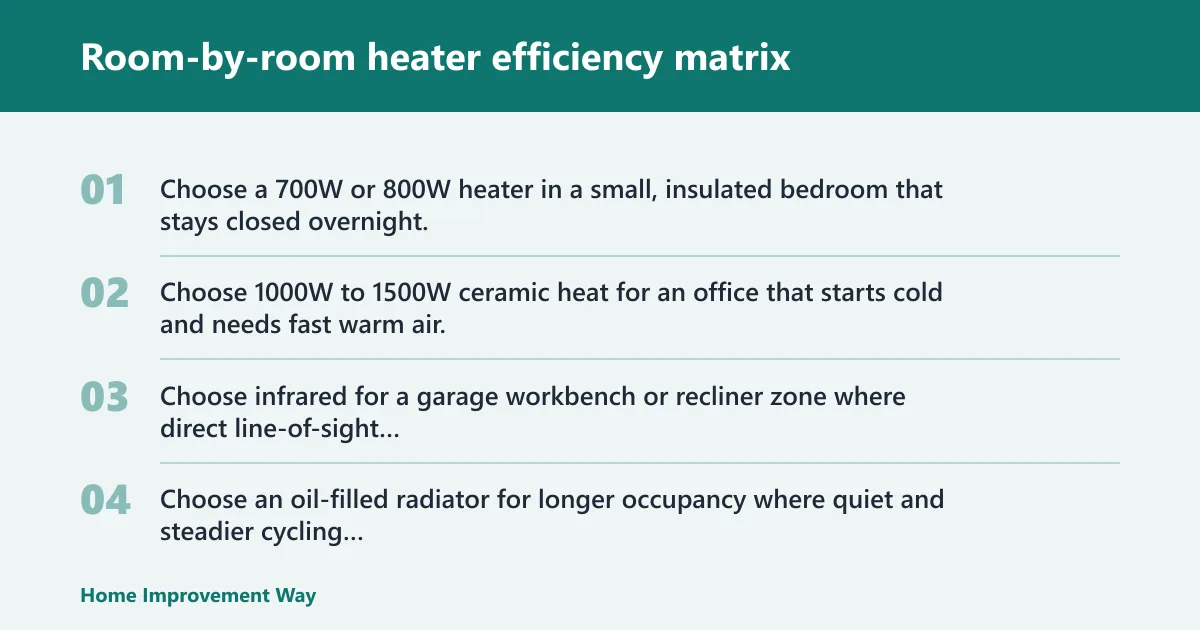
- Choose a 700W or 800W heater in a small, insulated bedroom that stays closed overnight.
- Choose 1000W to 1500W ceramic heat for an office that starts cold and needs fast warm air.
- Choose infrared for a garage workbench or recliner zone where direct line-of-sight warmth matters.
- Choose an oil-filled radiator for longer occupancy where quiet and steadier cycling matter.
When a 700W or 800W heater beats a 1500W unit
A lower-watt heater wins when the room’s heat loss is low enough that the bigger heater keeps overshooting. That often happens in compact bedrooms, nursery-size rooms, and small home offices with decent windows and a closed door.
It also wins when the goal is background temperature maintenance instead of fast recovery.
Failure cases: oversized, underpowered, and poorly placed heaters
An oversized heater in a tiny room causes wide temperature swings. An underpowered heater in a leaky space runs endlessly. A well-sized heater placed behind furniture, under a drafty window curtain, or in a busy doorway works harder than it should.
Do portable heaters save money compared with central heat?
Portable heaters can save money when they heat one occupied room and the central system is turned down for the rest of the house. They usually do not save money when several portable units run at once or when they try to replace whole-house heating in cold weather.
Spot heating one occupied room versus heating the whole house
This is where portable heaters make sense. If one person uses one office, one bedroom, or one TV room, a space heater can warm that zone while the rest of the home stays cooler.
When central heat is still the cheaper option
Central heat often wins when many rooms are occupied, doors stay open, or the house already has a reasonably efficient system. For context, Consumer Reports says heat-pump water heaters are two to four times more energy-efficient than conventional electric water heaters, and Consumer Reports notes gas water heaters generally cost less to run than electric water heaters. Those facts are about water heating, but they show an important point: system type and fuel matter when looking beyond plug-in resistance heaters.
For space heating, a portable electric heater is still resistance heat. It is a zoning tool, not a whole-house bargain by default.
Practical operating rules that trim cost without hurting comfort
- Heat occupied rooms, then close the door.
- Use the thermostat, not the window, to control overheating.
- Lower the central setting only if the house can still protect pipes and adjoining rooms.
- Do not scatter multiple 1500W heaters around the house and expect a lower bill.
Safety features and setup mistakes that affect real-world efficiency
Overheat protection, tip-over protection, and automatic shutoff
Safety protections are baseline features to expect. Overheat protection, tip-over protection, and automatic shutoff reduce obvious risk, especially with portable units used in bedrooms, offices, and family rooms. A heater with a thermostat and timer also reduces the odds of unnecessary overnight runtime.
Extension cords, outlet limits, and circuit loading
High-watt portable heaters put serious load on a household circuit. Plug them directly into a suitable wall outlet. Avoid extension cords and cheap power strips. A 1500W heater left on a marginal connection wastes energy as heat in the wrong place and creates a safety problem.
Placement mistakes that hurt performance and increase runtime
Do not tuck a heater behind a chair. Do not aim a fan heater into dead space. Do not place an infrared heater where the sofa blocks most of the radiant path.
Good placement cuts runtime because the heat reaches the people and surfaces that need it.
Frequently asked questions
What makes a heater more efficient?
A heater is more efficient in real use when its wattage fits the room, its thermostat keeps it from running flat out, and its heat delivery matches the job. Equal-watt electric resistance heaters use similar power at full draw, so runtime and room heat loss are what change the bill.
How do I compare heater efficiency by room size?
Use wattage first, with about 10 watts per square foot as a starting point in average insulation, then adjust for drafts, ceiling height, and door openings. After that, compare whether the heater will cycle off in that room or run nearly nonstop. Cycling is where savings usually appear.
Is a ceramic heater more efficient than a fan heater?
If wattage is the same, a ceramic heater and a basic fan heater use about the same electricity at full power. Ceramic designs may feel faster because fan-forced warm air reaches the occupied zone quickly, but the gain is usually in response and comfort, not lower power draw.
Is an oil-filled radiator cheaper to run than a ceramic heater?
It can be cheaper over a day only if it runs fewer minutes. Heat from an oil-filled radiator is not cheaper per watt. In steady rooms, the radiator may cycle gently and hold comfort well. In short-use rooms, a ceramic heater may warm faster and shut off sooner.
What wattage heater do I need for a bedroom?
A small, insulated bedroom often works well with 700W to 800W, especially for overnight maintenance. An average bedroom may need 1000W to 1500W if it starts cold or has average insulation. The best sign of correct sizing is that the heater can reach comfort and still cycle off.
Which heater type is best for a drafty room?
For a drafty room, heater type matters less than reducing heat loss. A 1500W ceramic heater often works best for fast air mixing, while infrared works well for direct spot heat on occupants. Oil-filled radiators are usually weaker fits unless the drafts are fixed and the room stays occupied for long periods.
Sponsored / affiliate links. As an Amazon Associate I earn from qualifying purchases. I may earn additional commission from eligible campaigns.