Are Ceramic Heaters More Efficient Than Fan Heaters?
No—ceramic heaters are not inherently more efficient than fan heaters; at the same wattage, both are generally close to fully converting electricity into heat, so running cost is usually the same. Pick the wrong model, and you may pay for heat that feels harsher, louder, or too weak for the room. This guide separates electrical efficiency from comfort and explains why ceramic heaters can seem better because they warm people more quietly at the same input.
Ceramic vs fan heaters: the real trade-off
The core trade-off is simple: the plug load is usually the same, but the room experience is not. A ceramic heater can feel calmer because the element is often paired with a different airflow pattern and a quieter housing, while a fan heater can feel quicker because its air stream throws warm air directly at you.
That difference affects comfort more than electricity use. If two portable heaters draw 1500W, each uses about 1.5 kilowatt-hours in one hour of full-power operation, and the electricity bill mainly depends on tariff and thermostat cycling rather than on whether the element is ceramic or resistive wire.
Ceramic heater vs fan heater comparison table
| Criterion | Ceramic heater | Fan heater |
|---|---|---|
| Typical portable wattage | 750W to 1500W is common | 1000W to 2000W is common |
| Warm-up speed | Fast element warm-up, then steady airflow | Fast spot heating with direct forced air |
| Noise | Usually quieter in feel, but still has a fan in many models | Audible fan noise is part of normal operation |
| Thermostat cycling | Often cycles on and off once the setpoint is reached | Often cycles on and off once the setpoint is reached |
| Room fit | Better for bedrooms and small offices when noise matters | Better for quick spot heat and drafty spaces |
| Likely running-cost outcome | Usually the same as any heater with the same wattage and duty cycle | Usually the same as any heater with the same wattage and duty cycle |
| Common safety features | Tip-over switch, overheat protection, sometimes cool-touch housing | Tip-over switch, overheat protection, automatic cut-offs |
Are ceramic heaters more efficient than fan heaters?
No. At the plug, both types are nearly 100% efficient at turning electricity into heat, because the goal of each is resistive heating. The difference is how that heat enters the room, how much noise the unit makes, and how often the thermostat cuts power.
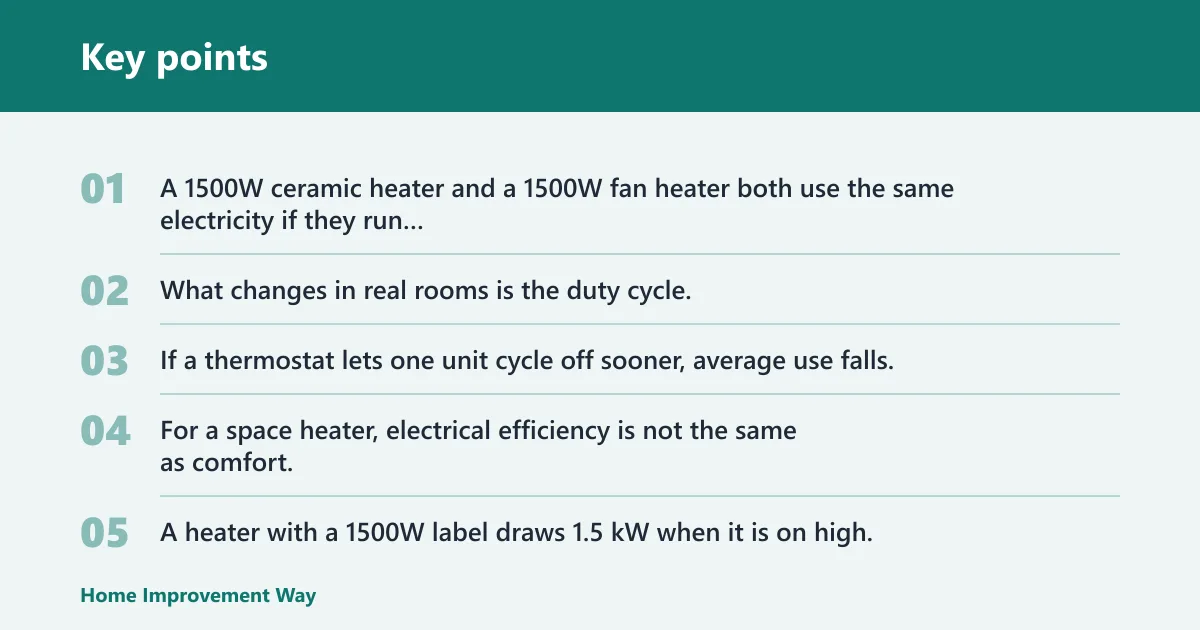
A 1500W ceramic heater and a 1500W fan heater both use the same electricity if they run for the same amount of time at full output. What changes in real rooms is the duty cycle. If a thermostat lets one unit cycle off sooner, average use falls, but that is a control effect, not a ceramic advantage.
What efficiency means at the plug
For a space heater, electrical efficiency is not the same as comfort. A heater with a 1500W label draws 1.5 kW when it is on high, and that becomes about 5,118 BTU/h because 1 watt equals about 3.412 BTU/h. The heat output tracks the wattage, not the heater style.
That is why a 1000W heater can cost less to run than a 1500W heater, while a 2000W heater can warm faster but also draw more power. The style matters for how the heat reaches you; wattage decides the energy bill.
Why 1500W usually costs the same either way
If electricity costs around 30 pence per kWh, a 1500W heater costs roughly 45 pence for one hour at full power. A 1000W heater costs about 30 pence per hour, and a 750W heater costs about 22.5 pence per hour. Those numbers are the same for ceramic and fan heaters with the same draw.
That is why the answer to “Do ceramic heaters use less electricity?” is usually no. Lower bills come from lower wattage, shorter run time, or thermostat cycling, not from the word ceramic on the box.
How thermostat cycling changes real use
Thermostats matter because they switch the heater off once the room reaches the set temperature, then back on when it falls. That on-off pattern can cut average energy use far below the nameplate wattage, especially in a small, insulated room with a modest setpoint.
Manual controls are often less exact than digital controls, so they can overshoot or run longer than needed. A digital thermostat with tighter setpoint control can reduce wasted run time, which affects cost more than the heating element type in many homes.
How wattage changes heat and cost
Wattage is the main number to watch. A 750W heater is a low-draw option for a small, enclosed room. A 1000W heater is a common middle ground. A 1500W unit is a standard portable size for a bedroom or office. A 2000W model gives more output, which can help in larger or leakier spaces, but it also uses more electricity when it runs.
kWh, tariff, and simple hourly cost math
Electricity use is measured in kilowatt-hours, or kWh. The math is simple: power in kilowatts multiplied by time in hours. Cost equals kWh multiplied by your tariff. So a 2000W heater running for one hour uses about 2 kWh; at around 30 pence per kWh, that is about 60 pence.
That same formula works for any heater type. A 1000W unit uses 1 kWh in one hour at full output, and a 750W unit uses 0.75 kWh. If the thermostat cycles the heater on for only half the hour, the average use drops to half those figures.
BTU and what it tells you about output
BTU per hour helps compare heat output in another unit. Since 1 watt is about 3.412 BTU/h, a 750W heater is about 2,559 BTU/h, a 1000W heater is about 3,412 BTU/h, a 1500W heater is about 5,118 BTU/h, and a 2000W heater is about 6,824 BTU/h.
That conversion does not tell you whether a room will feel warm enough by itself. Insulation, drafts, ceiling height, and room size still decide how far that heat goes.
Do ceramic heaters feel warmer than fan heaters?
Often, yes, but the reason is comfort, not higher electrical efficiency. Ceramic models can feel calmer because some are quieter and spread heat in a less aggressive way, while fan heaters can feel like they are blasting warm air at one spot. In a small room, that difference is easy to notice.
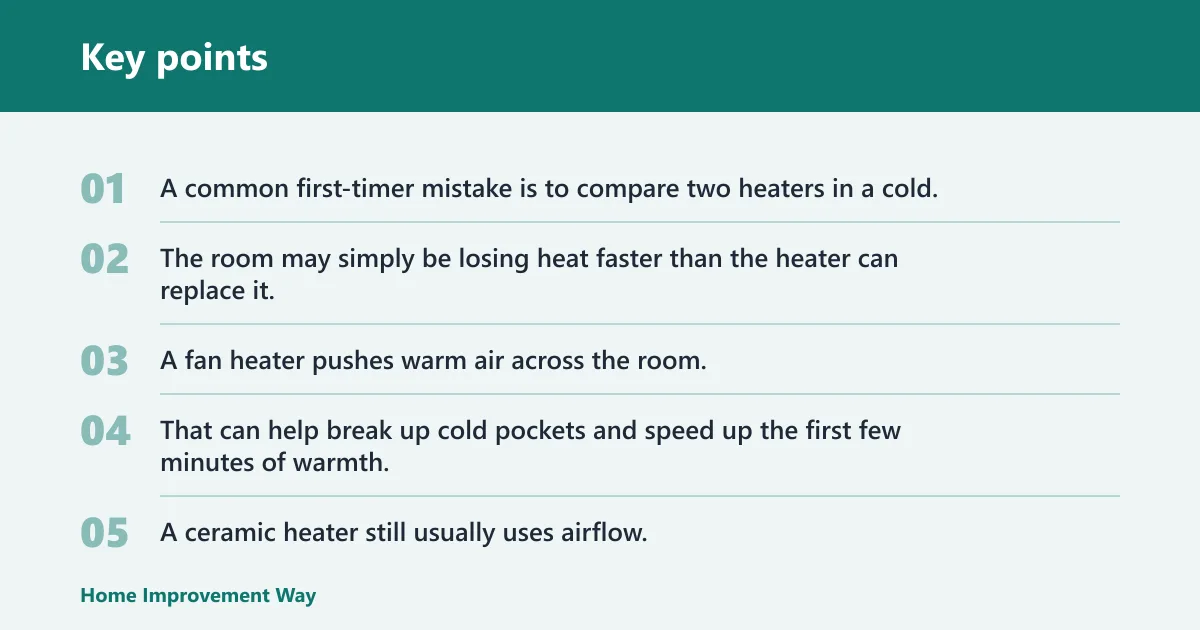
A common first-timer mistake is to compare two heaters in a cold, drafty room and assume the quieter one is weaker. The room may simply be losing heat faster than the heater can replace it, so the fan-driven unit feels more effective because it mixes the air around you sooner.
Heat distribution and airflow
A fan heater pushes warm air across the room. That can help break up cold pockets and speed up the first few minutes of warmth. A ceramic heater still usually uses airflow, but the element design and housing can make the experience feel smoother or less harsh.
If the room has strong drafts, a fan heater may hold the edge because the moving air helps distribute heat more quickly. If the room is already fairly sealed, the quieter feel of a ceramic heater may be more noticeable than any difference in output.
Why ceramic models can feel quieter
Noise matters more than many buyers expect. A fan motor and airflow are audible in most fan heaters, and that can be distracting in a bedroom or a study. Ceramic heaters often seem more comfortable because the noise profile is less sharp, even when the actual wattage is the same.
That does not mean every ceramic heater is quiet. Some still use a strong fan. The key point is that perceived warmth is shaped by both heat and sound, and sound can make a room feel less restful.
When a fan heater feels faster in a cold room
If you need to warm your hands or feet quickly at a desk, a fan heater often feels faster because it sends hot air directly where you sit. That makes it useful for short bursts of heat, especially in a small office or garage corner.
Suppose a 12 m² office sits at 14°C and you want the desk area warmer within ten minutes. A 1500W fan heater may feel quicker to the person sitting in the airflow than a ceramic unit with a softer spread, even though the electrical draw is similar.
Which heater is better for your room?
Room size and insulation matter more than heater style. A small, closed bedroom can work well with a 750W to 1500W ceramic heater. An office often suits either type, but noise can tip the choice. A drafty garage usually needs stronger output and better air movement than a quiet bedroom does.
Bedrooms
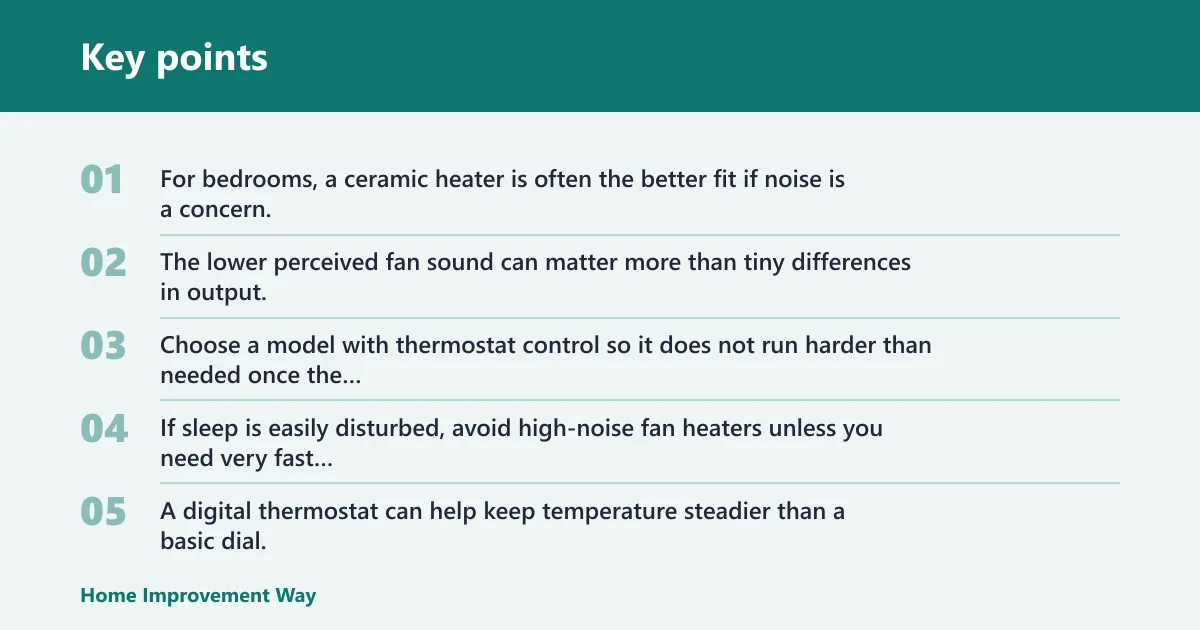
For bedrooms, a ceramic heater is often the better fit if noise is a concern. The lower perceived fan sound can matter more than tiny differences in output, especially overnight. Choose a model with thermostat control so it does not run harder than needed once the room warms up.
If sleep is easily disturbed, avoid high-noise fan heaters unless you need very fast preheating. A digital thermostat can help keep temperature steadier than a basic dial.
Home offices
For a home office, either type can work, but ceramic heaters usually win on comfort if you sit near the unit for long periods. Fan heaters can be useful if the room is cold at start-up and you want quick warmth before work begins.
If the desk is near a cold exterior wall, choose a heater with enough wattage for the room size and a thermostat that cycles accurately. Underpowered units run longer and cost more than a properly sized heater that reaches setpoint and idles.
Drafty rooms and garages
Drafty rooms often favor fan heaters because moving air helps heat the space more evenly. Ceramic heaters are not a bad choice there, but a quiet unit can feel underwhelming if the room is leaking heat as fast as it is added.
In a garage or utility space, output and air movement matter more than low noise. A 2000W model may be more practical than a 750W or 1000W unit if the goal is quick, localized warming rather than gentle background heat.
Choose ceramic if… / Choose fan if…
Choose a ceramic heater if you want quieter zone heating, a bedroom-friendly feel, or a small office heater that does not sound aggressive. Choose a fan heater if you want the quickest burst of warm air, especially in a drafty room or a space that starts very cold.
- Choose ceramic if the room is small or medium, noise matters, and you want gentler-feeling heat near a bed or desk.
- Choose ceramic if you want a portable heater with common safety features such as tip-over protection and overheat cut-offs.
- Choose fan if you need rapid spot heating, better air mixing, or a stronger feel in a leaky room.
- Choose fan if you can tolerate noise and want the room to warm quickly at the start of use.
Safety features and placement
Look for a tip-over switch, overheat protection, and clear safety labels before anything else. Some models also have cool-touch housing, which can help reduce burn risk on exposed surfaces. Place any portable heater on a flat floor with the clearances listed by the manufacturer, away from curtains, bedding, and loose fabric.
Safety does not change the efficiency question, but it does change whether the heater is suitable for the room. A heater that cycles well and fits the room size is the one that will usually cost less in practice.
Frequently asked questions
Are ceramic heaters better than fan heaters?
Not always. Ceramic heaters are often better for quieter bedroom or office use, while fan heaters are often better for fast spot heat and drafty spaces. The better choice depends on room size, insulation, and whether you care more about noise or quick airflow.
Do ceramic heaters use less electricity?
Usually no. Electricity use depends mainly on wattage and how long the heater stays on. A 1000W ceramic heater and a 1000W fan heater use the same energy if they run for the same time at the same output, and thermostat cycling matters more than heater type.
Which heater costs less to run: ceramic or fan?
Neither is automatically cheaper. If both are rated at 1500W and run for the same amount of time, the running cost is the same. The lower-cost option is the one with the right wattage for the room and a thermostat that shuts the unit off when heat is no longer needed.
Which heats a room faster, ceramic or fan heater?
Fan heaters often feel faster in the first few minutes because they push warm air directly into the room. Ceramic heaters can still warm a room quickly, but the perceived speed depends on airflow, draft level, and where you sit relative to the heater.
Is a fan heater or ceramic heater better for bedrooms?
Ceramic heaters are usually the better fit for bedrooms because they often feel quieter and less harsh. If the room is very cold at bedtime, a fan heater can preheat the space faster, but the noise can be a drawback for sleep.
What size room is best for a ceramic heater?
Small to medium rooms are the best match, especially bedrooms and offices with modest drafts.
Sponsored / affiliate links. As an Amazon Associate I earn from qualifying purchases. I may earn additional commission from eligible campaigns.