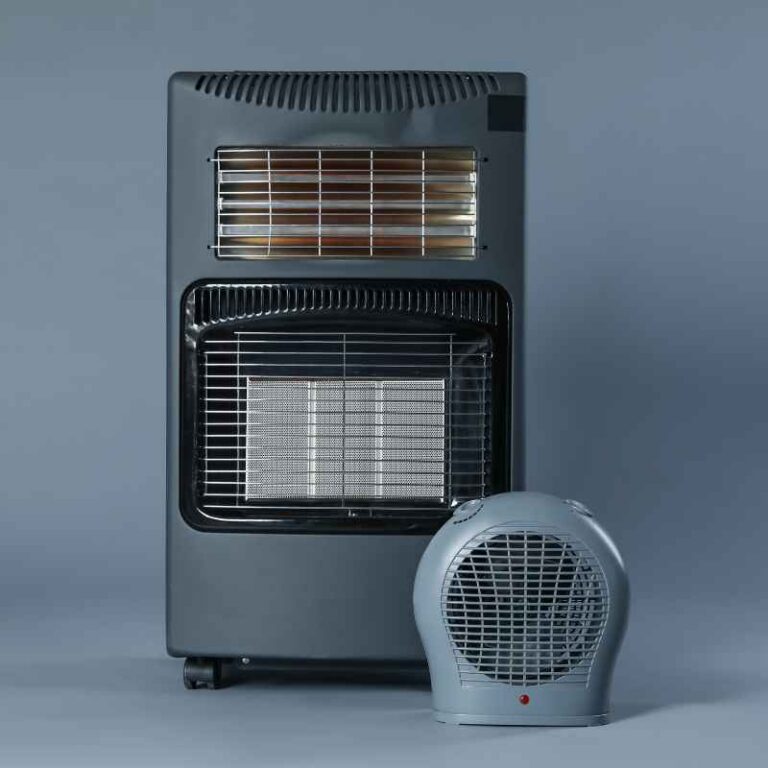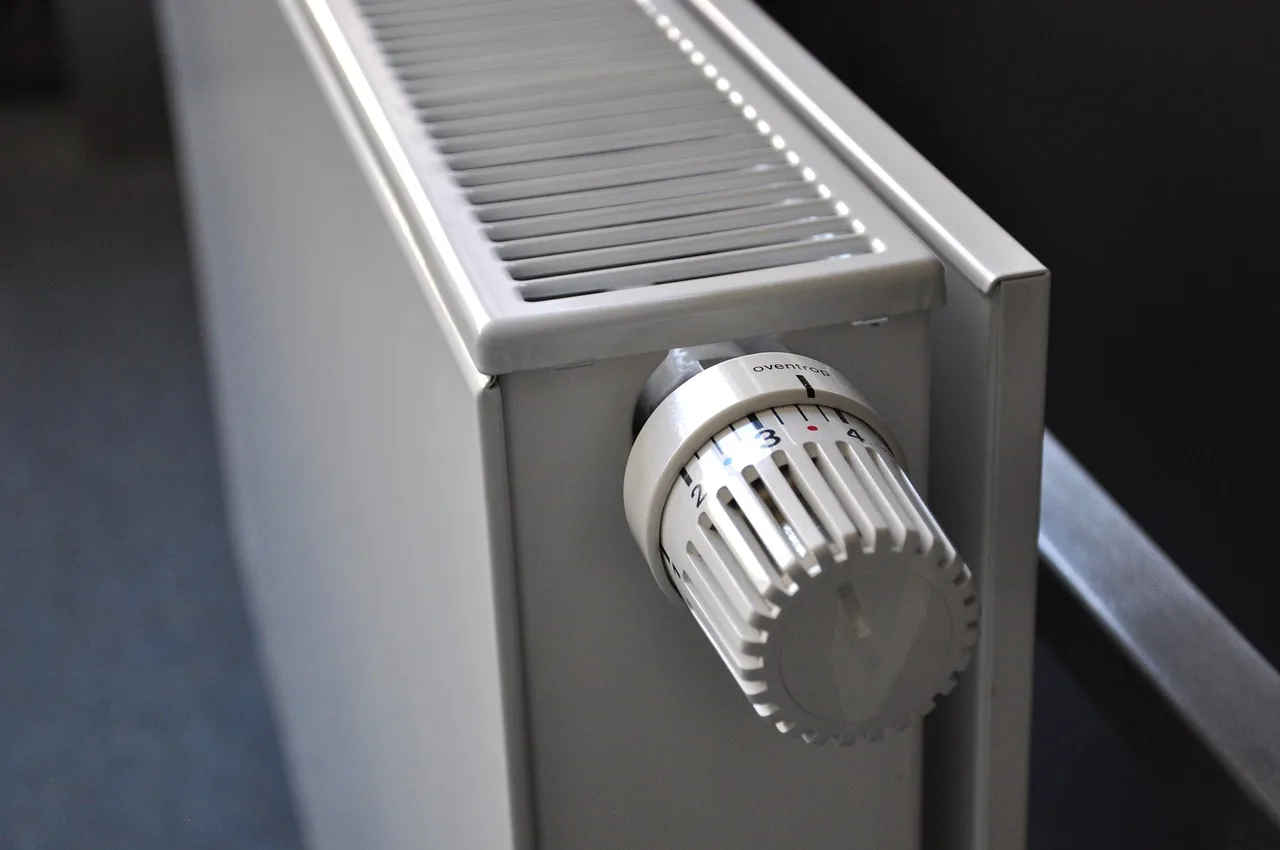
Radiator Heater vs Baseboard Heat: Which Is Better for Comfort?
Radiator heat often feels more comfortable than baseboard heat because it can reduce cold-wall drafts and feel less localized. Baseboard heat can be practical in some retrofits, but the better fit depends on the room, the emitter type, and the available wall layout. If you pick the wrong system, one room can feel hot near the unit and cold across the floor, which can lead to thermostat creep and higher bills. This guide compares warmth distribution, draft control, noise, and recovery so you can choose the better fit for each room.
| Decision factor | Radiator heater | Baseboard heat | Winner |
|---|---|---|---|
| How heat feels in the room | More even, with heat felt on nearby surfaces as well as in the air | More localized, with warmth starting low along the wall and rising | Radiator heater |
| Draft control near windows and exterior walls | Better at softening cold-surface discomfort | Depends on clear airflow and placement under the cold area | Radiator heater |
| Noise | Usually quiet; sound comes mostly from boiler and piping movement | Usually quiet; electric models avoid boiler noise, hydronic models can still click and expand | Tie |
| Recovery after a setback | Often steadier, especially with cast-iron mass | Usually faster to respond to thermostat changes | Baseboard heat |
| Room-by-room control | Strong if paired with thermostatic radiator valves or heads | Good when each zone has its own thermostat | Tie |
| Furniture and layout tolerance | Less affected by nearby furniture placement | More sensitive to blocked airflow and tight curtains | Radiator heater |
What each system is in a hydronic home
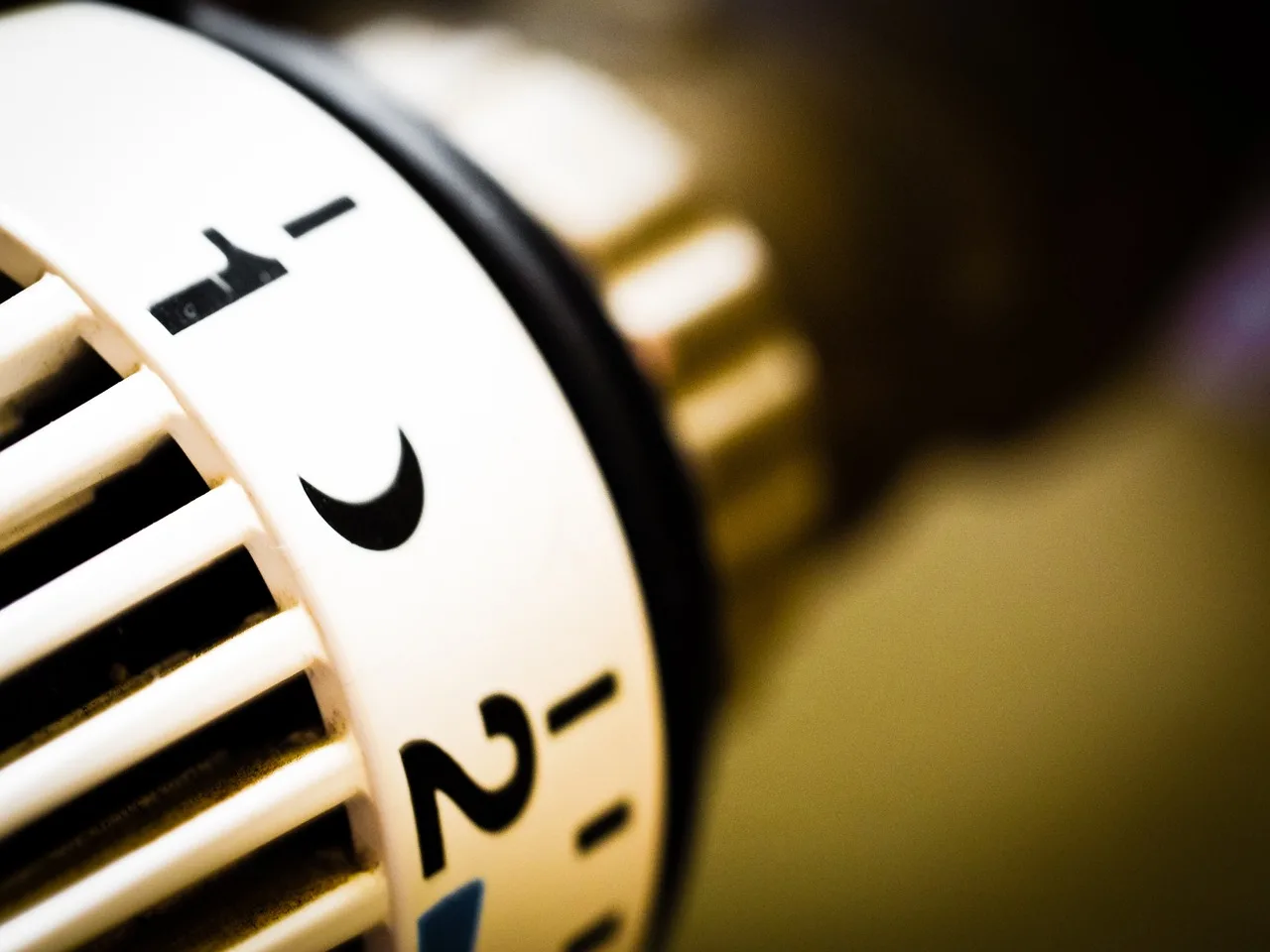
A hot water radiator heating system uses heated water from a boiler and releases heat through thermal radiation and natural air circulation. ASHRAE comfort guidance treats mean radiant temperature and other comfort factors as major drivers of how warm a room feels, not just its air temperature. Baseboard heat can be hydronic, using hot water through copper or aluminum fins, or electric, using resistance coils. Those differences matter because comfort depends on how the heat reaches you, not only on how much heat the room gets. The U.S. Department of Energy notes that electric resistance baseboards are typically simple to install, but they are usually less efficient to operate than heat pumps or other high-efficiency systems, so comfort and operating cost should be weighed separately (DOE Energy Saver).
Steam radiators are a separate case. They use steam that condenses back into water, and they often have longer warm-up times and a heavier heat curve than hot-water radiators. Cast-iron radiators also store more heat, so they tend to keep radiating warmth after the boiler shuts off. Manufacturer guidance for steam systems commonly emphasizes that steam-filled emitters, piping pitch, and venting behavior affect how quickly and evenly the system heats, which is why steam often feels different from hot-water radiation even in similar rooms.
Radiant heat versus convection
Thermal radiation warms objects and surfaces directly. Natural convection warms air so it rises naturally. Radiators use both, but they usually lean more on radiant comfort, while baseboard heaters depend more on air movement along the wall and into the room. ASHRAE comfort guidance treats radiant asymmetry, draft, and temperature stratification as important comfort variables, which is why a room can feel uncomfortable even when the thermostat reads the target temperature.
Radiator heater vs baseboard heat table
The comfort pick changes by room and use case. Radiator heater is often a good choice when the goal is steadier warmth, fewer drafts, and better feel near cold walls. Baseboard heat can be a better practical choice when a room needs a wall-mounted emitter and the retrofit favors that layout.
| Scenario | Radiator heater | Baseboard heat | Comfort winner | Why it wins | Radiator comfort score (1-5) | Baseboard comfort score (1-5) | Recommendation |
|---|---|---|---|---|---|---|---|
| Winter bedroom | Usually more even and less locally hot | Can feel warm at the wall and cooler across the floor | Radiator heater | Steadier surface warmth feels better during sleep and late-night setbacks. | 5 | 3 | Choose the radiator for quieter, steadier overnight comfort. |
| Drafty room | Better at softening cold-surface discomfort | Needs clear airflow to push warmed air across the room | Radiator heater | Radiant output helps offset the chill from leaky walls and windows. | 5 | 2 | Choose the radiator because it better offsets drafts and cold walls. |
| Corner room | More forgiving near two exterior walls | Can leave cold edges if the airflow pattern is weak | Radiator heater | Radiation reaches surfaces that otherwise stay cold. | 5 | 3 | Choose the radiator if the room has two cold exterior exposures. |
| Under-window placement | Often better at countering cold glass and wall losses | Can work well if nothing blocks the unit and air can rise freely | Radiator heater | It reduces the cold-wall effect that people notice near windows. | 5 | 3 | Choose the radiator unless the room is built around a clear, open baseboard run. |
| Overnight use | More stable feel, especially with cast-iron units | Quicker swings when the thermostat cycles | Radiator heater | Lower temperature swings usually feel calmer through the night. | 5 | 3 | Choose the radiator for steadier sleep comfort. |
| Furniture-heavy room | Less sensitive to blocked wall space | Can lose performance if sofas, drapes, or storage block airflow | Radiator heater | It is less dependent on an open convection path. | 5 | 2 | Choose the radiator when layout flexibility matters more than wall clearance. |
| Allergy-sensitive home | Usually less air movement across dust than a strong convective setup | Moves air more directly through the room | Radiator heater | Lower air movement can mean less dust disturbance. | 4 | 3 | Choose the radiator if lower air disturbance is the priority. |
| Zone-control retrofit | Works well if valves and piping can support room-by-room control | Often simpler to adapt in a small renovation | Baseboard heat | It is usually easier to add zoning and run new wall placement in a retrofit. | 3 | 4 | Choose baseboard when the retrofit must stay simple and compact. |
What the comfort score means
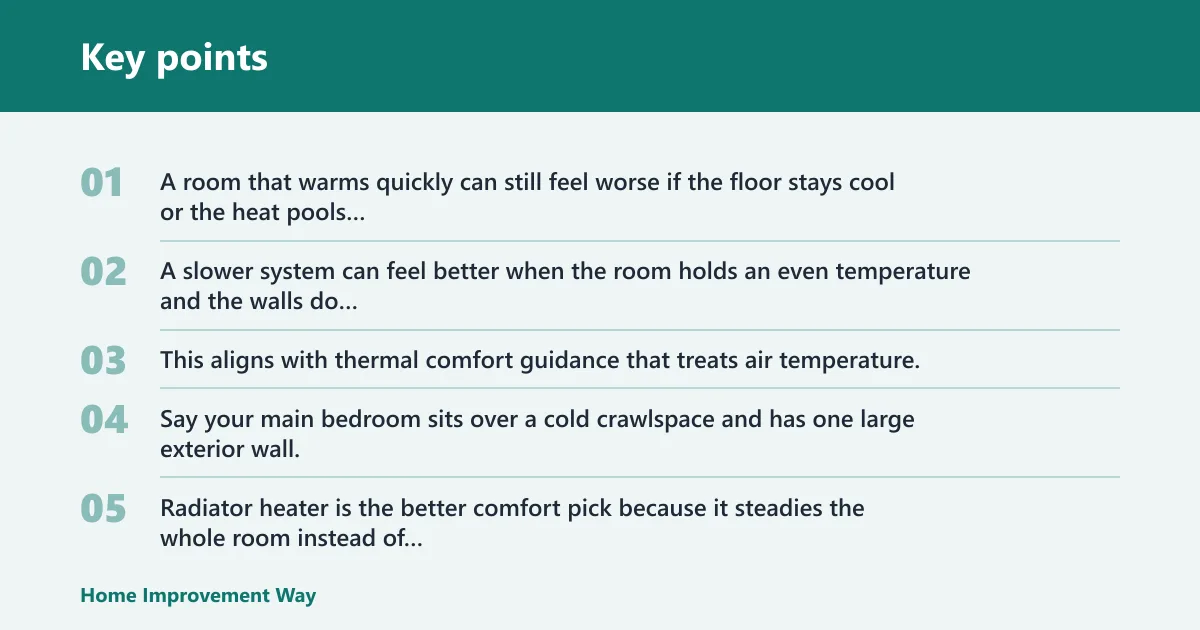
The table is about feel, not raw output. A room that warms quickly can still feel worse if the floor stays cool or the heat pools near one wall. A slower system can feel better when the room holds an even temperature and the walls do not radiate chill back at you. This aligns with thermal comfort guidance that treats air temperature, radiant temperature, air speed, and stratification as separate comfort inputs rather than one combined number.
Short recommendation by scenario
Say your main bedroom sits over a cold crawlspace and has one large exterior wall. Radiator heater is the better comfort pick because it steadies the whole room instead of creating a warm strip along the baseboard.
Suppose a small office needs heat fast between work hours, and wall space is already occupied by a desk and bookcase. Baseboard heat may be the more practical comfort choice because it can fit a wall run that would be difficult for a radiator.
Which feels more even?
Radiator heater can feel more even in many rooms because it warms nearby surfaces through thermal radiation while also warming air around the unit. Baseboard heat depends more on natural convection, so its comfort depends on air rising freely from the unit and spreading through the room without blockage.
Why radiators feel steadier across a room
Heat from a radiator reaches the surfaces you notice first: nearby walls, furniture faces, and your body. That matters in rooms with exterior glass or cold corners, because the room is not only heating air; it is also reducing the chill that comes off the surfaces around you. Manufacturer guidance also emphasizes keeping radiators unobstructed so the surrounding surfaces can warm properly.
Why baseboard heat depends on clear airflow
Hydronic baseboard heat and electric baseboard heaters both need an open path for air to move. The unit warms air low on the wall, and that air rises naturally. If the path is crowded, the room can show hot-and-cool layers, especially near the floor and far from the unit. Electric baseboards are often straightforward resistance heaters, but their comfort still depends on placement, room load, and airflow.
Drafts, cold walls, and ankle-level comfort
A common complaint in older rooms is cold air slipping down the window area and pooling low. Radiator heater tends to do better there because the warming effect is less tied to a single stream of rising air. Baseboard heat can still work well, but only when placement and airflow are right. CIBSE guidance similarly notes that perceived comfort drops when occupants are exposed to cold surfaces or asymmetric radiant conditions even if room air temperature looks acceptable.
Which is quieter and steadier?
Radiator heater and baseboard heat can both be quiet, but radiators often feel steadier. Cast-iron radiators hold heat longer after the boiler shuts off, which smooths the temperature curve. Baseboard heat can respond more quickly in some systems, so it may cycle more noticeably in rooms with frequent setbacks.
Fan-free operation and sound from piping expansion
Both systems are typically fan-free, so they avoid blower noise. The sound you may notice instead is water movement, piping expansion, or the click of controls. Steam radiator systems can be louder than hot-water radiators because steam and condensate movement create more distinct cycling sounds. Manufacturer documentation for steam systems commonly notes that venting and pitch affect noise and distribution, while hot-water systems usually run more quietly when properly balanced.
Cast-iron radiators versus fin-tube baseboards
Cast-iron radiators are heavy metal units with a lot of thermal mass. That mass helps them hold comfort longer, which can reduce the start-stop feeling people notice with lighter emitters. Hydronic baseboard heaters usually have less stored heat, so they follow thermostat changes more quickly. The tradeoff is that quick response can feel less smooth when the room load changes often.
Thermostat cycling, setbacks, and recovery behavior
Fast recovery is not always more comfortable. A room that drops a few degrees and then rebounds sharply can feel uneven during the cycle. Radiator heat often handles setbacks more calmly, while baseboard heat may be better when you want the room to warm quickly after an unoccupied period.
Do baseboards make a room feel dry?
Baseboard heaters do not remove moisture from the air the way a dehumidifier does. Still, they can feel dry because they warm the air close to the wall and raise temperature quickly, which can make a room feel less humid even when actual humidity has not changed much. Radiator heat often feels less drying because it relies more on radiant warmth and less on strong air movement.
Electric baseboard versus hydronic baseboard feel
Electric baseboard heater uses electrical resistance coils and usually gives a fast warm-up. That quick response can feel crisp, but it also makes hot-and-cool swings more noticeable if the thermostat cycles often. Hydronic baseboard heat usually feels gentler because the boiler and water mass smooth the temperature change.
When radiant heat feels less drying
Radiant heat can feel easier on the room because it warms people and surfaces directly. That can reduce the sense that dry air is blowing across you. It does not add humidity, but it often feels less harsh than a convection-heavy setup in a bedroom or living room.
Choose Radiator heater if… / Choose baseboard heat if…
Choose Radiator heater if you want steadier comfort in a bedroom, a corner room, or a room with cold exterior walls. Choose baseboard heat if you need a quicker response, have limited wall space, or are planning a retrofit where the piping and control layout already favor wall-mounted emitters.
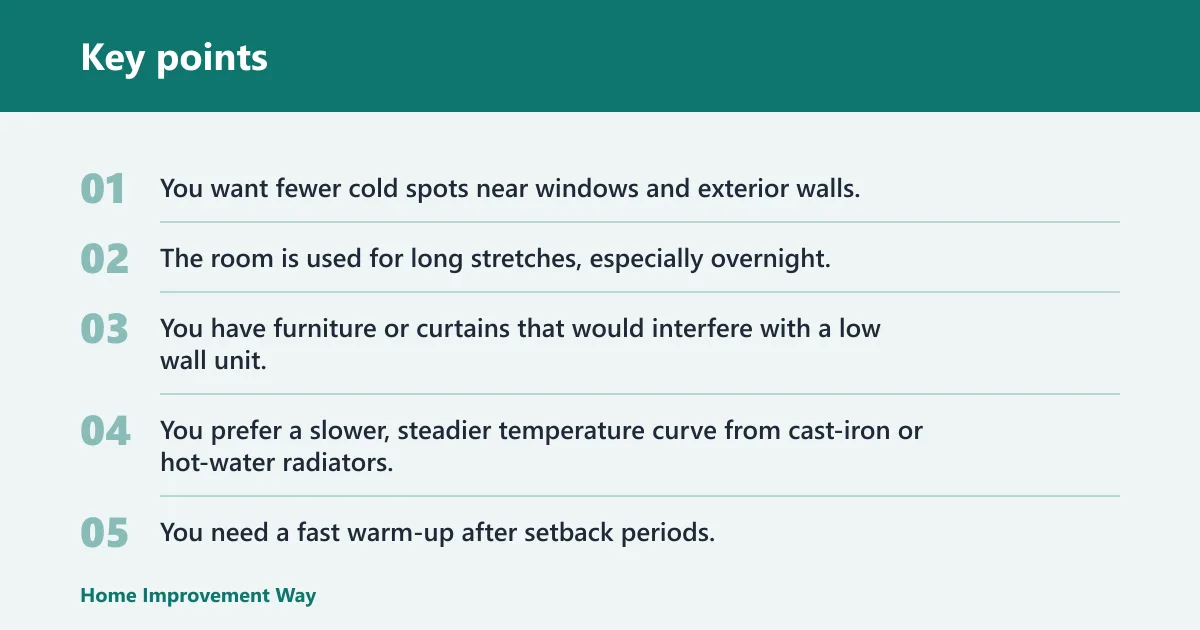
Choose Radiator heater if…
- You want fewer cold spots near windows and exterior walls.
- The room is used for long stretches, especially overnight.
- You have furniture or curtains that would interfere with a low wall unit.
- You prefer a slower, steadier temperature curve from cast-iron or hot-water radiators.
Choose baseboard heat if…
- You need a fast warm-up after setback periods.
- The room has little wall space for a radiator.
- You are doing a retrofit and want an easier fit with existing wall runs.
- You can keep the unit clear so natural convection can move air freely.
When thermostatic radiator valves improve comfort
Thermostatic radiator valves or thermostatic heads help match room temperature to use. They are useful when one bedroom runs warmer than the hall or when a sunny room needs less heat than a shaded one. They improve comfort most when the boiler and piping are already sized and balanced well. Manufacturer guidance for TRVs and hydronic balancing commonly notes that they are most effective when the system has stable supply temperatures and properly adjusted flow, rather than oversized equipment or poor circulation.
- Check where cold air enters the room, especially at windows and exterior walls.
- Look at wall space, furniture placement, and curtain length before choosing an emitter.
- Decide whether you care more about quick recovery or steady overnight comfort.
- For a hydronic system, confirm that the boiler, piping, and control layout can support the room you are renovating.
- If you want room-by-room control, plan for thermostatic radiator valves, zone controls, or a separate thermostat location that reads the room correctly.
Many homeowners compare them when renovating older homes because the comfort outcome changes with layout as much as with equipment. A room with lots of exterior glass and no clear wall space usually pushes the choice one way. A simple zone retrofit with short wall runs can push it the other way.
Radiator heater is usually the better comfort choice overall, but baseboard heat can be the better practical choice in a tight retrofit. The right answer is the one that matches the room’s draft pattern, wall space, and control needs.


Frequently asked questions
Is a radiator heater more comfortable than baseboard heat?
Usually yes. Radiator heater often feels more comfortable because it can reduce the cold-wall effect you notice near windows and exterior walls. Baseboard heat can feel fine, but its comfort depends more on clear airflow and unit placement.
Which gives more even heat, radiators or baseboard heaters?
Radiators often give more even heat in real rooms. They combine radiant heat with natural air circulation, so the room feels less tied to one wall. Baseboard heaters warm air from the bottom edge of the wall, which can create stronger temperature layering if airflow is blocked.
Do baseboard heaters make a room feel dry?
They can feel dry, but they do not actually remove moisture from the air. The dry feeling usually comes from rapid air warming and stronger convection, which can make the room seem less humid. Hydronic baseboard heat often feels gentler than electric baseboard heat.
Which is quieter, radiator heat or baseboard heat?
Both are usually quiet because they do not use fans. Radiator heat can still make some expansion and water-flow sounds, and steam systems can be more noticeable during cycling. Baseboard heat is also quiet, but electric units may cycle more often and feel less steady.
Can furniture block baseboard heat?
Yes. Baseboard heat needs clear air movement along the wall, so sofas, long drapes, storage bins, or tight built-ins can weaken performance and comfort. That blockage can leave the far side of the room cooler and make the thermostat call for more heat than the room really needs.
Can you replace baseboard heaters with radiators?
Sometimes, but the path depends on whether you mean electric baseboard heaters or hydronic baseboard heaters. An electric baseboard is a different retrofit from a hydronic one. If the system is hydronic, you need to account for piping routes, boiler capacity, balancing, and where the new radiator will sit in the room. If the system is electric, the retrofit is a different project entirely. In many homes, the better choice is to improve the existing emitter layout rather than replace everything at once.
Sources
- U.S. Department of Energy, Energy Saver: guidance on baseboard heaters, electric resistance heat, and efficient home heating choices.
- ASHRAE thermal comfort guidance: comfort depends on air temperature, mean radiant temperature, air speed, humidity, and draft/asymmetry effects.
- CIBSE comfort guidance: radiant asymmetry, draughts, and temperature stratification are major comfort factors in occupied rooms.
- Manufacturer documentation for steam and hot-water radiators: steam behavior, venting, pitch, and condensate return affect warm-up and sound.
- Manufacturer documentation on thermostatic radiator valves, balancing, and clearances around radiators and baseboards.
Sponsored / affiliate links. As an Amazon Associate I earn from qualifying purchases. I may earn additional commission from eligible campaigns.