Convector heater vs radiant heater for bedrooms guide
For bedrooms, choose a convector heater for steady, all-night room heat; choose a radiant heater for fast heat before bed, aimed at the bed or chair. Pick the wrong type and the room can stay cold, waste power, or swing between hot and cold spots overnight. This guide compares comfort, room size, noise, and overnight use so you can choose the right heater for the room.
This guide is part of our Heater efficiency guide series.
| Decision factor | Convector heater | Radiant heater | Winner |
|---|---|---|---|
| Best bedroom use pattern | Steady whole-room warmth overnight | Fast, targeted warmth beside the bed or chair | Convector heater |
| Warm-up feel | Slower, but more even room heating | Feels fast because it heats you directly | Radiant heater |
| Sleep comfort | Good for stable air temperature with fewer hot spots | Can leave the room cooler while one area feels hot | Convector heater |
| Noise sensitivity | Often fanless or low-noise | Often quiet, but comfort can feel more uneven | Convector heater |
| Drafty bedroom | Better fit if you need air circulation and room-wide heating | Can warm the occupant while the room stays chilly | Convector heater |
| Spot warming | Less focused | Best for personal heating and line-of-sight warmth | Radiant heater |
Convector heater vs radiant heater for bedrooms: the short answer
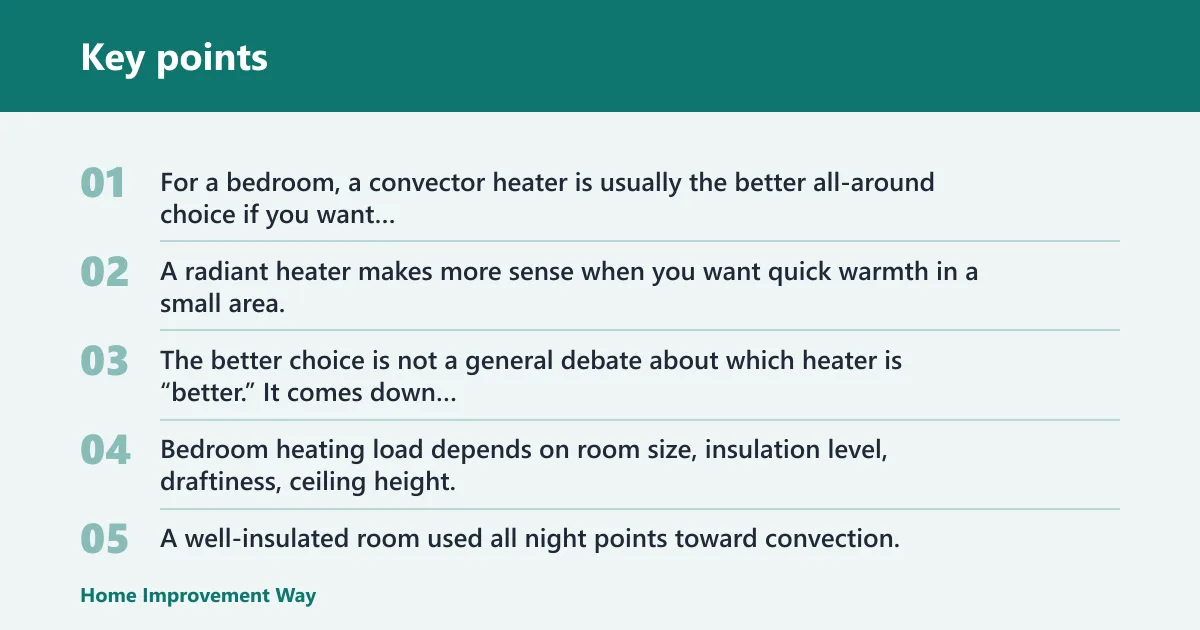
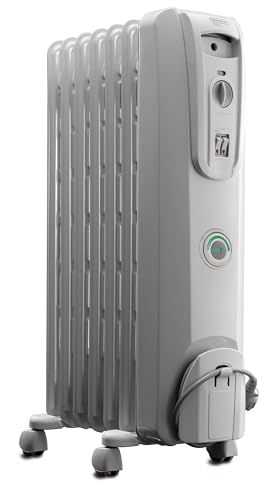

For a bedroom, a convector heater is usually the better all-around choice if you want steady, whole-room comfort through the night. A radiant heater makes more sense when you want quick warmth in a small area, such as beside the bed before sleep or near a chair for short use.
The better choice is not a general debate about which heater is “better.” It comes down to one question: do you need background heat that stays even, or direct heat that feels immediate but may leave the rest of the room cold?
What bedroom use pattern should drive the choice
Bedroom heating load depends on room size, insulation level, draftiness, ceiling height, occupancy time, and target temperature. A well-insulated room used all night points toward convection. A short pre-bed session in a compact room points toward radiant heat.
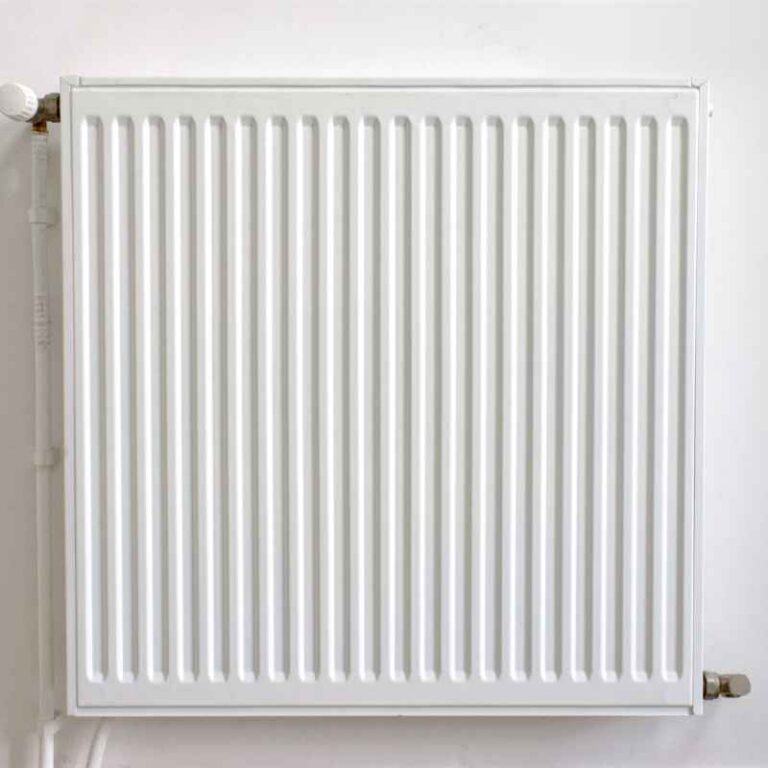
Panel heaters matter here too. A panel heater is an electric convection heater for residential and small commercial settings, and it is often used with another primary or central heating system. It is also often mistaken for an electric radiator.
📊 HeaterSphere lists infrared radiant quartz tower heater settings of 750 W and 1500 W. Source: Convection vs. Radiant Heaters: Which Is Right for You?.
How do convector and radiant heaters work?
A convector heater heats air through convection currents, then moves that warmed air through the room. A radiant heater heats people and objects directly. At the same wattage, both use the same electricity; the difference is how the heat reaches you. (en.wikipedia.org)
Convector heater: air circulation and room-wide heat
Convector heaters work best when air can move freely around them. Beacon Morris says convectors take up very little space, and Beacon Morris also notes that convectors distribute heat more efficiently than traditional radiators.
That makes them a practical match for a bedroom you want to keep comfortable for hours. They are not trying to warm only the skin or bedding nearby. They are trying to bring the room air up to a steadier temperature.
Radiant heater: direct heat to people and objects
Radiant heaters send heat straight to objects and people in front of them, often through quartz or infrared-style elements. HeaterSphere says radiant heaters heat small areas quickly, not whole rooms. That helps when you want your side of the bed warm without waiting for the entire room.
Infrared quartz heaters are a common example. HeaterSphere lists infrared radiant quartz tower heater settings of 750 W and 1500 W, and notes a portable radiant example weighs 5 lbs. They are compact, quick-acting, and aimed at personal heating.
Why line of sight matters for radiant heat
Radiant heat depends on line of sight. If the heater cannot “see” the bed, chair, or occupant, the warmth drops off fast. That makes placement more important than with a convector, which relies on air movement instead of direct exposure.
A common first-timer mistake is aiming a radiant heater at the foot of the bed and expecting the whole room to feel warmer. Instead, the feet may feel hot while the rest of the room stays cold.
Which heater is better for sleep and noise?
For sleep, a convector heater is usually the safer bet because it tends to keep room temperature steadier with less hot-and-cold contrast. Radiant heaters can feel quiet, but they can also create a strong warm zone that does not spread far enough for comfortable overnight use.
Fan noise, cycling noise, and bedroom disturbance
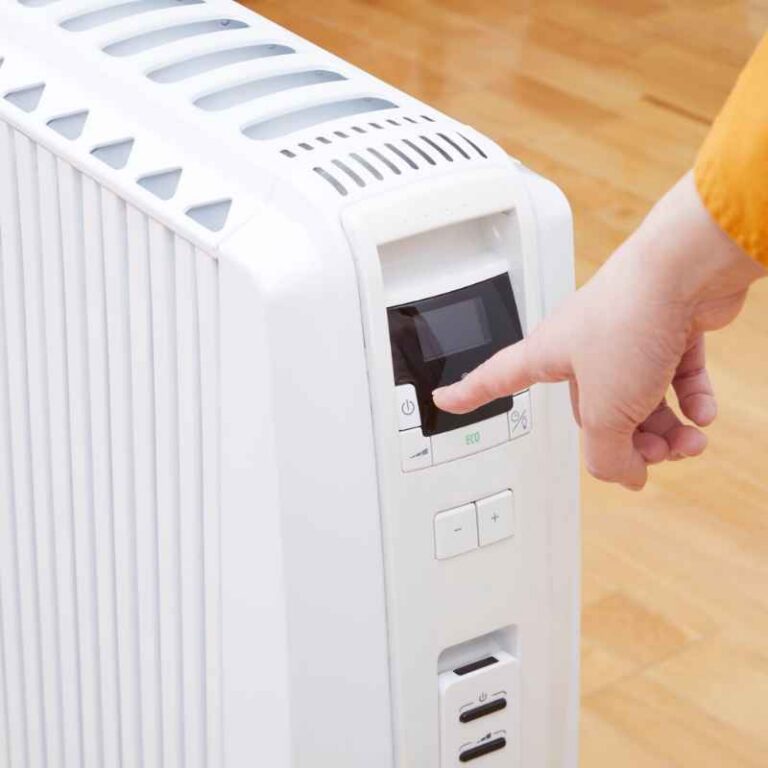
Noise matters more at night than during the day. Fanless convectors and oil-filled radiators are usually quiet, and modern fan heaters can have variable-speed fans that work separately from the heating element. That means some units can cut fan noise after the room reaches temperature.
Radiant heaters are often quiet too, but quiet does not always mean sleep-friendly. If the heater warms only one side of the bed or one chair, the room can feel uneven even without any fan sound.
Why fanless convectors and oil-filled radiators appeal to light sleepers
Oil-filled radiators combine radiant surface warmth with some convection, and they may warm more slowly. That slower response is not a problem for sleep if the goal is steady overnight warmth. The tradeoff is that they are less useful when you need heat right away.
For light sleepers, the best result is usually a unit that keeps temperature stable without frequent switching or fan bursts. A quiet convector or oil-filled radiator often fits that pattern better than a focused radiant heater.
When radiant heat feels quiet but uneven
Radiant heat can feel silent because there is little or no fan sound. But if the heater is too directional for the room size, the sleeper may feel one side of the body warmed while the air around the bed stays cool. That can be less restful than gentle whole-room heat.
Which heater warms a bedroom faster?
Radiant heaters usually feel faster because they heat people and objects directly. Convector heaters take longer to change the room air, but they usually spread heat more evenly. In a bedroom, speed and coverage are not the same thing.
Fast pre-bed warmth from radiant heaters
If you only want the bed area warm for 10 to 20 minutes before sleep, radiant heat has the advantage. It gives immediate comfort in line of sight, which is why it is common for personal heating. HeaterSphere says radiant heaters heat small areas quickly, and that is exactly the strength here.
Why convectors feel slower but spread heat more evenly
A convector heater often feels less dramatic in the first few minutes. That does not mean it is weak. It means the heat is being moved into the room air instead of beaming straight at you.
Suppose you have a 12-by-14-foot bedroom with the door closed and moderate insulation. A convector can steadily lift the room to a comfortable overnight temperature, while a radiant heater may make the person in bed feel warm long before the corners of the room do.
When a drafty room changes the answer
Draftiness changes everything. In a leaky bedroom, radiant heat can warm the occupant while the cold air keeps spilling in around the room. A convector has a better chance of making the space feel comfortable overall, though it may still struggle if the room is poorly sealed.
Safety and placement rules for bedrooms
Both heater types need careful placement, clearances, and stable support. Safety features like tip-over shutoff and overheat shutoff matter for both. Cool-touch housing is helpful, but it does not replace clearance from bedding, curtains, or furniture.
Tip-over shutoff, overheat shutoff, and cool-touch housings
A bedroom heater should sit on a stable surface and include the safety features the manufacturer specifies. Portable heaters should not be left unattended unless rated for it. That warning applies to both convector and radiant units.
Do not place any heater near loose bedding or drapery. A cool exterior is helpful, but it does not make a heater safe to touch or safe to crowd.
Clearance from bedding, curtains, and furniture
Radiant heaters need an open path to the person or surface being heated. Convector heaters need clear air circulation. If either type is blocked by furniture or fabric, performance drops and risk rises.
- Keep the heater away from bedding and curtains.
- Do not cover vents or air openings on convector units.
- Keep radiant heaters aimed only at the occupied area you intend to warm.
- Leave the clearances listed by the manufacturer on every side that matters.
Airflow clearance for convectors and line of sight for radiant heaters
Convector heaters work best when air can enter and leave the unit freely. That is why panel heaters are often mounted or placed where curtains and furniture will not block them. Radiant heaters, by contrast, need line of sight to the bed or chair.
Do not use a line-of-sight heater for a sleeping position outside the beam. If the occupant is not in the radiant path, the heater may run harder without making the bed comfortable.
Bedroom size, insulation, and wattage: what to choose
Room size and insulation usually matter more than the heater label. A small, well-insulated bedroom can work with lower wattage. A larger or draftier room often needs more output, and that usually means more electricity use per hour because wattage is the driver.
How room size and draftiness change the pick
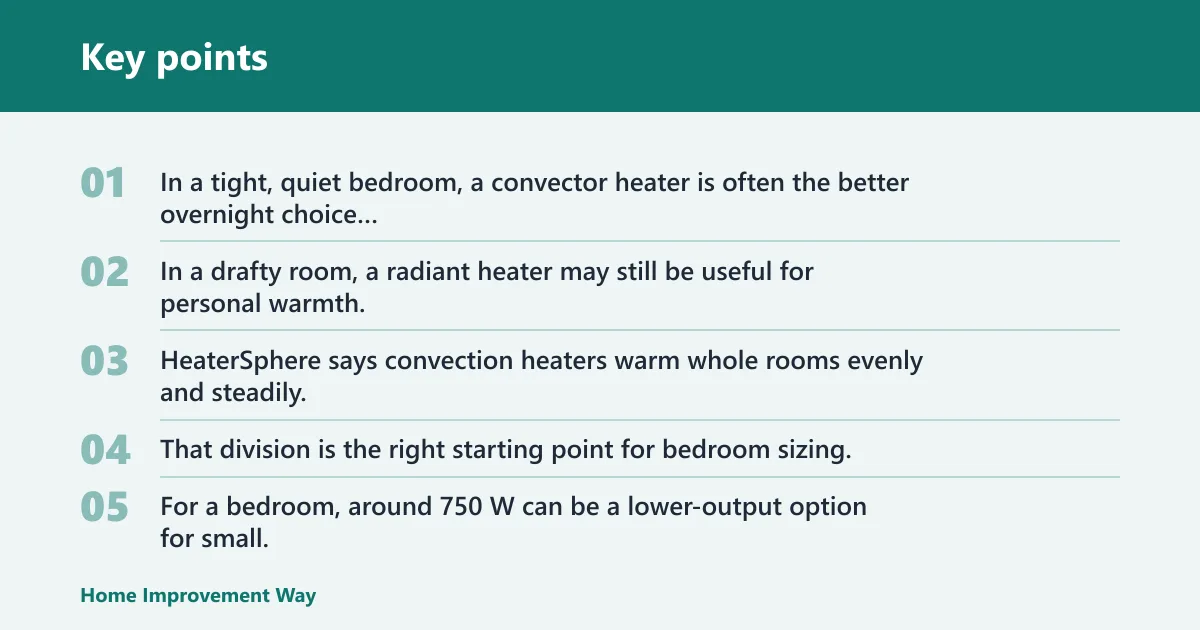
In a tight, quiet bedroom, a convector heater is often the better overnight choice because it can hold a steadier background temperature. In a drafty room, a radiant heater may still be useful for personal warmth, but it will not fix the room’s heat loss.
HeaterSphere says convection heaters warm whole rooms evenly and steadily, while radiant heaters heat small areas quickly. That division is the right starting point for bedroom sizing.
750 W, 1000 W, and 1500 W: what each wattage means
For a bedroom, around 750 W can be a lower-output option for small, well-insulated spaces or short personal use. Around 1000 W can be a middle-ground choice for modest rooms or gentler overnight heating. Around 1500 W is often the upper end for portable room heaters, and it can be a better pick when the room is larger, colder, or more drafty.
Higher wattage can heat a bedroom faster, but it also uses more electricity per hour. At the same wattage, running cost is the same for convector and radiant heaters. Wattage and runtime decide the bill, not the heater type alone.
Same wattage, same electricity use
HeaterSphere says the running cost is the same at the same wattage. That is the key point to remember when comparing a convector heater with a radiant heater. The comfort pattern changes, but the energy draw at a given wattage does not.
If a 1500 W radiant heater runs for the same time as a 1500 W convector heater, the electricity use is the same. The difference is that one may heat the person faster while the other may spread warmth through the room more evenly.
Bedroom heater decision matrix
This matrix scores the two heater types against the factors that matter in a bedroom: room size, insulation, noise sensitivity, overnight use, preheat time, and draftiness. Use it as a practical filter, not as a universal rule.
| Factor | Convector heater | Radiant heater | Winner |
|---|---|---|---|
| Small, well-insulated bedroom | Works well for steady room comfort | Works well for quick personal warmth | Tie |
| Drafty or leaky bedroom | Better chance of lifting room comfort | May warm the person but not the room | Convector heater |
| Noise-sensitive sleeper | Often fanless or low-noise | Can also be quiet, but may feel uneven | Convector heater |
| Short pre-bed use | Slower to feel warm | Fast direct warmth in line of sight | Radiant heater |
| Overnight use | Better for stable background warmth | Less suited to heating the whole room | Convector heater |
| Bedside spot heating | Less targeted | Best fit for focused warmth | Radiant heater |
Simple runtime checklist for 750 W, 1000 W, and 1500 W models
Use wattage as a runtime guide, then match it to the room’s condition. A higher wattage is better when you need faster warm-up or the room is larger. A lower wattage makes more sense when the bedroom is small and the heat demand is modest.
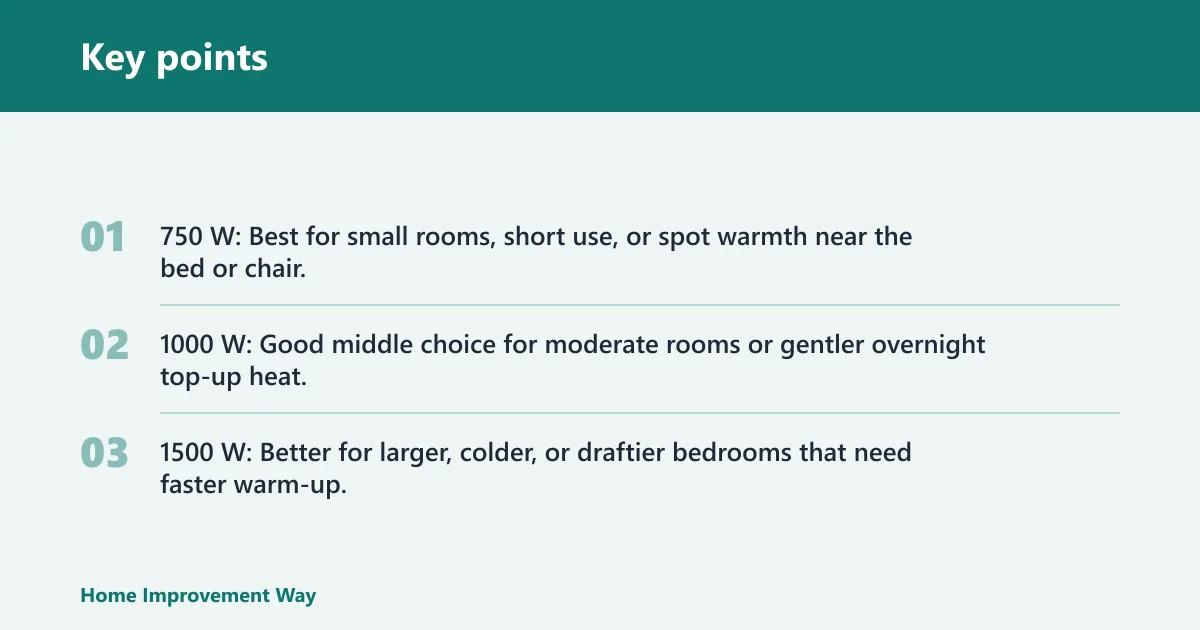
- 750 W: Best for small rooms, short use, or spot warmth near the bed or chair.
- 1000 W: Good middle choice for moderate rooms or gentler overnight top-up heat.
- 1500 W: Better for larger, colder, or draftier bedrooms that need faster warm-up.
When the matrix points to a panel heater, oil-filled radiator, or infrared quartz heater
If you want steady whole-room comfort and low visual bulk, a panel heater is a sensible convector-style option. If you want quieter, slower, fanless heat that feels less harsh, an oil-filled radiator is worth a look. If you want quick, focused warmth for a small room or personal spot, an infrared quartz heater is the most direct fit.
Choose convector heater if… / Choose radiant heater if…
Choose a convector heater if you want all-night, whole-room comfort, especially in a bedroom that is medium-sized, drafty, or used for long sleep periods. Choose a radiant heater if you want fast, targeted warmth near the bed or chair and only need heat for short periods before sleep or while sitting still.
Choose a convector heater if…
- You want steady overnight warmth across the room.
- The bedroom is medium to large, or has noticeable drafts.
- You are sensitive to hot-and-cold swings while sleeping.
- You prefer a fanless or low-noise heating pattern.
Choose a radiant heater if…
- You need fast pre-bed warmth at the bed or chair.
- The bedroom is small and you sit or lie within the heater’s line of sight.
- You want personal heat more than full-room heat.
- You need a quick warm-up window and will not rely on it to heat the entire room.
When neither type is ideal for the bedroom
If the room is very large, very drafty, or poorly insulated, either portable heater may struggle. In that case, the better fix is usually the room envelope or the main heating system, not a different small heater style. Portable heat works best as a supplement, not as a fix for a cold room.
Frequently asked questions
Convector heater vs radiant heater: which is better for bedrooms?
For most bedrooms, a convector heater is the better fit because it gives steadier whole-room warmth overnight. A radiant heater is better when you want fast, targeted heat near the bed or chair. The best choice depends on whether you need room comfort or personal spot warmth.
Are convector heaters better than radiant heaters for sleep?
Usually yes, if your goal is stable overnight comfort. Convector heaters warm the room more evenly, which can reduce the hot-and-cold feeling that disrupts sleep. Radiant heaters can be fine for brief pre-sleep use, but they are less useful when you need the whole room to stay warm.
Do radiant heaters warm a bedroom faster than convector heaters?
Yes, they usually feel faster because they heat people and objects directly. That does not mean they warm the whole bedroom faster. Convector heaters are slower to feel but do a better job of spreading warmth through the room air.
Which heater is quieter for a bedroom, convector or radiant?
Many convector heaters are fanless or low-noise, and that often makes them a better sleep choice. Radiant heaters can also be quiet, especially if they do not use a fan. Noise is only part of the issue, though; even a silent radiant heater can feel uneven in a bedroom.
Are convector heaters safer for bedrooms than radiant heaters?
Neither type is automatically safer. Both need tip-over shutoff, overheat protection, correct clearance, and stable placement away from bedding and curtains. Safety depends more on the specific model and how you place it than on whether it is convector or radiant.
What size heater do I need for a bedroom?
Match the heater to room size, insulation, draftiness, and how long you will use it. A 750 W model suits smaller or short-use situations, 1000 W is a middle-ground choice, and 1500 W is better for larger or colder bedrooms. Higher wattage heats faster but uses more electricity per hour.
Sponsored / affiliate links. As an Amazon Associate I earn from qualifying purchases. I may earn additional commission from eligible campaigns.