Infrared Heater vs Panel Heater: Which Fits a Drafty Room?
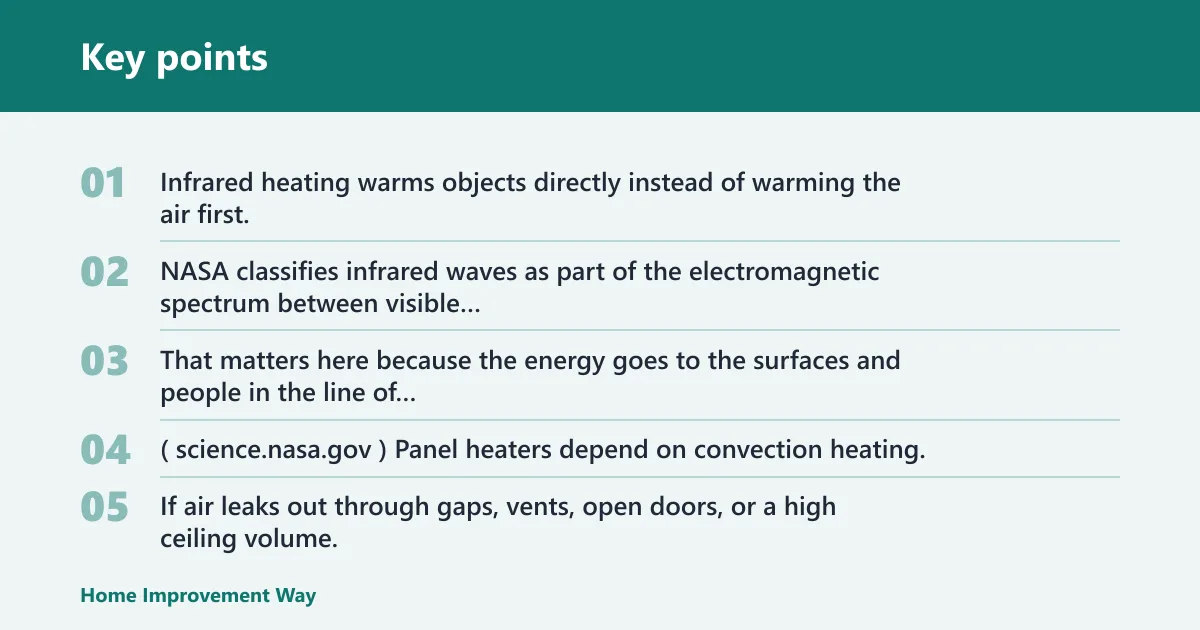
For a drafty room, choose an Infrared heater if you want heat aimed at people and objects; choose a panel heater only if the room can hold warm air well enough for air heating to matter. Pick the wrong type and you waste energy while the room still feels cold. This guide explains the difference, where each heater works best, and how to match the heater to a leaky room.
This guide is part of our Heater efficiency guide series.
Heat delivery and Draft tolerance
The trade-off is straightforward: an Infrared heater sends heat to people and surfaces first, while a panel heater sends heat into the air first. In a room that loses warmth quickly, direct radiant comfort usually holds up better than air heating. In a room that keeps heat, panel heat can feel more even over time.
| Decision factor | Infrared heater | panel heater | Winner |
|---|---|---|---|
| Heat delivery | Radiant heat reaches people and surfaces directly | Heats room air first, then warms occupants | Infrared heater |
| Draft tolerance | Less dependent on air retention | Performance drops when warm air escapes | Infrared heater |
| Best room type | Open, semi-open, or leaky rooms | Enclosed, well-insulated rooms | Depends on room |
| Comfort over long periods | Good for direct warmth, weaker for whole-room air warming | Stronger for steady whole-room comfort | panel heater |
| Response time | Instant or near-instant feel | Slower because the air must warm first | Infrared heater |
Heat delivery
Infrared heating warms objects directly instead of warming the air first, which is why it feels fast. NASA classifies infrared waves as part of the electromagnetic spectrum between visible light and microwaves, and infrared itself is generally understood to span roughly 780 nm to 1 mm. That matters here because the energy goes to the surfaces and people in the line of effect, not to the whole room volume first. (NASA)
Draft tolerance
Panel heaters depend on convection heating, so they need the warmed air to stay in the room long enough to make a difference. If air leaks out through gaps, vents, open doors, or a high ceiling volume, the heat disappears before the room feels stable. Infrared output is less exposed to that loss pattern.
Best room type
Open, semi-open, and drafty rooms favor radiant heating because the comfort zone is the person or task area, not the entire air mass. Enclosed rooms with decent insulation favor panel heat because the warmed air can build up. That split is the best starting point before you look at wattage or controls.
Comfort over long periods
Panel heat wins when the goal is steady, whole-room comfort for long stretches. Infrared can feel excellent at the seating area or workbench, but it can fall short if you need the whole room air temperature to rise and stay there for hours. That is the main failure case to watch.
Response time
Short-wave infrared is known for instant-on response, which makes it useful for quick spot heating and drying. Medium-wave versions are available in standard and fast-response configurations. Long-wave infrared, often used in ceramic-style comfort heaters, runs at lower surface temperature and gives gentler output.
What a drafty room changes
A drafty room changes the heater choice because air leakage is not a small penalty. It directly weakens convection heating, and it can change running cost more than the heater type alone if the room cannot keep warm air inside. The leakier the room, the less likely panel heat is to pay off.
Why air leakage matters
Convection heating works best in sealed spaces because it heats the air that stays put. When heat escapes through gaps, vents, or repeated door opening, the heater keeps replacing lost warm air instead of building comfort. That raises runtime and often leaves the room feeling uneven.
Why ceiling height and open doors matter
High ceilings increase the air volume that must be warmed, and open doors create a direct escape path. A leaky room with a tall ceiling is especially hard for a panel heater because hot air rises and spreads into a larger space before occupants feel stable comfort. Radiant heat is less sensitive to that problem.
Say your home office is about 10 by 12 feet, but the door opens to a hallway every few minutes. A panel heater may keep the air from settling, while an infrared unit can make the desk area comfortable without waiting for the whole room to stabilize.
How infrared heat behaves in leaky spaces
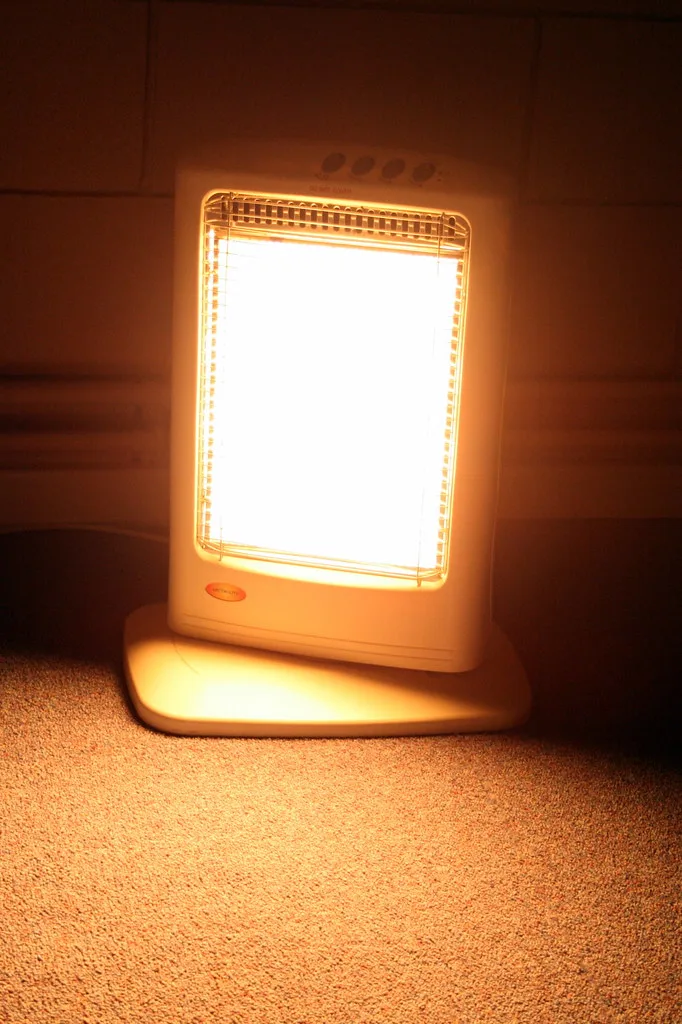
Infrared heat works well in leaky spaces because it warms people and objects directly, so comfort does not depend on holding a big pocket of warm air. That makes it a better fit for open, semi-open, or drafty rooms, especially when you need heat fast and only in a specific zone. It is less suitable when the goal is to warm the whole room air for long periods.
Long-wave, medium-wave, and short-wave differences
Long-wave infrared and far-infrared options usually run at lower surface temperatures and are used for gentler comfort heating. Medium-wave lamps sit between comfort and speed, and some are built for standard or fast response. Short-wave infrared gives high-intensity output with near-instant response, which is why it is common in industrial spot-heating and drying.
Where infrared underperforms
Infrared can be less suitable in a room that needs steady air warming, such as a bedroom that needs to stay evenly warm all night. It can also feel one-sided if the person moves out of the radiation path. In those cases, the air may still feel cool even though the occupied zone feels better.
How panel heat behaves in leaky spaces
Panel heaters are convection-based or radiant-convection hybrid room heaters, so they usually work best in enclosed, well-insulated rooms. They warm air first, then the room. If the warmed air keeps escaping, their efficiency falls because the heater keeps chasing a moving target.
Where panel heaters fit best
Panel heat fits a bedroom, small study, or closed sitting room that can hold temperature between cycles. It also suits continuous, all-day heating in sealed occupied rooms, where the warmed air has time to build and stay stable. In that setting, the room can feel evenly comfortable rather than locally warm.
Suppose a basement office has insulated walls, a door that stays shut, and only light drafts around the trim. A panel heater can make sense there because the room holds heat long enough for air warming to build instead of leaking away immediately.
Will a panel heater keep working efficiently if heat keeps escaping?
Not usually. It may still heat, but the room keeps paying the leakage penalty, so the heater spends more time replacing lost warmth than raising comfort. That makes efficiency drop, and it can also make the room feel colder than the thermostat suggests.
Heater decision matrix
Use this matrix to turn room traits into a heater choice. Score each line, then follow the recommendation that appears most often. If your room splits the scores, favor the factor tied to the way you actually use the space.
| Room trait | Score 1 | Score 2 | Score 3 | Infrared heater recommendation | panel heater recommendation |
|---|---|---|---|---|---|
| Draft level | Frequent drafts, open door, or obvious leaks | Some drafts, but not constant | Mostly sealed room | Score 1-2: choose infrared; Score 3: less of an edge | Score 3: choose panel; Score 1-2: weak fit |
| Insulation | Poor insulation or thin boundaries | Average insulation | Good insulation | Score 1-2: choose infrared | Score 3: choose panel |
| Ceiling height | High ceiling or large air volume | Moderate ceiling height | Standard low ceiling | Score 1: choose infrared | Score 3: stronger fit |
| Occupancy pattern | Short bursts, seated spot use, intermittent occupancy | Mixed use | Long, steady occupancy | Score 1-2: choose infrared | Score 3: choose panel |
| Heating goal | Warm people or a task area fast | Mixed comfort goals | Whole-room, steady air temperature | Score 1-2: choose infrared | Score 3: choose panel |
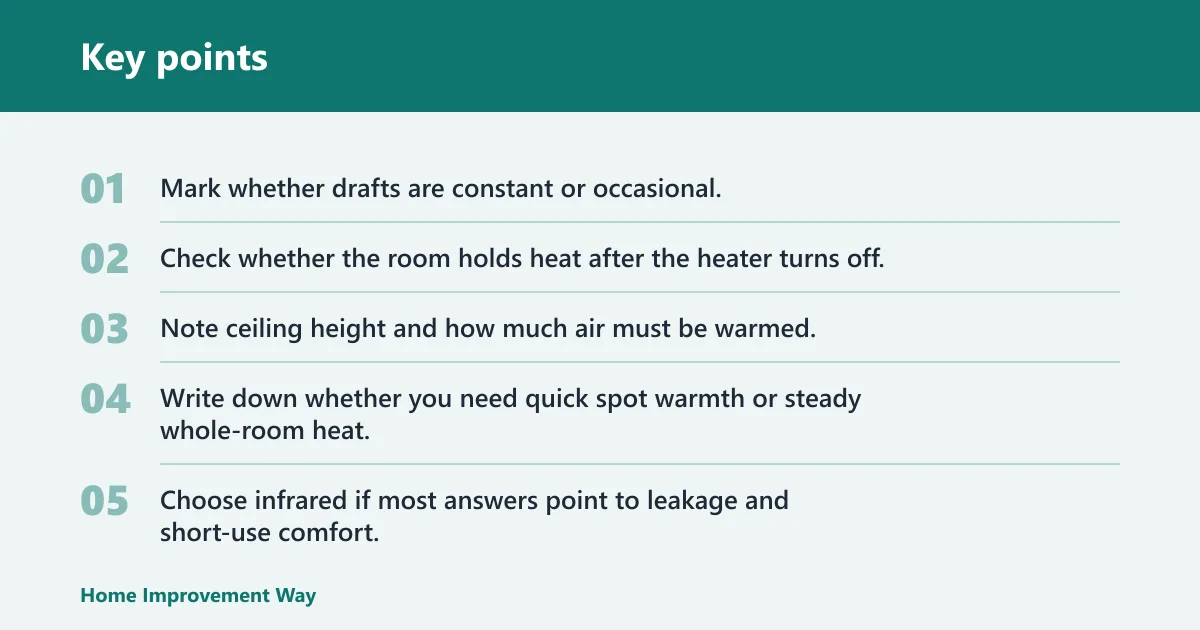
- Mark whether drafts are constant or occasional.
- Check whether the room holds heat after the heater turns off.
- Note ceiling height and how much air must be warmed.
- Write down whether you need quick spot warmth or steady whole-room heat.
- Choose infrared if most answers point to leakage and short-use comfort.
- Choose panel heat if most answers point to sealed-room, long-duration warmth.
Which is cheaper to run when air leaks?
In a leaky room, the cheaper choice is often the heater that delivers useful comfort with less dependence on warm air staying put. That can make infrared the lower-cost option for short bursts or spot use. For steady whole-room heating in a sealed room, panel heat can be the better fit because the air-heating approach has time to work.
Why leakage changes operating cost
Heat loss through air leakage can affect running costs more than heater type alone. If the room sheds heat quickly, a panel heater may cycle longer or run harder to keep up. Infrared can reduce wasted energy in that situation because it sends warmth to the occupied zone instead of trying to heat all escaping air.
When efficiency and comfort point to different answers
A heater can be efficient in one sense and still be the wrong comfort choice. Infrared may feel good quickly but not hold the whole room at a stable air temperature. Panel heat may feel more even, yet cost more in a drafty room because the heated air keeps leaving.
Choose Infrared heater if… / Choose panel heater if…
Choose Infrared heater if the room is open, semi-open, or leaky; if you need heat fast; if you sit in one zone for short periods; or if the ceiling is high and the air mass is hard to warm. Choose panel heater if the room is enclosed, well-insulated, used for long stretches, and able to keep warmed air inside long enough to matter.
Choose Infrared heater if…
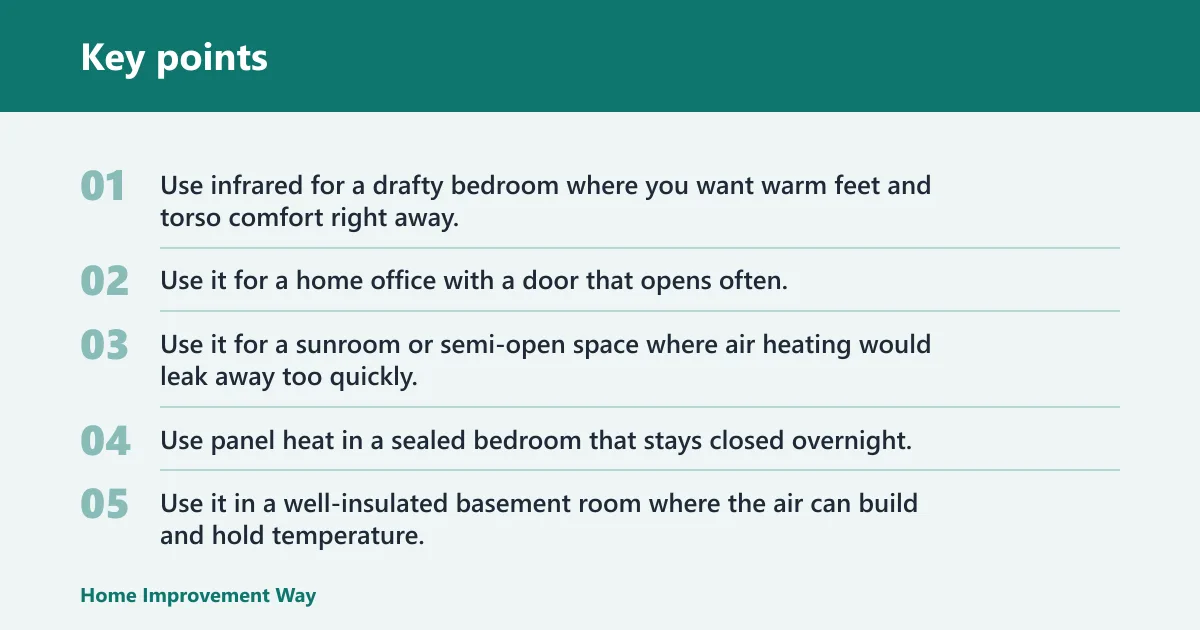
Use infrared for a drafty bedroom where you want warm feet and torso comfort right away, even if the room air stays only partly warm. Use it for a home office with a door that opens often. Use it for a sunroom or semi-open space where air heating would leak away too quickly.
Choose panel heater if…
Use panel heat in a sealed bedroom that stays closed overnight. Use it in a well-insulated basement room where the air can build and hold temperature. Use it when your real goal is steady whole-room comfort rather than a warm seat or desk area.


Frequently asked questions
Is an infrared heater better than a panel heater for a drafty room?
Usually, yes. A drafty room leaks the warm air a panel heater depends on, so radiant comfort from an infrared heater tends to hold up better. The more the room loses heat, the less advantage panel heating has. If the room is also used only in short bursts, infrared becomes an even stronger fit.
Do infrared heaters heat a room faster than panel heaters?
They usually feel faster because they warm people and surfaces directly. Fannon describes short-wave infrared lamps as having an instant-on response, and ScienceInsights says infrared heating can be faster than methods that warm air first. That does not mean the whole room air becomes warm faster.
Which heater is cheaper to run in a room with poor insulation?
It depends on how you use the room, but poor insulation usually hurts panel heat more because the warmed air escapes. If you need quick, targeted comfort, infrared can be the lower-cost choice. If you need the whole room warm for long periods, neither option is ideal in a leaky space.
Can a panel heater work well in a draughty bedroom?
Only if the drafts are mild and the bedroom still holds heat reasonably well. A panel heater can struggle when warm air leaks out through gaps or an open door. In a truly draughty bedroom, radiant heat often gives better comfort for the same effort.
Does infrared heat warm people or the air?
It warms people and objects directly. The air may warm a little after surfaces absorb and release that energy, but the main effect is radiant. That is why infrared feels useful in open or drafty spaces where heating the air alone would not last.
How do I choose heater type based on room insulation?
Start with the room shell, not the heater label. If the room is leaky, drafty, or open to other spaces, choose infrared. If the room is enclosed and insulated well enough to keep warm air inside, choose panel heat for steadier whole-room comfort.
Sponsored / affiliate links. As an Amazon Associate I earn from qualifying purchases. I may earn additional commission from eligible campaigns.