Baseboard Heater vs Mini-Split: Which Is More Efficient?
A mini-split often becomes the better choice once a room needs roughly 1,500 to 2,000 kWh of electric heat a year; below that, baseboard often remains the cheaper choice. Pick wrong, and you can lock in higher bills or pay for equipment that never earns back its install cost. Here’s how efficiency, operating cost, and payback compare room by room for one room or a small home.
| Decision factor | Baseboard heater | Mini-split | Winner |
|---|---|---|---|
| Upfront cost | Lower. Simple electrical install, room by room. | Higher. Outdoor compressor, indoor air handler, refrigerant work, and professional install. | Baseboard heater |
| Operating efficiency | COP 1.0; nearly all electricity becomes heat in the room. | COP commonly 3.0 to 4.0 or higher; heat pump moves heat instead of making it. | Mini-split |
| Cooling | No cooling capability. | Heats and cools individual rooms or zones. | Mini-split |
| Room-by-room fit | Strong for tiny, insulated, or rarely used rooms. | Strong for rooms used daily, larger rooms, and spaces that need both heating and cooling. | Tie |
| Cold-weather performance | Steady output as long as the circuit is sized correctly. | Modern cold-climate models work below freezing, but capacity and efficiency fall as outdoor temperature drops. | Tie |
Baseboard heater vs mini-split
The core trade-off is simple: electric baseboard heater systems cost less to install, while mini-split systems usually cost less to run. The right answer depends on room size, insulation, how many hours the room stays occupied, and your electricity rate.
A room that needs heat all day can justify a higher install price because the operating savings add up fast. A guest room used a few weekends a month usually cannot.
Upfront cost versus operating cost
Baseboard heater installs are usually simpler and cheaper because each zone only needs a thermostat and wiring sized for resistance heat. Mini-splits cost more because they add an outdoor compressor, an indoor air handler, and refrigerant lines.
That higher install cost only makes sense if the room will run enough hours for lower electric use to repay the gap. If electricity costs more per kilowatt-hour, the break-even point arrives sooner.
Why room use changes the answer
Zone heating matters for both systems, but the waste looks different. Baseboard heater zoning works well when you heat only the room you are in. Mini-splits save more when the room gets steady use, because their higher efficiency compounds over long run times.
Say your 120-square-foot guest room stays closed most of the month. Baseboard heat can be rational there, because the room may only need a few dozen heated hours. Say the same room becomes a daily office. The mini-split starts to look much better.
How do these heaters work?
Electric baseboard heaters use resistance heat. Electricity passes through heating elements, and nearly all of it becomes heat in the room. They are simple, cheap initially, and easy to install, but they do not cool.
Electric baseboard heat
Electric baseboard heaters rely on convection or hydronic heat, depending on the design, and each room can have its own thermostat. That makes them a straightforward form of zone heating. Their main limitation is operating cost, since they do not multiply the heat output from each kilowatt-hour.
Ductless mini-split heat pump
A ductless mini-split uses a heat pump with an outdoor compressor and an indoor air handler. It moves heat with refrigerant instead of generating heat with resistance, and it can heat and cool the same room or zone.
That is why mini-splits are typically more energy efficient than baseboard heaters, even though they cost more to install.
Which is more efficient?
Mini-splits are more efficient than baseboard heat because they move heat rather than create it. Baseboard heaters have a coefficient of performance of 1.0, while a modern mini split heat pump can achieve a COP of 3.0 to 4.0 or higher.
Seasonal ratings matter too. Mini-splits are often rated with HSPF for heating and SEER for cooling, and higher numbers point to better seasonal performance.
COP explained in plain terms
COP compares heat output to electricity input. A COP of 1.0 means 1 unit of electricity becomes about 1 unit of heat. A COP of 3.0 means the system delivers about 3 units of heat for the same electric input.
That gap is the reason a mini-split can lower the monthly bill even when the install is more expensive.
Why cold-climate models matter
Cold-climate mini-split models are built to keep working in low outdoor temperatures, and modern units can operate below freezing. That matters in winter regions where standard heat pumps used to lose capacity too quickly.
Even so, capacity and efficiency still fall as outdoor temperature drops. In very cold weather, a mini-split may still beat resistance heat on cost, but not by as much as it does in mild weather.
What does it cost to run?
Electricity rate and runtime drive the bill. A room that needs 1,000 kWh of heat in a season costs about 1,000 kWh with baseboard heat, because the COP is 1.0. The same heat load with a mini-split at a COP near 3.0 may use about one-third as much electricity.
At 12 cents per kWh, that gap trims the bill but may not move the payback date much. At 30 cents per kWh, the savings can shorten payback fast.
- Estimate how many hours the room will be heated in a month.
- Estimate the heat needed from room size, insulation, and weather.
- Multiply the electricity use by your local kWh rate.
- Compare that monthly savings against the extra install cost of the mini-split.
- Choose baseboard if the room will stay lightly used and the payback is too slow.
Baseboard heater vs mini-split decision table
| Scenario | Estimated runtime | Relative monthly cost | Comfort notes | Tipping point | Best pick |
|---|---|---|---|---|---|
| Small insulated bedroom | 4 to 6 hours a day in cold months | Baseboard: low to moderate; mini-split: lower | Either system can keep up if sized correctly. A mini-split may feel steadier, but a tiny room may not repay a big install quickly. | A mini-split starts to make sense if the room is used daily and the annual heat load is around 1,500 kWh or more. | Baseboard heater |
| Drafty basement | 8 to 16 hours a day in cold months | Baseboard: high; mini-split: medium | Baseboard can struggle because drafts keep pulling heat away. A mini-split may feel better if the basement is used often, but sizing and cold-weather output matter. | If the basement needs long daily runtimes and the electricity rate is high, mini-split savings can repay the install faster. | Mini-split |
| Occupied all-day living room | 10 to 18 hours a day | Baseboard: very high; mini-split: lower | This is the strongest case for a mini-split because the room stays in use and can also benefit from summer cooling. | At this runtime, the operating savings usually justify the higher upfront cost in a few heating seasons. | Mini-split |
| Guest room used occasionally | 20 to 60 hours a month | Baseboard: low; mini-split: lower, but not by enough to matter quickly | Baseboard is often the smarter buy because the room does not run long enough to pay back a higher install. | If the room becomes a home office or daily bedroom, the choice can flip. | Baseboard heater |
| Cold-climate addition | 6 to 12 hours a day, longer in severe weather | Baseboard: high; mini-split: lower in shoulder seasons, less so in deep cold | A cold-climate mini-split can work well, but capacity loss below freezing must be part of the sizing plan. | If the addition will be occupied most days and the install can be completed without major electrical upgrades, mini-split often pays back. | Mini-split |
Suppose a 150-square-foot bedroom in a well insulated house only needs evening heat. Baseboard may remain the better choice because the room does not rack up enough runtime to repay the larger install cost of a mini-split.
Now picture the same size room, but as a daily office in a drafty basement. The operating cost gap widens, and the mini-split has a much better shot at paying for itself.
When does payback make sense?
Payback makes sense when a room runs enough hours each year for mini-split savings to cover the extra install cost. In many homes, that happens somewhere around 1,500 to 2,000 kWh of electric heat a year for the room in question.
The exact break-even point changes with insulation, occupancy, climate zone, and electricity rate. Higher power prices shorten the payback period. More daily runtime does the same.
How install cost changes the break-even date
Baseboard heater systems may also look cheaper because they can avoid some electrical work in a small room. A mini-split retrofit can require a dedicated circuit, outdoor placement, and professional installation.
That extra cost matters. If you need several heated rooms, the hidden cost of adding electrical capacity for multiple baseboard zones can also shrink the gap. In that case, compare the full project cost, not just the heater price.
Cold weather does not erase the math
Does a mini-split save money in cold climates? Often yes, especially with a cold-climate model, but the savings may narrow during deep winter. Capacity and efficiency both drop as the outdoor temperature falls.
That is why baseboard can still be rational in a tiny or rarely used room, even in a cold region. The smaller the runtime, the harder it is for a high-efficiency system to earn back its extra cost.
Choose baseboard heater if… / Choose mini-split if…
Choose baseboard heater if you need cheap, simple heat for one small room, a guest room, or another space that stays unused much of the time. It also fits best when you want the lowest upfront cost and do not need cooling.
Choose mini-split if the room is occupied every day, if you want lower monthly bills, or if you want both heating and cooling from one system. It is the stronger pick for larger rooms, draftier spaces, and additions that will be used long enough to repay the install.
For a bedroom or basement, the answer hinges on runtime. A lightly used bedroom often favors baseboard heater. A basement used daily usually favors mini-split.

Frequently asked questions
Is a baseboard heater cheaper to run than a mini-split?
No, not in normal use. A baseboard heater has a COP of 1.0, so each unit of electricity becomes about one unit of heat. A mini-split usually uses far less electricity for the same heat output, so its monthly bill is usually lower.
How much more efficient is a mini-split than baseboard heat?
A modern mini-split heat pump can achieve a COP of 3.0 to 4.0 or higher, compared with 1.0 for baseboard heat. That means the mini-split can deliver about three to four times as much heat per unit of electricity, depending on conditions.
Does a mini-split save money in cold climates?
Often yes, especially with a cold-climate model. Those units are built to work below freezing, but their capacity and efficiency still fall as outdoor temperatures drop. Savings usually remain, yet the gap may narrow in the coldest part of winter.
Is electric baseboard heat 100% efficient?
At the point of use, yes. Electric baseboard heaters have a coefficient of performance of 1.0, which means nearly all consumed electricity becomes heat in the room. The catch is cost, not conversion efficiency, because resistance heat does not multiply the energy.
What is the payback period for switching from baseboard to mini-split?
There is no single answer. The payback period depends on install cost, runtime, room size, insulation, and your electricity rate. A room that needs about 1,500 to 2,000 kWh of electric heat a year often gives a mini-split enough operating savings to justify the upgrade.
Can a mini-split heat a room without ducts?
Yes. That is one of its main advantages. A ductless mini-split uses an outdoor compressor and an indoor air handler, so it can heat and cool a room or zone without ductwork.
Do mini-splits also cool the house?
Yes. Mini-splits provide both heating and cooling, while baseboard heaters do not. That year-round use adds value if the room needs summer cooling as well as winter heat, and it can tilt the decision toward a mini-split for daily-use spaces.
Sponsored / affiliate links. As an Amazon Associate I earn from qualifying purchases. I may earn additional commission from eligible campaigns.
 ROVSUN 18000 BTU Mini Split AC/Heating System with Inverter, 20 SEER2 Energy Saving 230V Ductless Split-System Air Conditioner with Pre-Charged Condenser, Heat Pump, Remote Control & Installation Kit
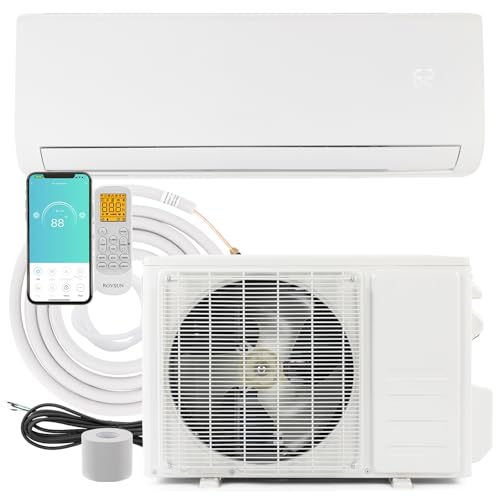 Bonnlo 18,000 BTU Ductless Mini Split AC/Heating System, 230 V / 20 SEER Split-System Wall Air Conditioner Pre-Charged Inverter Heat Pump with 16ft Installation Kit