Electric Heater vs Natural Gas Heater: Which Is More Efficient?
Scope note: This article separates space heating (electric resistance heaters and natural gas furnaces) from water heating (electric and gas water heaters). That distinction matters because efficiency, venting, and payback can differ by use case. The quick answer for space heating is that electric heat converts energy to heat more directly, while natural gas can still cost less to run where fuel prices and installed equipment favor gas. For water heating, the comparison shifts to tank, tankless, and recovery-rate performance.
Electric heater vs natural gas heater: the real trade-off
Electric heaters are generally described as nearly 100% efficient at turning electricity into heat, while natural gas furnaces are often described as roughly 80% to 98% efficient, depending on equipment type and AFUE rating. DOE Energy Saver explains that electric resistance heat is close to 100% at the point of use, while modern gas furnaces can range from standard-efficiency to high-efficiency condensing models. Gas can still cost less to run if your utility rate is low enough. Choose the wrong fuel, and you can pay more each month or end up with a system that feels underpowered. This guide compares conversion efficiency, operating cost, installation, and comfort so you can pick the cheaper fit for your home.
| Factor | Electric heater | natural gas heater | Winner |
|---|---|---|---|
| Energy conversion | Converts electricity to heat at the point of use; no combustion loss. | Burns fuel, so some input energy is lost through combustion and venting. | Electric heater |
| Monthly operating cost | Can cost more where electricity prices are high. | Can cost less where natural gas prices are favorable. | Tie, depending on utility rates |
| Heat speed and recovery | Usually slower to recover set temperature under heavy demand. | Usually faster recovery for short-burst or high-demand use. | natural gas heater |
| Installation complexity | No venting required; depends on available electrical capacity. | Needs a gas line and a venting system. | Electric heater |
| Tankless fit | Compact and efficient, but can struggle with high flow rates. | On-demand heating with faster recovery and stronger output. | natural gas heater |
Energy conversion compared for space heating
Electric resistance heat converts electricity directly into heat at the point of use, so its site efficiency is higher than combustion-based heat. The same source notes that electric resistance systems are close to 100% efficient at the house, while gas furnaces lose some input energy through combustion and venting. ENERGY STAR also distinguishes between standard and high-efficiency furnaces by AFUE, which is why a modern gas furnace can perform much better than an older one even though it still burns fuel.
That does not mean the electric option always wins on the bill. It means the heater turns input energy into usable heat more completely at the appliance itself, which is only one part of the cost equation.
Energy Factor numbers for water heaters
Water-heating scope: For storage water heaters, the useful comparisons are Energy Factor or UEF rather than furnace AFUE. ENERGY STAR and manufacturer spec sheets show that high-efficiency electric heat pump water heaters can have much higher UEF than standard electric resistance tanks, while many gas storage models sit lower because combustion and standby losses reduce delivered efficiency. As a general planning shorthand, older electric resistance tanks are often roughly 0.90 to 0.95 UEF-equivalent, while standard gas storage models are often lower, and high-efficiency condensing gas models can improve that result. Always confirm the specific model sheet.
Electric water heaters are usually considered more energy efficient than gas models at the point of use. Electric water heaters are less expensive to purchase and install, while gas water heaters typically cost more upfront because they need a gas line and proper ventilation. For gas storage and tankless water heaters, building-code and manufacturer instructions commonly require approved venting, combustion air, and clearances, which can change both cost and placement.
Which is cheaper to run: electric heat or natural gas heat?
Short answer: The cheaper fuel depends on your local utility rates and the amount of heat your home actually needs. A simple way to compare is useful-heat cost: cost per useful million Btu = fuel price per unit ÷ appliance efficiency, then compare the result across fuels. Electric heat can be cheaper where electricity is low-cost or where gas service is unavailable, but natural gas often wins when gas prices are favorable and the home already has the right hookups. The appliance label matters less than local rates.
How utility rate spread changes the answer
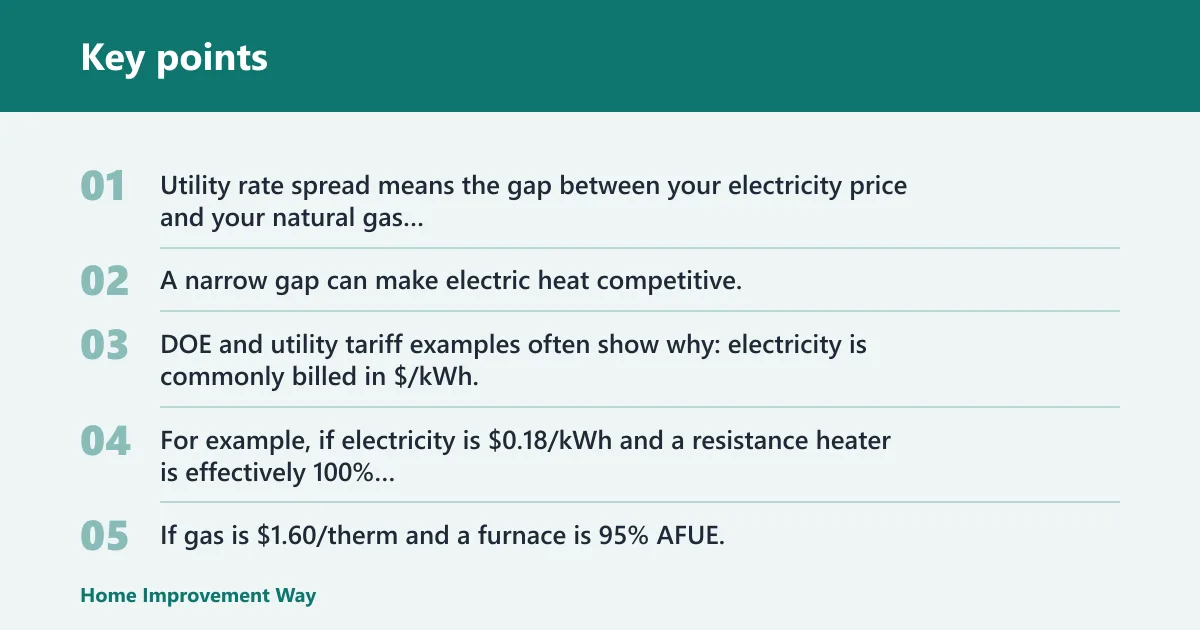
Utility rate spread means the gap between your electricity price and your natural gas price. A narrow gap can make electric heat competitive, while a wide gap can make gas the lower monthly-cost choice even if the electric unit is more efficient at conversion. DOE and utility tariff examples often show why: electricity is commonly billed in $/kWh, while gas is billed in $/therm, so you need to normalize both to delivered heat.
For example, if electricity is $0.18/kWh and a resistance heater is effectively 100% efficient, the useful-heat cost is about $52.80 per million Btu (because 1 kWh equals about 3,412 Btu). If gas is $1.60/therm and a furnace is 95% AFUE, the useful-heat cost is about $16.84 per million Btu. If gas rises to $2.50/therm and efficiency is 80%, the useful-heat cost is about $31.25 per million Btu. Those examples show why the cheaper fuel changes by region.
When winter usage pushes bills higher
Does electric heat cost more than gas in winter? Often yes in colder months, but only when winter runtime, home size, and local rates stack up against electric pricing. A colder climate pushes both systems harder, so the higher-cost fuel gets expensive fast. DOE climate guidance consistently shows that heating load rises with colder outdoor temperatures and with leaky, undersized, or poorly insulated homes.
Picture a drafty 2,000-square-foot house with long heating cycles and a high electricity rate. In that setup, electric resistance heat can drive bills up quickly, while a gas heater may stay cheaper to run if the utility spread favors natural gas.
Why local rates matter more than the fuel label
The same heater can look efficient on paper and still be the wrong financial choice. Monthly operating cost depends on how much heat the house needs, how long the system runs, and what each unit of energy costs in your utility territory. That is why utility tariff examples and a load estimate matter more than a generic “electric vs gas” label.
That is why a gas heater can be the cheaper option in one city and the more expensive option in another. The fuel label does not settle the question by itself.
Which heats faster?
Short answer: Natural gas heaters are usually faster at recovery, which means they restore set temperature more quickly after a demand spike. Electric heaters can heat effectively, but they often lag in short-burst or high-demand households where several fixtures or rooms call for heat at once. For water heating, the output and recovery numbers on the manufacturer spec sheet matter more than marketing terms.
Recovery time and high-demand households
Recovery time matters most when demand is uneven. If many showers, a large storage tank, or repeated space-heating cycles pull temperature down fast, a faster-recovering heater keeps the system closer to setpoint. That is especially important in homes where occupant schedules cluster demand into the same hour.
A common first-timer mistake is assuming the heater with the higher label rating will always cost less to run when comparing an electric unit to a natural gas unit. A heater that converts energy well can still feel underpowered if it cannot recover fast enough for the household’s usage pattern.
Why gas often wins on short bursts
Gas heaters often deliver heat faster because combustion can produce high output quickly. That matters for homes with frequent spikes, especially where occupants want rapid temperature recovery after a setback. HVAC and plumbing manufacturers typically size gas equipment around input rate and recovery, which helps explain the advantage in peak-demand situations.
For water heating, tankless gas heaters are often described as on-demand units with faster recovery and a higher upfront cost. That faster recovery is one reason gas can feel better in high-demand households. Manufacturer spec sheets often show higher flow capacity at a given temperature rise than comparable electric tankless units.
Where electric heating keeps up well enough
Electric heat can still be a good fit when the load is modest and steady. In smaller homes, well-insulated houses, or homes that do not need rapid recovery, the slower response may not matter. That is especially true where the electrical system is already sized for the load and the home’s demand is predictable.
Tankless electric heaters are often described as compact and efficient, but they may struggle with higher flow rates. That limit matters when multiple fixtures or a large draw happen at the same time. ENERGY STAR and manufacturer guidance commonly flag electrical service size as part of the selection process.
Installation and venting costs
Short answer: Installation often changes the total cost more than the efficiency difference does. Electric heaters usually need enough panel capacity and the right circuit, while gas heaters need a fuel line and a venting system. For water heaters and furnaces, venting and combustion-air requirements can also affect where the unit can be installed and whether code upgrades are needed.
Electric capacity and panel limits
Electric models have no venting required, making them easier to place in utility spaces. The main check is whether the electrical service can support the load without overtaxing the panel or requiring an upgrade. If the home already has adequate electrical capacity, the upfront job can be simpler. If the panel is tight, the cost of upgrading it can narrow or erase the expected savings.
For water heating specifically, some electric resistance tanks need only the proper circuit, but heat pump water heaters can also need adequate clearance for airflow. Manufacturer manuals and local electrical code guidance should be checked before purchase.
Gas line and venting system requirements
Gas water heaters typically cost more upfront because they need a gas line and proper ventilation. Natural gas heaters also need to be placed in well-ventilated areas, which affects layout and installation cost. DOE and code guidance generally require safe vent termination, combustion air, and clearances per manufacturer instructions and adopted building code.
That extra work can be worth it if the household will benefit from lower operating cost or faster recovery. It can also be the deciding factor when a house already has a gas line and vent path in place.
How upfront cost changes payback
Installation cost can outweigh a small efficiency gap over time. A cheaper-to-buy electric unit may still be the better deal if the gas install needs line work, venting, or structural changes. The reverse can be true when a gas unit avoids a costly electrical upgrade. A simple payback walkthrough is: extra installed cost ÷ annual energy savings = years to recover the premium.
- Compare the installed price, not just the appliance sticker price.
- Estimate yearly fuel cost using your local utility rates.
- Divide the price difference by the annual savings to estimate payback.
- Choose the option with the shorter payback only if it also fits your load.
As a practical example, a $2,000 installed cost difference with $250 in annual utility savings implies an eight-year simple payback. If a panel upgrade, gas piping, or venting change adds $1,500 to the install, payback stretches to fourteen years unless the fuel savings are much larger.
Tankless electric heater vs tankless gas heater
Short answer: Tankless units change the trade-off because they heat on demand instead of storing hot water. Tankless gas heaters are often stronger on recovery and output, while tankless electric heaters are compact and highly efficient but may struggle when flow rates rise. Manufacturer spec sheets are the best way to compare gallons-per-minute at a given temperature rise.
On-demand operation and space use
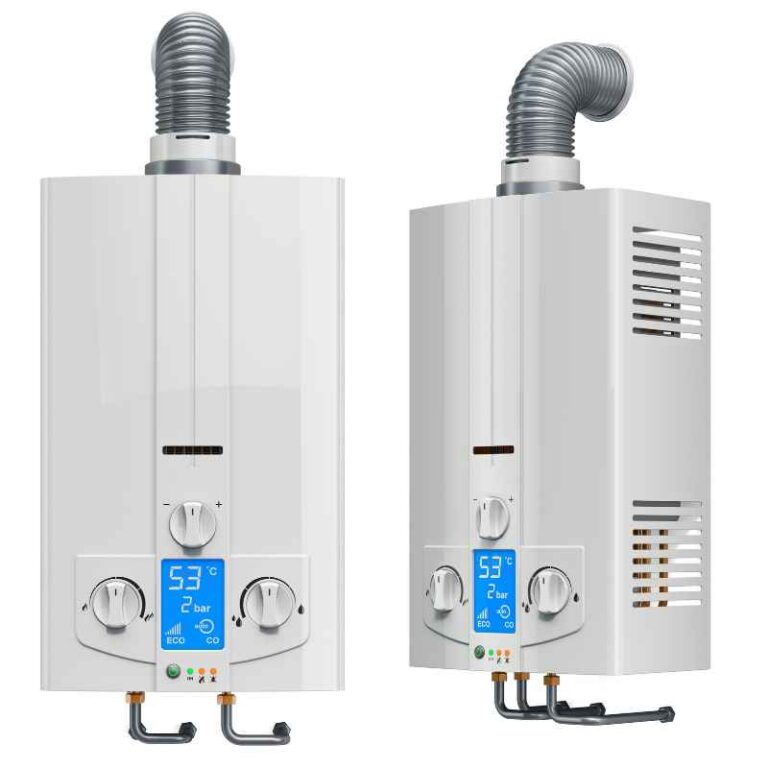
Tankless gas heaters save space and heat only when needed, which can suit homes with limited mechanical-room room. The higher upfront cost usually comes from the combustion setup, venting, and gas connection. Building-code and manufacturer instructions are especially important here because vent length, termination, and combustion air all affect where the unit can go.
Tankless electric heaters are also space-saving and avoid venting. Their compact design makes them attractive in homes where the available install area is tight and the hot-water demand is moderate.
High flow rates, recovery, and output limits
High flow rates can change the answer fast. A tankless electric heater that works well for one bathroom may not keep up with multiple simultaneous draws, while a tankless gas heater is usually better at sustained output and faster recovery. ENERGY STAR and manufacturer specification sheets typically make those differences visible through flow rate, temperature rise, and electrical service requirements.
That is why tankless is not a blanket answer. It is a good fit only when the household’s peak demand matches the unit’s output limits.
Electric heater decision table
| Home setup | Utility-rate condition | Usage pattern | Winner |
|---|---|---|---|
| No gas line | Electric service already in place | Standard household use | Electric heater — Best choice because installation is simpler and avoids gas-line and venting work. |
| Older home with existing gas service | High electricity rates | Moderate to heavy winter use | natural gas heater — Best choice when local gas pricing keeps monthly operating cost lower. |
| Large family or frequent hot-water draws | Either rate can be acceptable | High short-burst demand | natural gas heater, Best choice because faster recovery helps during repeated demand spikes. |
| All-electric home with renewables | Low net electricity cost from solar or other onsite generation | Steady daily use | Electric heater, Best choice because the home already favors electric supply and avoids combustion equipment. |
Quantified scenarios: If electricity costs $0.16 to $0.24/kWh, resistance heat generally stays expensive relative to gas unless gas is also costly or the home’s total load is small. If gas costs roughly $1.20 to $2.00/therm, a 90% to 95% efficient furnace often has a lower useful-heat cost than resistance heat. In colder climates with higher seasonal runtime, the gap widens; in mild climates with short runtime, install cost and standby losses matter more. If a gas install requires venting or a new line, that added cost can delay payback enough that electric becomes the better total-cost choice.
For a home with no gas line, electric usually wins on total install effort. For a home with high electricity rates, gas may win on monthly cost if the gas utility rate is favorable enough.
For high short-burst demand, gas is the safer pick because recovery speed matters. For an all-electric home with renewables, electric often wins because the home is already built around that fuel path.
Choose Electric heater if… / Choose natural gas heater if…
Choose Electric heater if… you do not have a gas line, you want to avoid venting work, your household load is steady rather than spiky, or your home already has low-cost electric supply from renewables. Electric also makes sense when installation simplicity matters more than the fastest recovery.
Choose natural gas heater if… your local gas rate is low enough to cut monthly cost, your home sees high short-burst demand, or you need faster recovery for a larger household. Gas is also the better fit when you already have the needed gas line and venting path in place.
Quick checklist: Confirm whether you already have a gas line, check your electric panel capacity, compare local $/kWh against $/therm, estimate peak demand from home size and hot-water use, and check whether venting changes or code upgrades will affect the install budget. If the answer is unclear, calculate useful-heat cost for both fuels before buying.

Frequently asked questions
Is an electric heater more efficient than a natural gas heater?
At the appliance level, electric heaters are usually more efficient because they convert electricity to heat at the point of use. Natural gas heaters lose some energy through combustion and venting. That said, “more efficient” does not always mean lower monthly cost. DOE Energy Saver and ENERGY STAR both emphasize that efficiency and operating cost are related but not identical.
Does electric heat cost more than gas in winter?
It often can, especially in colder weather when runtime rises and electricity rates are high. The answer depends on winter load, local fuel pricing, and how well the home holds heat. A well-insulated home can narrow the gap a lot. DOE climate guidance and local utility tariffs usually give the clearest picture.
When is a gas heater better than an electric heater?
Gas is usually better when the home needs fast recovery, when there are many occupants, or when electricity is expensive compared with gas. It is also the stronger choice if the house already has a gas line and a venting path, which lowers install friction. For water heating, gas tankless models are often favored when peak draw is high.
How do installation costs affect the total cost of electric vs gas heat?
They can change the answer more than the fuel price does at first. Electric units may be cheaper to buy and install, while gas units can require a fuel line and venting system. A higher upfront install cost can take years to recover through lower monthly bills. Manufacturer spec sheets and local code requirements matter here because electrical service, vent termination, and clearances can all affect the installed price.
Do electric heaters heat faster than gas heaters?
Usually no. Gas heaters are typically faster at recovery, which is why they are often preferred in high-demand homes. Electric heaters can still be effective, but they are better when the load is steady and the home does not need rapid recovery. For tankless water heating, the manufacturer’s flow-rate and temperature-rise data are the most reliable guide.
Sponsored / affiliate links. As an Amazon Associate I earn from qualifying purchases. I may earn additional commission from eligible campaigns.