Furnace Troubleshooting: Fix Common Winter Heating Problems
Start with the thermostat, filter, power switch, and vents; if your furnace still blows cold air, short-cycles, or will not start after these four checks, stop and schedule service. A wrong guess can make a no-heat call worse, damage parts, or let a carbon monoxide risk go unnoticed. This guide matches winter furnace symptoms to likely causes, safe homeowner checks, and clear stop points for gas and electric systems.
A winter no-heat problem affects comfort and safety, so you need fast triage based on the symptom and the stage where startup stops. Skip the long catch-all checklist and use what the furnace is doing right now: no airflow, blower with cold air, clicking without flame, shutdown after a few minutes, or weak heat that never catches up.
Winter furnace safety first


Stop troubleshooting right away if you smell gas, a carbon monoxide alarm sounds, you see sparks, smoke, scorch marks, or flame outside the burner area, or the furnace breaker trips again after reset. At that point, the problem is beyond homeowner-safe checks and into emergency or technician-only work.
Stop-now signs
Natural gas is odorized to smell like rotten eggs. If you notice that odor, leave the home and call 911 immediately. Do not search for the leak, flip switches, or try to restart the furnace.
Carbon monoxide cannot be seen or smelled. Working CO alarms are required, and if one activates, everyone should leave first and call for help from outside. (WA)
Also stop if you see scorch marks near the burner compartment, hear electrical arcing, find melted insulation, or spot visible flame where it does not belong. Burner rollout and repeated breaker trips can point to venting, combustion, wiring, or motor faults that need instruments and trained diagnosis.
What carbon monoxide symptoms mean for occupants
Headache, dizziness, nausea, confusion, unusual fatigue, or symptoms that ease after leaving the house can fit carbon monoxide exposure. Those signs do not prove the source, but they are enough to leave the home, account for everyone, and get emergency help involved if a CO alarm is active or exposure is suspected.
Safe checks before touching the furnace
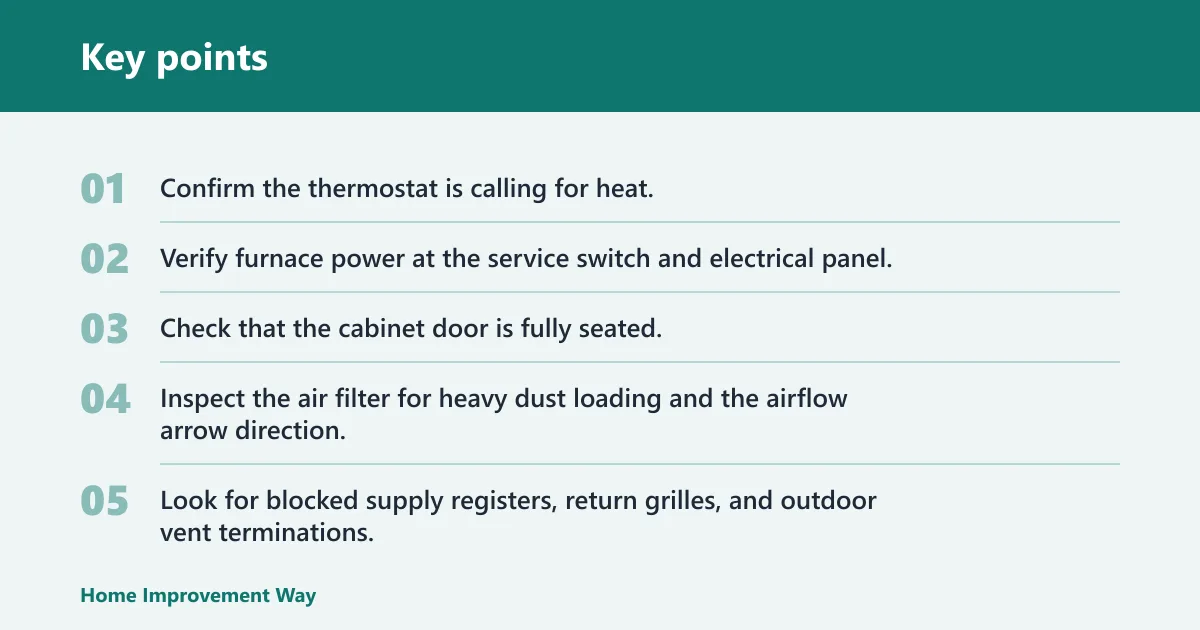
- Confirm the thermostat is calling for heat.
- Verify furnace power at the service switch and electrical panel.
- Check that the cabinet door is fully seated.
- Inspect the air filter for heavy dust loading and the airflow arrow direction.
- Look for blocked supply registers, return grilles, and outdoor vent terminations.
- Watch one startup attempt and note where the sequence stops.
If the unit has a viewing window, visible control-board error codes can narrow the failure point fast. Do not remove panels or defeat a door safety switch just to chase a code.
Safe furnace lockout reset procedures
Repeatedly forcing a locked-out furnace can flood the burner or damage the control board, so safety dictates a one-time reset only after identifying the underlying cause. The supporting guide distinguishes between gas, oil, and electric systems to ensure the correct restart sequence is used each time.
This prevents common errors, such as misreading status lights or ignoring fuel-specific safeguards, that often turn minor lockouts into expensive repairs. Learn furnace lockout reset to safely restore heating and determine when professional service is truly required.
Use a First Cold Day Furnace Startup Checklist
If your heat hasn’t run in a while, the safest first step is a simple startup check: confirm the thermostat is set to heat, the furnace has power and gas, the filter is clean, and supply and return vents are clear. On high-efficiency systems, also look at the condensate drain. Then let the unit run long enough to verify the normal cycle starts, heats steadily, and shuts down without tripping a safety device.
The furnace startup checklist article explains that sequence in plain terms, including what sounds and symptoms are normal and when a failure means you should stop restarting the system and call for service instead of forcing another cycle.
Why a Gas Oven Is Not a Safe Heat Source
A gas oven should not be used to warm a house. The supporting article explains the main hazards—carbon monoxide buildup, fire risk, excess moisture, and uneven heating—and why leaving the door open does not make the setup safe. That matters because a kitchen oven can seem like a quick fix during a cold snap, but it can create a much bigger emergency than the outage itself.
The guide also lays out safer short-term options for staying warm and helps you recognize when a heating problem is serious enough to require immediate repair. If you are weighing risky backup heat against safer choices, gas oven heat safety is the article to read.
What should you check first if your furnace is not heating?
Check that the thermostat is actually calling for heat, that the furnace has electrical power, and that airflow is not restricted enough to shut the system down. Set the thermostat to Heat, raise the setpoint at least 3-5°F above room temperature so the call is unmistakable, set the fan to Auto, confirm the furnace switch is on and the breaker or fuse is intact, make sure the door panel is seated, and inspect the filter.
Thermostat call for heat
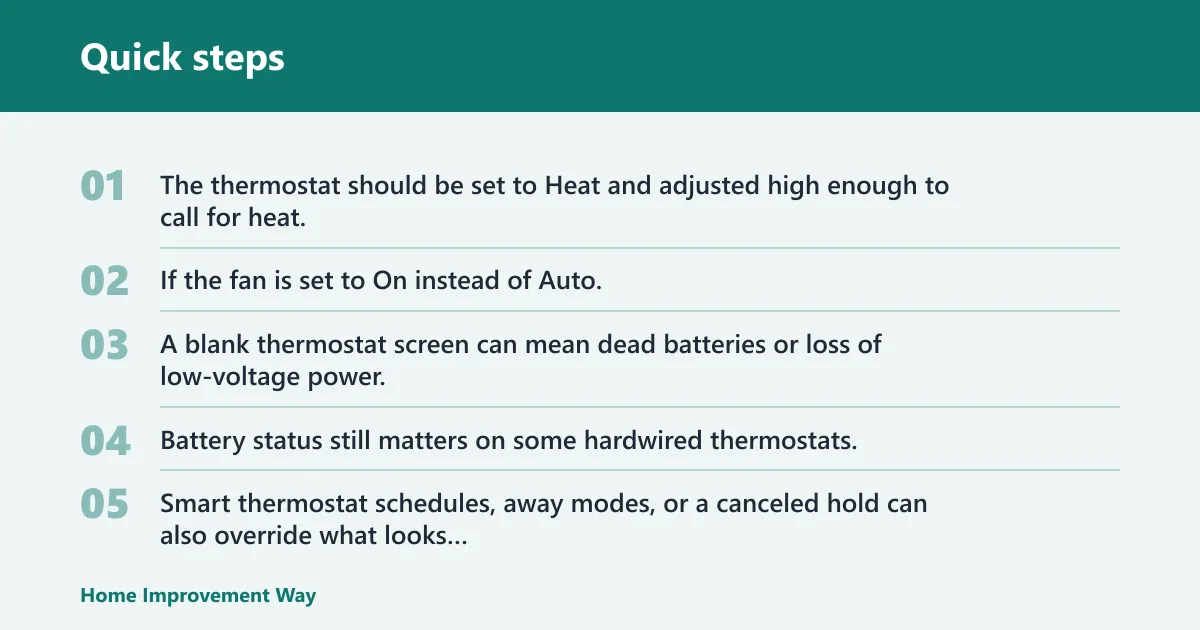
The thermostat should be set to Heat and adjusted high enough to call for heat. If the fan is set to On instead of Auto, the blower may run between heating cycles and make it seem like the furnace is blowing cold air.
A blank thermostat screen can mean dead batteries or loss of low-voltage power. Battery status still matters on some hardwired thermostats. Smart thermostat schedules, away modes, or a canceled hold can also override what looks like a heat call.
Say the thermostat shows 68, the room is 64, the mode is Heat, and the fan is On. The blower may keep moving unheated air, which looks like furnace failure even though the first fix is simply switching the fan to Auto.
Power basics: switch, breaker, fuse, door switch
Look for the furnace service switch on or near the unit, often mounted to the side of the furnace, on a nearby wall, or at the basement stairway. It usually looks like a standard light switch, and if it is off, the furnace will not start no matter what the thermostat does. Then check the electrical panel for a tripped breaker.
Older homes may use fuses instead of breakers. Replace a blown fuse only with the same amperage. If a breaker trips again or a fuse blows again, there may be a short, motor problem, wiring fault, or capacitor issue, and that is a common point to stop DIY troubleshooting.
The cabinet door must also be fully seated. Many furnaces use a door safety switch, and a loose panel can shut the system down completely.
Filter and airflow checks
Pull the filter out and look at the intake side under bright light. If the media is matted with dust, pet hair, or gray buildup across most of the surface, replace it instead of trying to clean it in place. Many homeowners should change air filters every 1-3 months, and homes with pets or heavy pollen often need more frequent changes in winter because windows stay closed and filters load faster.
Verify the airflow arrow points toward the furnace cabinet or blower section, based on the filter slot layout. A backward filter can cut airflow and add noise.
Restricted airflow can overheat the heat exchanger area, trip the limit switch, shut the burners off, and leave the blower running to cool the furnace. That is one of the most common ways a dirty filter turns into short cycling.
Check the Thermostat Batteries First
A dead or weak thermostat battery can look a lot like a furnace problem: the display goes blank, controls stop responding, or the system won’t call for heat. Before you assume the furnace, start with the thermostat and replace the batteries if you see a low-battery warning or suspect the power is fading. The thermostat battery guide explains which battery type to use, how to open the compartment, and what should happen after the swap. That matters because a simple battery issue can save you time, prevent unnecessary HVAC troubleshooting, and get your heat back faster.
How to tell if the furnace filter is installed backward
If your filter is in the wrong direction, airflow can be restricted and the furnace may work harder than it should. The key is simple: the arrow on the filter should point toward the furnace blower and ductwork, following the direction air travels through the system. That matters because the filter media is designed to catch particles as air moves downstream, and a reversed filter can reduce performance or let dust pass around a poor seal.
The furnace filter arrow guide explains how to read the arrow, confirm airflow when the slot is confusing, and spot the difference between a reversed filter and a filter that just doesn’t fit well. Those details help prevent avoidable strain on the system and keep filtration working as intended.
How to choose the right furnace filter size
The right furnace filter size is the one that fits the rack or return opening snugly, not just the number printed on the box. If the label is missing or unclear, the safest next step is to measure the old filter frame or the slot opening in inches, then match the correct nominal size and thickness. Choosing the wrong size can let dust slip around the edges, restrict airflow, or put extra strain on the blower.
For a step-by-step way to identify the size, thickness, and MERV rating that fit your system without causing airflow problems, see furnace filter sizing. It explains how to use the frame, opening, or cabinet dimensions to avoid leaks and performance issues.
How to tell if a MERV 13 filter will overwork your furnace
If you want the filtration benefits of MERV 13 without hurting airflow, the key question is whether your furnace can handle the added resistance. This article explains the main factors that decide the answer: blower type, filter cabinet size, duct static pressure, and whether the system is already close to its airflow limit. It also shows why a MERV 13 filter can be a problem in some older or undersized setups, leading to weak heating, higher energy use, or shutdowns. For a practical way to judge the risk before swapping filters, see MERV 13 furnace restrictions.
Furnace symptom decision table
Use the symptom column first, then match it to the safe homeowner check before touching anything else. The stop-now column marks the line between routine triage and a problem that calls for service or emergency response next.
| Symptom | Likely cause | Safe homeowner check | Stop-now safety trigger | Likely next professional test |
|---|---|---|---|---|
| No heat | Thermostat not calling, power loss, open door switch, failed ignition, gas supply issue, or electric heat component failure | Set thermostat to Heat and above room temperature, fan to Auto, check batteries, service switch, breaker or fuse, door panel, and filter | Breaker trips again, sparks, smoke, scorch marks, CO alarm, or gas odor | Voltage and control-circuit checks, ignition sequence diagnosis, amp draw, and safety-switch verification |
| Cold air | Fan set to On, ignition failure with blower running, overheating shutdown, duct heat loss, or heat pump confusion | Set fan to Auto, confirm burners or electric heat actually energize, inspect filter and open registers | Gas odor, rollout signs, or repeated shutdowns after ignition attempt | Igniter or flame-sense test, limit-switch diagnosis, supply-air temperature check, and duct inspection |
| Short cycling | Dirty filter, blocked vents, overheating limit switch, blower weakness, thermostat placement issue, or condensate/venting fault | Replace dirty filter, open blocked registers, clear return grilles, note how many minutes before shutdown | Hot electrical smell, visible flame issues, or repeated breaker trips | Static pressure, limit-switch operation, blower motor amp draw, vent draft, and condensate drainage checks |
| Clicking without ignition | Failed igniter, dirty flame sensor, gas supply interruption, pilot problem on older units, or control-board fault | Listen for inducer or blower start, note whether there is glow or repeated clicking, confirm gas valve is open if accessible | Gas odor, delayed ignition boom, or flame outside burner area | Igniter resistance or current test, gas pressure, flame-sense signal, and board output verification |
| Weak airflow | Dirty filter, failing blower motor, slipping wheel, duct restriction, closed dampers, or iced/blocked return path | Replace dirty filter, open registers, check return grilles, listen for humming or squealing | Motor overheating smell or breaker trip during blower run | Static pressure, blower speed tap setup, capacitor and motor amp draw, duct inspection |
| Gas odor | Gas leak, loose connection, valve fault, or combustion problem | Do not troubleshoot; leave immediately | Any rotten-egg gas smell | Leak detection, gas pressure checks, and combustion safety inspection after area is made safe |
How to handle a furnace pressure switch error
A furnace pressure switch error usually means the unit cannot confirm safe venting or airflow, so ignition gets blocked. The supporting article explains what that code means, what you are likely to notice in the first minute, and which checks are safe to make before you call for service. It also covers the most common causes, including vent obstructions, drain issues, weak inducer performance, and a failed switch.
If your furnace is stopping before heat starts, this guide helps you narrow the problem without guessing. See the step-by-step advice in furnace pressure switch error before replacing parts or resetting the system repeatedly.
When a Furnace Tune-Up Pays Off
A furnace tune-up is usually worth the cost when your system is due for annual maintenance and is still heating normally. It helps catch dirty burners, weak airflow, loose electrical parts, and small wear issues before they turn into breakdowns or higher energy bills. If the furnace is short-cycling, making new noises, or leaving rooms cold, the smarter first step is diagnostics, not a routine tune-up.
This furnace tune-up guide explains when maintenance is a good buy, when it is mostly insurance, and how to decide between a tune-up, a maintenance plan, or repair-focused service.
What a loud furnace bang at startup can mean
A furnace that bangs when it starts is often signaling delayed ignition, where gas builds up before it lights, or a mechanical issue such as duct expansion or a loose component. The supporting article breaks down the most likely causes, explains which sounds are harmless versus concerning, and shows how to narrow down the problem before you call for service.
That matters because a repeated startup bang can waste fuel, strain the heat exchanger or ductwork, and sometimes point to a safety issue. If you want a clear breakdown of the warning signs and next steps, see furnace banging noise.
What a burning-plastic furnace smell means
A burning-plastic odor from your furnace is a warning sign you should not ignore. It can point to simple dust burn-off during first startup, but it can also mean plastic near a vent, an overheated wire, or another electrical issue that needs fast attention. The difference matters because a harmless startup smell fades quickly, while a strong or worsening odor can mean damage is already happening.
The supporting article on burning plastic furnace smells shows how to tell normal first-use odors from unsafe ones, when to shut the system down, and which symptoms suggest you need HVAC service right away. That helps you protect your equipment and reduce fire risk before a small problem becomes expensive.
Why is your furnace blowing cold air instead of heat?
Cold air usually means one of four things: the fan is set to On, the blower is running after a failed ignition, the furnace overheated and shut the burners down, or the system is moving air but not adding enough heat to the house. The symptom matters more than the label “running.”
Fan setting versus failed heat
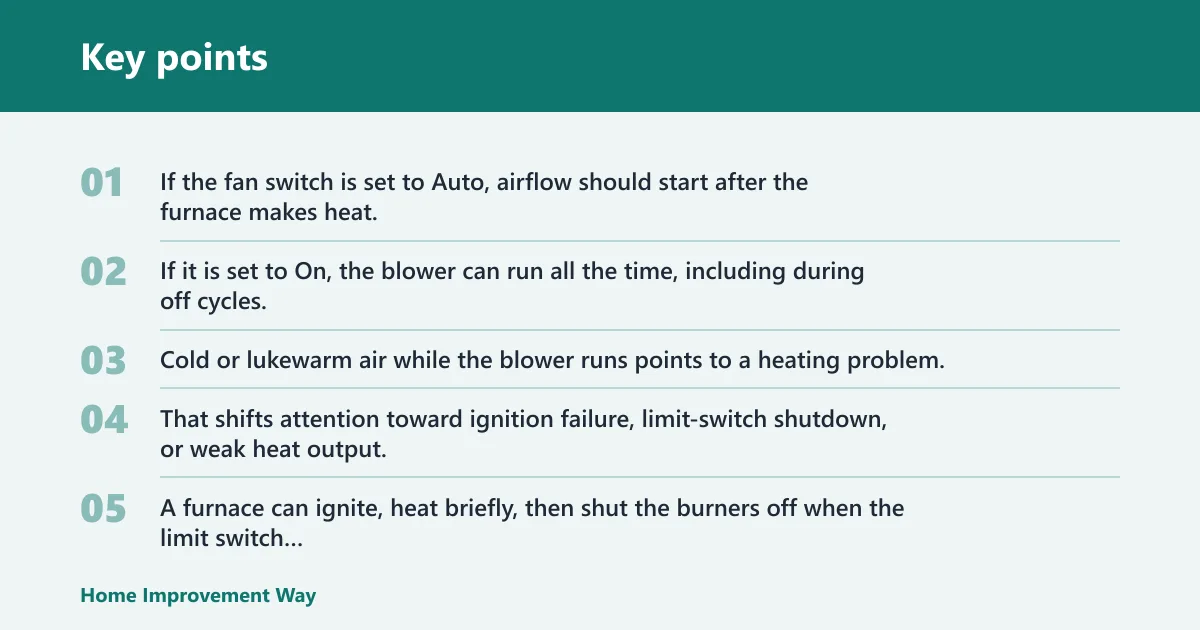
If the fan switch is set to Auto, airflow should start after the furnace makes heat. If it is set to On, the blower can run all the time, including during off cycles, which sends room-temperature air through the ducts.
Cold or lukewarm air while the blower runs points to a heating problem, not only an airflow problem. That shifts attention toward ignition failure, limit-switch shutdown, or weak heat output.
Overheating shutdowns and duct losses
A furnace can ignite, heat briefly, then shut the burners off when the limit switch senses overheating. The blower often keeps running to cool the unit. The house feels chilly because air is still moving, but the burners are no longer adding heat.
Common reasons include a dirty filter, too many closed supply registers, blocked returns, or a blower motor that cannot move enough air. Duct leaks in an attic or crawlspace can also dump heat before it reaches the rooms.
Suppose the burners light, run for a short time, then shut off while the blower keeps going and the main hallway stays at 62 even though the thermostat is set higher. That pattern fits an overheating shutdown more than a thermostat problem.
Heat pump confusion and winter expectations
Some homeowners use “furnace” to mean any central heating system. A heat pump often delivers air that feels cooler than gas-furnace air even when it is working normally. If the outdoor unit is part of the system, the diagnosis path changes.
Why does your furnace keep shutting off after a few minutes?
A furnace that stops after a few minutes is often short cycling from overheating, airflow restriction, venting trouble, or a control issue. Thermostat problems can play a part, but they are not the only cause. Shutdown timing, filter condition, and airflow strength are usually the fastest clues.
How airflow restriction trips the limit switch
When airflow drops, heat stays inside the furnace longer than intended. Temperature rises, the limit switch opens, and burner operation stops to protect the furnace. Once it cools, the system may try again, creating the on-off pattern called short cycling.
Dirty filters are common here, but they are not the only cause. Closed registers, blocked return grilles, collapsed duct sections, and a weak blower motor can create the same overheating chain.
Thermostat placement and control settings
If a thermostat sits near a supply register, in direct sun, or close to a space heater, it may satisfy too quickly and shut the furnace down early. On some systems, setup or cycle settings in the thermostat can also affect runtime.
That said, a furnace that clicks, lights, then shuts off hard after a brief hot run should still be checked for airflow and safety-switch issues before blaming thermostat location alone.
Winter venting and condensate faults
High-efficiency furnaces commonly depend on clear intake and exhaust piping plus a free-flowing condensate trap and drain. Snow, ice, leaves, or a partly blocked condensate line can interrupt pressure-switch proof or force repeated shutdowns.
Picture a condensing furnace that worked yesterday, then starts failing during a wind-driven snow event. If the thermostat is correct and the filter is clean, an outdoor intake or exhaust obstruction is a stronger suspect than the thermostat.
How a Clogged Filter Triggers Furnace Shut‑Off
A clogged filter is often the hidden trigger that forces a furnace to overheat and shut down. When airflow is restricted, the heat exchanger can’t release enough heat, causing temperature sensors to hit safety limits and cut power. This results in short‑cycling, a brief start‑up followed by an immediate shutdown, and a noticeable rise in energy use. Recognizing the tell‑tale signs—reduced airflow, a dusty filter, and the furnace turning off after a few minutes—lets you replace the filter before the problem escalates. For a step‑by‑step guide on diagnosing and fixing this issue, see the article on the dirty furnace filter.
Why Your Thermostat Changes on Its Own
If your setpoint keeps shifting, the cause is usually a schedule, smart-home automation, bad sensing, weak power, or an HVAC control conflict—not the thermostat “deciding” on its own. The supporting guide breaks down how to tell whether the number changed in the app, whether the thermostat only thinks the room needs a different setting, and which checks to run first. That matters because the wrong fix can waste energy, leave rooms uncomfortable, and mask a bigger system issue.
Use this thermostat changing issue guide to sort out control problems from sensor or wiring problems, then decide whether the fix is a settings change, a battery or power check, or a call for HVAC service.
Why a Missing C-Wire Can Make Smart Thermostats Unstable
If you are choosing a smart thermostat, the wiring behind the wall matters as much as the model you buy. This guide explains what a C-wire does, how to tell whether your current thermostat already has one, and what can happen when a thermostat tries to run without steady power—such as rebooting, losing Wi-Fi, or causing HVAC short cycling. It also helps you decide whether your setup truly needs a C-wire or whether a compatible workaround is safe. For a clear breakdown of the wiring check and the safest next step, see C-wire thermostat guide.
How do you troubleshoot clicking without ignition?
Clicking without flame means the furnace is trying to light but failing somewhere in the ignition sequence. Your safe job is to identify where the sequence stops: call for heat, inducer or blower start, igniter glow or click, flame attempt, then shutdown. That pattern points the service call in the right direction.
Standing pilot versus electronic igniter
Older furnaces may use a standing pilot. Most newer gas furnaces use electronic ignition. If an older unit has no pilot flame when it should, the fix depends on the manufacturer instructions and the cause of pilot failure; this is not a place to improvise.
On electronically ignited furnaces, repeated clicking without flame often points to a failed igniter, gas supply issue, flame-sensing problem, or a control fault.
What the startup sequence tells you
Watch one cycle from the thermostat. A typical gas furnace sequence is: thermostat calls for heat, inducer starts, pressure proving completes, igniter glows or sparks, burners light, flame is sensed, then the blower starts after a short delay.
If the sequence stops before flame appears, think igniter, pilot, gas valve, pressure proving, or control-board fault. If flame starts but drops out quickly, flame sensing or venting moves higher on the list.
Some furnaces display a blink code through a sight glass. If one is visible, note it for the service call. Do not enter live electrical or sealed burner compartments to chase it.
When clicking points to professional-only faults
Clicking plus no flame can involve the igniter, gas pressure, a dirty flame sensor, or the board that commands ignition. Those are technician tests because they often require meter readings, combustion checks, or gas-pressure measurement.
Do not force repeated restarts if there is delayed ignition, a small boom, or gas odor. Stop there and schedule service.
Why is the furnace running but not warming the house?
When the furnace runs but the house stays cold, either the system is not producing full heat, the blower is not moving enough air, or the heat is being lost before it reaches the rooms. Weak airflow and winter venting issues are especially common in extended cold weather.
Weak airflow from filter, blower, or duct restriction
If airflow at several registers is noticeably weak, start with the filter, then the registers and returns. A blower motor can also run poorly from wear, failing bearings, a weak capacitor, or internal electrical trouble. Humming, squealing, or airflow that fades during a cycle supports that path.
Blower issues matter even when burners are fine. Heat trapped in the furnace does little for the rooms.
Burners cycle on but delivered heat stays low
A furnace can make heat and still lose the house-temperature battle if duct leakage is large, a zone damper is stuck, or the unit keeps hitting a limit and cutting burners off. The pattern is often steady blower operation with room temperature rising very slowly.
Condensing-furnace winter failures
High-efficiency condensing furnaces can shut down from blocked intake or exhaust terminations, frozen or clogged condensate traps, or pressure-switch faults caused by drainage problems. Those issues become more likely during freezing weather and after heavy snow or wind.
Why the furnace may not start after a heat call
If your thermostat is calling for heat but the furnace stays silent, the problem usually sits in one of four places: power, airflow, ignition, or a safety shutdown. The supporting guide walks through that startup sequence in order so you can check the thermostat, furnace switch, breaker, filter, and other simple points before assuming a major failure.
That matters because the symptom can look the same whether the issue is a dead thermostat battery or a failed control board. Use this furnace startup guide to narrow the failure fast, avoid unnecessary guesswork, and know when it is time to stop troubleshooting and call an HVAC technician.
Diagnosing a ‘Heat On’ but No Warm Air Situation
When the thermostat displays “Heat On” but the vents stay cold, the problem is usually with ignition, airflow, safety limits, or low‑voltage controls. The thermostat heat issue guide walks you through a step‑by‑step checklist—starting with thermostat wiring, then blower operation, ignition failure, and airflow restrictions—so you can pinpoint the fault before the furnace cycles repeatedly or wastes fuel. Understanding these distinctions helps you avoid costly service calls and prevents a minor glitch from turning into a full no‑heat emergency. If the checks don’t restore heat within 15 minutes, it’s time to call a qualified HVAC professional.
When a boiler heats water but not the radiators
If your boiler still gives you hot tap water but the home heating stays off, the issue is usually on the heating side rather than a total boiler failure. The supporting guide on boiler hot water issues explains the most likely causes, starting with simple checks like the timer, thermostat, and heating controls before moving to parts such as the diverter valve, zone valve, or low system pressure.
This matters because it helps you narrow the problem quickly, avoid unnecessary part swaps, and know when the fault is likely electrical, control-related, or a job for a Gas Safe engineer.
When a Baseboard Heater Stays Cold
If a baseboard unit isn’t getting hot, the problem is usually easy to narrow down: electrical supply, thermostat control, or a failed heating component. The exact checks depend on whether you have electric baseboard heat or a hot-water system, so identifying the type first saves time and prevents guesswork. A focused troubleshooting sequence can also help you avoid wasting energy on a room that will never warm properly until the fault is fixed.
The baseboard heater guide breaks down the most common causes, from tripped breakers and bad thermostats to closed valves, air in the line, or circulation issues, and shows which symptoms point to each one. It matters because a cold heater can be a simple fix—or an early warning of a bigger electrical or boiler problem.
When radiator reflectors are worth installing
Radiator reflectors can help when a radiator sits on a cold external wall and a noticeable share of its heat is being absorbed by the masonry instead of warming the room. The supporting guide explains which setups benefit most, why wall type matters, and why the gains are often modest on already insulated walls. It also breaks down the practical choice between foil and purpose-made panels, so you can avoid spending money on a fix that won’t move the needle.
Just as important, it shows how poor placement can reduce the payoff and when reflectors are simply not worth the effort. If you’re deciding whether to buy them, radiator reflectors is a useful guide to the conditions that make them effective.
How to handle a boiler that keeps dropping pressure
If your boiler pressure keeps falling after you top it up, the problem is usually a leak, a faulty pressure relief valve, a bad expansion vessel, or an inaccurate gauge—not something you can safely ignore. The key question is whether the drop happens once or returns in a repeat pattern, because that clue helps separate a simple top-up issue from an underlying fault that needs repair. The article on boiler pressure loss walks through the most common causes and what each symptom tends to mean.
That matters because repeated low pressure can leave you without heating or hot water and can put stress on the boiler if it keeps running in that state.
Normal Boiler Pressure Ranges in Winter
Winter heating cycles cause boiler water to expand, which naturally shifts pressure readings compared to summer. Understanding the baseline cold pressure is essential to avoid over-topping the system. boiler winter pressure guides detail the typical 1.0 to 1.5 bar cold start range. This specific data helps distinguish normal thermal expansion from genuine faults like leaky valves or faulty expansion vessels.
Recognizing these normal fluctuations prevents unnecessary repairs and highlights when a system is genuinely under-pressurized or over-pressurized. Accurate pressure interpretation ensures the relief valve does not trigger during peak demand periods.
Why Upstairs Rooms Stay Colder in Winter
If the upstairs feels chilly while the rest of the house is comfortable, the problem usually comes down to one of three things: the thermostat is satisfying the system too soon, heat is leaking out through the attic, or the upstairs is not getting enough warm air. The supporting guide breaks down each cause so you can match the symptom to the fix instead of guessing.
That matters because uneven heating can lead to higher bills, constant thermostat changes, and rooms that never quite warm up. For a clear walkthrough of the most likely causes and practical next steps, see upstairs colder guide.
Can closing unused room vents help lower winter bills?
Usually, closing one or two vents in rooms you are not using is low-risk in a properly sized forced-air system, but closing too many can increase static pressure, reduce airflow, and make the furnace work harder than it should. The practical takeaway is simple: vent closure is sometimes safe, but it is not a universal energy-saving fix.
This guide on closing unused room vents explains when shutting vents is likely harmless, when it can cause comfort or equipment problems, and what to do instead if you want to cut winter heating costs without stressing the system.
How Fast a House Cools After the Heat Stops
If your furnace quits, the key question is how quickly indoor temperatures will drop and when conditions become risky for people, pipes, and pets. The supporting guide on house cooling times explains the broad range you can expect, from a few hours of noticeable chill to much faster cooling in poorly insulated or windy conditions.
That timing matters because it helps you decide when to layer up, protect plumbing, and bring in backup heat or service before a small outage turns into frozen pipes or unsafe living conditions. The article also shows what factors make one house cool faster than another, so you can judge your situation more accurately.
When a Nighttime Thermostat Setback Can Lower Heating Bills
Lowering the thermostat at night can reduce heating costs, especially if you have a furnace or heat pump and the house can stay comfortable with a 7–10°F setback for several hours. The supporting article explains when that savings is real, how much of a temperature drop usually makes sense, and why the result depends on your home’s insulation, air leakage, and heating system. It also covers cases where setbacks may not help much, such as homes that lose heat quickly or setups that rebound inefficiently.
If you want a practical way to decide whether this strategy is worth using in your own home, the thermostat setback guide breaks down the tradeoffs and helps you match the setting to your comfort and heating system.
Determining the Minimum Safe Winter Thermostat Setting
Understanding the minimum temperature you can safely set your thermostat in winter helps prevent frozen pipes, excess humidity, and health risks for vulnerable occupants. This article breaks down the recommended baseline for occupied homes (around 68°F), the lower limit for empty houses (about 55°F), and the higher thresholds needed for infants, seniors, or medical conditions, typically 70°F or above. It also offers practical tips—like programmable thermostats and zone heating—to maintain these levels without inflating energy bills. For a detailed guide on the exact numbers and how to achieve them, see the lowest safe indoor temperature.
When to Use Emergency Heat on a Heat Pump
Emergency heat is the backup setting to use only when the heat pump itself has failed, is badly iced over, or an HVAC technician has told you to switch modes. The supporting guide explains the difference between emergency heat and auxiliary heat, so you know when the system should handle the load on its own and when manual intervention is justified. It also lays out a fast decision checklist to help you avoid using the setting longer than necessary, since that can raise electric bills and mask a fixable problem.
If you are unsure whether the situation calls for backup heat or service, this emergency heat guide gives clear signs to watch for and explains what to do next.
When a Heat Pump Runs Constantly in Winter
A heat pump that seems to run nonstop in cold weather is not automatically failing. In winter, longer runtimes can be normal if the system is holding the thermostat setpoint, moving enough warm air, and going through defrost cycles as needed. The key is to separate normal seasonal operation from warning signs like the house never reaching temperature, frequent short cycling, weak airflow, or ice that lingers on the outdoor unit.
The constant winter runtime guide explains how to judge those symptoms, starting with thermostat settings and moving through common causes such as undersizing, restricted airflow, refrigerant issues, and defrost problems. That matters because the wrong diagnosis can mean higher bills, extra wear, and a cold house when the real fix is straightforward.
Gas vs electric furnace troubleshooting
Gas and electric furnaces share thermostat, filter, blower, power, and airflow issues, but the heat-making parts fail differently. Gas units add fuel, ignition, flame sensing, and venting. Electric units depend on heating elements, sequencers or relays, and high-amperage electrical circuits.
Gas furnace checks
If the unit is gas-fired, the shut-off valve must be open. On commonly used quarter-turn valves, parallel with the pipe indicates open. If the home smells like rotten eggs, leave immediately instead of checking valve position.
Gas-furnace no-heat calls often come down to igniter or pilot malfunction, flame-sense problems, venting faults, pressure-switch issues, or a limit switch opening from restricted airflow. The blower can still run while burners do not ignite.
Electric furnace checks
Electric furnaces do not use gas valves, pilots, or flame sensors. If the blower runs but air is cold, suspect heating elements, sequencers, relays, or high-limit trips from low airflow. Because these systems draw high amperage, breaker behavior matters even more.
A breaker that trips again after reset is a stop point. Heating elements and sequencers are not homeowner-safe repairs, and repeated trips can also mean blower-motor or wiring trouble.
What overlaps and what does not
Dirty filters, blocked vents, loose door panels, thermostat errors, and blower faults affect both furnace types. Clicking without ignition, gas shut-off position, standing pilot problems, and flame-sense issues belong to gas systems, not electric ones.
If your oil furnace has locked out, the red reset button is the last step after you confirm the fuel tank has oil, the switch is on, and the filter is not clogged. The supporting guide to oil furnace reset buttons explains how the lockout system works, why the burner may shut itself down, and the safe sequence for trying a reset only once.
This matters because repeated pressing can overfuel the burner, strain the ignition system, and turn a simple startup problem into a bigger repair. It also helps you recognize when the issue is beyond a reset and should be handed to a technician.
When should you stop troubleshooting and call an HVAC technician?
You should stop when the problem moves into combustion safety, repeated electrical faults, or internal component diagnosis. Gas odor, carbon monoxide concerns, scorch marks, rollout signs, repeated breaker trips, and any issue that needs gas pressure, voltage, amp draw, draft, or static-pressure testing belongs to a technician.
Clear stop points
Stop after one repeated breaker trip. Stop for any rotten-egg gas odor. Stop if a CO alarm sounds, if occupants have possible CO symptoms, if the furnace shows flame outside the burner area, or if there is smoke, sparks, or melted wiring.
Also stop if the filter, thermostat, switch, breaker or fuse, door panel, and vent obstructions all check out but the furnace still will not complete a normal startup sequence.
Tests that require tools and training
Professional diagnosis often includes gas pressure, ignition current or resistance, flame-sense microamp reading, motor amp draw, line and control voltage, draft, condensate drainage verification, and external static pressure. Those tests separate guesswork from a sound repair plan.
Repair versus replacement in winter
Replacement becomes a discussion when no-heat calls keep repeating in the same winter, when a cracked heat exchanger is suspected, or when major motor or control failures stack up on aging equipment. There is no single age cutoff that decides it. Condition, safety findings, part cost, and repair frequency matter more than one birthday on a data plate.
Troubleshooting a single cold room during heating season
A single cold room often stems from restricted airflow, leaky ductwork, or excessive heat loss in that specific space while the rest of the house stays warm. To isolate the root cause, you can follow a systematic cold room diagnosis table that helps you check supply registers, filter status, and structural insulation levels.
Addressing the issue quickly prevents your heating system from overworking while keeping utility bills manageable. Knowing whether a problem requires a simple damper adjustment or professional HVAC repair ensures you can restore comfortable temperatures throughout your home efficiently.
How to tell a normal condensate issue from a real leak
A high-efficiency furnace can produce water as part of normal operation, but standing water, repeat puddles, or leaks that appear only during certain cycles usually point to a problem that needs attention. The supporting guide explains how to separate harmless condensation from failures such as a clogged drain, bad trap, condensate pump trouble, or a damaged component. That matters because a small leak can quickly shut the furnace down, damage flooring, and create corrosion or mold concerns. Use this high-efficiency furnace leak guide to trace the water by location and operating mode so you can narrow down the cause faster.
Frequently asked questions
Can a dirty air filter stop a furnace from heating?
Yes. A dirty filter can restrict airflow enough to overheat the furnace, open the limit switch, and shut the burners off while the blower keeps running. Replace any filter that is visibly dirty or caked with dust, and check it more often if the home has pets or heavy winter dust loading.
What does it mean if my furnace breaker keeps tripping?
One trip can happen from an isolated fault or power event, but a breaker that trips again points to a motor, wiring, capacitor, heating-element, or short-circuit problem. Stop resetting it after the repeat trip. That is a technician call, especially on electric furnaces with high current draw.
Why is my furnace blowing cold air instead of heat?
The most common reasons are the thermostat fan set to On instead of Auto, failed gas ignition, an overheating shutdown from low airflow, or heat being lost through ducts before it reaches rooms. The key clue is whether the burners or electric heat actually energize before the blower starts.
What should I check first if my furnace is not heating?
Check the thermostat mode, setpoint, and fan setting, then confirm power at the furnace switch and breaker or fuse. Make sure the cabinet door is fully seated and inspect the filter for dust loading. Those checks sort out many no-heat calls without entering unsafe compartments.
How do I troubleshoot a furnace that clicks but won’t ignite?
Watch one startup attempt and note where it stops. If the thermostat calls for heat and the furnace clicks but never establishes flame, the likely causes include a failed igniter, gas supply issue, pilot problem on an older unit, flame-sensing fault, or board problem. Do not keep forcing restarts.
When should I call an HVAC technician for furnace troubleshooting?
Call right away for gas odor, a carbon monoxide alarm, scorch marks, sparks, smoke, rollout signs, or a breaker that trips again. Also call when the thermostat, filter, switch, breaker or fuse, door panel, and vents all check out but the furnace still stops mid-sequence or will not heat reliably.
Sponsored / affiliate links. As an Amazon Associate I earn from qualifying purchases. I may earn additional commission from eligible campaigns.