Why Won’t My Furnace Turn on? Troubleshoot It
A furnace that won’t start after the thermostat calls for heat usually has a power, air-supply, ignition, flame-sensing, or control-board fault. Check the thermostat setting, batteries, furnace switch, breaker, and filter first, then call a technician if the blower still never starts. Ignoring the wrong stage can waste time, leave you without heat, and turn a simple fix into a more expensive repair. This guide walks through the furnace startup sequence step by step so you can find where the call for heat fails and what you can safely check yourself.
What you’ll need

- Flashlight
- Replacement thermostat batteries
- New air filter, if the current one is dirty
- Owner’s manual or the furnace control board code chart
Why won’t the furnace start?
The startup sequence stops at the first failed stage. The thermostat calls for heat, the furnace receives power, the draft inducer starts, the pressure switch proves airflow, the igniter warms, gas opens, flame proves, and the blower moves air. If heat never starts, the symptom tells you where the chain broke.
That order matters because the same no-heat symptom can come from very different parts. A thermostat with dead batteries, a tripped breaker, a blocked vent, a failed igniter, or a dirty flame sensor can all look similar from the room thermostat.
What the thermostat is asking the furnace to do
Set the thermostat to Heat, raise the setpoint above room temperature, and confirm the fan is set to Auto. If the thermostat is battery powered, replace the batteries. If it is hardwired, check whether the display is lit and whether the furnace wires land on the R and W terminals after turning off HVAC power first.
Why the startup sequence matters
Each stage confirms the next one is safe. The control board watches safety circuits, then either continues or locks out. A blinking status LED or error code helps you see whether the furnace stopped at power, draft, ignition, or safety shutdown.
Step 1: Is the thermostat calling for heat?
If the thermostat is not calling, the furnace will not begin the sequence. Start with settings and power, then check whether the thermostat is actually sending a heat signal to the furnace. A wrong setting is common; bad wiring is less common but important.
- Set the thermostat to Heat and raise the setpoint at least 3°F above the room temperature.
- Set the fan to Auto, not On, so you do not confuse circulation with a real heat call.
- Replace thermostat batteries if the display is dim, blank, or showing a low-battery alert.
- Remove the thermostat cover and confirm the R and W wires are secure after turning off HVAC power first.
Picture a thermostat set to 68°F in a 70°F room. That setup will not call for heat, even if the furnace is fine. Raise the setpoint and wait a few minutes before moving on.
Step 2: Is the furnace getting power?
If the thermostat is calling for heat but nothing happens, check power next. A furnace with no power cannot light, run the inducer, or report fault codes. The control board’s status LED is useful here because it often shows whether the board is alive or locked out.
- Check the furnace switch, usually mounted near the unit, and make sure it is On.
- Inspect the breaker labeled furnace, air handler, or HVAC, and reset a tripped breaker once.
- Open the blower door or use the sight glass if equipped, and look for the control board status LED.
- Match any blink pattern or fault code to the chart on the furnace door or in the manual.
If the LED is dark, the furnace may have lost power at the disconnect, breaker, or service switch. If it flashes a fault pattern, the board is monitoring a safety circuit and telling you the sequence stopped for a reason.
Step 3: Did startup reach ignition?
Once power and the thermostat check out, the furnace should start the draft inducer motor before ignition. The inducer clears exhaust and creates draft. Then the pressure switch confirms venting. After that, the igniter warms and gas opens on pilotless ignition systems.
- Listen for the draft inducer motor starting a few seconds after the heat call.
- Check outside intake and exhaust openings for snow, leaves, nests, or other blockage.
- Read the control board code if the inducer starts and then the unit stops.
- Watch for the igniter glow or spark; most hot surface igniters warm for a short sequence before gas opens.
If the inducer runs but the furnace locks out before flame, the pressure switch may not be closing. A blocked vent, failed inducer, or damaged pressure switch can all stop the sequence. A crack or no-glow symptom at the igniter points to a failed igniter.
Step 4: Is airflow or safety shutdown stopping heat?
If the furnace starts, then shuts off before sending warm air, look at airflow and safety devices. A dirty filter can overheat the furnace, which opens the limit switch. That can stop burner operation while the blower keeps running to cool the unit.
- Remove the filter and check whether it is loaded with dust.
- Replace a dirty filter with the same size and a similar MERV rating unless the manufacturer allows a different one.
- Watch whether the blower runs continuously after a heat call without burner flame.
- Read the control board code for an open limit or overheat fault if the blower stays on.
A common mistake is assuming the furnace is broken when the issue is actually a tripped float switch from a clogged condensate drain. A clogged filter can stop heat, but it usually explains overheating or short cycling, not a furnace that never begins the startup sequence.
Furnace startup decision table
Use this table to match the stage where the sequence stops with the most likely part and the safest next check.
| Startup stage | Likely failing part | Most common homeowner check | Red-flag condition for a technician |
|---|---|---|---|
| Thermostat call | Thermostat settings, batteries, R/W wiring | Set Heat, raise setpoint 3°F, set fan to Auto | Display is blank, wiring is loose, or the furnace never receives a call |
| Power | Breaker, furnace switch, service disconnect, control board | Reset one tripped breaker and confirm the switch is On | Breaker trips again or the control board LED stays dark |
| Inducer and pressure switch | Draft inducer motor, pressure switch, blocked intake or exhaust | Listen for inducer startup and inspect vent openings | Inducer runs but the furnace locks out or flashes a pressure fault |
| Ignition, gas, flame, and blower | Igniter, gas valve, flame sensor, limit switch | Check filter restriction and note whether the igniter glows or sparks | Gas odor, repeated lockouts, no flame, or blower runs with no heat |
Common mistakes
The most common mistake is resetting the furnace before reading the fault pattern. That can erase the clue you needed. Another mistake is blaming the thermostat too early when the inducer, pressure switch, igniter, gas valve, flame sensor, or limit switch is the real cause.
Do not ignore blocked intake or exhaust venting. Pressure switches are designed to stop ignition when draft is not proven. Also, do not keep cycling the furnace if you smell gas, see repeated lockouts, or hear unusual combustion noises.
If that didn’t work, what should you check next?
If the thermostat, power, filter, and vents all check out, the next step is to read the control board code and stop there if it indicates a safety fault. That narrows the problem to a specific stage instead of guessing at parts.
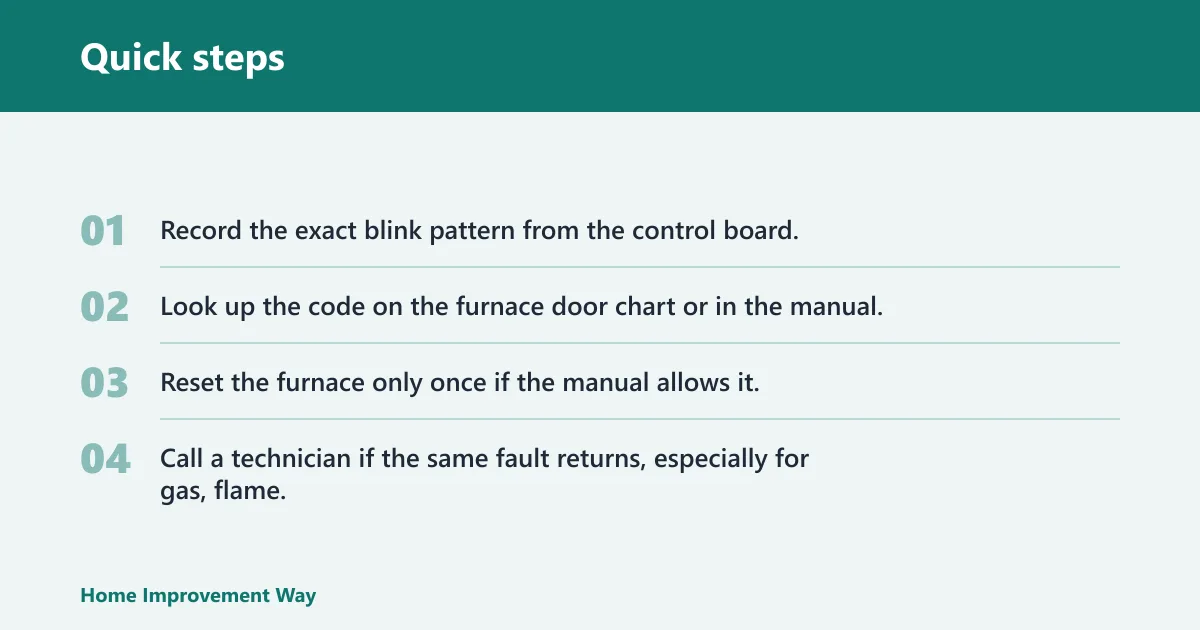
- Record the exact blink pattern from the control board.
- Look up the code on the furnace door chart or in the manual.
- Reset the furnace only once if the manual allows it.
- Call a technician if the same fault returns, especially for gas, flame, or pressure-switch errors.
Suppose the inducer starts, the igniter glows, and then the furnace shuts off before flame appears. That points to the ignition or gas stage, not the thermostat. Different stage, different part.
When should you call an HVAC technician for no-heat symptoms?
Call a technician if the furnace shows repeated lockouts, the breaker trips again, the control board reports a safety fault, or the unit smells like gas. Those signs can involve combustion, venting, or electrical problems that need proper testing and repair.
You should also stop and call for service if the blower runs but the burners never light after you have already checked settings, power, and the filter. At that point, the likely fault is inside the furnace sequence, not at the thermostat.
Frequently asked questions
Why won’t my furnace turn on when the thermostat calls for heat?
Start with the thermostat set to Heat, the setpoint at least 3°F above room temperature, the fan on Auto, and the furnace switch and breaker on. If the call is present but the furnace still does nothing, the fault is usually in power, the control board, or a safety circuit.
How do I know if the thermostat is the problem or the furnace?
If the display is blank, the batteries are weak, or the R and W wires are loose, the thermostat may be the problem. If the thermostat clearly calls for heat and the furnace LED flashes a fault code, the problem is farther into the furnace startup sequence.
What should I check first if the furnace is not responding?
Check the thermostat mode and setpoint, then the furnace switch, breaker, and filter. Those are the fastest checks that can stop the sequence before ignition. After that, read the control board light pattern so you know which stage failed.
Why is the furnace blower running but no heat starts?
That often means the furnace reached a safety stage but never completed ignition. A dirty filter can trigger the limit switch and keep the burners off, while a failed igniter, dirty flame sensor, or gas valve problem can also leave you with airflow and no heat.
Can a dirty filter stop a furnace from turning on?
Yes, a badly restricted filter can cause overheating and open the limit switch. That usually stops burner operation and may leave the blower running. Use the filter size and the manufacturer’s MERV guidance, then replace it at the interval listed in the manual.
How do I reset a furnace that won’t ignite?
Turn the thermostat off for a few minutes, then restore power at the furnace switch and breaker if the manual allows a reset. Do this once. If the same fault returns, or the board shows a pressure, ignition, or flame error, stop and call a technician.
Should I replace batteries in my thermostat if heat won’t come on?
Yes, if the thermostat is battery powered, fresh batteries are a low-cost first check. Replace them if the display is dim, blank, or warning of low power. If the thermostat is hardwired, the issue is more likely wiring, power to the furnace, or a furnace-side fault.
Sponsored / affiliate links. As an Amazon Associate I earn from qualifying purchases. I may earn additional commission from eligible campaigns.
 Faryuan Bladeless Fan, 25inch Heating & Cooling & Filter Combo Tower Fan 80° Oscillating with Remote, 9H Timer, 8 Speeds, Portable Quiet for Indoor, Bedroom, Home Office Room(Grey & Red)
 Faryuan Bladeless Heater Fan, 25inch Heating & Cooling & Filter Combo Tower Fan 80° Oscillating with Remote, 9H Timer, 8 Speeds, Portable Quiet for Indoor, Bedroom, Home Office Room, White&Sliver