Why Does My Furnace Click but Not Start?
By Home Improvement Way Editorial Team — Reviewed for safety by a licensed HVAC technician
This guide is part of our Furnace Troubleshooting: Fix Common Winter Heating Problems series.
A furnace that clicks but won’t start usually has a failed startup step: no power, a safety switch open, a weak igniter, no gas, or a control board fault. Carrier, Trane, and Lennox service instructions all follow the same basic sequence: thermostat call, power, safety checks, inducer, pressure switch, ignition, and flame proving. If the furnace is not progressing normally, stop guessing before you bypass a safety or keep resetting a lockout. This guide shows how to pinpoint the failure by where the clicking stops in the startup sequence, with clear stop-and-call thresholds based on OEM manuals, NFPA gas safety guidance, Consumer Product Safety guidance, and ENERGY STAR maintenance advice.
Safety boundary: Homeowners can check thermostat settings, furnace switch position, breaker position, panel fit, filter condition, and visible condensate problems. Do not remove sealed compartments, test gas pressure, bypass limit switches, jumper the pressure switch, clean internal burner components, or keep resetting a breaker that trips again. If you smell gas, hear repeated popping, see scorch damage, or the furnace locks out after several tries, stop and call a technician.
Startup diagnostic table

- Measures AC/DC voltage, current, resistance, continuity
- Auto-ranging with large backlit LCD
- Double ceramic fuse adds overload protection
| Symptom heard | Likely failure stage | Safe homeowner check | When to stop and call a technician |
|---|---|---|---|
| Click only | Thermostat call, power supply, door switch, or control board never completes the first step | Set the thermostat to Heat, raise the set temperature at least 3 degrees above room temperature, check thermostat batteries, make sure the furnace switch is on, and inspect the breaker position | If there is still no inducer sound, or the breaker trips again after reset |
| Click plus inducer | Draft inducer starts, but the pressure switch does not close | Look for a blocked vent, a crooked access panel, or standing water in the condensate drain on a high-efficiency unit | If the inducer runs but the furnace never moves to ignition, or the issue repeats after one restart |
| Click plus igniter glow | Ignition stage starts, but gas does not light or the sequence is interrupted | Look through the sight glass if the unit has one and confirm the igniter glows bright orange before shutdown | If it still does not light, or it lights once and then locks out after several tries |
| Click plus brief ignition then shutdown | Flame proved briefly, then the flame sensor or control board shut the furnace down | Do not keep resetting. Note whether flame appears for a few seconds before shutdown | Call a technician for flame sensor cleaning, control-board checks, or gas/venting diagnosis |
What the click means
The click usually means the furnace relay or control board has started a new step, not that the burners will light. Carrier, Trane, and Lennox manuals all treat startup as a sequence, so the exact sound pattern matters. A silent furnace with no blower and no click belongs in a different category than a clicked-but-stalled furnace.
How the startup sequence begins
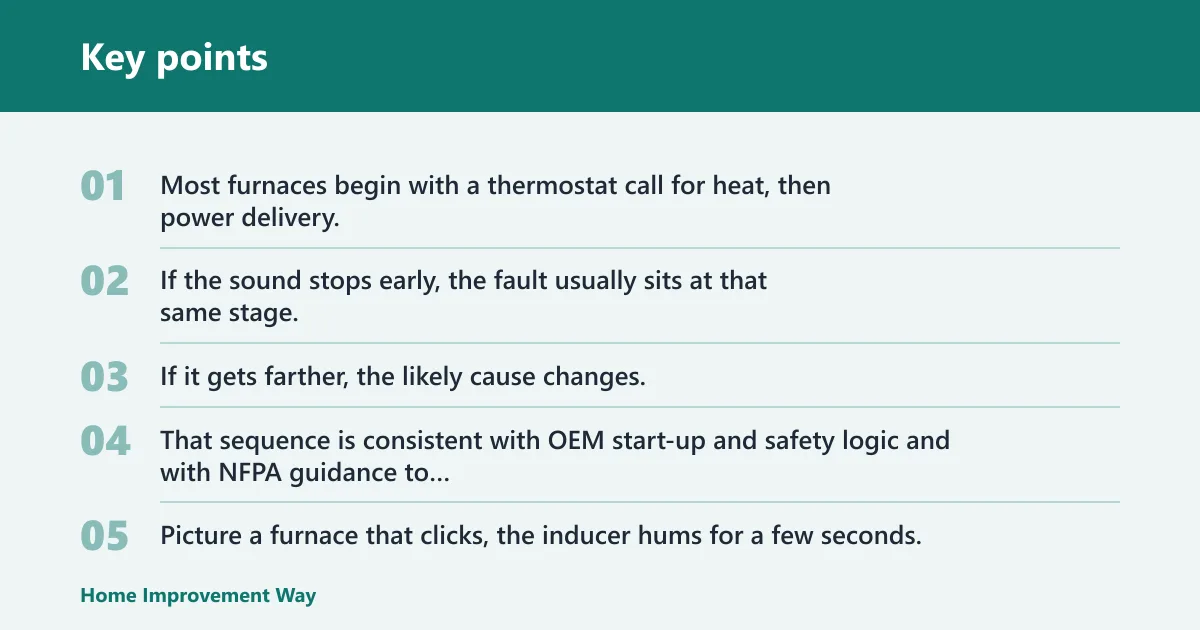
Most furnaces begin with a thermostat call for heat, then power delivery, then safety checks, then the draft inducer, then the pressure switch, then ignition, then flame sensing. If the sound stops early, the fault usually sits at that same stage. If it gets farther, the likely cause changes. That sequence is consistent with OEM start-up and safety logic and with NFPA guidance to avoid bypassing safeties.
Picture a furnace that clicks, the inducer hums for a few seconds, and then everything goes quiet. That points away from the thermostat and toward airflow, venting, or a safety interlock. A different pattern, such as a glow followed by no flame, points more toward ignition. For a deeper walk-through of the igniter stage, see the bad furnace igniter guide.
Why the stop point matters
Homeowners often call every no-heat problem the same thing. That hides useful clues. A click only, a click with inducer, a click with glowing igniter, and a click with brief ignition each point to a different layer of the system. Sorting those layers saves time and avoids risky guesswork.
Is the thermostat calling for heat?
Yes, this is the first thing to verify. The thermostat should be set to Heat, not Auto, Cool, or Off, and the set point should be at least 3 degrees above the current room temperature. Even when the screen is lit, dead batteries can still stop a proper call for heat.
Heat mode and set point
If the thermostat is in the wrong mode, the furnace will not get the call it needs. Set it to Heat and raise the target temperature enough that the furnace should respond right away. If the room is 68 degrees, for example, set it to at least 71 degrees before waiting for a response.
Dead batteries with a lit screen
Some thermostats keep displaying information long after their batteries can no longer send a reliable signal. That can create a confusing click with no start. Replace the batteries if the thermostat uses them, even if the display still looks active.
Check power at the furnace
A furnace can click and still fail if it is not getting steady power. Check the furnace power switch first. It often looks like a regular light switch and is often within 6 feet of the furnace, so it can be bumped off without anyone noticing. ENERGY STAR also recommends keeping basic maintenance simple and avoiding repeated electrical resets when a system is faulting.
Furnace switch near the unit
Look for a wall switch or service switch close to the furnace cabinet. If it is off, turn it on once and wait for the sequence. Do not keep flipping it repeatedly.
Breaker label and halfway trip
At the electrical panel, the furnace breaker may be labeled Furnace, Air Handler, or HVAC. A tripped breaker can sit halfway between On and Off, which is easy to miss. If it is in that middle position, move it fully Off, then back On once. NFPA and Consumer Product Safety guidance both treat repeated tripping as a warning, not something to keep resetting.
Why repeated trips matter
Repeatedly resetting a breaker is a warning sign because it can point to a serious electrical fault. If the breaker trips again, stop. That is not a normal nuisance issue, and it deserves a technician’s diagnosis.
Say your furnace is in a hallway closet and the wall switch beside it looks like a light switch. If a filter change or laundry basket bumped that switch off, the furnace may click once or not at all, then stop because power never stayed on long enough for the sequence to finish.
Why is the safety switch stopping it?
The access-panel safety switch can stop the furnace before startup if the front panel is off or crooked. This is a plunger-style switch behind the access panel. It keeps the furnace from running when the panel is not seated correctly, which is common after filter changes or panel removal. OEM manuals on Carrier, Trane, and Lennox units all stress that the access door must be properly installed before operation.
Door switch and access panel fit
If the panel is not fully in place, the plunger may not be depressed. The furnace may click, then refuse to continue. Re-seat the panel carefully and make sure it sits flush. If the panel is bent or misaligned, the switch may never close reliably.
Filter change problems
A filter change can leave the panel slightly out of place. That can be enough to hold the switch open. A dirty filter can also matter, but it usually creates airflow trouble later in the sequence, not an immediate power failure by itself.
Control board lockout after retries
The control board manages the ignition sequence and may lock out after multiple retries. A furnace can click, attempt startup three times, then stop trying. That is a safety response, not a random failure. Repeated resets can keep the lockout going instead of fixing it. If the unit enters hard lockout, most manuals call for correcting the fault and power-cycling only once, not endlessly.
Inducer and ignition checks
Once the thermostat, power, and door switch are working, the furnace should move into the draft inducer stage. The draft inducer motor starts before ignition and creates the airflow needed to close the pressure switch. If that stage fails, the burners will not light.
Draft inducer motor starts first
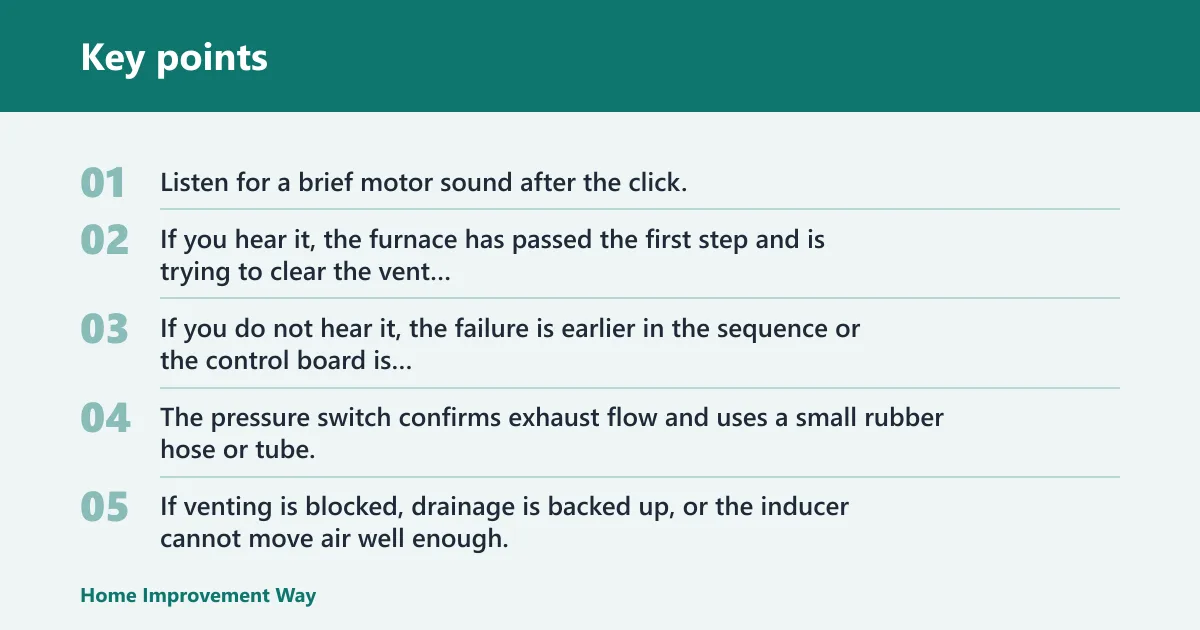
Listen for a brief motor sound after the click. If you hear it, the furnace has passed the first step and is trying to clear the vent path. If you do not hear it, the failure is earlier in the sequence or the control board is not advancing.
Pressure switch and venting
The pressure switch confirms exhaust flow and uses a small rubber hose or tube. If venting is blocked, drainage is backed up, or the inducer cannot move air well enough, the switch may not close. That stops ignition even though the furnace has already clicked and the inducer has started. This is a common lockout trigger in OEM service guides.
High-efficiency furnaces can be especially confusing here because they produce water as a byproduct of combustion. A clogged condensate drain can trigger a float switch shutdown, and that can look like a no-start problem even when the ignition parts are fine. Trane, Lennox, and Carrier service literature all treat condensate drainage as part of the startup safety path on condensing models.
Hot surface igniter glow
Modern furnaces often use a hot surface igniter that glows bright orange before gas opens. On some units, you can view that glow through a sight glass. If the inducer runs but the igniter never glows, the problem is likely in the ignition stage rather than the thermostat or door switch.
Flame sensor after ignition
The flame sensor confirms that flame is present after ignition. A coated sensor can act like an insulator because of a nearly invisible film on the rod. That problem usually causes short run times or lockout after ignition, which is different from a true no-start condition. If flame appears briefly and then shuts off, call a technician if cleaning the sensor does not clearly resolve the issue.
A common first-timer mistake is to treat a furnace that lights for three seconds and shuts off the same as a furnace that never lights. Those are different failures. A brief flame means the system got farther than a no-start, and the flame sensor or control board moves up the list.
Drain and airflow problems on high-efficiency units
On high-efficiency furnaces, a water problem can stop startup before the burners light. Check the condensate pan, pump, and drain line for standing water or obvious blockage. If the unit uses a float switch, water in the pan or line can open that switch and hold the furnace off. This is a recognized service issue in condensing furnace manuals and should be treated as a safety shutdown, not ignored.
Condensate pan, pump, and drain line
Look for water where it should not be. A clogged line, a stalled pump, or a disconnected drain hose can all keep the furnace from moving past the safety check. This is one of the most overlooked reasons a furnace clicks but does not start.
Float switch shutdown
If the float switch has opened, the furnace may stay silent after the initial click or may try and then stop. Drying the area or clearing the drain path may solve the underlying issue, but a repeated water fault needs attention because it can return quickly. If water is present again after one cleanup, stop and call for service.
Why does my furnace click and then do nothing?
That pattern usually means the furnace begins a startup step and then a safety or control condition stops the rest of the sequence. The click may come from a relay on the control board, then the unit halts because the thermostat call is weak, a door switch is open, the inducer does not prove airflow, or the system locks out after retries.
Start by identifying whether anything else runs after the click. No inducer sound suggests an earlier problem. A humming inducer points toward pressure-switch or venting trouble. A glow without flame points toward ignition. A short flame followed by shutdown points toward flame sensing or a control issue. Stop and call if you smell gas, hear repeated ignition attempts, or the furnace locks out again after one reset.
Frequently asked questions
Why does my furnace click but not start?
A click without startup usually means the furnace began its sequence but failed at a later step. Common causes include thermostat settings, lost power, an open door switch, inducer or pressure-switch trouble, ignition failure, or a control board lockout after repeated retries. The sound pattern tells you where to look first.
Is the thermostat the reason my furnace clicks but won’t run?
It can be. Confirm Heat mode, raise the set point at least 3 degrees above room temperature, and replace thermostat batteries if needed. A thermostat can look alive on the screen and still fail to send a usable heat call, which leads to clicking without a full startup.
Could a tripped breaker stop my furnace after it clicks?
Yes. A furnace breaker may trip halfway between On and Off, and that can cut power right after a click or prevent the next step from starting. If the breaker trips again after you reset it once, stop there and call a technician because repeated trips are a red flag.
Does a dirty filter keep a furnace from starting?
Sometimes, but not in the same way for every symptom. A dirty filter more often shows up as airflow trouble later in the cycle, or it may contribute to a safety shutdown. It is worth checking, but it is not the first explanation for every furnace that clicks and stops.
Can a furnace safety switch stop it from starting?
Yes. The access-panel safety switch is a plunger-style switch behind the front panel, and it prevents operation when the panel is off or crooked. That problem often shows up after filter changes or panel removal. Re-seat the panel before moving on to ignition parts or electrical troubleshooting.
Why won’t my furnace start?
When a furnace will not start, the problem is often in one of several places: the thermostat call, power supply, door safety switch, inducer and pressure switch, ignition, flame sensing, or a control-board lockout. The best clue is the exact sound pattern, because a silent unit is not the same as one that clicks and stalls.
Sources: Carrier furnace installation and service manuals; Trane gas furnace service literature; Lennox furnace installation and troubleshooting guides; AHRI residential furnace guidance; ENERGY STAR maintenance recommendations; NFPA gas appliance safety guidance; Consumer Product Safety guidance on electrical and gas appliance hazards.
Sponsored / affiliate links. As an Amazon Associate I earn from qualifying purchases. I may earn additional commission from eligible campaigns.