Why Does My Furnace Keep Shutting Off After a Few Minutes?
If your furnace starts, runs for 2 to 5 minutes, then shuts off, the problem is usually short cycling from airflow restriction, a thermostat issue, ignition trouble, or a safety switch opening. Ignoring it can leave you with no heat, higher fuel use, and repeated wear on the blower, igniter, and control board. This guide shows how to tell those causes apart by shutdown timing and symptoms before you call for repair.
This guide is part of our Furnace Troubleshooting: Fix Common Winter Heating Problems series.
Quick answer


By [HVAC Professional Credentialed Expert] — Licensed HVAC technician and building-comfort writer specializing in furnace diagnostics, airflow, and safety controls.
Why does my furnace shut off after a few minutes?
If a furnace starts, runs for about 2 to 5 minutes, then shuts off, the problem is often short cycling from airflow restriction, a thermostat issue, ignition trouble, or a safety switch opening. Ignoring it can leave you with no heat, higher fuel use, and repeated wear on the blower, igniter, and control board. This guide shows how to tell those causes apart by shutdown timing and symptoms before you call for repair.
What short cycling means
Short cycling means the furnace turns on and off too quickly instead of running a normal heating cycle. A typical cycle often lasts 10 to 20 minutes, depending on unit size and home demand. When the furnace only runs for a few minutes, comfort drops, starts become frequent, and wear rises on moving and ignition parts.
Why shutdown timing matters
The runtime tells you where to look first. A shutdown after a few seconds often points to ignition, flame sensing, or a safety lockout. A shutdown after about 2 to 5 minutes often points to airflow restriction, overheating, or a pressure-switch problem. If the furnace runs longer before stopping, the thermostat or sizing may be a better fit for the clue set. On many gas furnaces, the high-limit control is designed to open when supply-air temperatures climb too high; older fan-limit controls commonly open around 200°F and reset near 150°F, while modern electronic limits vary by model and are listed in the manufacturer’s installation instructions. The pressure switch is equally specific: if the inducer cannot establish the required negative pressure for that exact furnace, the switch remains open and the board shuts the burner down rather than guess. Those values are manufacturer-set, not universal, so the rating plate and service literature are the best references.
Which symptoms point to safety lockout?
Safety lockout is more likely when the furnace tries to start several times, shows an error code, or shuts down and stays off until power is reset. Burnt odors, water around a high-efficiency unit, or repeated fault lights also point away from simple thermostat trouble and toward a protection circuit opening for a reason. EPA indoor-air guidance also treats repeated combustion-related odors, soot, or moisture problems as signs to investigate the appliance and venting rather than keep resetting it. Manufacturer safety manuals similarly instruct technicians to stop and correct the underlying fault after repeated ignition or pressure-switch failures instead of overriding the control.
Furnace keep shutting off table
| Runtime pattern | Probable cause | What to inspect first | Escalation threshold |
|---|---|---|---|
| A few seconds to 1 minute | Ignition failure, flame-sensing fault, or control board lockout | Thermostat call for heat, power at the breaker, and any error code on the furnace | Call for service if it repeats after one reset or shows the same fault code again |
| About 2 to 5 minutes | Dirty air filter, blocked vents, airflow restriction, overheating, or pressure-switch fault | Filter condition, supply and return vents, and obvious blocked airflow around the cabinet | Stop if the unit smells hot, shuts off repeatedly, or trips a safety switch again |
| Runs longer, then stops and restarts | Thermostat placement or sensor issue, oversizing, or a weaker airflow problem | Thermostat batteries, location near vents or sunlight, and room-to-room temperature balance | Book service if the pattern persists after basic thermostat and filter checks |
| Shuts off only during long demand cycles | Overheating, dirty blower path, or venting issue that appears after the system warms up | Filter, vents, condensate drain on high-efficiency units, and furnace error display | Call a technician promptly if the furnace locks out or shows repeated safety faults |
Say your furnace heats the house normally for about 3 minutes, then shuts down before the rooms feel warm. That pattern fits airflow restriction better than a thermostat problem, especially if the return grille is clogged or several supply vents are closed. A 20-minute cycle would point in a different direction.
What should you check first?
Begin with the filter, the thermostat, and the vents. Those checks catch many short-cycling problems, and you can verify them fast without tools. If the furnace still shuts off after that, move to airflow path and safety-switch clues before resetting power or opening panels.
Replace or inspect the air filter
A dirty or clogged air filter is one of the most common causes of short cycling. It cuts airflow, can make the furnace overheat quickly, and may trigger a safety shutoff. Check the filter and replace it if it looks loaded with dust. An overdue furnace filter should be checked and replaced, typically every 1-3 months.
Check thermostat batteries and placement
Thermostat problems can look like furnace failure. If the batteries are weak, the thermostat may send unstable calls for heat. Also check placement. A thermostat near a supply vent, direct sunlight, or a draft can read the room incorrectly and end the heating cycle too early. For room-placement guidance, it helps to think of the thermostat as a measurement device first and a switch second; if the measurement is off, the furnace may never get a proper signal to stay on. For a deeper walkthrough of related control problems, see why furnace short cycle.
Thermostat sensor error can show up as short runs with no other furnace fault. If the display is blank, the batteries are the first place to look. If the unit sits in a hallway with a return grille nearby, air movement can make the sensor think the room is warmer than it is.
Open blocked supply and return vents
Blocked vents or duct issues can create pressure imbalances and frequent shutdowns. Walk through the home and open closed supply registers. Then make sure return grilles are not covered by furniture, rugs, or storage. Room-to-room temperature imbalance is a useful clue: one room overheats while another stays cool.
Look for obvious airflow obstructions
Check the area around the furnace cabinet too. Boxes, paint cans, and laundry can choke the air path around the unit. A dirty blower path or visible dust buildup near the intake and blower housing can also reduce circulation. Poor airflow often makes the furnace heat up too fast and stop early.
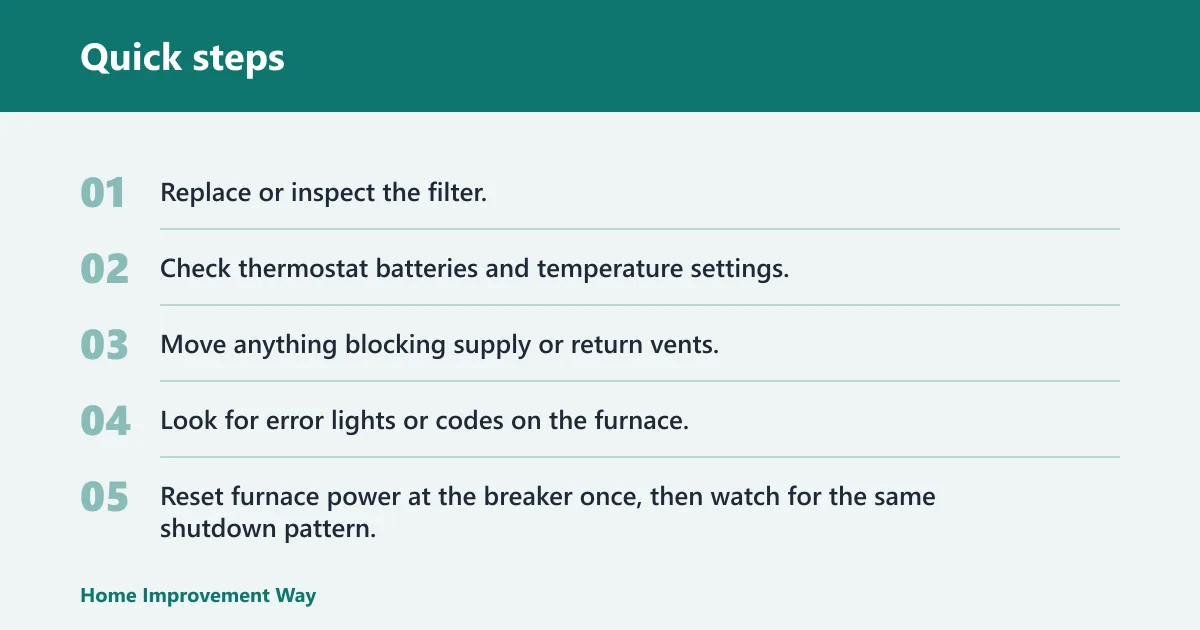
- Replace or inspect the filter.
- Check thermostat batteries and temperature settings.
- Move anything blocking supply or return vents.
- Look for error lights or codes on the furnace.
- Reset furnace power at the breaker once, then watch for the same shutdown pattern.
Could airflow or venting be the cause?
Yes. Airflow and venting problems are common when a furnace runs for a few minutes and then stops. A restricted filter, dirty blower path, blocked vent, or venting fault can change temperature and pressure enough to trip a limit switch or pressure switch. High-efficiency furnaces add condensate drain issues to that list.
Dirty blower path and weak circulation
The blower motor moves heated air through the ducts, and it takes a hit when airflow is poor. Repeated starts can cause repeated high-amp draws, which add wear. If the blower wheel, cabinet, or nearby duct opening is dirty, the furnace may not move enough air to stay within safe temperature limits.
High-efficiency vent and drain issues
On high-efficiency furnaces, a blocked condensate drain or vent fault can stop the unit even when the thermostat still calls for heat. Water in the drain line, a clogged trap, or a partially blocked intake or exhaust pipe can change pressure enough to trigger shutdown. That is a different path from a simple dirty filter. Many condensing furnace manuals call for verifying the condensate trap, drain slope, and vent termination before replacing components, because water backing up into the pressure system can prevent a proper draft signal.
Pressure switch faults tied to airflow
The pressure switch is a safety device tied to airflow and venting. If the system cannot prove proper draft or pressure, the furnace shuts down. This often shows up with vent blockages, drain issues, or other airflow restrictions in condensing furnaces. If the same code returns after a reset, the switch is usually reacting to a real fault, not a random glitch. In practical terms, the board is waiting for the inducer to establish the required negative pressure before allowing ignition; if the required differential is not met, the sequence stops. That is why repeated pressure-switch lockouts should be treated as a venting or inducer problem until proven otherwise, not as a sensor to bypass.
Picture a high-efficiency furnace that runs 4 minutes, then stops with a fault light after a rainy day. Water in the condensate trap or a partially blocked vent can change the pressure enough to stop the cycle. That symptom points away from the thermostat and toward venting or drain service.
Can the thermostat or ignition be causing it?
Yes. If airflow looks fine, the next split is between thermostat sensing and startup components. Thermostat errors usually show up as poor temperature control or short runs that happen at random. Ignition problems often show up when the furnace starts, then drops out shortly after ignition or during the first heat call.
Thermostat sensing problems
A thermostat can end a cycle too soon if its sensor is reading the wrong temperature. Weak batteries, bad placement, or dust inside the thermostat can cause that. Check that the setting is on heat, the fan setting is not forcing odd behavior, and the unit is not near a vent, sunlight, or a draft.
Ignition or flame-sensing shutdowns
Ignition systems wear faster when they are constantly demanded. If the furnace starts and then drops out soon after ignition, the issue may be with the igniter, flame-sensing circuit, or gas delivery path. That is not a DIY burner-flame check. It is a repair bucket for a technician with the right test gear. Manufacturer service guides typically treat repeated ignition retries and flame-loss lockouts as a call-for-service condition because the control board is already verifying safety before allowing another attempt.
Furnace control board fault codes
The furnace control board reads safety fault conditions and can stop the cycle when a problem shows up. Error codes on the board or through the status light help narrow the cause. If the same code appears after a single breaker reset, that is usually a sign to stop guessing and move to service.
A common first-timer mistake is replacing the thermostat because the room feels uneven, when the real issue is a clogged filter and a control board that is reacting to overheating. The clue is the timing: a few minutes of runtime, then shutdown, especially with warm air from one register and little flow from another.
When is short cycling a safety issue?
Short cycling becomes a safety issue when it is tied to overheating, repeated lockouts, water around the furnace, or a fault that returns after reset. Those signs mean the furnace is not just inefficient; it is reacting to a condition that could damage parts or keep the system from operating safely.
Overheating and limit shutdowns
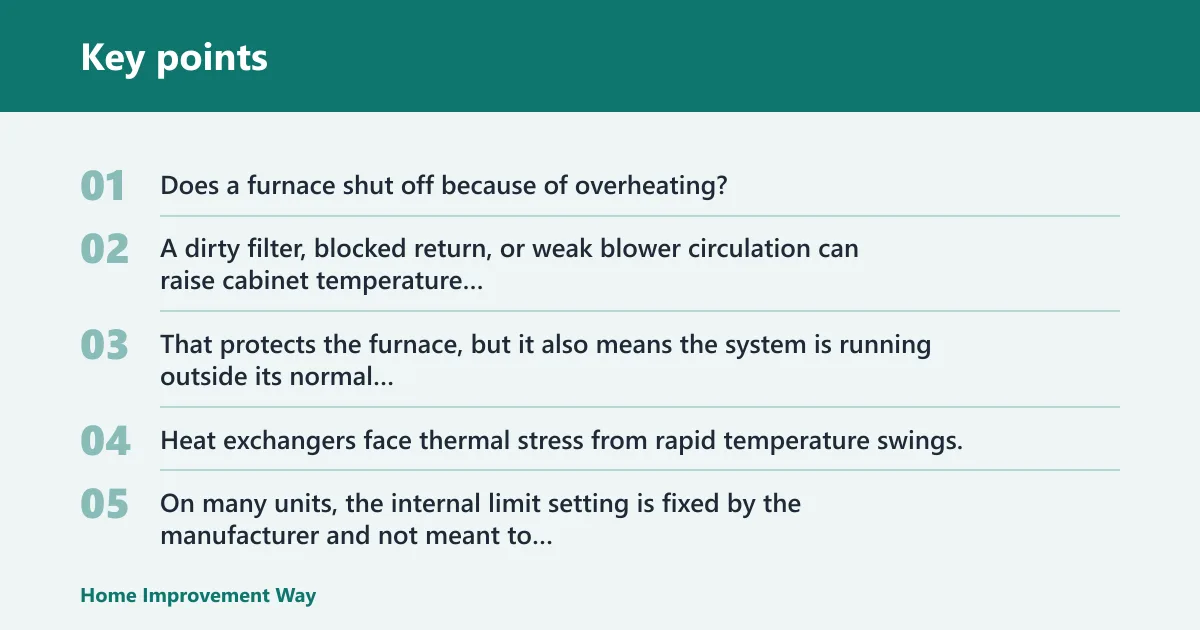
Does a furnace shut off because of overheating? Often, yes. A dirty filter, blocked return, or weak blower circulation can raise cabinet temperature until the limit switch opens. That protects the furnace, but it also means the system is running outside its normal airflow range. Heat exchangers face thermal stress from rapid temperature swings, so repeated overheating is not something to ignore. On many units, the internal limit setting is fixed by the manufacturer and not meant to be adjusted in the field; a technician uses the service literature to confirm the specified trip point instead of guessing.
Repeated lockouts
If the furnace keeps trying, stops, and then locks out, the board is likely seeing the same fault over and over. Repeated lockouts matter because they point to a recurring problem rather than a one-time glitch. That can be a vent issue, a pressure-switch fault, or a failed ignition component. Safety lockout is a protective mode, not a nuisance feature; when the same fault repeats, the control is warning that the sequence did not meet the manufacturer’s operating conditions.
Burning smells, water around the unit, or visible error codes
Stop troubleshooting and call for service if you smell hot insulation, see water near a high-efficiency furnace, or see the same error code again after a reset. Those are not normal signs of short cycling. They point to overheating, condensate trouble, or a safety device doing its job.
When to book an HVAC technician
Call an HVAC technician if the filter, thermostat, and vents check out but the furnace still shuts off after a few minutes. A technician will usually test airflow, ignition, pressure switch operation, drain condition on high-efficiency units, and the control board’s fault history. Annual professional tune-ups are recommended to clean burners and test safety controls.
Frequently asked questions
Why does my furnace keep shutting off after a few minutes?
That pattern usually points to short cycling from airflow restriction, a thermostat issue, ignition trouble, or a safety switch opening. A shutdown after 2 to 5 minutes leans toward overheating or venting trouble more than a pure thermostat fault. Check the filter and vents first, then look for error codes.
Why does my furnace keep turning off?
If the furnace turns on and off frequently, the cause may be a dirty filter, blocked vents, weak thermostat sensing, or an ignition fault. Start with the easiest checks, filter, thermostat batteries, and visible airflow obstructions. If the same shutdown repeats after one reset, a technician should test the safety controls.
Why does my furnace keep shutting off after a few seconds?
A shutdown after a few seconds usually points to startup failure rather than overheating. That can mean an ignition problem, a flame-sensing fault, or a control board lockout. If the furnace does not stay lit long enough to begin a normal heat cycle, it is less likely to be a simple airflow issue.
Is a dirty air filter enough to make a furnace short cycle?
Yes. A dirty air filter can restrict airflow enough to make the furnace overheat and trigger a safety shutoff. That is one of the most common and most fixable causes. If the filter is overdue or visibly loaded with dust, replace it and watch whether the cycle length returns closer to normal.
Can a thermostat problem cause short cycling?
Yes. Weak batteries, poor placement, or a sensor that reads the room wrong can end the heat call too early. A thermostat near sunlight, a vent, or a draft may shut the furnace down before the space truly warms up. If replacing the batteries does not help, the sensor or location may need attention.
When should I call an HVAC technician for short cycling?
Call for service if the furnace still shuts off after the filter, thermostat, and vent checks, or if you see repeated fault lights, burning smells, water around a high-efficiency unit, or the same shutdown after a breaker reset. Those signs suggest a safety-related fault, not a simple setting problem.
Sources
- Environmental Protection Agency (EPA), indoor air quality and combustion appliance guidance: repeated odors, moisture, soot, or combustion concerns should be evaluated rather than ignored.
- Manufacturer installation and service instructions for residential gas furnaces: limit control, pressure-switch, and lockout behavior are model-specific and must be verified against the unit’s technical literature.
- ASHRAE comfort and ventilation guidance: airflow, temperature balance, and pressure relationships affect how heating systems operate and why nuisance shutdowns can occur.
Sponsored / affiliate links. As an Amazon Associate I earn from qualifying purchases. I may earn additional commission from eligible campaigns.
 ROVSUN 18000 BTU Mini Split AC/Heating System with Inverter, 20 SEER2 Energy Saving 230V Ductless Split-System Air Conditioner with Pre-Charged Condenser, Heat Pump, Remote Control & Installation Kit
 Faryuan Bladeless Heater Fan, 25inch Heating & Cooling & Filter Combo Tower Fan 80° Oscillating with Remote, 9H Timer, 8 Speeds, Portable Quiet for Indoor, Bedroom, Home Office Room, White&Sliver