Are Electric Fireplaces Good for Heating a Room?
Yes, an electric fireplace can heat a small, well-insulated room, often up to about 400 square feet with a 1500-watt unit that outputs around 4,600 BTU, but it will not heat a whole house. Size it wrong, and you waste electricity while the room stays cold. This guide explains how much heat electric fireplaces provide, which rooms they can handle, and when you need a different heater.
When electric fireplaces excel—and where they fail
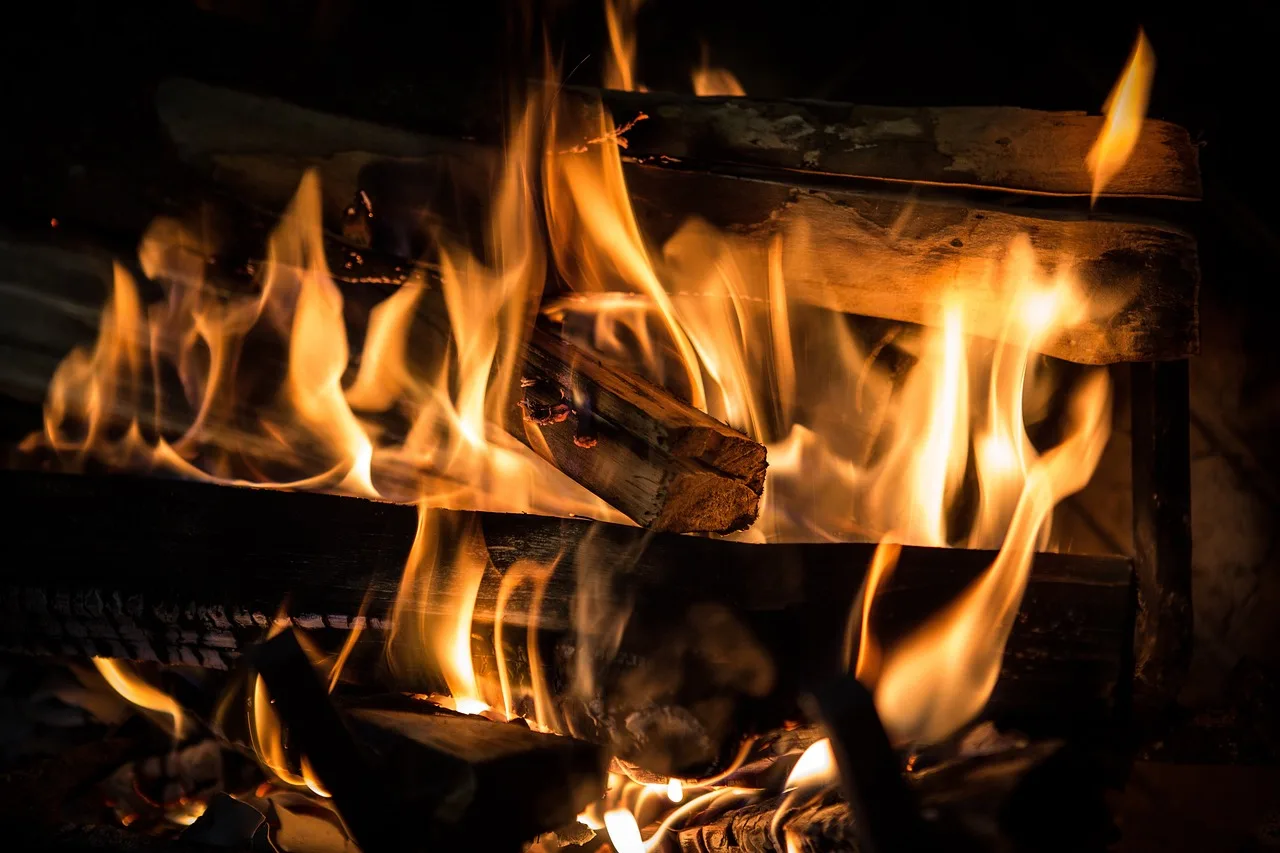
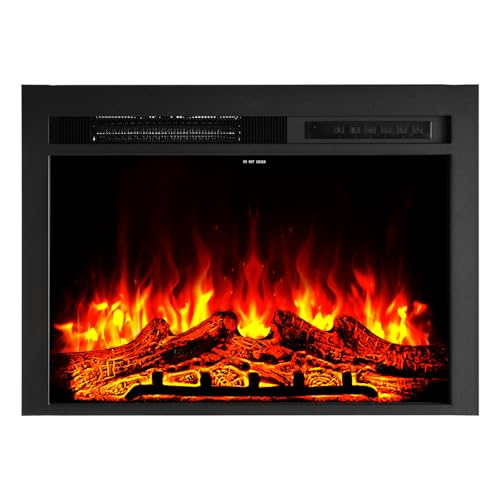

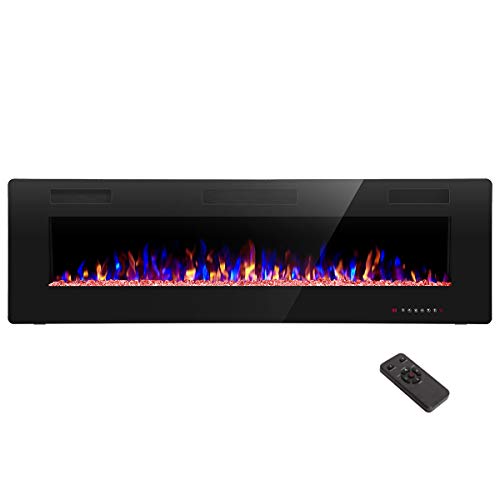
Yes, for targeted room heat. An electric fireplace is a fair choice when you want noticeable warmth in an occupied room, especially a bedroom, office, den, or finished basement that stays closed off. It is a poor choice for heating an entire home, large open spaces, or rooms with strong drafts.
The key limit is output. A common electric fireplace heat mode uses 750 W or 1500 W settings, and heat depends on how much air it must warm, how leaky the room is, and how high the ceiling is. The flame effect can look convincing, but it does not add heat.
What they heat well
Electric fireplaces work best as extra heat for one room. They are often most useful in rooms where people sit for long stretches and want the space a few degrees warmer without running central heat harder than needed.
- Small to medium enclosed rooms
- Rooms with standard 8-foot ceilings
- Spaces with closed doors and limited drafts
- Areas where you want heat in one zone, not the entire home
Where they fall short
They lose usefulness fast as room volume and air leakage rise. Open floor plans, vaulted ceilings, uninsulated additions, and rooms with frequent door opening are the common failure points. In those spaces, the heater can run and still feel underpowered.
Suppose you place a 1500-watt unit in a roughly 500-square-foot family room that opens to a kitchen and hallway. The flame effect still looks the same, but the warm air spreads thin. The result is a comfort feature, not a room heater you can count on.
How much heat can an electric fireplace really provide?
Most electric fireplaces are limited by wattage, not by the look of the firebox. The common 750 W and 1500 W settings matter more than the flame style, because they determine how much electrical energy becomes heat. In practice, 1500 W is the setting that usually gives the most useful room warming.
Room size matters more than decoration. A competitor product review says heating worked well for a room up to around 400 square feet, and the same review notes dual heat settings of 750W and 1500W. Another review says an infrared stove warmed up to around 1,000 square feet, but that is not a standard expectation for a typical electric fireplace.
Electric fireplace heat table
| Room condition | Approx. square footage band | Insulation quality | Ceiling height | Draft level | Likely usefulness |
|---|---|---|---|---|---|
| Bedroom, office, or den with door closed | Up to 200 sq ft | Good | 8 ft | Low | Noticeable supplemental heat |
| Finished room with moderate heat loss | 200–400 sq ft | Average | 8 ft | Low to moderate | Noticeable supplemental heat |
| Living room with some openings | 400–600 sq ft | Average | 8 ft | Moderate | Marginal heat |
| Open-plan main floor | 600 sq ft and up | Average or poor | 8 ft or higher | Moderate to high | Insufficient heat |
| Room with vaulted ceiling or unsealed additions | Any size above 250 sq ft | Poor | 10 ft or higher | Moderate to high | Insufficient heat |
That table is the practical test. If your room is small, closed off, and reasonably sealed, the heater can make a clear difference. If the space is large, tall, or drafty, the same unit becomes a weak comfort aid.
What wattage and electrical setup do you need?
Check the nameplate rating before you buy. Electric fireplace heaters commonly use 750 W or 1500 W heat settings, but the plug and circuit still need to match the unit’s electrical demand. A unit that looks slim can still draw enough current to matter on an overloaded branch circuit.
One electric fireplace example uses a VDE-tested plug, and one product shows operating voltage of 220–240 V at 50 Hz. Overall width alone does not prove outlet compatibility. That is the right caution: dimensions tell you little about electrical fit.
When a dedicated circuit matters
A dedicated circuit matters when the fireplace shares power with other high-load appliances or when the branch circuit is already near capacity. That issue is more common in older homes, converted basements, and rooms with other heaters, dehumidifiers, or entertainment gear on the same line.
If the fireplace trips a breaker, dims lights when it starts, or is on a circuit serving multiple outlets in the same room, the electrical setup deserves a closer look. The unit may still be fine. The wiring may not be.
- Read the nameplate rating. Check the voltage, wattage, and plug type on the label or manual before purchase. This tells you whether the unit expects a standard outlet or a different supply.
- Match the outlet type. Confirm the outlet can accept the plug without adapters. A plug that fits physically does not always mean the circuit is appropriate for the load.
- Check circuit sharing. Find out what else runs on that breaker. If the fireplace shares a circuit with other heavy loads, the chance of nuisance trips goes up.
- Ask for an electrician review. Bring in an electrician if the room wiring is old, the breaker trips, or the unit calls for a setup that does not match the outlet you have. That is the safe point to verify capacity and compliance.
Which room conditions help or hurt performance?
Square footage is only one part of the answer. Insulation, drafts, and ceiling height change how much heat stays in the room after the fireplace runs. A room that seems only a little larger on paper can demand much more heat if air leaks and volume are high.
Room size and ceiling height
Heat rises, and tall ceilings give it more space to spread out before it helps the people in the room. Standard-height rooms are easier for electric fireplaces to warm because the heated air stays concentrated where people sit or stand.
As a general rule, a 1500-watt unit is often more plausible in a closed 150- to 400-square-foot room than in a vaulted great room. The same heater can feel strong in one setup and weak in another.
Insulation and drafts
Insulation quality changes the result as much as wattage does. A small room with poor insulation and leaky windows can feel colder than a larger room that is tight and well sealed. Drafts pull away the warm air the heater just made.
Open floor plans and adjoining spaces
Open floor plans are the hardest fit. If the fireplace sits in a room that flows into a kitchen, hall, or stairwell, the heated air spreads into more square footage than the unit can handle. That is why a compact den may warm up while an open main floor barely changes.
A common first-timer mistake is judging the unit by flame brightness instead of room shape. Picture a 300-square-foot office with a closed door versus a 300-square-foot sitting area open to a stairwell. Same size on paper. Very different heat retention.
Can an electric fireplace replace central heat?
No. An electric fireplace should not replace central heat for a whole home. It is best used as localized heat in a room you are occupying, especially when you want to warm one space without raising the thermostat for the entire house.
That use case is also where the energy tradeoff makes sense. Running a 1500-watt heater can be reasonable for one room for a short period, but it is a poor substitute for a properly sized heating system serving the full house. Electric fireplaces are comfort tools, not system replacements.
Best use in occupied rooms
The best use is simple: heat the room you are in now. If you work from home in a small office, read in a den, or sleep in a cool bedroom, the fireplace can add local warmth without heating unused rooms.
Why whole-house heating is a bad fit
Whole-house heating needs airflow, distribution, and capacity that most electric fireplaces do not have. They do not move heat through ductwork, and they do not make sense as the main source for multiple rooms at once. A single appliance with one outlet cannot cover that load reliably.
What controls and safety features matter most?
Look for controls that let you separate heat from the flame effect. Many models keep the LED flame effect on with the heat off, which is useful for ambience during mild weather. Remote control, multiple heat settings, and a thermostat or timer make the heater easier to use in a real room.
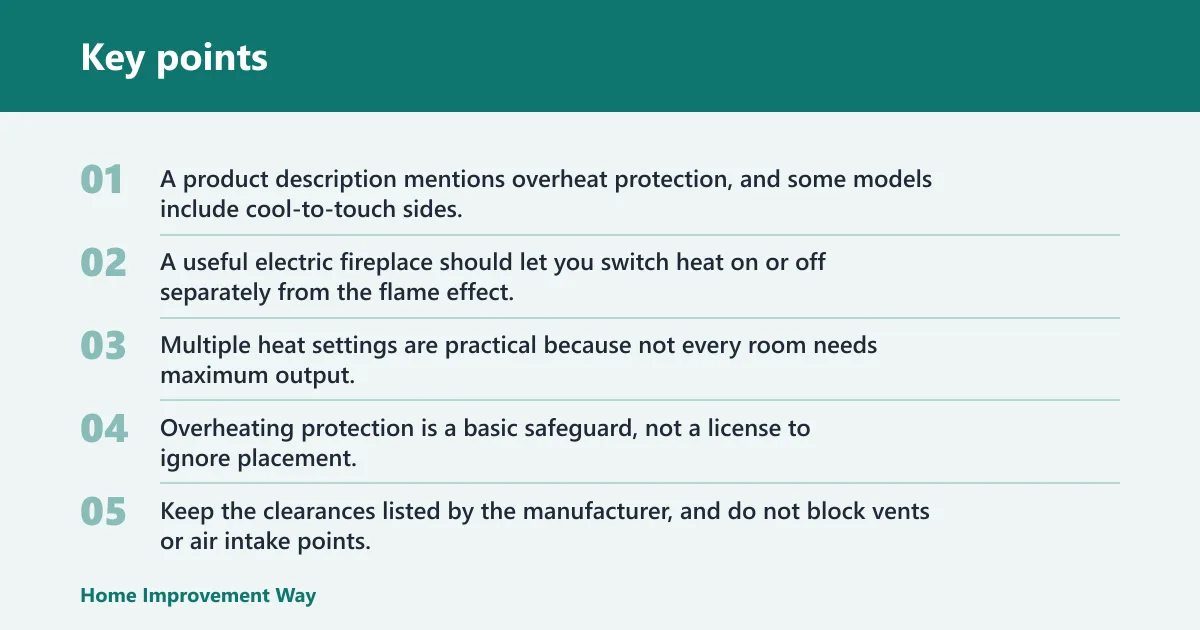
Safety features matter just as much. A product description mentions overheat protection, and some models include cool-to-touch sides. Clearance requirements still apply, and the unit should never be treated as safe to place against curtains, furniture, or trim.
Heat controls and timers
A useful electric fireplace should let you switch heat on or off separately from the flame effect. The same listing that mentions three flame brightness levels also offers a 7-day timer, which helps if you want scheduled heating or ambient light without leaving the unit on all day.
Multiple heat settings are practical because not every room needs maximum output. Lower heat can be enough for a small, sealed room, while the 1500 W setting is the one that usually matters when you need the strongest room warming.
Safety features and clearances
Overheating protection is a basic safeguard, not a license to ignore placement. Keep the clearances listed by the manufacturer, and do not block vents or air intake points. Even a cool-to-touch cabinet still needs space around it for safe operation.
Remember the outage limit too. Electric fireplaces will not work in a power outage. That is an important difference from wood or gas fireplaces, and it matters in homes that expect emergency heat during storms.
Flame effect versus heat function
The flame effect is visual only. LED flame effect systems may offer brightness adjustment and color customization, but those settings change appearance, not heating output. Realism is a design choice, not proof of strong heat.
Frequently asked questions
Are electric fireplaces good for heat?
Yes, if you need extra heat in a small, enclosed room. They are a practical choice for targeted comfort, especially at 1500 W. They are not a whole-house heater, and they lose effectiveness quickly as room size, drafts, and ceiling height increase.
Does a fireplace actually heat a room?
An electric fireplace can heat a room, but only within its limits. A small or medium closed room can feel warmer within minutes, while a large open area may change little. The result depends more on square footage and insulation than on the flame effect.
Can an electric fireplace heat a house?
No. An electric fireplace is not built to heat an entire house. It can warm one occupied room, but it cannot distribute heat through multiple rooms or overcome large-scale heat loss the way a central system does.
How much room can an electric fireplace heat?
A common 1500-watt unit can be useful in a room up to around 400 square feet when the space is fairly well sealed. Smaller rooms do better. Larger rooms, open plans, and high ceilings reduce the practical heating range fast.
What wattage is best for an electric fireplace heater?
For most room-heating use, 1500 W is the more useful setting. The 750 W setting can add mild comfort or help in a very small room, but it is usually too weak for serious extra heat. Room size and insulation still decide the outcome.
Do electric fireplaces work during a power outage?
No. Electric fireplaces need power to run the heater and the flame effect. If the power goes out, they stop working. That makes them unsuitable as emergency heat unless you have another backup source.
Sponsored / affiliate links. As an Amazon Associate I earn from qualifying purchases. I may earn additional commission from eligible campaigns.
 ROVSUN 18000 BTU Mini Split AC/Heating System with Inverter, 20 SEER2 Energy Saving 230V Ductless Split-System Air Conditioner with Pre-Charged Condenser, Heat Pump, Remote Control & Installation Kit
 Key Finder with Up to 131ft Working Range in Open Space, Simjar Wireless Remote Control RF Key Finder Locator for Keys Wallet Phone Glasses Luggage Pet Tracker