Why Is the Air From My Vents Lukewarm? Causes and Checks
Lukewarm vent air usually means restricted airflow or a heat-production problem. If supply air is about 15° to 30°F warmer than return air, start with airflow checks before replacing parts. Skipping those checks can raise energy use, shorten furnace run cycles, and send you toward the wrong repair. This guide shows how to separate filter, duct, and blower issues from burner, ignition, and gas-supply failures.
Lukewarm vent air decision table


| Symptom pattern | Likely subsystem | Safe homeowner check | When to stop troubleshooting and call a technician |
|---|---|---|---|
| Air feels warm, but not hot, from every supply vent | Airflow, blower, ignition, or heat exchanger | Confirm Heat mode, setpoint above room temperature, and fan on Auto; inspect the filter and return grilles | If the furnace short-cycles, locks out, or keeps sending lukewarm air after basic checks |
| One room feels okay while another stays cool | Duct balance or a blocked branch | Check for closed supply registers, furniture in front of vents, and a blocked return grille | If the unevenness persists after opening vents and clearing returns |
| Furnace runs, blower moves air, but heat never feels fully hot | Igniter, draft inducer, pressure switch, or control issue | Look for error lights or reset conditions only if the access panel is already closed and safe to observe | If the furnace never lights, lights and shuts down, or shows repeated fault codes |
| Airflow seems weak at many vents | Filter, blower motor, capacitor, or high static pressure | Check the filter size, confirm it is clean, and verify supply vents are open | If weak airflow continues after those checks |
| Air starts warm, then turns cooler during the cycle | Overheating, airflow restriction, or safety shutdown | See whether several vents are closed and whether the return path is clear | If the furnace stops early or restarts after a cooling-off pause |
Is your thermostat set correctly?
Start here because the thermostat can stop heating before any furnace part matters. The system should be set to Heat, the setpoint should be above room temperature, and the thermostat fan setting should usually be Auto during normal heating diagnosis. If the display, wiring, or control communication is wrong, the furnace may never get the signal to heat.
Heat mode and setpoint
During heating season, Heat mode should be selected and the setpoint should sit above the current room temperature. If the thermostat is set too close to room temperature, the furnace may idle or cycle too briefly to feel hot at the vents.
Fan setting: Auto versus
Auto is usually the right choice for diagnosis because the blower runs only when the furnace is actually producing heat. On can move room-temperature air through the ducts and make the supply air feel lukewarm, especially right after a call for heat ends.
When thermostat wiring or communication may be the issue
If the thermostat is calling for heat but the furnace does not respond, the problem may be wiring or control communication rather than a bad burner. That is the point where the issue has moved beyond a simple setting check and into system troubleshooting.
Can a dirty filter make air feel lukewarm?
Yes. A dirty or clogged filter is a leading cause of airflow issues, and a furnace needs enough airflow across the heat exchanger to deliver proper heat. When airflow drops, the air leaving the registers can feel only mildly warm, and the furnace may overheat or shut down on safety controls.
Why a clogged filter changes the feel at the vents
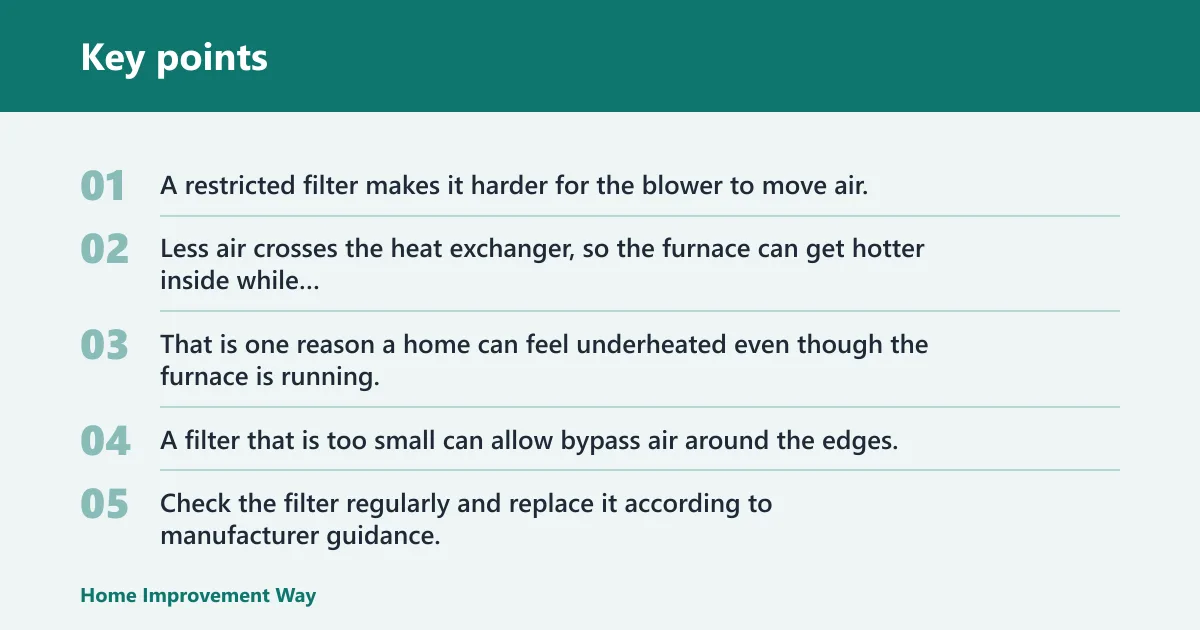
A restricted filter makes it harder for the blower to move air. Less air crosses the heat exchanger, so the furnace can get hotter inside while delivering less heat to the rooms. That is one reason a home can feel underheated even though the furnace is running.
Why the correct filter size matters
The filter must match the furnace opening. A filter that is too small can allow bypass air around the edges, while an incorrect fit can add unnecessary resistance. Either problem can hurt airflow and comfort.
How often to check it
Check the filter regularly and replace it according to manufacturer guidance, with more frequent checks in dusty homes or homes with pets. Dust load matters more than a calendar date alone, so a short interval in one home may be normal while a longer interval works in another.
Picture a 3-ton gas furnace that heats fine for a few minutes, then the air turns tepid and the burner stops. If the filter is gray and loaded with dust, the airflow restriction may be enough to make the furnace overheat and shut down before the house warms up.
Are vents and returns blocking airflow?
Yes. Supply vents and return grilles should stay open and free of blockage. Blocked vents reduce airflow and comfort, and closing several supply vents raises static pressure instead of reliably sending more air to one room. That extra resistance can make the whole system feel weaker.
Open supply vents and clear return grilles
Furniture, drapes, rugs, and storage boxes can block the intake or the supply path. Return air matters as much as supply air because the furnace can only deliver what it can pull back through the system.
Why closed vents raise static pressure
Static pressure is the resistance the blower works against. When you close several supply vents or have restricted ducts, pressure rises and airflow drops. Higher pressure can also worsen duct leaks and other hidden losses, which means less conditioned air reaches the rooms.
Signs of duct or room balance problems
If one bedroom feels fine while the far end of the house stays lukewarm, the issue may be a restricted branch, a weak return path, or poor duct balance rather than a failed heat source. That pattern points to airflow distribution, not automatically to the furnace burner.
A common first-timer mistake is closing several registers in an effort to send more heat to one room. That often does the opposite: the furnace works against higher resistance, delivered airflow falls, and the rest of the house can feel cooler.
How the furnace heats air
A furnace heats air in stages. The igniter lights the gas, the draft inducer helps support safe venting in many furnaces, the pressure switch helps confirm the venting path is working, and the heat exchanger transfers heat to the air that the blower moves through it. If any of those steps fail, the blower can still run while the supply air stays lukewarm.
Heat exchanger and delivered heat
The heat exchanger is where the air picks up heat before it reaches the ducts. If airflow is restricted, the furnace may overheat and shut down even though the burner is producing heat. That is why a weak filter or closed vents can create a heating complaint that looks like a part failure.
Blower motor and capacitor
The blower motor moves air across the heat exchanger. On some systems, a weak capacitor can affect blower startup or reduce airflow, which leaves the furnace running but the vents feeling mild. Older furnaces may use a belt-driven blower motor, so belt wear can also reduce delivery.
Igniter, draft inducer, and pressure switch
If the igniter fails, the furnace may never light, so the blower can move unheated air. If the draft inducer motor or pressure switch has a problem, the furnace may not start the heating cycle or may stop partway through it because the venting sequence is not proving out correctly.
Why some vents are warmer than others
Uneven vent temperatures usually point to duct balance, return-air problems, or a restricted branch. If one supply is hot and another is lukewarm, the furnace may still be producing heat; the issue can be in how that heat is distributed from room to room.
Duct balance and restricted branches
A long branch run, a partially closed damper, or a crushed flex duct can starve one room of airflow while another room gets more than enough. Closing too many vents in the house can make the difference worse by increasing static pressure throughout the system.
Return-air problems
A room with little return air can feel stuffy and cooler because air cannot move through it efficiently. If a bedroom has a closed door and no good return path, the supply register may blow warm air while the room itself stays behind the rest of the house.
When uneven temperatures point to a service call
If the unevenness appeared suddenly, or if several rooms changed at once, the problem may be deeper than balance alone. A technician should inspect for duct restriction, blower output problems, or a control issue if the pattern does not improve after basic airflow checks.
What happens when static pressure gets too high
High static pressure means the blower is pushing against too much resistance. That can reduce delivered airflow, make heat feel weaker at the vents, and create a chain where restricted airflow raises furnace temperature, which can trigger safety shutdown. The result is lukewarm air, shorter cycles, or repeated restarts.
How restricted airflow affects comfort
Restricted airflow can make the house feel underheated even when the furnace is technically running. The air leaving the registers may not move far enough or long enough to warm the rooms well, so comfort drops before the furnace fully fails.
How overheating can trigger safety shutdown
If the furnace overheats from interrupted airflow, the safety controls can stop the burner to protect the heat exchanger. That shutdown can make the blower keep running while the supply air gradually turns cooler, which confuses the diagnosis if you are only checking the vents.
What a homeowner can check safely
- Set the thermostat to Heat and raise the setpoint above room temperature.
- Switch the fan to Auto for normal heating diagnosis.
- Inspect the filter and replace it if it is dirty or clogged.
- Open supply vents and clear return grilles of furniture, drapes, and debris.
- Verify the furnace breaker and service switch.
- Stop there if the furnace still short-cycles, locks out, or blows lukewarm air.
What should I check first before calling for furnace repair?
Check the thermostat, filter, vents, and power first. Those items are safe to verify, and they cover the most common airflow-related causes of weak heat. If those checks do not help, the remaining suspects are usually internal components or controls that need a technician.
Suppose the thermostat is set correctly, the filter is clean, and all vents are open, but the furnace still runs with lukewarm supply air. That pattern shifts attention away from the easy checks and toward ignition, blower, pressure switch, or venting faults.
Frequently asked questions
Why is the air from my vents lukewarm instead of hot?
Lukewarm vent air usually means the furnace is moving air faster than it is making heat, or it is not making heat long enough. Start with the thermostat, filter, and vents. If those are fine and the problem persists, look at ignition, blower output, or venting controls.
Why is my furnace running but not heating the house?
If the furnace runs but the house still feels cold, the blower may be moving air without enough heat added to it. A failed igniter, pressure switch problem, draft inducer issue, or overheating shutdown can all leave you with airflow but little usable heat.
Can a dirty filter make furnace air feel lukewarm?
Yes. A blocked or dirty filter can cut airflow enough that the air never picks up enough heat at the heat exchanger. It can also raise the risk of overheating and shutdown, which makes the problem feel worse even though the furnace is technically operating.
Why are some vents blowing warm air and others not?
Uneven vent temperatures usually point to duct balance, restricted branches, or return-air problems. One room may get enough airflow while another is starved by a closed vent, a blocked grille, or a long duct run. If the pattern is sudden or widespread, call for service.
Should the furnace fan be on Auto or On?
Auto is usually the right setting during heating diagnosis because it lets the blower run only when the furnace is calling for heat. On can move room-temperature air through the ducts and make the supply air feel lukewarm, which can hide the real problem.
Can closed supply vents make my heat weaker?
Yes. Closing several vents raises static pressure instead of reliably sending more air to one room. That higher resistance can reduce delivered airflow, make some rooms colder, and even contribute to overheating and shutdown if the furnace cannot move enough air.
Sponsored / affiliate links. As an Amazon Associate I earn from qualifying purchases. I may earn additional commission from eligible campaigns.