Why Does My Electric Fireplace Keep Shutting Off?
If it shuts off after reaching your set temperature and restarts as the room cools, that is normal thermostat cycling. If it quits early or needs a reset, suspect overheating, airflow, or power-supply faults. Ignoring the wrong cause can leave you with no heat, repeated shutdowns, or a damaged insert. This guide shows how to tell normal cycling from a fault and then check the most common electric-fireplace causes step by step.
Why does an electric fireplace shut off?
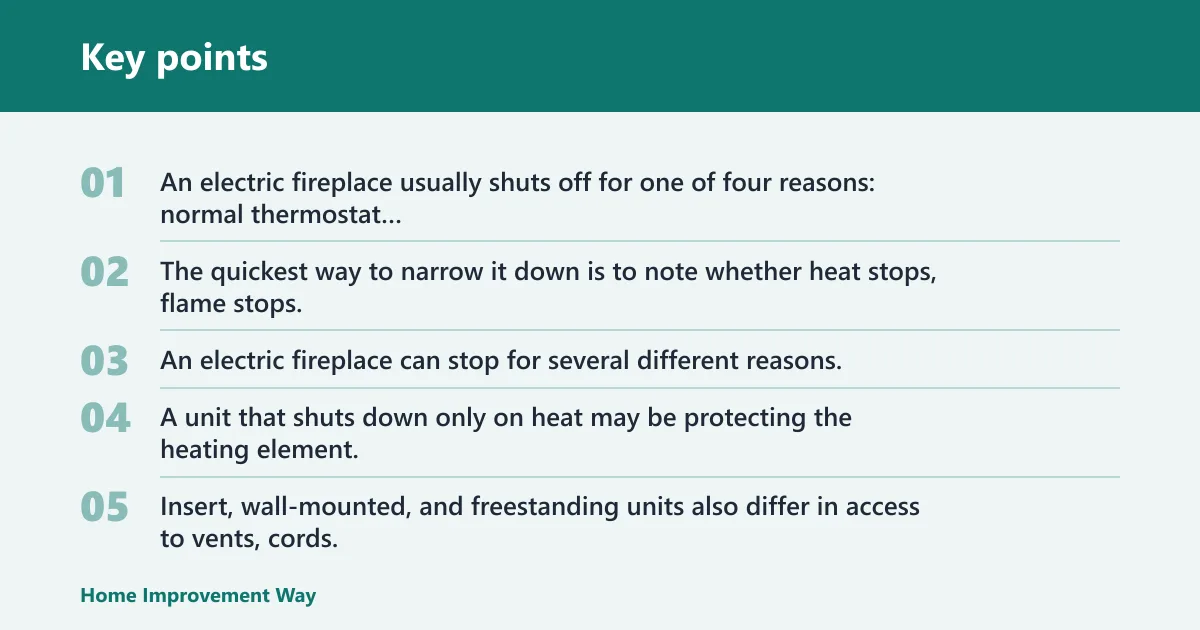


An electric fireplace usually shuts off for one of four reasons: normal thermostat cycling, overheat protection, a control/sensor fault, or a power-supply issue. The quickest way to narrow it down is to note whether heat stops, flame stops, or both stop, and whether the unit restarts by itself or needs a manual reset.
Electric fireplace shutdowns
An electric fireplace can stop for several different reasons, and the symptom can help narrow the cause. A unit that shuts down only on heat may be protecting the heating element, while a flame effect that goes dark with no heat problem points elsewhere. Insert, wall-mounted, and freestanding units also differ in access to vents, cords, and controls.
Normal cycling means the thermostat opens and closes the heater circuit to help hold the room near the set temperature. A true shutdown is different: the unit may stop before the set temperature is met, may need a manual restart, may trip a breaker, or may come back only after it cools. That is the fault pattern to chase.
Electric fireplace troubleshooting matrix
Use the table to match the symptom to the most likely cause before you open panels or press reset buttons. Check the unit’s vents, cord, and power source first. If the unit trips a breaker, smells hot, or shows visible cord damage, stop and call a pro. For heater load context, many electric fireplaces and space heaters are rated around 1,500 watts on 120-volt household power, which is about 12.5 amps; that leaves limited headroom on a 15-amp circuit once other loads are added. See the U.S. Department of Energy’s guidance on portable heaters and a manufacturer example such as a manufacturer manual for model-specific electrical ratings, plus CPSC heater safety guidance for safe placement and use.
| Symptom | Likely cause | Quick check | Safe homeowner fix | When to stop and call a pro | Safe to keep testing? |
|---|---|---|---|---|---|
| Heat shuts off but flame stays on | Thermal cutoff switch or overheating heater circuit | Feel for blocked vents, dust buildup, or very hot cabinet surfaces | Clear vents, vacuum dust, allow cool-down, reduce nearby clutter | If it repeats after cleaning and proper clearance, or needs repeated resets | No |
| Flame shuts off but heat stays on | LED strip, flame motor, display, or controller fault | Check whether the heater still responds normally | Replace remote batteries, re-pair the remote if the manual allows it, cycle power once | If the flame system stays dark, flickers, or makes noise after reset | Yes, after one power cycle |
| Random on-off cycling | Thermostat setting, bad sensor input, weak outlet, or control board fault | Watch whether it cycles near the set temperature or at random times | Lower the set temperature, move the unit to a proper outlet, check the remote receiver | If cycling ignores the set point or happens with no heat demand | Yes, briefly |
| Breaker trips | Overload, short, failing element, weak outlet, or wiring fault | Note whether the trip happens at startup or after minutes of heating | Unplug other loads from the same circuit and avoid extension cords | If the breaker trips again after a single reset, stop using the fireplace | No |
| Shuts off after several minutes | Overheat protection, airflow restriction, low voltage at the outlet, or a weak heating element | Check vents, cord condition, and whether the plug or receptacle feels warm | Clean vents, give the unit more clearance, and move it off an extension cord | If it shuts down at the same time on every run, or the cord/outlet is hot | No |
| Heat-only shutdown | Heating element or thermal cutoff problem | Does flame still run while heat stops? | Let it cool, inspect airflow, and use the lowest practical heat setting | If heat fails again even with clear vents and normal power | No |
| Manual reset or fault code appears | Overheat lockout, sensor fault, or board-protected shutdown | Check the display, indicator lights, and owner’s manual for model-specific codes | Unplug the unit, let it cool, then follow the manual’s reset steps exactly | If the same code returns after one reset, or the manual says not to keep resetting | No |
| Hot plug or outlet symptoms | Loose receptacle, overloaded circuit, damaged cord, or poor connection | Feel for warmth at the plug, receptacle, or cord; look for discoloration | Stop using the outlet, move to a known-good receptacle, and avoid adapters | If the outlet or plug is hot, scorched, or repeatedly loses power | No |
How to use the matrix safely
Match the symptom first, not the guess. If the flame stays on while heat stops, you are dealing with the heater path, not the decorative effect. If both stop together, look harder at power, control, or overheat protection. That separation saves time and prevents unnecessary part swaps.
A common mistake is to assume the fireplace is failing when a blocked intake vent is actually causing it to overheat and shut off. Suppose a wall-mounted fireplace shuts off after about eight minutes with the flame still on. If the rear intake is packed with dust and the trim blocks the exhaust, the thermal cutoff may be doing exactly what it was designed to do.
Check airflow and overheating first
Unexpected shutdowns are often a safety feature, not a total failure. Electric fireplaces commonly use overheat protection and a thermal cutoff switch to stop the heater when internal temperatures rise too high. If the same unit runs longer after cooling, airflow is one of the first things to inspect. CPSC heater guidance also emphasizes keeping the area around heaters clear and placing them away from combustibles.
Blocked vents and dust buildup
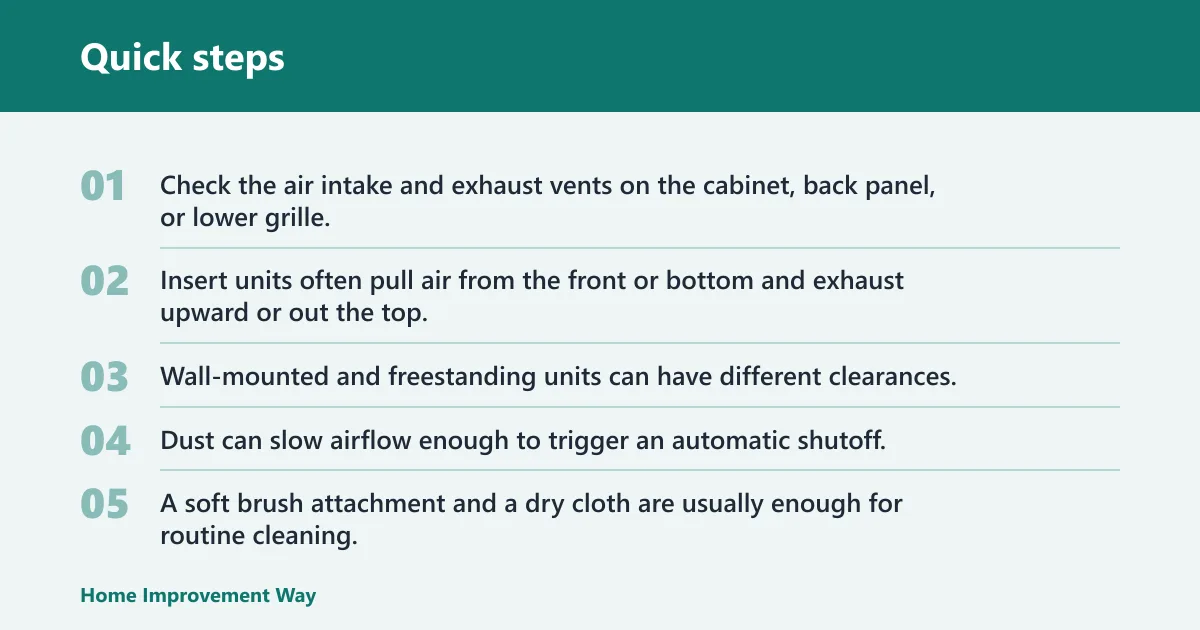
Check the air intake and exhaust vents on the cabinet, back panel, or lower grille, depending on the model. Insert units often pull air from the front or bottom and exhaust upward or out the top. Wall-mounted and freestanding units can have different clearances, so use the owner’s manual instead of guessing.
Dust can slow airflow enough to trigger an automatic shutoff. A soft brush attachment and a dry cloth are usually enough for routine cleaning. Unplug the unit first. Do not spray liquid into the vents.
Most manufacturers specify clearance around the unit and around the vents themselves. Keep curtains, rugs, furniture, and decor out of the intake path. Even a small blocked opening can raise internal temperature fast.
Thermal cutoff switch behavior
The thermal cutoff switch is an automatic shutoff safety. It opens when the unit overheats and may close again after the fireplace cools, or it may require a manufacturer-specific reset. Some models use a manual reset button or a service replacement part; others rely on a one-time cutoff that must be replaced if it fails.
If the fireplace keeps tripping the thermal cutoff after a normal cool-down and cleanup, treat that as a part problem or an airflow problem that has not been solved. Repeated trips are not normal cycling. They are a warning.
How do you reset an electric fireplace safely?
Unplug the fireplace, let it cool, and then use only the reset steps in the owner’s manual for that exact model. Do not guess at timing unless the manual specifies a wait period. If the manual mentions a fault code, look for it on the display or control panel before resetting so the code can be matched to the correct cause.
Reset steps and fault-code checks
Start by turning the unit off, unplugging it, and waiting until it is fully cool. Some manuals call for a specific wait time after an overheat trip, but many do not, so the safest default is to wait for complete cool-down unless the manufacturer gives a different instruction. Then inspect the display, indicator lights, or remote screen for a model-specific code and compare it with the manual before restoring power.
If the same reset is needed more than once, or the same fault code comes back, stop use. Repeated resets can point to a blocked fan path, a failing thermal cutoff, a sensor error, or a wiring issue that should not be ignored.
Could the thermostat or control board be cycling it off?
Yes. A thermostat setting can make the heater turn off and on by design, and a bad sensor input can make that cycling look random. If the unit stops near the set temperature, that is usually expected behavior. If it shuts down far below the set point, the control path deserves attention.
Temperature setting and sensor input
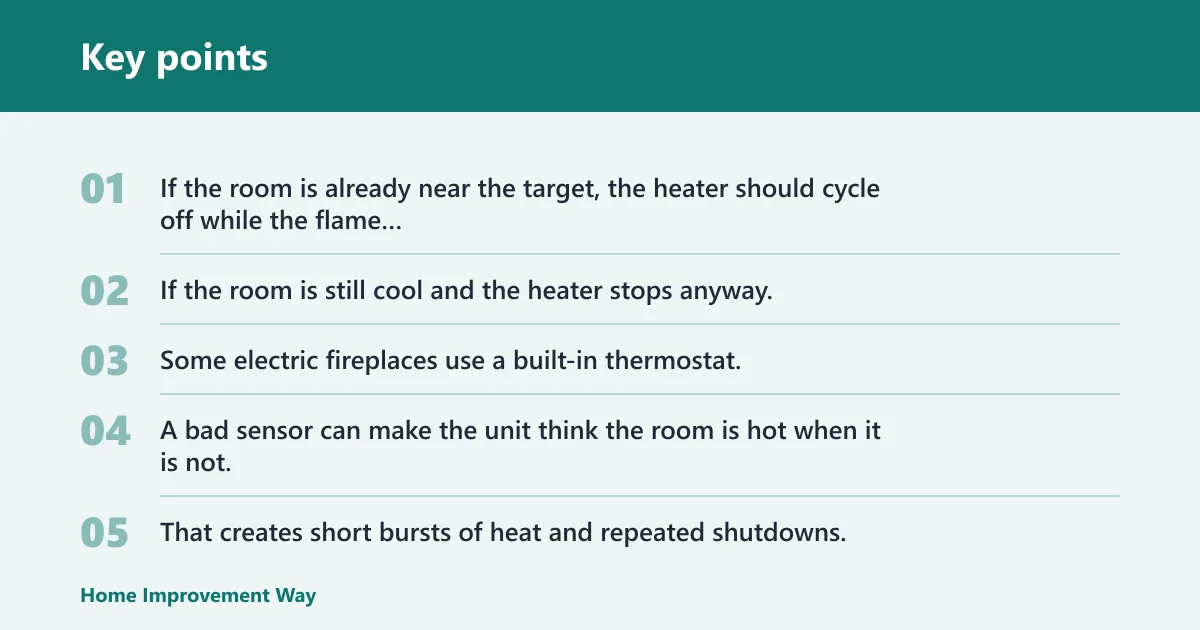
Check the set temperature first. If the room is already near the target, the heater should cycle off while the flame effect may continue. That is normal. If the room is still cool and the heater stops anyway, the thermostat sensor may be reading the wrong temperature or losing contact with the control board.
Some electric fireplaces use a built-in thermostat, while others use a remote sensor or a control board that reads temperature from a small probe. A bad sensor can make the unit think the room is hot when it is not. That creates short bursts of heat and repeated shutdowns.
Remote receiver and wall switch problems
Remote-control batteries, pairing issues, and signal loss can create false shutoff behavior. If the unit responds to the wall switch but not the remote, the problem may be the receiver or the battery. If it turns itself off when nobody touches the controls, the receiver may be picking up stray signals or failing internally.
Wall switches can also be part of the problem on some installations. Loose connections, a failing wall control, or an incorrect switch type can interrupt power to the receiver or control board. If the fireplace turns off when the switch is bumped or when another load starts on the same circuit, check the control path before replacing the heater.
Why does my electric fireplace keep shutting off after a few minutes?
When an electric fireplace shuts off after only a few minutes, the most common causes are overheating, restricted airflow, or a power-supply problem that shows up once the heater draws full load. A weak outlet, an extension cord, or a failing heating element can all look similar at first. The timing is the clue.
Overheat protection tripping too early
If the unit runs for a few minutes, then stops and starts again after cooling, the thermal cutoff switch may be seeing excess heat. Dust, blocked intake, blocked exhaust, or tight clearance around an insert can raise internal temperature quickly. Wall-mounted models are especially sensitive when the cabinet has little breathing room.
Check the manual for the recommended clear space and clean the vents before assuming a major part failure. If the same shutdown happens even with clear airflow and normal room temperature, the sensor, cutoff switch, or control board may be faulty.
Heating element problems after startup
The heating element can fail partly, not only all at once. A weak element may draw current unevenly, run hot, and then shut down as protection reacts. Signs include heat that starts normally, then drops out without changing the flame display, or heat that never feels as strong as it should for the wattage rating.
Many residential electric fireplaces are rated around 1,500 watts on a standard 120-volt circuit, though exact ratings vary by model. The U.S. Department of Energy notes that portable heaters commonly use this kind of load, which is why a single heater can use much of a 15-amp circuit once other appliances are present. For model-specific electrical ratings and warnings, follow the manufacturer manual and CPSC heater safety guidance.
Power supply problems to check
Do the power checks before deeper repair work. Outlet quality, cord condition, breaker behavior, and GFCI trips can all cause a fireplace to shut off without warning. The issue may be electrical supply, not the fireplace itself. CPSC guidance recommends plugging heaters directly into a wall outlet and keeping them away from extension cords, power strips, and overloaded circuits.
Outlet, plug, and cord inspection
Verify that the fireplace is plugged into a suitable outlet with no looseness, scorch marks, or heat at the plug. A warm plug or receptacle is a warning sign. Check the cord for cuts, pinches, crushed spots, and tight bends behind the unit.
Do not use a damaged extension cord, and avoid one altogether unless the manual specifically allows it. Extension cords can cause voltage drop under heater load, which can make the unit shut down or run poorly. A dedicated outlet is the safer choice for a high-draw appliance.
Breaker trips and GFCI trips
If the circuit breaker trips, the fireplace may be pulling more current than the circuit can handle, or a fault may be present. If the unit is on a GFCI outlet and that outlet trips, look for moisture, a failing cord, or a ground fault inside the fireplace. Resetting the same breaker over and over is not a fix.
Shutoff that repeats on the same circuit, especially with lights dimming or other devices acting up, can point to a wiring problem. That is the point to stop and call an electrician.
Why does my electric fireplace keep turning off and on by itself?
Random on-off cycling usually points to control logic, sensor input, or power interruptions rather than normal thermostat behavior. If the unit flips on and off when the room is nowhere near the target temperature, the control board, remote receiver, wall switch, or supply voltage may be unstable.
Control board and sensor faults
A control board that misreads the thermostat can shut the heater down early or start it again without a clear pattern. Fault symptoms include delayed response, uncommanded restarts, or a display that acts normally while the heat output changes on its own. Some units also show a fault code in the display, which should be checked in the manual.
Manufacturer-specific reset steps matter here. Some models need a full power disconnect for a set time. Others require a sequence on the remote or control panel. Do not assume one reset method works across brands.
Flame effect motor and LED system
The flame effect can fail separately from the heater. If the flame goes dark but the heat keeps running, the LED strip, flame motor, or display circuit may be the problem. If the flame flickers, stutters, or makes a faint rubbing sound, the motor or fan assembly may be at fault.
That separation matters because a flame-only shutdown does not point to the same part as a heat-only shutdown. A fireplace can still warm the room while the decorative effect fails, and the reverse can happen too.
Why does my electric fireplace insert keep turning off?
An insert can shut off for the same basic reasons as other electric fireplaces, but the enclosed cabinet and tighter installation make airflow and outlet access more important. Inserts often trap heat if the surround is too tight or the rear path is dusty. They can also be harder to inspect without pulling the unit forward.
Installation-specific airflow limits
Check that the insert is not pressed against trim, insulation, or stored items inside the cavity. A blocked intake or exhaust can trip overheat protection fast. If the insert uses a fan-assisted heater, a clogged fan path may be enough to create repeated shutdowns after only a short run.
Also verify that the insert is seated correctly and not pinching the power cord. A cord under pressure can fail under load and cause intermittent shutoff.
Why does my electric fireplace keep shutting off when it gets hot?
That pattern usually means the overheat protection is doing its job. Heat builds, the thermal cutoff opens, and the fireplace stops to protect the heater and surrounding parts. If it happens only when the room, cabinet, or nearby wall gets hot, the issue is usually airflow, clearance, or a failing cutoff component.
Safe homeowner checks before service
- Unplug the unit and let it cool fully.
- Vacuum the intake and exhaust areas.
- Check the manual for clearance requirements around the model.
- Remove nearby items that block the airflow path.
- Plug the unit directly into a proper outlet and test again.
If the fireplace still shuts down at the same point after these checks, repeated overheating is likely. That can mean a failing fan, a defective sensor, or a thermal cutoff switch that needs replacement.
When is an electric fireplace shutting off a sign of a wiring problem?
Repeated shutdowns point to a wiring or electrical fault when the breaker trips, the plug or receptacle gets hot, the cord is damaged, or the unit behaves differently on another known-good outlet. That is especially true when the fireplace shuts down immediately at startup or when another appliance starts on the same circuit.
Do not keep resetting a breaker that trips more than once. Do not keep using a cord that is warm, brittle, or discolored. Those are stop signs, not troubleshooting clues.
Frequently asked questions
Why does my electric fireplace keep shutting off?
The most common reasons are normal thermostat cycling, overheat protection, blocked airflow, or a power-supply problem. Separate heat-only shutdowns from flame-only shutdowns first. Then check the outlet, cord, vents, and manual reset steps before assuming the whole unit has failed.
Why does my electric fireplace keep shutting off after a few minutes: that pattern often points?
That pattern often points to overheating, weak airflow, or voltage drop under load. If the flame stays on while heat stops, focus on the heater path and thermal cutoff switch. If both stop, check the outlet, breaker, and any extension cord before looking at the control board.
Why does my electric fireplace heater keep shutting off?
The heater usually shuts off because the thermostat reached its set point, the thermal cutoff tripped, or the control board lost a valid sensor reading. If it stops well before the room is warm, clean the vents, confirm clearance, and inspect the power supply. Repeated stops suggest a part problem.
Can a dirty filter or vent make an electric fireplace shut off?
Yes. Dust buildup and blocked vents can restrict airflow enough to trigger overheat protection. Clean the intake and exhaust area with the unit unplugged, and keep the clearance called for in the manual. If cleaning does not stop the shutdowns, the fan, cutoff switch, or sensor may be failing.
Should I reset my electric fireplace if it keeps shutting off?
A reset can help if the manual calls for it, but it is not a cure-all. Use the model-specific reset steps and error codes in the owner’s manual. If the unit keeps shutting off after a reset, especially with heat-related symptoms, stop using it and check for airflow or electrical faults.
Sponsored / affiliate links. As an Amazon Associate I earn from qualifying purchases. I may earn additional commission from eligible campaigns.
 MEGAWISE Portable Air Conditioner and Heater, 420W 110V Compact AC Unit with Remote Control, 1400W Cooling Capacity, 800W Heating, Dehumidifier, Fan, Sleep Timer, ChampagneAZEUS Portable AC and Heater Unit, 420W 110V Compact Air Conditioner for Tent RV Truck Cabin and Small Room, 1400W Cooling, 800W Heating, Remote Control, Dehumidifier, Sleep Timer, Champagne