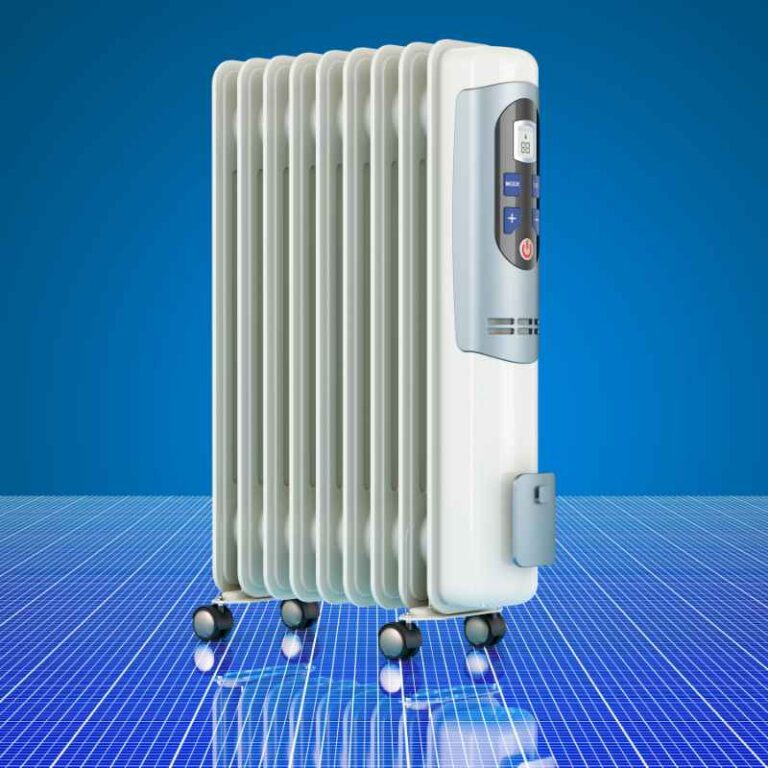
How Many Space Heaters Can You Run on One Circuit?
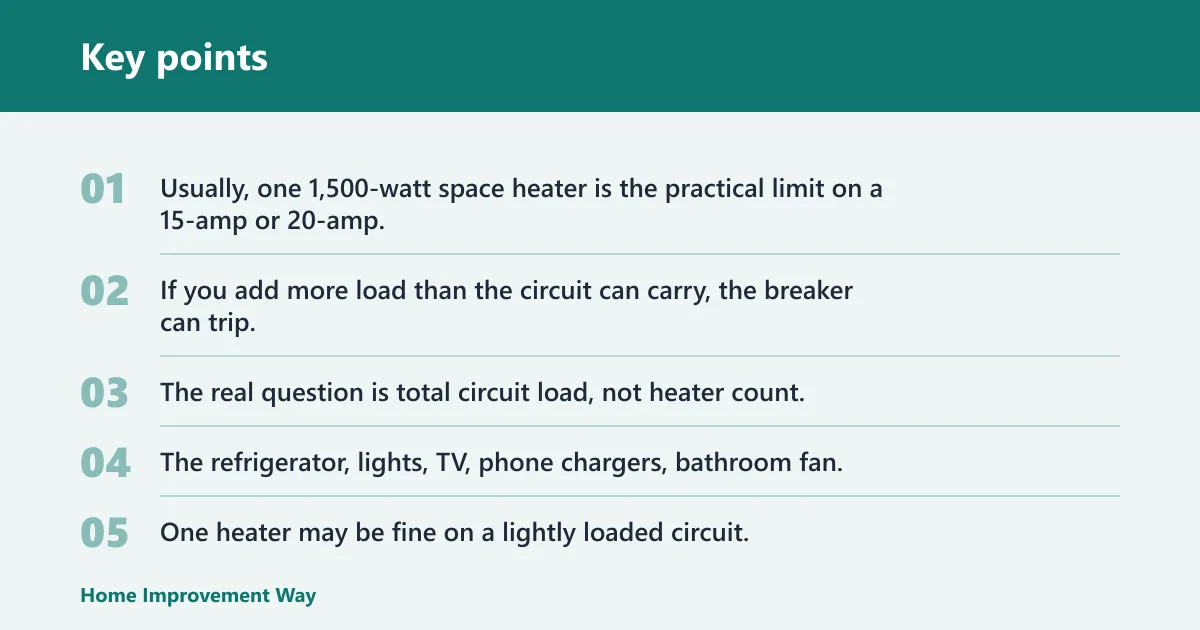
Usually, one 1,500-watt space heater is the practical limit on a 15-amp or 20-amp, 120-volt circuit, and only when that circuit has little or no other load. If you add more load than the circuit can carry, the breaker can trip, wiring can heat up, and fire risk rises. The real question is total circuit load, not heater count.


Why heater count depends on total circuit load
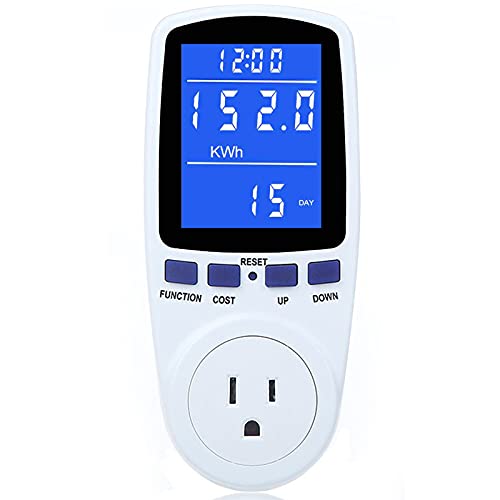
A space heater does not use power by itself. The refrigerator, lights, TV, phone chargers, bathroom fan, and anything else on that branch circuit all share the same amperage limit. One heater may be fine on a lightly loaded circuit. Two heaters on the same branch often push the total past a safe margin.
That is why “one heater per room” is only a rough shortcut. A room can have more than one outlet on the same branch circuit, and a heater in the bedroom may still share wiring with other rooms. The breaker protects the circuit, not the outlet you are using.
Why other devices on the same branch matter
Every device already running on the circuit cuts into the wattage left for a heater. A lamp and TV may seem small, but together they can take a meaningful share of the available load. If the circuit already serves a microwave, hair dryer, or portable heater elsewhere, the margin can disappear fast.
Suppose a bedroom circuit already has 250 watts of lighting and a 150-watt TV. On a 15-amp circuit, that 400 watts reduces the safe heater allowance before you ever plug the heater in. The heater label alone does not tell you whether the circuit can carry it.
The short answer for most homes
For most homes, the practical answer is one heater only, and only on a lightly loaded circuit. Two heaters may be possible on a 20-amp circuit only if each heater is low wattage and the rest of the branch load is very small, but that is a calculation, not a guess. If the circuit trips, the load is too high.
Circuit load worksheet
Use this worksheet to compare what is already on the circuit with what a heater would add. Fill in the first column, then compare the remaining safe heater wattage to the heater label. If the answer is near zero or negative, the circuit is not a safe place for a space heater.
| Device watts/amps already on circuit | Remaining safe heater wattage |
|---|---|
| 0 watts on a 15-amp circuit | About 1,440 watts max continuous; one 1,500-watt heater is too close |
| 300 watts already on a 15-amp circuit | About 1,140 watts left; a 1,500-watt heater is too much |
| 0 watts on a 20-amp circuit | About 1,920 watts max continuous; one 1,500-watt heater can fit if the circuit is otherwise light |
| 400 watts already on a 20-amp circuit | About 1,520 watts left; one 1,500-watt heater is possible only if the branch is otherwise very light |
15-amp and 20-amp decision rows
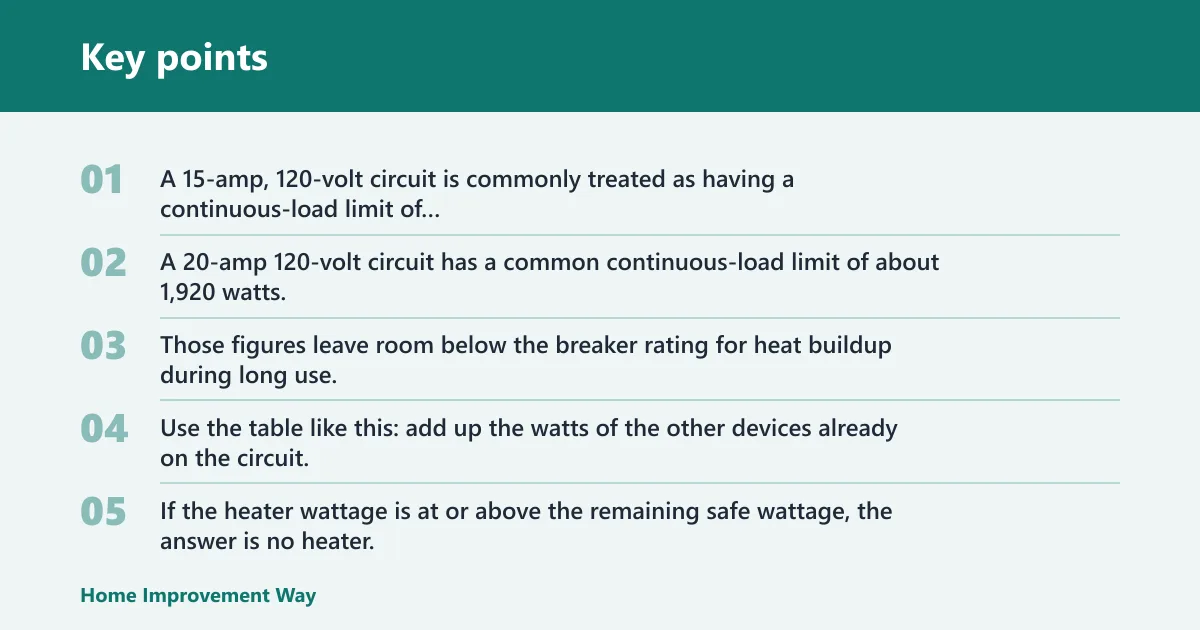
A 15-amp, 120-volt circuit is commonly treated as having a continuous-load limit of about 80%, or about 1,440 watts. A 20-amp 120-volt circuit has a common continuous-load limit of about 1,920 watts. Those figures leave room below the breaker rating for heat buildup during long use.
Use the table like this: add up the watts of the other devices already on the circuit, subtract that total from 1,440 or 1,920, then compare the remainder with the heater label. If the heater wattage is at or above the remaining safe wattage, the answer is no heater.
Final outcome: one heater only, no heater, or call electrician
If the remaining safe heater wattage is comfortably above the heater’s actual draw, one heater only may be acceptable. If the remaining amount is close to the heater load, the setup is marginal and you should avoid it. If the breaker trips, outlets feel warm, or the circuit already has several active loads, call an electrician.
How heater watts turn into amps
Most space heaters list watts on the label, and many list amps too. If the label gives watts, divide by 120 volts to estimate current draw on a typical household circuit. A 1,500-watt heater draws about 12.5 amps, which leaves little room on a 15-amp circuit.
Reading the heater label
Look for the wattage on the nameplate or rating label. Many portable electric heaters list a high setting around 1,500 watts and a low setting that may be much lower. The low setting is still a real load, and it still counts against the circuit when the heater cycles on.
Using 120 volts for typical home circuits
Most portable space heaters are meant for standard 120-volt outlets. To estimate amps, use watts divided by 120. A 750-watt setting draws about 6.25 amps. A 1,500-watt setting draws about 12.5 amps. That difference matters when the circuit already has other appliances running.
Why high and low settings still matter
A thermostat does not erase the load; it only turns the heater on and off. High and low settings also change the draw. A heater on low may fit on a light circuit, while the same heater on high may be too much. For hours of use, the highest setting is the safer planning number.
What a 15-amp circuit can handle
A 15-amp circuit is common in homes, especially for general lighting and receptacles. On a 120-volt system, the breaker rating suggests 1,800 watts maximum, but the usual continuous-load guideline is 80%, or about 1,440 watts. That is the number that matters for heaters used for 3 hours or more.
Common safe-load math for 15 amps
Use this simple check: 15 amps × 120 volts = 1,800 watts total capacity, then 1,800 × 0.8 = 1,440 watts for continuous use. A common 1,500-watt heater already exceeds that continuous guideline before you count lamps, chargers, or a TV on the same branch.
What happens when the breaker trips
A breaker trip is a warning sign, not a solution. It means the circuit load exceeded what the breaker was set to protect. Resetting it does not make the heater safer or the wiring cooler. If a heater keeps tripping the breaker, the circuit is overloaded or shared with too much else.
What a 20-amp circuit can handle
A 20-amp circuit can handle more load than a 15-amp circuit, but it still has limits. At 120 volts, the breaker rating is 2,400 watts, and the common continuous-load target is about 1,920 watts. That gives more room, but it does not make two full-size heaters automatically safe.
How 20 amps differs from 15 amps
The extra 5 amps matters, especially for a single heater on a lightly loaded circuit. A 1,500-watt heater uses about 12.5 amps, which fits under the 20-amp continuous guideline more comfortably than it does on a 15-amp branch. Still, lights, fans, and TVs on the same circuit reduce the margin.
When a 20-amp circuit still is not enough
If the circuit already powers several outlets, a bathroom fan, or another appliance, the remaining safe heater wattage can drop below a 1,500-watt heater. Two heaters are even harder to justify. A pair of 750-watt heaters adds up to 1,500 watts before any other load is counted.
Do space heaters need a dedicated circuit?

They often should, especially if you plan to use the heater for long stretches or the branch circuit already carries other loads. A dedicated circuit is the better answer when you want one appliance to own the breaker and wiring path. It reduces the chance that another device pushes the load over the limit.
When a dedicated circuit is the better answer
If a heater is part of your winter routine, a dedicated branch is worth discussing with an electrician. That is also true if the heater causes dimming lights, warm receptacles, or repeated breaker trips. The circuit may be functioning as designed, but the setup is not suitable for the heater load.
Signs the heater is too much for the branch
Watch for repeated breaker trips, a heater that only works when other loads are off, warm outlet covers, buzzing receptacles, or lights that dim when the heater cycles on. Those signs point to too much load or a poor branch setup. Stop using the heater there until the circuit is checked.
Why baseboard heaters are a special case
How many electric baseboard heaters can you put on one circuit depends on the heater’s total wattage, the circuit rating, and the wiring design. Baseboard heat is usually installed as a fixed load, often on a dedicated circuit sized to the heater. Do not treat it like a portable plug-in heater.
For baseboards, the circuit must match the connected load, and the breaker size must match the wire size. If you are adding baseboard heat or changing the length of an existing run, have an electrician size the circuit. That is not a place to guess from outlet count.
Sometimes yes, but the outlet itself is not the issue. The branch circuit is. A TV by itself is usually a small load, but the heater may use most of the available capacity on a 15-amp circuit. If the TV, lights, and heater share the same branch, calculate the total first.
Small loads vs heater loads
A 100-watt TV and a few LED lamps are small compared with a 1,500-watt heater. On a 20-amp circuit, that may still leave enough room if the rest of the circuit is light. On a 15-amp circuit, the heater can leave too little margin for a shared outlet run.
Picture a living room circuit with a TV, router, and two lamps already drawing about 220 watts. Adding a 1,500-watt heater pushes the branch near or past the continuous limit on a 15-amp circuit. The TV is not the problem. The combined load is.
When extension cords and power strips are unsafe
Power strips are not a safe fix for heater overload, and extension cords are a limitation, not a workaround. A strip or cord does not increase the circuit capacity. It only adds another point of heat, resistance, and failure if the heater load is already too high.
Power strips are not a fix for overload
Do not plug a space heater into a power strip, even one with surge protection. Surge protection does nothing to raise the safe current limit for a heater. Many heater manufacturers warn against this because the plug and strip can overheat under sustained load.
Extension cord gauge and length limits
Extension cords must be rated for the heater load, but even a properly rated cord is not the preferred answer for a space heater. Longer cords create more voltage drop and heat risk. Avoid daisy-chaining extension cords entirely. If the heater needs a distant outlet, the real fix is a better circuit or heater placement.
Why daisy-chaining cords raises heat risk
Each added connection point increases resistance and the chance of a loose fit. That can create hot spots at the plug or socket. A heater draws current for long periods, so those weak points matter. If you need more reach, do not stack cords together to force the setup.
Frequently asked questions
How many heaters on one circuit
Most of the time, only one full-size space heater belongs on one branch circuit, and only if the circuit has little else running. Two smaller heaters can sometimes fit on a 20-amp circuit, but only after you add up every other device already on that branch and compare the total to the 80% limit.
Can two space heaters trip a breaker?
Yes. Two space heaters can easily trip a breaker because their combined wattage often exceeds the safe load for a 15-amp circuit and may still overwhelm a 20-amp circuit if other devices are present. If the breaker trips, treat that as an overload warning and reduce the load.
How many watts can a 15 amp circuit handle?
For heaters used for 3 hours or more, the 1,440-watt figure is the safer planning number.
How many watts can a 20 amp circuit handle?
That still leaves little room for a 1,500-watt heater if the circuit already powers lights, a TV, or other appliances.
Is it safe to plug a space heater into a power strip?
No. A power strip does not make a heater safer or give the circuit more capacity, and the strip itself can overheat under a heater’s sustained draw. Plug a space heater directly into a properly rated wall receptacle, and only if the circuit load leaves enough margin.
Why does my breaker trip when I use a heater?
The circuit is probably overloaded, either by the heater alone or by the heater plus other devices on the same branch. Breakers trip to protect wiring from excess current. If the heater keeps causing trips, lower the load, move the heater, or have an electrician inspect the circuit.
Sponsored / affiliate links. As an Amazon Associate I earn from qualifying purchases. I may earn additional commission from eligible campaigns.
 AZEUS Portable AC and Heater Unit, 420W 110V Compact Air Conditioner for Tent RV Truck Cabin and Small Room, 1400W Cooling, 800W Heating, Remote Control, Dehumidifier, Sleep Timer, ChampagneMEGAWISE Portable Air Conditioner and Heater, 420W 110V Compact AC Unit with Remote Control, 1400W Cooling Capacity, 800W Heating, Dehumidifier, Fan, Sleep Timer, Champagne