Do Hard Wired Heaters Have To Be On Dedicated Circuits?
It’s a question that pops up when you’re thinking about adding some cozy warmth to a room. You’ve got that sleek, wall-mounted electric heater, and it looks so clean. No plugs, just wires going right into the wall.
But then, the electrical part hits you: does this thing need its own special power line, a dedicated circuit?
This isn’t just about being picky. Getting the wiring right for heaters is super important. It keeps your home safe and makes sure your heater works the way it should, without causing problems for other things plugged in around your house.
Let’s dive into this a bit.
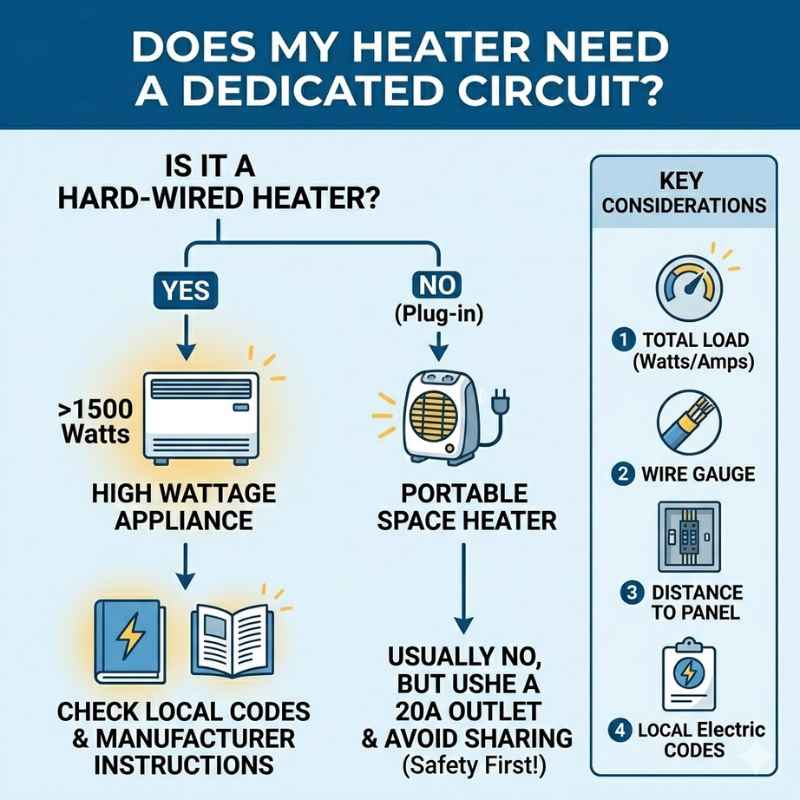
A hard-wired heater does not always have to be on its own dedicated circuit, but it often should be. The decision depends on the heater’s wattage, the existing circuit’s capacity, and local electrical codes. For many powerful heaters, a dedicated circuit is the safest and most reliable option.
Understanding Dedicated Circuits for Heaters
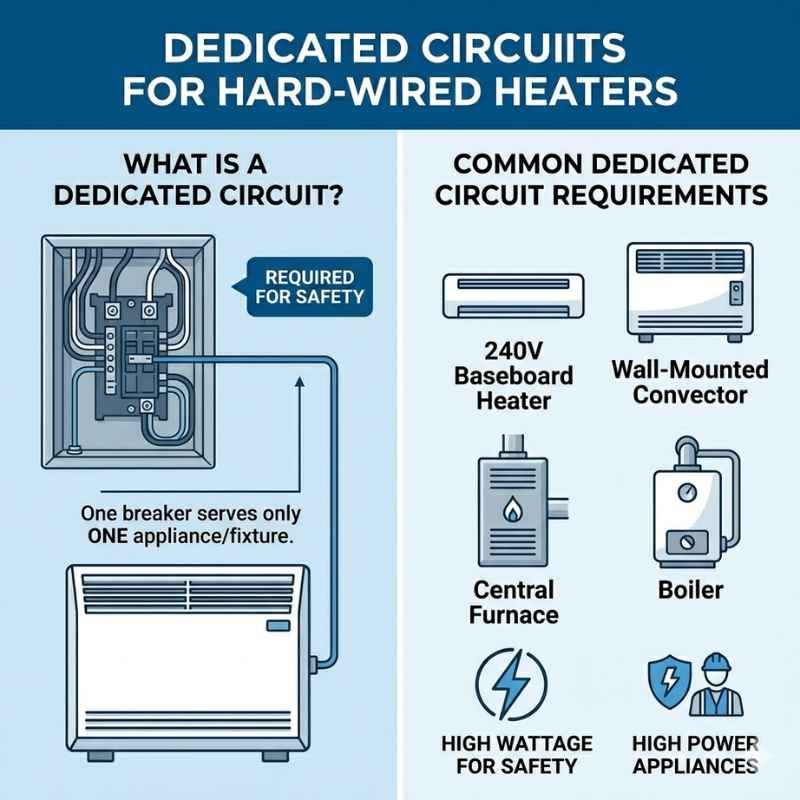
Think of your home’s electrical system like a road. Circuits are the lanes that carry power to different parts of your house. A dedicated circuit is like a special, express lane just for one high-demand appliance.
It means that appliance gets all the power it needs without sharing with other devices.
Why do we even have circuits? They are safety features. They protect your home from fires and electrical damage.
Each circuit breaker or fuse is set to handle a certain amount of electrical current, measured in amps. If too much current flows through a circuit, the breaker trips or the fuse blows. This stops the flow of electricity and prevents overheating.
Heaters, especially electric ones, use a lot of power. They convert electricity into heat. This process requires a significant amount of amps.
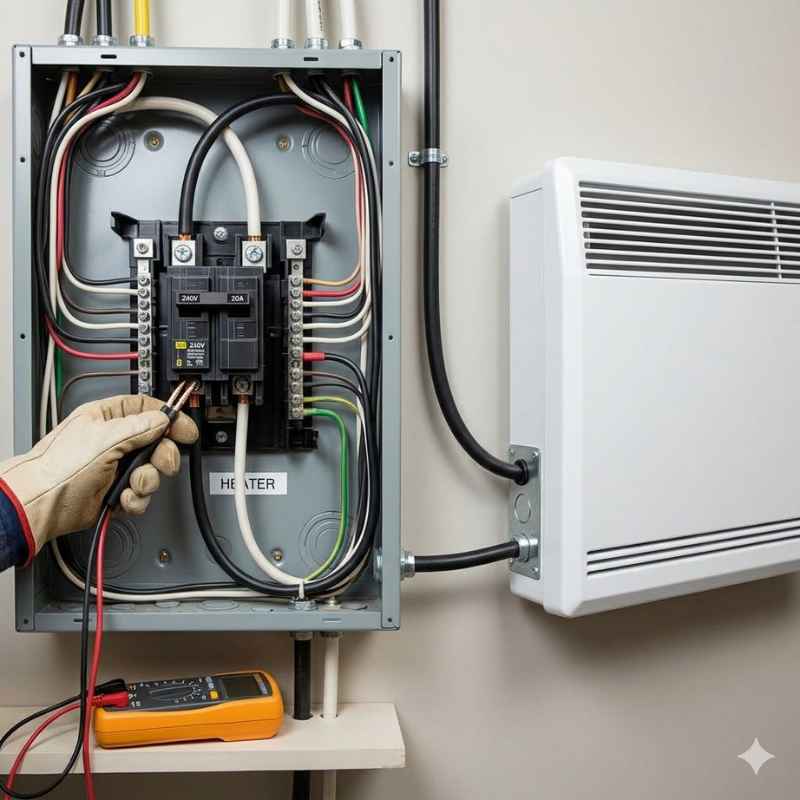
When a heater is hard-wired, it means its power connection is made directly to the electrical wiring in the wall. There’s no plug you can easily unplug.
Why Dedicated Circuits Matter for High-Wattage Devices
Many electric heaters have a wattage rating of 1,500 watts or more. This is a lot of power. When you plug a device into a regular outlet, that outlet is usually part of a circuit that powers other things too.
This could be lights, a TV, a computer, or other small appliances in the same room.
Most standard household circuits are rated for 15 amps or 20 amps. Using Ohm’s Law (Voltage x Amps = Watts), we can see how much power a circuit can handle. In the U.S., household voltage is typically 120 volts.
A 15-amp circuit can handle about 1,800 watts (120V x 15A). A 20-amp circuit can handle about 2,400 watts (120V x 20A).
If you have a 1,500-watt heater running on a 15-amp circuit that also powers other devices, you could easily overload it. Imagine a busy highway. If too many cars try to use the same lanes, traffic jams up.
In an electrical system, this overload can cause the breaker to trip. It can also lead to overheating wires, which is a fire risk.
Hard-wired heaters often bypass the convenience of a plug. This means they are intended for a more permanent and powerful connection. Because of their direct connection and high power draw, electrical codes often require them to have their own dedicated circuit.
This ensures they have enough power and don’t put other circuits at risk.
Wattage vs. Amperage: What’s the Difference?
Watts (W): This measures the total amount of electrical power a device uses. Think of it as how much energy it needs to do its job.
Amps (A): This measures the flow of electrical current. It’s like the volume of traffic on your electrical road.
Voltage (V): This is the electrical pressure pushing the current. In the U.S., it’s usually 120V or 240V.
The relationship is simple: Watts = Volts x Amps. For example, a 1500-watt heater on a 120-volt circuit draws 12.5 amps (1500W / 120V = 12.5A).
My Own Heater Scare
I remember this one time, a few years back, I decided to put a small electric baseboard heater in my home office. It was hard-wired. It looked so neat, blending right into the wall.
I figured it would be fine on the same circuit as my desk lamp and my computer. It worked for a while, and I didn’t think much of it.
Then, one particularly cold afternoon, I turned the heater up a bit. Within an hour, my computer screen flickered and died. The lights dimmed.
A few minutes later, the breaker for that room flipped off. I was annoyed, then a little worried. I reset the breaker, and it tripped again almost immediately.
This is when I realized I’d made a mistake. I was trying to power a significant heat source along with other electronics on a circuit that wasn’t designed for it. I had to unplug some things and call an electrician.
He explained how my heater, even though it seemed small, was drawing too much power and that hard-wired appliances like that are often best on their own circuits. It was a wake-up call to respect the electrical limits in my home.
When is a Dedicated Circuit Required?
Electrical codes, like the National Electrical Code (NEC) in the U.S., are designed to keep everyone safe. While the NEC doesn’t always say “all hard-wired heaters MUST have a dedicated circuit,” it has rules that lead to this conclusion in most cases.
The key principle is that a circuit should not be loaded beyond 80% of its rating for continuous use. Many heaters are used for more than three hours at a time, making their use “continuous.” So, if you have a 15-amp circuit (1800 watts maximum), you should only use 80% of that, which is 1440 watts (1800 x 0.80). A 20-amp circuit (2400 watts maximum) should only be loaded to 1920 watts (2400 x 0.80).
Most hard-wired electric heaters are rated at 1,500 watts. This means on a standard 120-volt circuit, they draw 12.5 amps (1500W / 120V = 12.5A). If this heater is on a circuit that also has other loads, it’s very likely to exceed the 80% continuous load limit, especially if other devices are running simultaneously.
So, even if not explicitly stated for every heater, the 80% rule and the high wattage of most electric heaters effectively make a dedicated circuit a necessity. This is especially true for permanently installed units designed for significant heating.
Circuit Load Calculation Example
Scenario: You have a 1500-watt hard-wired heater and a living room circuit that also powers a ceiling fan (100W) and a smart TV (150W).
Total Wattage: 1500W + 100W + 150W = 1750W
Amperage Draw (at 120V): 1750W / 120V = 14.58 Amps
80% Continuous Load Limit for a 15A Circuit: 120V x 15A x 0.80 = 1440 Watts
Result: The total load (1750W) exceeds the safe continuous load limit (1440W) for this circuit. This setup could trip the breaker or pose a fire hazard.
What the Codes Say (Generally)
The NEC provides guidelines for branch circuits. For general-purpose receptacles (outlets), it recommends using 15-amp or 20-amp circuits. It also has specific rules for fixed electric space heating equipment.
Article 424 of the NEC covers fixed electric space heating equipment. It states that branch circuits supplying fixed electric space heating equipment intended for continuous operation must have overcurrent protection set at 125% of the total continuous load. This is another way of saying you need to account for the continuous nature of heating loads.
For a 1500-watt heater (drawing 12.5 amps), 125% of this load is 15.625 amps (12.5A x 1.25). This means the circuit breaker protecting this heater must be rated to handle at least this much current. A 15-amp breaker is insufficient.
A 20-amp breaker would be the minimum required for just the heater if it were the only load on the circuit.
If a circuit is rated at 20 amps, the maximum continuous load it can safely handle is 16 amps (20A x 0.80). Since the heater alone draws 12.5 amps, adding even small loads like a lamp or chargers could push it over the safe limit.
This is why electricians almost always recommend a dedicated circuit for hard-wired heaters. It simplifies calculations and ensures the circuit is properly sized for the equipment’s power needs and its expected usage pattern.
Types of Hard-Wired Heaters and Their Needs
Not all hard-wired heaters are created equal. Their power consumption varies greatly. This directly impacts their circuit requirements.
Baseboard Heaters
These are common in many homes, especially older ones. They run along the bottom of walls. Many are hard-wired.
They come in various lengths and wattages. A typical 4-foot baseboard heater might be around 750 watts. A longer 8-foot one could be 1,500 watts or more.
If you have multiple baseboard heaters in a room, they will likely need to be on separate circuits, or at least very carefully calculated.
Wall Heaters (Fan-Forced)
These are the units that blow hot air. They are often installed in bathrooms, kitchens, or workshops. Many of these are designed to be hard-wired and often have higher wattages, frequently 1,500 watts or even more.
Due to their powerful heating elements and fan motors, they almost always require a dedicated circuit.
Radiant Heaters (Panel Heaters)
These heaters warm objects directly rather than just the air. They can be sleek and modern. Some are designed for wall mounting and hard-wiring.
Their wattage varies, but many common models are in the 400-1000 watt range. A lower-wattage radiant heater might potentially be on a shared circuit if the total load is well within limits, but it’s still wise to check the specific appliance’s requirements and consult an electrician.
Propane or Natural Gas Heaters
It’s worth noting that some “hard-wired” heaters might refer to gas-powered units that have a small electrical component for the fan or ignition. These typically have very low electrical demands and do not require dedicated circuits for their electrical needs. The focus here is on electric resistance heaters.
Quick Scan: Heater Circuit Needs
Heater Type | Typical Wattage | Circuit Recommendation
Small Baseboard Heater | 400-750W | May share if total load is low.
Large Baseboard Heater | 1000-1500W | Dedicated circuit recommended.
Wall Fan Heater | 1500W+ | Dedicated circuit required.
Radiant Panel Heater | 400-1000W | May share if total load is low, but check specs.
High-Efficiency Electric Furnace | Varies greatly | Dedicated circuits, often 240V, specific design.
The short answer is: sometimes, but it’s risky and often not recommended, especially for powerful heaters.
Here’s when it might be technically possible, though still not ideal:
- The heater has a very low wattage (e.g., under 500 watts).
- The existing circuit has a high amperage rating (e.g., 20 amps) and is dedicated to very few other loads.
- The total wattage of the heater plus all other devices on the circuit, when running simultaneously, stays well below the 80% continuous load limit (around 1440 watts for a 15A circuit, or 1920 watts for a 20A circuit).
In practice, this scenario is rare for hard-wired heaters because they are often chosen for their ability to provide significant heat. Most hard-wired units are 1,500 watts or higher. Trying to share a circuit with a heater of that size is asking for trouble.
Consider this: if you have a 1500-watt heater on a 20-amp circuit (which is 2400 watts maximum, or 1920 watts safe continuous). You might think you have room for other things. But what if you have a space heater, a computer, a monitor, and some desk lamps all on the same circuit?
You could easily exceed the safe limit. This is where the “dedicated circuit” recommendation becomes almost a rule for safety.
Many manufacturers will explicitly state in their installation manuals that their hard-wired heaters require a dedicated circuit. Ignoring this can void your warranty and, more importantly, compromise your home’s safety.
When to Call a Professional Electrician
Electrical work can be dangerous. If you’re not experienced, it’s always best to bring in a professional. Here are times you should definitely call an electrician:
- You’re unsure about your circuit capacity. An electrician can test your existing circuits and determine their load limits.
- You need to install a new circuit. This involves running new wires from your electrical panel, installing a new breaker, and ensuring proper connections. This is not a DIY job for most people.
- Your existing breakers keep tripping. This is a clear sign of an overloaded circuit or a faulty breaker that needs professional diagnosis.
- The heater manufacturer specifies a dedicated circuit. Follow the manufacturer’s instructions to ensure safe operation and maintain your warranty.
- You are making significant electrical upgrades to your home. A qualified electrician can ensure everything meets current codes and is installed safely.
Electricians have the knowledge and tools to assess your home’s electrical system. They understand the complexities of load calculations, wiring methods, and code requirements. Getting it right the first time saves you headaches and potential safety hazards down the road.
Electrician’s Checklist: Key Considerations
1. Heater Wattage: How much power does the heater use?
2. Circuit Breaker Rating: What is the amperage of the existing circuit breaker (15A, 20A, etc.)?
3. Existing Circuit Loads: What other devices are on the same circuit?
4. Continuous Use Factor: Will the heater run for more than 3 hours at a time? (Most do).
5. NEC Requirements: Ensuring compliance with the National Electrical Code.
6. Manufacturer Specifications: What does the heater’s manual say?
7. Panel Capacity: Does the main electrical panel have enough capacity for a new circuit if needed?
Real-World Scenarios
Let’s look at some common situations where hard-wired heaters are used.
Scenario 1: Bathroom Heater
Many people add a wall-mounted fan heater to a bathroom for quick warmth. These are often 1,500 watts. Bathrooms also have lights, exhaust fans, and outlets for hairdryers or curling irons.
Plugging a 1,500-watt heater into an outlet that shares power with other bathroom electronics is a recipe for a tripped breaker, especially if multiple people are getting ready at once.
The safe and standard practice here is to install a dedicated 20-amp circuit for the bathroom heater. This ensures it has ample power and doesn’t overload the lighting or general-purpose outlets in the room.
Scenario 2: Basement Workshop Heater
A basement workshop might have a powerful 1,500-watt or even 2,000-watt heater to keep it comfortable for year-round work. Workshops often have many power tools, chargers, and lights. Running a high-wattage heater on a circuit shared with these other tools will almost certainly cause issues.
A dedicated circuit for the heater is essential here to prevent overloads and ensure the tools have enough power too.
Scenario 3: Small Studio Apartment
In a small studio, space is often at a premium. You might have a hard-wired heater that is rated at only 750 watts. The electrical panel might have fewer circuits.
In this case, it might be possible to share a circuit, but only after a careful calculation. If the studio has a 20-amp circuit for general outlets and lighting, and the total load (heater + lights + TV + small appliances) is kept below 1920 watts, it could work. However, even then, many electricians would still suggest a dedicated circuit for the primary heat source for peace of mind.
This is where understanding your specific needs and the capabilities of your home’s electrical system is critical. The goal is always safety and reliable operation.
What This Means for Your Home
For homeowners, understanding circuit requirements for hard-wired heaters means being proactive about safety and efficiency.
When it’s Likely Okay (with caution):
- You have a very low-wattage heater (under 750 watts).
- You are adding it to a circuit that has very few other devices, and their total wattage is also quite low.
- You have confirmed, through calculation or an electrician’s assessment, that the total continuous load is well under the 80% safety limit of the circuit.
- The heater’s manual does not explicitly state it must be on a dedicated circuit.
When You Should Definitely Use a Dedicated Circuit:
- The heater is 1,500 watts or higher.
- It’s being installed in a bathroom or kitchen where multiple appliances might run at once.
- The heater is the primary source of heat for a room or area.
- The manufacturer’s instructions require it.
- Your existing circuit breakers frequently trip when the heater is in use.
The trend in modern home building and renovations is towards more dedicated circuits for major appliances. This is because appliances are getting more powerful, and people are using more electronics. Proper circuit allocation prevents issues and ensures the electrical system can handle the demands placed upon it.
It’s always better to err on the side of caution. Investing in a dedicated circuit for a hard-wired heater is a small price to pay for the safety and reliability it provides. It ensures your heater functions optimally without risking electrical overloads or fire hazards.
Quick Fixes and Tips
While major electrical work should be done by a professional, here are some general tips to keep in mind regarding your heaters and circuits:
- Read the Manual: Always check the installation and operation manual for your specific heater. It will often state its power requirements and circuit recommendations.
- Know Your Wattage: Find the wattage rating on your heater. This is usually on a label on the unit itself.
- Identify Your Circuits: Label your electrical panel breakers clearly. This helps you know what each circuit controls.
- Avoid Overloading: If a breaker trips, don’t just reset it and keep going. See what was running on that circuit. Try to reduce the load before resetting.
- Regular Inspections: Occasionally check for any signs of overheating around outlets or switches connected to your heater circuits. Discoloration or a burning smell means immediate attention is needed.
- Consult an Electrician: When in doubt, always call a qualified electrician. They can provide the safest and most effective solution.
Remember, these are tips to help you be more aware. They are not a substitute for professional advice or installation.
Frequently Asked Questions
Do all hard-wired heaters need their own circuit?
Not all, but many do. High-wattage heaters, especially those used for continuous heating like in bathrooms or workshops, almost always require a dedicated circuit to prevent overloading and ensure safety according to electrical codes.
What happens if a heater is on an overloaded circuit?
If a heater is on an overloaded circuit, the circuit breaker will likely trip, shutting off power. In some cases, it can lead to overheating wires, which is a serious fire hazard. It can also damage the heater or other appliances on the circuit.
How do I know if my heater is high-wattage?
Check the label on the heater itself. It will list the wattage (W). Most electric heaters designed for significant room heating are 1,500 watts or higher.
Can I put a 1500-watt heater on a 15-amp circuit?
Generally, no. A 1500-watt heater on a 120-volt circuit draws 12.5 amps. Electrical codes recommend not exceeding 80% of a circuit’s rating for continuous loads.
This means a 15-amp circuit (max 1800W) should ideally only handle 1440W. A 1500-watt heater alone already exceeds this safe continuous load, and that’s before adding anything else.
What is the 80% rule for circuits?
The 80% rule means that for circuits intended for continuous use (like heaters, which can run for many hours), you should not load them beyond 80% of their maximum capacity. For a 15-amp circuit, this is 12 amps (15A 0.80). For a 20-amp circuit, this is 16 amps (20A 0.80).
How much does it cost to add a dedicated circuit?
The cost can vary widely depending on your location, the complexity of the job, and the electrician’s rates. It typically ranges from $200 to $500 or more per circuit.
What does “hard-wired” mean for a heater?
Hard-wired means the heater is connected directly to your home’s electrical wiring, usually behind a wall plate. It does not use a standard plug and socket. This is common for permanently installed heating units.
Conclusion
Deciding whether a hard-wired heater needs a dedicated circuit is a matter of safety, code compliance, and efficient operation. For most powerful electric heaters, the answer leans heavily towards yes. It’s about protecting your home, ensuring your heater works reliably, and avoiding the frustration of tripped breakers.
Always consult your heater’s manual and, when in doubt, call a qualified electrician. They can assess your home’s specific needs and ensure the installation is safe and up to code.
Sponsored / affiliate links. As an Amazon Associate I earn from qualifying purchases. I may earn additional commission from eligible campaigns.